Coinbase's $2.9 billion blockbuster
TechFlow Selected TechFlow Selected
Coinbase's $2.9 billion blockbuster
To understand what is truly happening, we need more than just headlines—we must examine the nature of this larger game.
 Navigating Web3 tides with focused insights
By: TOKEN DISPATCH, THEJASWINI M A
Translation: Block unicorn
Introduction
In one week, Coinbase orchestrated the largest acquisition in cryptocurrency history, revealed it had been quietly accumulating Bitcoin, assisted in solving a murder case, and faced scrutiny over customer losses of $45 million—all while its quarterly revenue declined.
Are these carefully calculated risks by a company aiming for a trillion-dollar future, or a desperate strategy by an exchange struggling through tough times?
CEO Brian Armstrong appears to be building something far beyond a typical exchange—an entity that could transform Coinbase from a retail-focused trading platform into financial infrastructure underpinning the global crypto market.
But to understand what’s truly happening, we need more than headlines—we must examine the essence of this larger game.
The Derivatives War
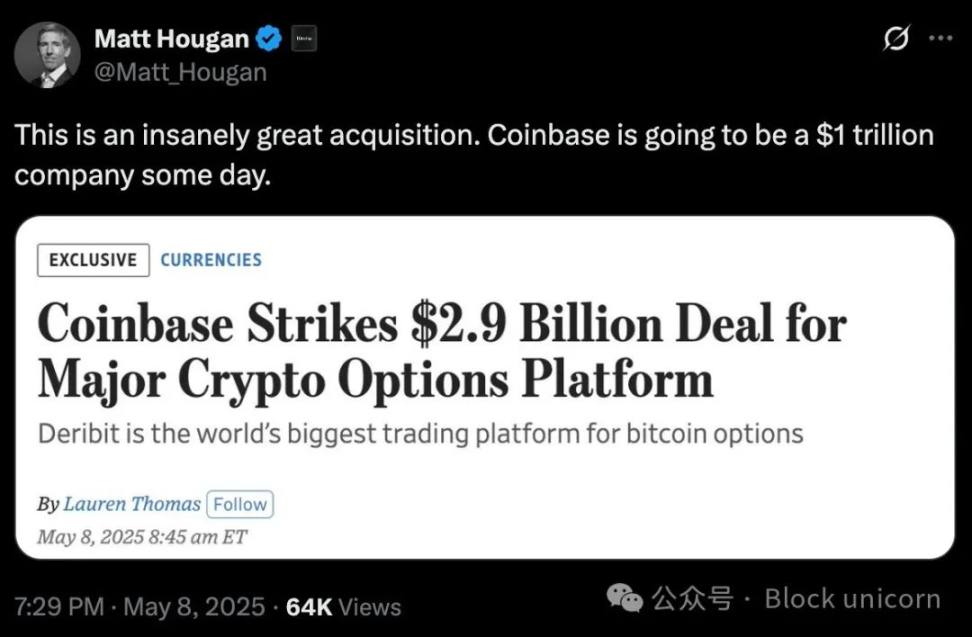
When Coinbase announced its $2.9 billion acquisition of Deribit (comprising $700 million in cash and 11 million shares of Coinbase stock), most analysis focused on the price tag.

This deal immediately gives Coinbase:
-
$30 billion in current open interest
-
Over $1 trillion in trading volume last year
-
Dominance in Bitcoin and Ethereum options platforms
Options trading is typically more resilient during market downturns than spot trading, as traders use options to manage risk in both bull and bear markets.
Greg Tusar, Coinbase's Vice President of Institutional Products, noted: "We believe crypto options are poised for significant expansion, similar to the equity options boom of the 1990s. This acquisition positions Coinbase to lead that growth."
Just a week earlier, rival exchange Kraken completed its $1.5 billion acquisition of futures trading platform NinjaTrader. The similar moves by both exchanges indicate broad industry recognition that derivatives—not spot trading—will be the next major battleground.
By acquiring Deribit, which operates outside the United States, Coinbase instantly gains access to a lucrative derivatives market while positioning itself for potential future regulatory developments allowing such products in the U.S. market.
Jeff Park, Head of Alpha Strategies at Bitwise, commented: "This might be the most 'value' I've ever seen in a crypto transaction," calling the acquisition "a masterstroke by Coinbase."
Bitwise Chief Investment Officer Matt Hougan went further: "Coinbase will one day become a $1 trillion company."
Given Coinbase's current market cap of around $50 billion, this implies an ambitious twentyfold growth.
Profit, Security, and Mixed Signals
While the Deribit acquisition dominated headlines, Coinbase's quarterly earnings revealed a more complex picture of a company navigating turbulence.
Total revenue fell 10% quarter-on-quarter to $2 billion, missing industry expectations due to slowing market activity. More strikingly, net profit plummeted 95% from a record $1.29 billion in Q4 to just $66 million in Q1.
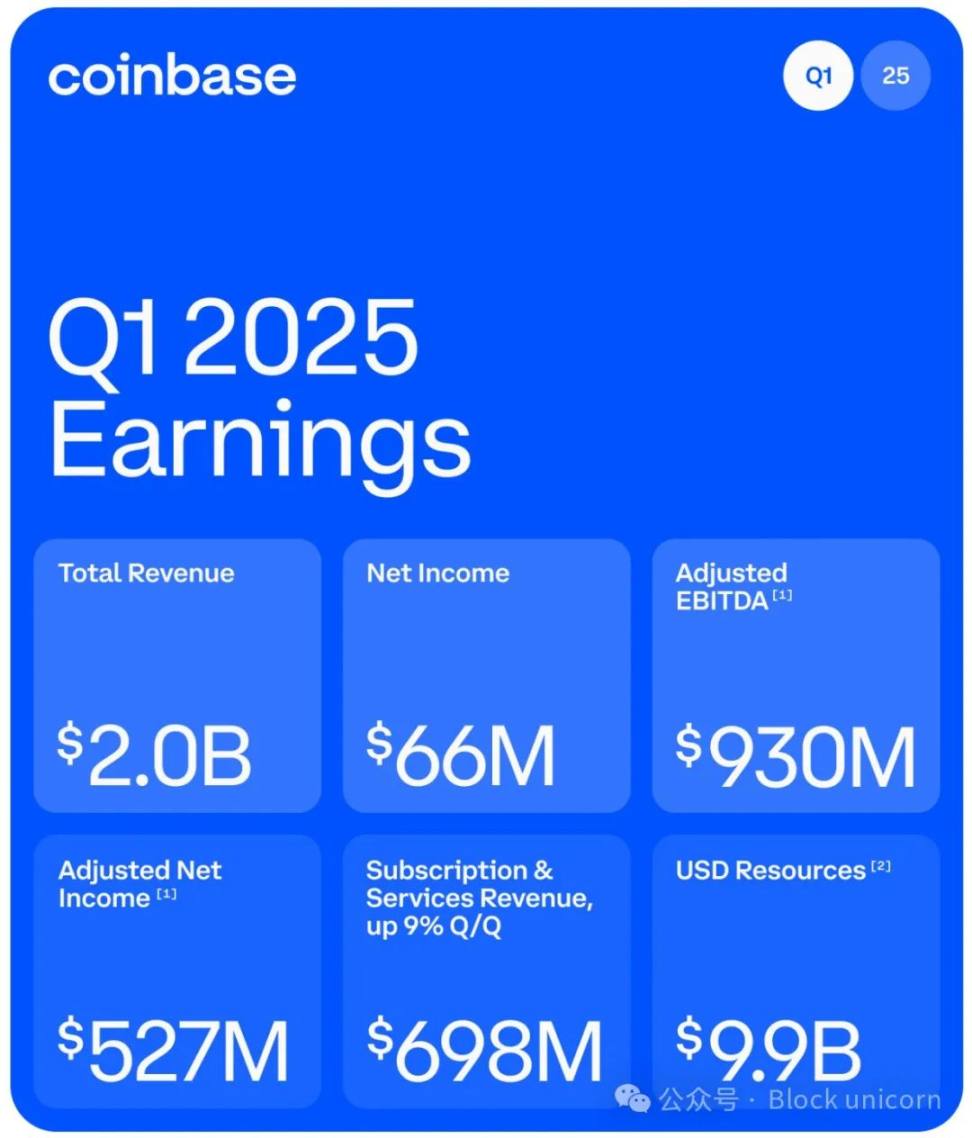
This sharp decline was primarily driven by a $596 million paper loss on Coinbase’s held crypto assets due to falling market prices. Trading revenue dropped 18.9% to $1.26 billion, with trading volume down 10.5% to $393 billion.
Yet beneath these surface numbers lies a more nuanced story. Subscription and services revenue actually grew 8.9% to $698.1 million, with stablecoin revenue performing particularly well. This growing revenue diversification suggests Coinbase is steadily reducing its reliance on volatile trading fees.
Meanwhile, Coinbase disclosed it purchased an additional $153 million worth of crypto assets, primarily Bitcoin, bringing its long-term portfolio to $1.3 billion—approximately 25% of its net cash.
CFO Alesia Haas emphasized during the earnings call: "To be clear, we are an operating company. But we do invest alongside the industry."
It was previously reported that Coinbase had considered adopting a Bitcoin-heavy treasury strategy akin to Michael Saylor's Strategy but ultimately decided against it.
Armstrong told Bloomberg: "Over the past 12 years, we’ve seriously considered several times whether to put 80% of our balance sheet into crypto—specifically Bitcoin. We made thoughtful choices about risk."
Unlike companies that explicitly tie their corporate identity to holding Bitcoin, Coinbase has taken a more cautious approach, recycling operating profits back into crypto assets as a capital alignment strategy rather than a full balance sheet transformation.
The Dark Side of Growth
As Coinbase expands its institutional offerings, it continues to face major security challenges threatening user trust.
On May 2, on-chain investigator ZachXBT revealed that within just seven days, Coinbase users lost approximately $45 million to social engineering scams. Even more alarming, he claimed that over recent months, Coinbase users have lost nine-figure sums to similar scams—a problem he described as unique among major exchanges.

These claims suggest Coinbase users may lose up to $330 million annually to social engineering attacks, reflecting increasingly sophisticated tactics targeting crypto holders.
However, Coinbase has also leveraged its security expertise to assist law enforcement in solving serious crimes. On May 6, Chief Legal Officer Paul Grewal revealed that the company’s blockchain forensics team played a key role in a criminal investigation in New York City that led to convictions in multiple murders.
The case involved a series of violent robberies where victims—often from the LGBTQ+ community—were drugged outside Manhattan bars and clubs, their phones stolen, and financial and crypto accounts drained. Several victims were found dead from fentanyl-laced substances, and over $250,000 was stolen across multiple platforms, including Coinbase.
Grewal explained: "Our blockchain analysis linked multiple wallets to the same criminal group, helped recover evidence across traditional finance and crypto channels, and supported convictions on 24 charges, including second-degree murder." He added: "This case shows that cryptocurrency isn't the risk—it provides the chain of evidence to bring violent criminals to justice."
This duality—as both a target for scammers and a valuable tool for law enforcement—highlights the complex position Coinbase occupies as it scales its operations.
Institutional Play
Taken together, these developments clarify Coinbase’s strategic landscape.
The Deribit acquisition is the latest in a series of strategic purchases systematically expanding its institutional capabilities:
-
2019 acquisition of Xapo, leading to Coinbase Custody
-
2020 acquisition of Tagomi, leading to Coinbase Prime
-
2022 acquisition of FairX, leading to Coinbase Derivatives Exchange
-
2023 acquisition of One River Digital, leading to Coinbase Asset Management
-
2025 acquisition of Deribit, making Coinbase the world’s leading crypto derivatives platform
Each acquisition fills a specific gap in Coinbase’s institutional service suite, gradually building a system that could become comprehensive financial infrastructure for crypto.
This push toward institutional infrastructure aligns with reports that Coinbase is considering applying for a U.S. banking charter, potentially following Circle and BitGo by formally bridging the gap between crypto and traditional finance through official banking status.
The goal appears to be creating a platform where professional traders can access spot, futures, perpetuals, and options trading within a seamless, capital-efficient environment. This would elevate Coinbase beyond being merely a retail gateway to crypto, positioning it as a backbone for global institutional crypto trading.
At the same time, Coinbase’s cautious stance on holding crypto on its balance sheet reflects its balancing act between its crypto-native identity and responsibilities as a public company.
Our View
In previous crypto cycles, when enthusiasts spoke of "institutional adoption," they often envisioned BlackRock and Goldman Sachs buying Bitcoin for their balance sheets or offering crypto products to clients. While the arrival of Bitcoin ETFs partially fulfilled this vision, a different kind of institutional infrastructure is quietly emerging.
Coinbase’s acquisition of Deribit marks a pivotal moment in this evolution. Rather than traditional institutions fully embracing crypto, crypto-native firms are becoming institutional themselves.
Reports that Coinbase is actively considering a U.S. banking license solidify its transition from outsider to insider—an astonishing reversal for a company that, just a few years ago, couldn’t even maintain basic banking relationships for many of its executives.
This creates an interesting dynamic. Coinbase began as a retail exchange, simplifying Bitcoin purchases for everyday users. Now, it is evolving into an entity resembling a traditional financial powerhouse—with prime brokerage, custody, asset management, and now advanced derivatives trading.
Yet unlike traditional financial institutions, Coinbase retains its crypto-native DNA. It holds Bitcoin on its balance sheet, provides blockchain forensics to law enforcement, and remains committed to crypto’s potential to reshape finance.
This hybrid identity could become Coinbase’s greatest strength—or its most glaring vulnerability. Traditional financial firms operate within decades-old regulatory frameworks that both constrain and protect them. Crypto-native institutions are creating new models with few precedents and limited safeguards against unknown risks.
The future of crypto may hinge on whether companies like Coinbase can successfully bridge this gap—maintaining the innovative potential of crypto while developing institutional-grade security and compliance. Their success or failure will determine whether crypto fulfills its promise of financial transformation or remains forever on the fringes.
Join TechFlow official community to stay tuned
Telegram:https://t.me/TechFlowDaily
X (Twitter):https://x.com/TechFlowPost
X (Twitter) EN:https://x.com/BlockFlow_News