








The battle for dominance in the stablecoin era: What are Visa and Mastercard building?
TechFlow Selected TechFlow Selected
The battle for dominance in the stablecoin era: What are Visa and Mastercard building?
Visa and Mastercard are competing for dominance in the Web3 payments market.
 Navigating Web3 tides with focused insights
Author: 100y
Translation: TechFlow
Key Takeaways
-
Visa and Mastercard are the two major operators of global payment networks, and it's no exaggeration to say they dominate nearly the entire global payments market. Global payment transaction volume is expected to reach $20 trillion by 2024. If card-based payments could be processed via blockchain networks in the future, this would bring significant growth opportunities for the blockchain and stablecoin industries.
-
Although front-end user experiences in today’s payment systems have greatly improved due to innovations from various fintech companies, the backend systems that actually process transactions still rely on outdated technology. Settlements and cross-border payments continue to face numerous challenges, while blockchain offers promising solutions.
-
In April this year, both Visa and Mastercard unveiled their roadmaps for blockchain and stablecoin applications. Both companies have launched initiatives in four key areas: 1) card services linked to stablecoins; 2) settlement systems based on stablecoins; 3) peer-to-peer international remittances; and 4) institutional tokenization platforms. It remains to be seen who will take the lead in the Web3 payments market.

"Visardilo Crocodilo" and "Tralalero Mastercara," two fictional characters symbolizing imaginative innovation in the payments space, are now waging war over the next-generation payment system. Indeed, for financial institutions, adopting blockchain and stablecoin-related technologies has become an obvious strategic choice.
1. Background — Can Blockchain Be Used for Payments?
1.1 The Two Giants of Traditional Payments
Source: Statista and Nilson
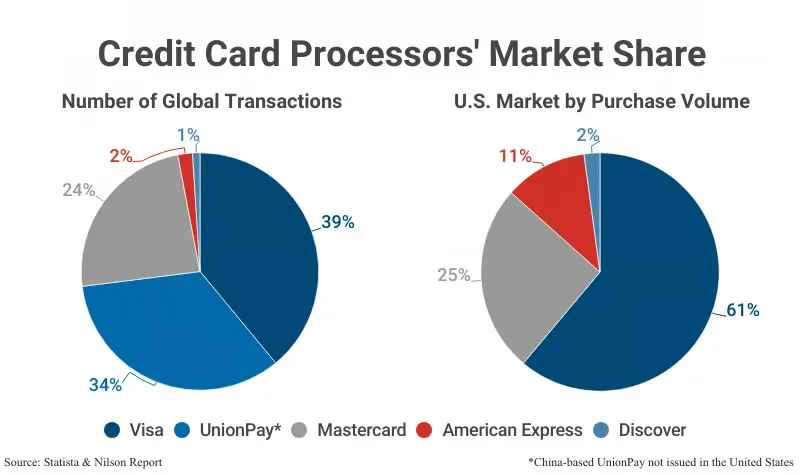
Visa and Mastercard are the world's leading payment network companies. As of 2024, Visa holds 39% of the global payment market share, while Mastercard holds 24%. Given that China's UnionPay primarily handles domestic transactions within China, it's fair to say that Visa and Mastercard almost entirely dominate the global payment landscape.
Both companies generate substantial profits by providing card payment networks that facilitate transactions between consumers and merchants, settling funds between issuing and acquiring institutions while charging small fees. (We'll explore the payment process in detail below.) In fact, Visa and Mastercard achieved operating profit margins of 67% and 57%, respectively, in 2023—reflecting their low fixed-cost, high-volume network business model.
According to Upgraded Points, card network transaction volume in the U.S. alone is projected to reach approximately $10.5 trillion in 2024. Combined with UnionPay’s domestic transaction volume, total global transaction value is expected to reach around $20 trillion. If card payment processing were to shift to blockchain networks in the future, this would create massive opportunities for the blockchain and stablecoin sectors.
1.2 The Card Payment Process
Visa and Mastercard operate open card payment networks using a “four-party model” consisting of issuers, acquirers, merchants, and cardholders. Neither company directly issues cards or provides loans—they only provide the payment network infrastructure. The basic flow of the widely used four-party model in the U.S. is as follows:
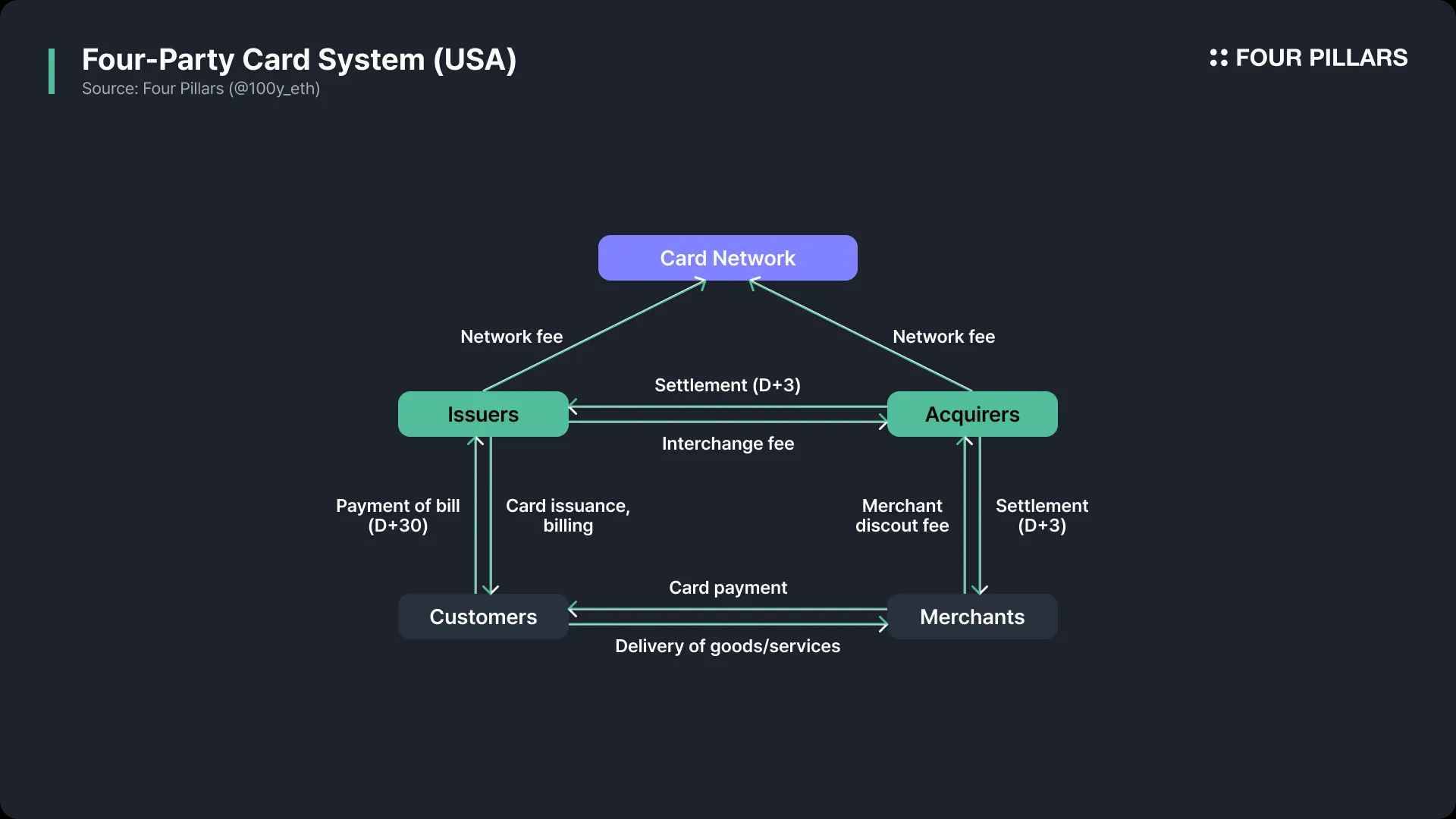
Payment Request (D+0: Transaction Day): When a cardholder makes a purchase at a merchant, a payment request is initiated through the card. Payment information flows from the merchant to the acquirer, then to the card network, and finally to the issuer.
Authorization (D+0: Transaction Day): The issuer checks the cardholder’s credit limit, card validity, and potential fraud indicators before deciding whether to approve the transaction. The approval response travels back through the same path to the merchant, completing the transaction.
Settlement (D+3: Third Business Day After Transaction): The issuer pays the acquirer after deducting settlement fees, and the acquirer pays the merchant after deducting merchant fees. The card network charges network fees to both the issuer and acquirer for each transaction.
Billing and Repayment (D+30: Thirtieth Business Day After Transaction): The cardholder receives a bill from the issuer the following month and repays the amount due.
1.3 Can Blockchain Be Used for Payments?
Over the past few decades, numerous fintech services related to payments have emerged—from early PayPal to later Stripe, Square, Apple Pay, and Google Pay. These services brought innovation to the front end, enabling users to pay faster and more easily than ever before. However, the backend processes that actually execute payments have changed little. As a result, existing payment systems still suffer from several problems.
The first issue is settlement time.
In traditional payment systems, most merchants and acquirers process transactions in daily batches, typically once per day. Additionally, settlements are usually processed only on business days, meaning overall settlement times can be extended during weekends or holidays.
The second issue is high costs for international transactions.
When the issuer and merchant are located in different countries, cross-border fund transfers are required during authorization and settlement. This adds approximately 1% in cross-border transaction fees and another 1% in foreign exchange fees, making international payments significantly more expensive than domestic ones.
A system capable of addressing both issues is blockchain. As a decentralized network, blockchain operates 24/7 without geographical boundaries, enabling fast settlement and lower fees even for international transactions. Leveraging these advantages, Visa and Mastercard have actively adopted stablecoins and blockchain technology in recent years within their payment networks. But how exactly are they utilizing blockchain?
2. Key Insight: The Payment War Has Begun
Visa’s Four Strategic Initiatives

Source: Visa
Visa operates one of the world’s largest payment networks—VisaNet—which can handle up to 65,000 transactions per second and supports payments across 150 million merchants in over 200 countries. Visa views stablecoins as a core component of future digital payment systems and announced four concrete strategic initiatives in April this year to integrate stablecoins into its existing payment infrastructure.
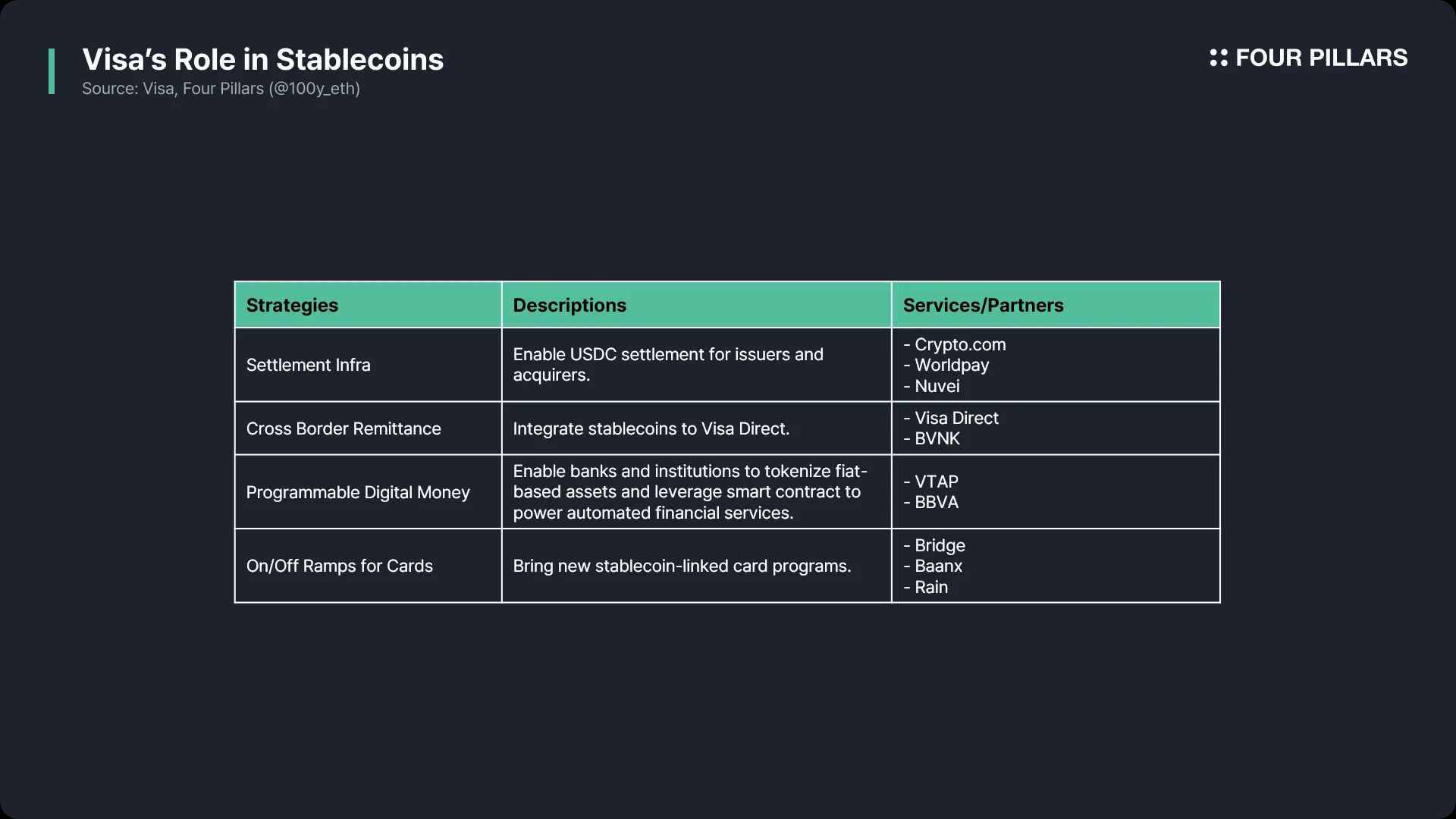
1. Modernizing Settlement Infrastructure
Since 2021, Visa has piloted the use of USDC (a U.S. dollar-pegged stablecoin) for payment settlements over its existing VisaNet network. To date, over $225 million in settlements have been completed. Traditionally, issuers had to transfer U.S. dollars to Visa for settlement purposes, but now they can also settle directly using USDC. This improves settlement efficiency and reduces cross-border transaction costs.
For example, Crypto.com offers the Crypto.com Visa Card, which allows users to make payments directly from their cryptocurrency accounts. Previously, crypto-native companies like this needed to convert digital assets into fiat currencies such as USD—a process that was time-consuming and costly. Now, they can settle directly using USDC. In collaboration with Anchorage, Visa established custodial accounts to securely store stablecoins. Issuers like Crypto.com can transfer stablecoins via the Ethereum network into these accounts to complete settlements.
By eliminating the need to convert cryptocurrencies into fiat and conduct cross-border wire transfers, Crypto.com has reduced average pre-funding time from 8 days to 4 days and cut foreign exchange fees to 20–30 basis points.
Visa not only allows issuers to settle with USDC but has also introduced functionality for acquirers to directly receive USDC for settlement. In September 2023, Visa built settlement infrastructure for acquirers like Worldpay and Nuvei, enabling them to receive USDC via the Ethereum and Solana networks. Acquirers can pass USDC on to merchants or convert it into fiat currency as needed.
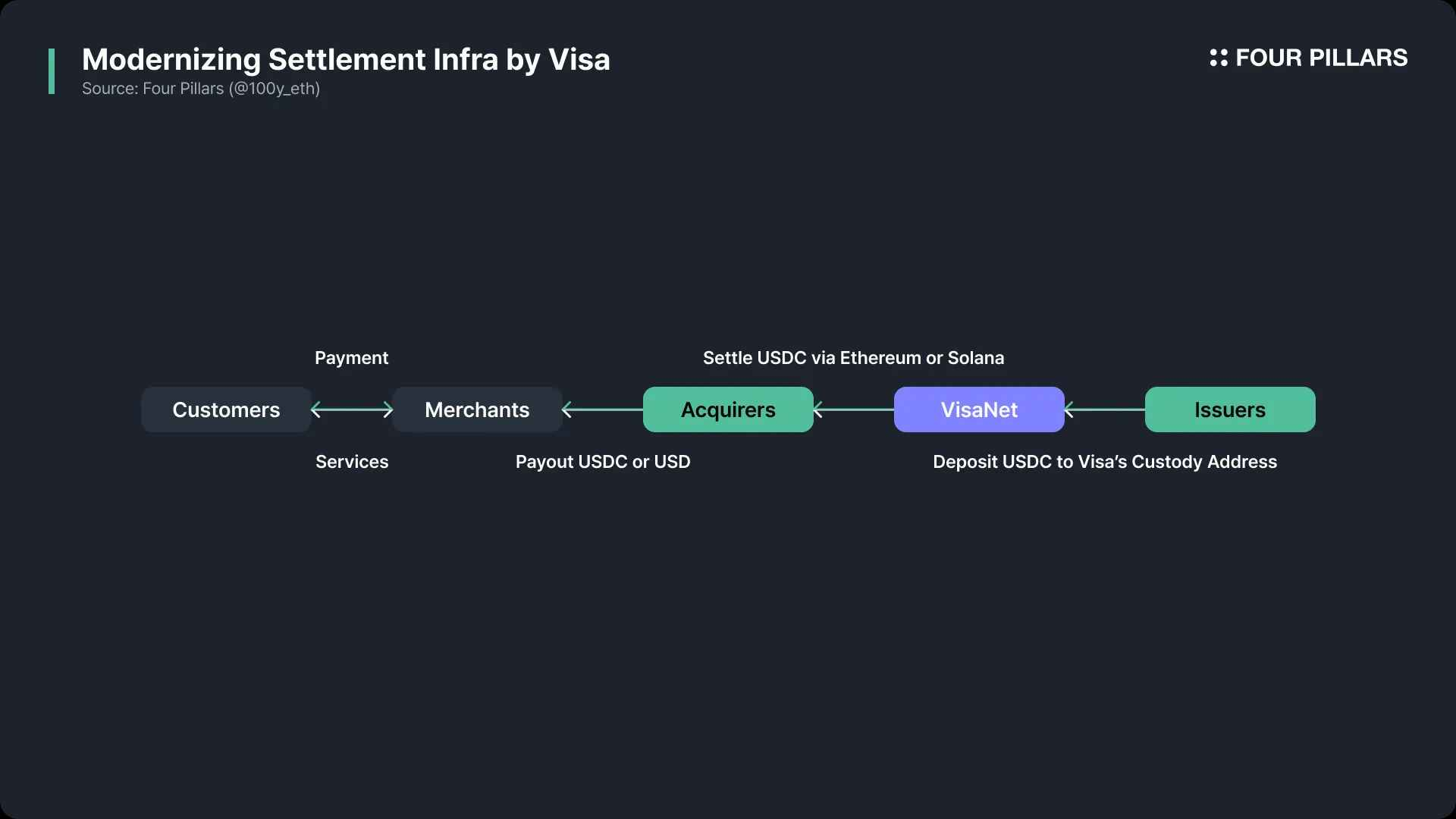
In summary, Visa has successfully established a pipeline allowing issuers to settle with acquirers via the Visa network using USDC instead of USD. Going forward, Visa plans to expand this stablecoin settlement system to more partners and regions, implement 24/7 real-time settlement, and support multiple blockchains and stablecoins.
2. Strengthening Global Remittance Infrastructure
Visa already supports large-scale cross-border transactions through its VisaNet infrastructure. One of its services, Visa Direct, enables peer-to-peer money transfers via cards, wallets, and account numbers, covering personal and business-to-customer scenarios. Visa plans to further enhance the efficiency of global remittances by integrating stablecoins into Visa Direct. Additionally, Visa recently invested in BVNK, a startup building stablecoin infrastructure for enterprises, aiming to expand its stablecoin capabilities beyond retail into the broader enterprise ecosystem.
3. Launching Programmable Digital Currency
One major advantage of stablecoins over traditional cash is their ability to leverage smart contracts on blockchains. Visa places strong emphasis on the potential of automated financial services powered by smart contracts and announced the launch of the “Visa Tokenized Asset Platform (VTAP)” in October 2024.
VTAP is a blockchain-based financial infrastructure that enables banks and financial institutions to issue and manage fiat-backed digital tokens such as stablecoins and tokenized deposits. Because these functions are accessible via Visa’s APIs, integration with existing financial systems becomes seamless. Tokens issued via VTAP can interact with smart contracts to automate complex processes such as conditional payments or customer lending.
Currently, VTAP is not publicly available and remains in a sandbox environment. Initially, it partnered with Spanish bank BBVA to test token issuance, transfer, and redemption functionalities. According to the roadmap, Visa plans to begin pilot programs for real clients on the public Ethereum blockchain starting in 2025.
4. Developing Stablecoin On-Ramp and Off-Ramp Cards
Visa is helping issuers provide on-ramp and off-ramp services through cards linked to stablecoins. To date, Visa has processed over $100 billion in cryptocurrency purchases and $25 billion in cryptocurrency spending through its card network. To expand this ecosystem, Visa is collaborating with stablecoin card infrastructure providers such as Bridge, Baanx, and Rain.
Bridge is a stablecoin infrastructure platform acquired by Stripe. Recently, Bridge partnered with Visa to launch a card issuance solution enabling users to make real-world payments using stablecoins. Fintech companies can offer card services linked to stablecoins to their users via Bridge’s simple API. Cardholders can directly use their stablecoin balances for payments, and Bridge converts the stablecoins into fiat currency to settle with merchants. The service is currently live in Argentina, Colombia, Ecuador, Mexico, Peru, and Chile, with plans to expand gradually into Europe, Africa, and Asia.
Baanx, a London-based fintech company founded in 2018, focuses on bridging traditional finance with digital assets. In April 2025, Baanx announced a partnership with Visa to launch a stablecoin payment card, allowing users to pay directly with USDC held in self-custodied crypto wallets. During payment, USDC is sent in real time via smart contract to Baanx, which then converts it into fiat currency to settle with merchants.
Rain, a New York-based fintech startup founded in 2021, operates a global card issuance platform powered by stablecoins. Rain provides APIs that enable businesses to issue Visa cards linked to stablecoins and offers additional financial services such as 24/7 real-time payment settlement, tokenization of credit receivables, and automated settlement workflows via smart contracts.
Mastercard’s End-to-End Stablecoin Payment Solution

Source: Mastercard
Like Visa, Mastercard is one of the leading companies in the global payment network industry. Unlike Visa’s high-capacity centralized VisaNet, Mastercard processes payments through Banknet—a robust distributed architecture supported by over 1,000 data centers worldwide. On April 28, 2025, Mastercard announced it had built an end-to-end infrastructure covering the entire stablecoin payment ecosystem, from wallets to checkout functionality.
1. Card Issuance and Payment Support
Mastercard collaborates with multiple crypto wallets (e.g., MetaMask), exchanges (e.g., Kraken, Gemini, Bybit, Crypto.com, Binance, OKX), and fintech startups (e.g., Monavate and Bleap) to offer stablecoin payment services.
MetaMask, in partnership with Mastercard and Baanx, launched the MetaMask Card, enabling users to make card payments using crypto assets stored in their MetaMask wallet. Settlement occurs in the background via Monavate’s solution, which connects the Ethereum network to Mastercard’s Banknet and converts crypto into fiat currency. The MetaMask Card will initially launch in Argentina, Brazil, Colombia, Mexico, Switzerland, the UK, and the U.S.
Mastercard also works with the aforementioned crypto exchanges to allow users to pay using stablecoins held in their exchange accounts.
2. USDC Settlement Support for Merchants
Despite growing adoption of stablecoin-based payments, most merchants still prefer to settle in fiat currency. However, if a merchant chooses, Mastercard supports USDC settlement through partnerships with Nuvei and Circle. Beyond USDC, Mastercard also supports settlement with Paxos-issued stablecoins via its collaboration with Paxos.
3. On-Chain Remittance Support: Mastercard Crypto Credential Service
Sending stablecoins via blockchain offers simplicity, speed, and low cost. However, when applied to real-life use cases, user experience, security, and compliance remain key challenges. To address this, Mastercard launched the “Mastercard Crypto Credential” service, allowing users on crypto exchanges to create aliases through a verification process and conveniently send stablecoins using those aliases. Visa and Mastercard are actively expanding the application scenarios of stablecoin payments—from card issuance and on-chain settlement to merchant support—by deeply collaborating with fintech firms, crypto wallets, and exchanges, thereby promoting the integration of blockchain technology with traditional payment systems. This marks a significant step forward for stablecoin payments globally and lays the foundation for the future development of the crypto industry.
Mastercard’s Crypto Credential service simplifies the blockchain payment experience through an alias system, eliminating the need to enter complex cryptocurrency wallet addresses and greatly improving usability. Additionally, if the recipient’s wallet does not support a specific cryptocurrency or blockchain prior to transfer, the transaction is blocked in advance to prevent asset loss. On the compliance front, Mastercard automatically exchanges Travel Rule data required for international remittances, meeting regulatory requirements and ensuring transaction transparency. Exchanges currently supporting the service include Wirex, Bit2Me, and Mercado Bitcoin. The service is now available in Latin American countries such as Argentina, Brazil, Chile, Mexico, and Peru, as well as European countries including Spain, Switzerland, and France.
4. Enterprise Tokenization Platform
Mastercard’s Multi-Token Network (MTN) is a private blockchain-based service designed to help financial institutions and enterprises issue, redeem, and manage tokens, enabling real-time cross-border transactions. Below are some use cases of MTN:
-
Ondo Finance tokenized its short-term U.S. Treasury bond fund (OUSG) and integrated it into MTN, allowing enterprises to buy and redeem OUSG in real time around the clock without relying on traditional financial infrastructure, while earning stable returns.
-
JPMorgan integrated its blockchain payment system Kinexys with MTN to support enterprise real-time payment needs.
-
In May 2024, Standard Chartered Bank conducted a pilot project via MTN to tokenize and trade carbon credits as part of a proof of concept.
The Race for Dominance in the Web3 Payment Market
As the U.S. government increasingly signals support for cryptocurrencies, momentum for blockchain and stablecoin adoption continues to grow across industries. Financial infrastructure—one of the core functions of blockchain networks—naturally attracts the attention of payment giants like Visa and Mastercard. Both companies are actively developing next-generation payment infrastructure.
Notably, both Visa and Mastercard announced their respective plans for blockchain and stablecoin payment systems in April 2025 (Visa released its vision on stablecoins on April 30, 2025, while Mastercard unveiled its end-to-end stablecoin transaction capabilities on April 28, 2025). Both emphasized four key areas: 1) card services linked to stablecoins; 2) enterprise tokenization platforms; 3) stablecoin-based settlement systems; and 4) peer-to-peer (P2P) remittances.
This indicates that Visa and Mastercard are competing head-to-head for leadership in the Web3 payment market.
Will the adoption of blockchain payment systems significantly disrupt existing market shares and competitive dynamics? The author believes that while the next-generation system will substantially transform the payment infrastructure itself, it won’t drastically alter market shares or the competitive structure. Blockchain payment systems will improve the efficiency of settlements and international transactions, helping businesses optimize revenue models and competitiveness. However, market share in the payments industry ultimately depends on long-standing business and marketing relationships with merchants, acquirers, and issuers—relationships that have been deeply entrenched over decades. Therefore, blockchain adoption may not significantly reshape the competitive landscape.
Resource Links:
Join TechFlow official community to stay tuned
Telegram:https://t.me/TechFlowDaily
X (Twitter):https://x.com/TechFlowPost
X (Twitter) EN:https://x.com/BlockFlow_News
 Four Pillars


