








The Stablecoin Yield Race Stalls U.S. Crypto Regulatory Legislation
TechFlow Selected TechFlow Selected
The Stablecoin Yield Race Stalls U.S. Crypto Regulatory Legislation
Congress has only a few weeks left to secure bank support for the CLARITY Act before it risks being shelved due to the midterm elections.
 Navigating Web3 tides with focused insights
By Oluwapelumi Adejumo
Translated by Saoirse, Foresight News
This presidential-backed legislative effort—aimed at establishing a more comprehensive regulatory framework for the U.S. cryptocurrency market—is approaching its political deadline in Congress. At the same time, the banking industry is pressuring lawmakers and regulators to ban stablecoin issuers from offering interest-like returns comparable to bank deposits.
This battle has become one of the most critical unresolved issues on Washington’s crypto agenda. The core dispute centers on whether dollar-pegged stablecoins should focus solely on payment and settlement functions—or whether they may also incorporate wealth-management features that compete directly with bank accounts and money market funds.
The Senate’s market-structure bill, titled the CLARITY Act, has stalled due to a breakdown in negotiations over so-called “stablecoin yields.”
Industry insiders and lobbyists say that if the bill is to have any realistic chance of passage before the election-year calendar tightens, late April to early May represents the practical window for advancement.
Congressional Research Service Sharpens the Legal Debate
The Congressional Research Service (CRS) frames this issue more narrowly than the public debate suggests.
In a March 6 report, the CRS noted that the GENIUS Act prohibits stablecoin issuers from directly paying yield to users—but remains ambiguous about the legality of what it terms the “third-party model,” where intermediaries such as exchanges sit between issuers and end users.
The CRS observed that the bill does not explicitly define the term “holder,” leaving open the question of whether intermediaries may still pass economic benefits through to their customers. This ambiguity is precisely why banks want Congress to clarify the matter in the broader market-structure legislation.
Banks argue that even limited yield incentives could make stablecoins formidable competitors to bank deposits—especially threatening to regional and community banks.
Crypto firms, however, contend that incentives tied to payments, wallet usage, or network activity could help digital dollars compete with traditional payment rails—and potentially elevate their standing within mainstream finance.
This divide also reflects fundamentally different visions for the future role of stablecoins.
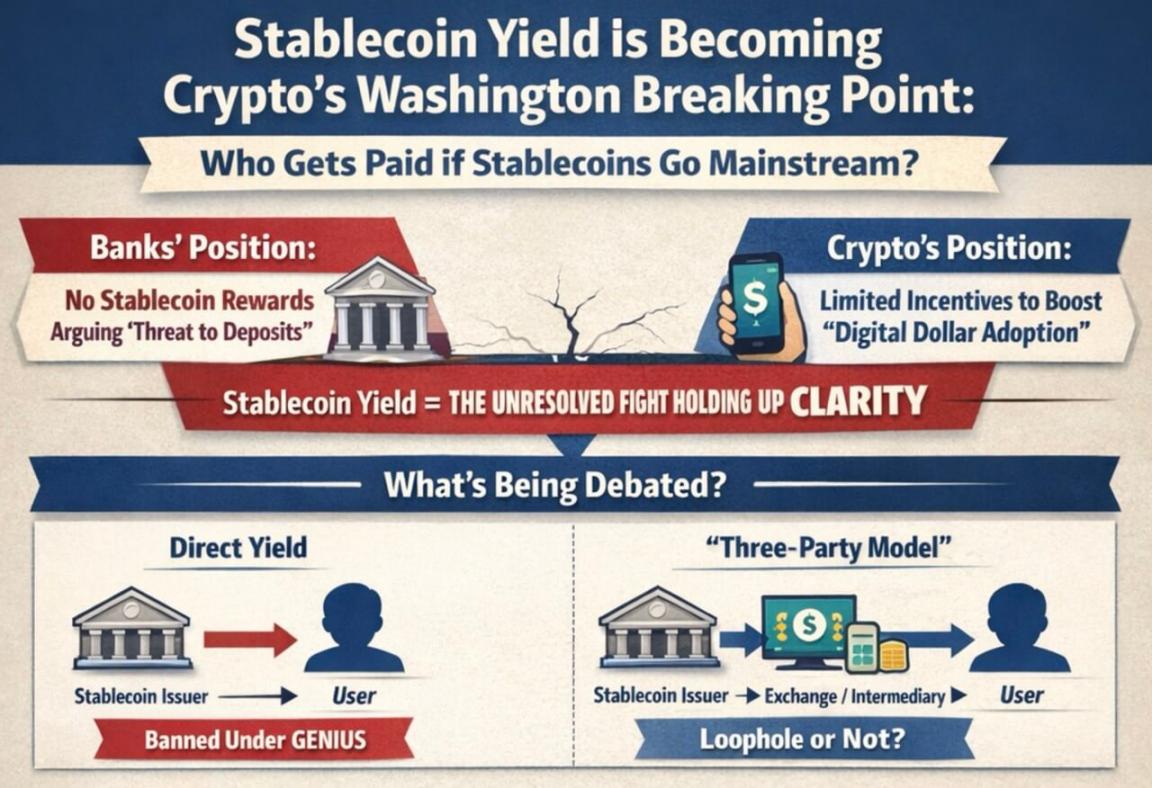
This infographic illustrates how banks and crypto firms hold sharply divergent views on “who should benefit from stablecoin yields” as digital dollar adoption expands.
If lawmakers treat stablecoins primarily as payment tools, stricter limits on associated rewards become more justifiable. Conversely, if lawmakers view them as part of a broader transformation in how value flows across digital platforms, then arguments supporting limited incentives gain stronger footing.
The American Bankers Association has urged legislators to close what it calls a “regulatory loophole” before such reward mechanisms become more widespread. Banks claim that permitting yield on idle balances would cause depositors to shift funds out of banks—thereby weakening the core funding source banks rely on to lend to households and businesses.
Standard Chartered estimated in January that stablecoins could drain approximately $500 billion in deposits from the U.S. banking system by the end of 2028—with smaller banks bearing the greatest pressure.
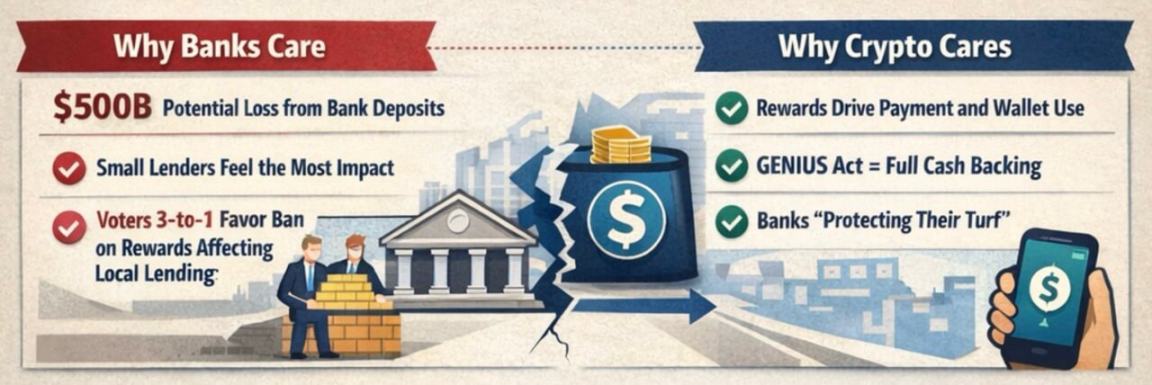
This infographic contrasts why banks and crypto firms care about stablecoin legislation—highlighting deposit outflows, impacts on borrowers, cash-back rewards, and bank protectionism.
Banks are also attempting to demonstrate public support for their position. The American Bankers Association recently released polling results showing:
- When respondents were told that allowing stablecoin yields “could reduce banks’ lending capacity and harm community and economic growth,” they supported banning stablecoin yields by a 3-to-1 margin;
- By a 6-to-1 margin, they believed stablecoin legislation should proceed cautiously to avoid disrupting the existing financial system—particularly community banks.
Crypto industry advocates counter that banks simply seek to protect their own funding models by limiting competition from digital dollars.
Industry leaders—including Coinbase CEO Brian Armstrong—argue that under the GENIUS Act, stablecoin issuers face stricter reserve requirements than banks: every issued stablecoin must be fully backed by cash or cash equivalents.
Transaction Scale Raises the Stakes in Washington
Market scale has elevated this yield debate beyond niche concerns.
Boston Consulting Group estimates that total stablecoin transaction volume reached approximately $62 trillion last year. After excluding bot-driven trades and internal exchange flows, real-world economic activity amounted to only around $4.2 trillion.
The vast gap between headline transaction volume and actual economic utility helps explain why the “yield” question has become so pivotal.
If stablecoins remain largely tools for trading and market infrastructure settlement, lawmakers will find it easier to classify them strictly as payment instruments. But if yield mechanisms transform stablecoins into widely used cash-holding tools within consumer apps, pressure on banks will escalate rapidly.
To that end, the White House earlier this year attempted to broker a compromise: permitting limited yield in narrow use cases—such as peer-to-peer payments—while prohibiting returns on idle balances. Crypto firms accepted this framework, but banks rejected it—leading to a complete impasse in Senate negotiations.
Even if Congress takes no action, regulators may step in to tighten yield models.
The Office of the Comptroller of the Currency (OCC), in a proposed rule implementing the GENIUS Act, stated that if a stablecoin issuer provides funds to an affiliate or third party—which then pays yield to stablecoin holders—that arrangement would constitute an impermissible indirect payment of prohibited yield.
That means if Congress fails to legislate, executive agencies may unilaterally draw boundaries via regulatory rulemaking.
Time Is Running Out in Congress
The current contest unfolds along two parallel tracks:
- Congress debates whether to resolve the issue through statutory law;
- Regulators interpret firm behavior within existing legal frameworks.
For the Senate bill, time itself is the greatest constraint.
Alex Thorn, Head of Research at Galaxy Digital, wrote on social media:
“If the CLARITY Act fails to clear committee review by the end of April, its chances of passage in 2026 will be extremely low. It must reach full Senate floor consideration by early May. Legislative time is evaporating—each passing day reduces the odds of success.”
He also cautioned that resolving the yield dispute alone wouldn’t guarantee progress:
“Many assume the stablecoin yield issue is what’s holding up the CLARITY Act. But even if consensus emerges on yield, other hurdles likely remain.”
Those hurdles could include DeFi regulation, agency jurisdictional authority—or even ethical questions.
With the November midterm elections looming, crypto regulation is almost certain to become an even more prominent political battleground—adding urgency to the current impasse. Delay risks pushing the bill into a far more congested legislative calendar and a significantly more difficult political environment.
Prediction markets reflect shifting sentiment. In early January, Polymarket priced the bill’s passage probability at ~80%; following recent setbacks—including Armstrong declaring the current version unworkable—the odds have fallen to nearly 50%.
Kalshi data shows only a 7% chance the bill passes before May, and a 65% chance it passes by year-end.
Failure Would Shift More Authority to Regulators and Markets
The consequences of failure extend well beyond the yield debate. The CLARITY Act’s central purpose is to clarify whether crypto tokens qualify as securities, commodities, or something else entirely—establishing a clear legal foundation for market oversight.
If the bill stalls, the entire industry will grow increasingly dependent on regulatory guidance, ad hoc rules, and future political shifts.
That’s one reason why markets are watching the bill so closely. Matt Hougan, Chief Investment Officer at Bitwise, said earlier this year that the CLARITY Act would codify the current crypto-friendly regulatory environment into law; otherwise, future administrations could reverse existing policy.
He wrote that failure would usher in a “prove-it” period for the industry—a three-year stretch during which crypto must demonstrate its indispensability to both everyday users and traditional finance.
Under that logic, future growth will depend less on expectations of legislative enactment—and more on whether stablecoins, tokenized assets, and similar products achieve genuine mass adoption.
This places markets on two starkly divergent paths:
- Bill passes → Investors price in stablecoin and tokenization growth in advance;
- Bill fails → Future growth hinges on real-world uptake—and faces uncertainty amid potential shifts in Washington’s policy direction.
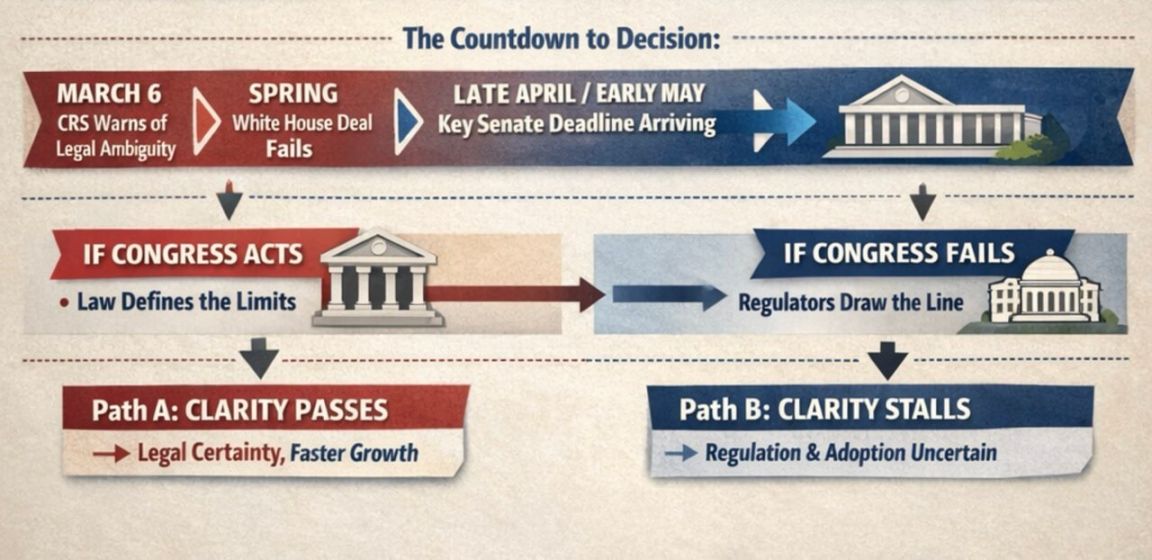
This flowchart outlines the Senate’s stablecoin decision countdown: March 6 and the late-April/early-May deadlines trigger two paths—if Congress acts, it delivers regulatory clarity and faster growth; if it doesn’t, uncertainty prevails.
For now, the next move lies with Washington. If Senators can revive this market-structure bill this spring, they retain the power to define—on their own terms—how much value stablecoins may transfer to users, and how much of the broader crypto regulatory framework may be enshrined in statute. If they cannot, regulators have clearly signaled their readiness to set at least part of those rules themselves.
Whatever the outcome, this debate has long since transcended the question of “whether stablecoins belong in the financial system”—and moved deeper into how they will operate within it, and who stands to benefit from their evolution.
Join TechFlow official community to stay tuned
Telegram:https://t.me/TechFlowDaily
X (Twitter):https://x.com/TechFlowPost
X (Twitter) EN:https://x.com/BlockFlow_News
 @CryptoSlate


