IOSG: The Full Spectrum of On-Chain Yields—From Yield-Bearing Stablecoins to Crypto Credit Products
TechFlow Selected TechFlow Selected
IOSG: The Full Spectrum of On-Chain Yields—From Yield-Bearing Stablecoins to Crypto Credit Products
The crypto industry is entering the application era, where retail users can access financial services via mobile apps.
 Navigating Web3 tides with focused insights
Author: Turbo @IOSG & James @Surf
TL;DR
- Yield products built on stablecoins gain greater traction during bear markets.
- TVL rises across all products in bull markets but diverges significantly in bear markets. During bear markets, investors prioritize stable returns and lower underlying risk—driving growth in yield-bearing stablecoins.
- Protocols evolve toward both frontend and backend roles.
- Major DeFi protocols are building their own wallets and mobile apps to control traffic entry points. The crypto industry is entering an “application era,” where retail users access financial services via mobile apps—a more intuitive Web3 onboarding path for Web2 users.
- New L1/L2s and DeFi projects’ demand for native stablecoins will push yield protocols toward a “backend” model, creating massive new demand for yield infrastructure.
- Interest rate cuts, declining Treasury yields, and the rise of alternative RWA yield sources.
- Anticipated rate cuts will reduce U.S. Treasury bill yields, prompting stablecoins to broaden their underlying asset portfolios to include a wider range of RWAs.
- Real-world businesses and financial products can serve as robust yield sources—even with weak frontend appeal—providing yield protocols with a distinctive competitive edge.
Current Onchain Yield Landscape
We analyzed 18 onchain yield products spanning diverse yield sources: tokenized Treasuries and derivatives; native staking (ETH/SOL); liquid staking tokens (LSTs) such as Lido and Jito; yield-bearing stablecoins (sUSDe, SyrupUSD); protocol revenue-sharing models (JLP, SKY); DeFi strategies and ecosystem incentives (Lido GGV, SIUSD/LIUSD, asBNB); DEX liquidity provision (Uniswap); market-making (HLP); and RWA-based products (PRIME, USDai, USP). For each product, we evaluated APY, liquidity, withdrawal time, and key risks.
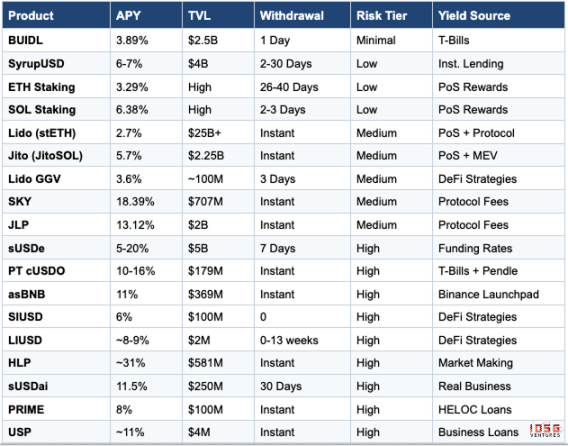
▲ Source: IOSG; Data as of November 2025; USP, SIUSD, and LIUSD data reflect January 2026
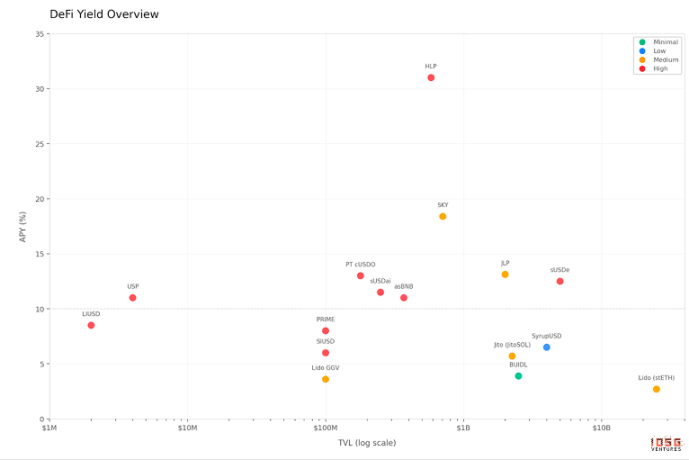
▲ Source: Surf
Yield Mechanisms
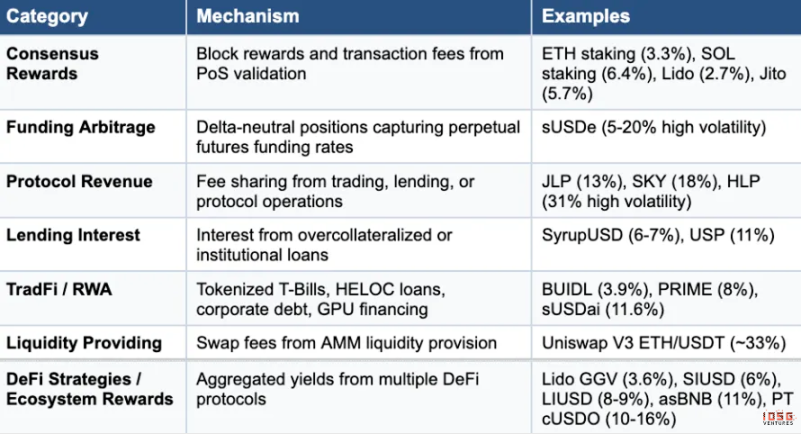
Onchain yield arises from eight distinct mechanisms—each offering different yields, risk profiles, and sensitivities to market conditions:
Consensus rewards (e.g., ETH/SOL staking, LSTs) deliver stable, protocol-guaranteed yields. Funding rate arbitrage and protocol revenue are cyclical—strong in bull markets, compressed in bear markets. Lending and RWA yields introduce counterparty risk but remain relatively stable. Liquidity providers (LPs) capture trading fees. DeFi strategies and ecosystem incentives aggregate yields across multiple protocols but carry smart contract risk.
Risk Stratification
Products face risk along four primary dimensions:
- Protocol risk: Technical risks, including smart contract vulnerabilities.
- Counterparty risk: Dependence on centralized entities or offchain participants.
- Strategy risk: Exposure to asset price volatility or flawed strategy design.
- Liquidity risk: Depth of TVL and withdrawal mechanics.
The lowest-risk tier includes tokenized Treasuries and mature lending protocols. Low-risk products—such as native staking and LST derivatives—introduce smart contract risk, though their codebases are battle-tested and thus low-risk in practice. Medium-risk products increase protocol complexity via DeFi strategies or revenue-sharing models, exposing users to token price volatility and yield fluctuations. High-risk products layer multiple risks: funding rate strategies suffer yield compression in bear markets; market-making vaults face manipulation risk; and emerging RWA protocols involve opaque third-party participants and limited liquidity.
Key Conclusions and the Future of Onchain Yield
Stablecoin-Based / Relatively Fixed-Rate Products Are Preferred in Bear Markets
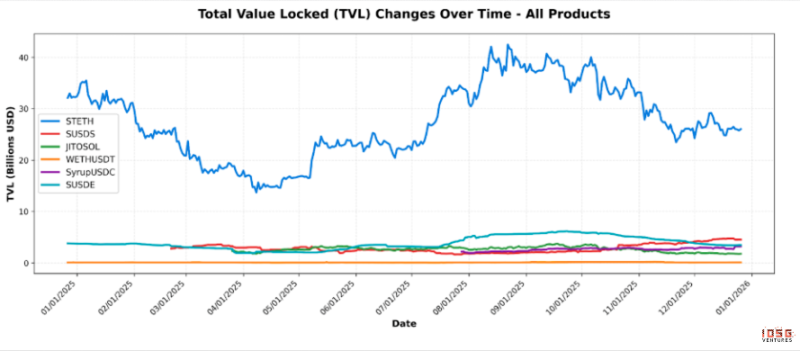
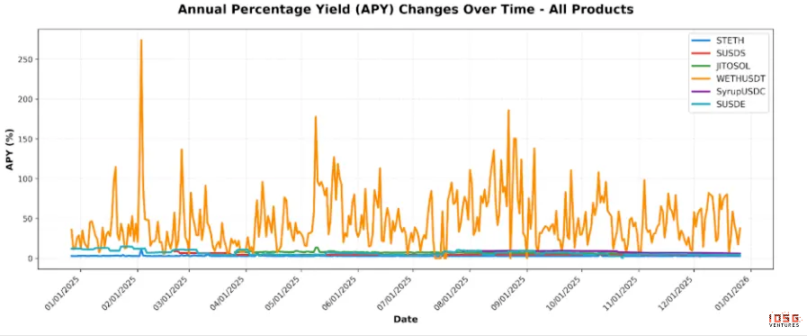
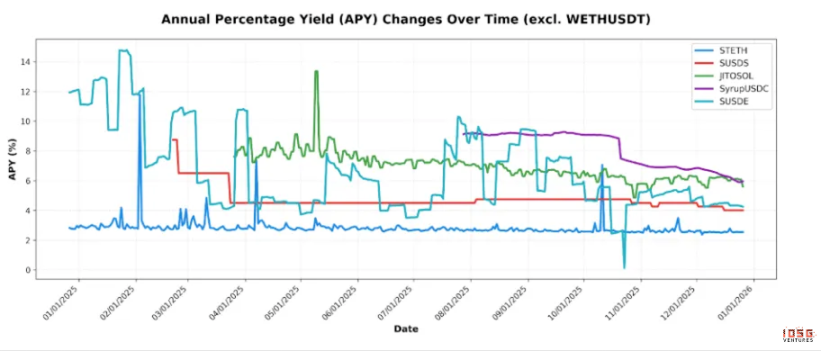
We conducted an in-depth analysis of how various yield products performed in bull vs. bear markets across both TVL and APY. We selected representative products across yield categories: stETH (staking), JitoSOL (staking), sUSDS (lending), WETH/USDT (Uniswap DEX LP), SyrupUSDC (Maple lending), and sUSDE (Ethena funding rate strategy). The bull market spanned roughly June–October, followed by a bear market transition.
▲ Source: DeFiLlama
TVL data shows that all products gained TVL during the bull market. In the bear market, however, stETH, sUSDE, and JitoSOL experienced TVL declines, while sUSDS and SyrupUSDC saw TVL increases.
▲ Source: DeFiLlama
APY for the WETH/USDT pool and stETH remained relatively stable across market cycles. APY for JitoSOL, SyrupUSDC, sUSDE, and sUSDS all declined—with sUSDE and SyrupUSDC seeing particularly sharp drops. Charts also reveal higher APYs correlate strongly with greater volatility. sUSDS’s APY is primarily governance-driven rather than market-driven, resulting in consistent stability over time.
Overall, stablecoin-based yield products attract stronger attention and higher liquidity during bear markets. Non-stablecoin-backed yield products suffer TVL erosion in bear markets due to falling underlying asset prices. Investors likewise favor stable returns and lower underlying risk—further fueling TVL growth in yield-bearing stablecoins.
In bear markets, relatively fixed-rate products represent more rational choices. Although sUSDS is not market-driven, its APY remains stable and predictable over medium-term horizons. By contrast, sUSDE’s APY fluctuates excessively with market conditions—and may collapse sharply in bear markets—making it suboptimal.
This underscores that APY alone is insufficient for evaluating onchain yield opportunities. Underlying assets critically determine real-world performance—especially for products like JLP (an index fund composed of SOL, BTC, and ETH), asBNB, and SKY. In these cases, token price volatility often dwarfs APY itself, rendering asset selection equally—if not more—important than yield magnitude. Some investors mitigate this exposure via hedging—for instance, shorting equivalent underlying assets on CEXs or DEXs to isolate yield returns while neutralizing price risk.
Protocols Evolve Toward Frontend and Backend Roles
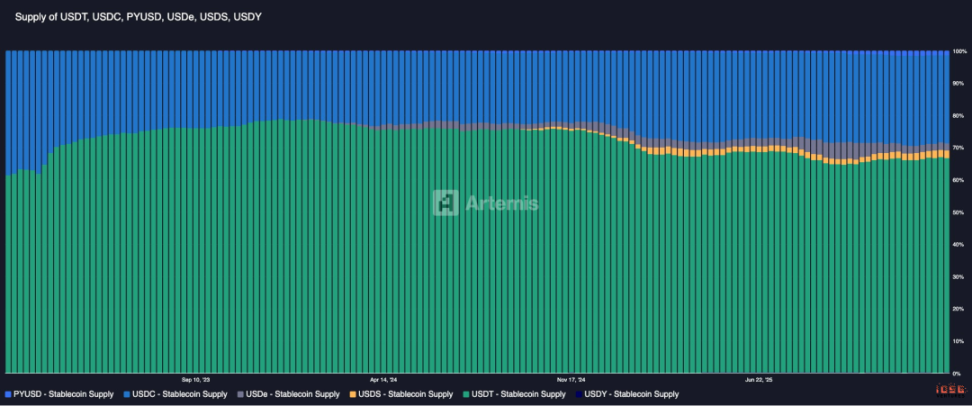
Historically, stablecoins generating ~4% yield from Treasuries represented highly cash-flow-positive businesses. Yet yield-bearing stablecoins distribute nearly 100% of that Treasury yield to users—posing a structural challenge to traditional stablecoins. Since 2024, yield-bearing stablecoins have steadily gained market share. Examining supply volumes of the top three native-yield stablecoins versus the top three non-yield-bearing stablecoins (USDT, USDC, PYUSD, USDe, USDS, USDY), native-yield stablecoins’ market share rose from 0.1% to 7.6%, peaking at 11.5%.
▲ Source: Artemis
This explains why many DeFi protocols are now seizing control of traffic entry points and developing proprietary distribution channels. Major DeFi protocols are building their own wallets or mobile apps to own user acquisition.
This signals a broader trend: the crypto industry is entering an “application era.” Retail users access financial services through mobile apps—an intuitive Web3 onboarding path for Web2 users. These apps can also offer seedless experiences, lowering barriers to adoption.
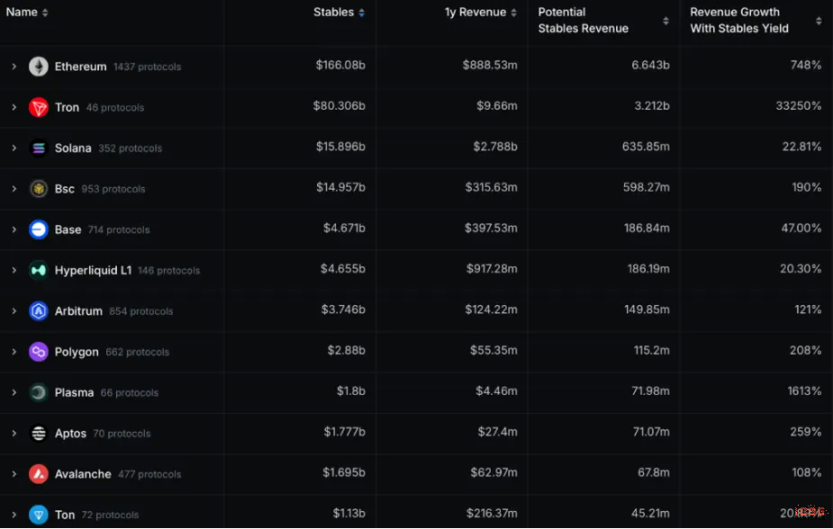
Demand for native stablecoins from L1s and DeFi projects will become a major catalyst for future yield protocol growth—and may push yield protocols into a “backend” role.
Given current stablecoin supply dynamics, if every L1 deployed its own stablecoin instead of relying on USDT or USDC, potential revenue could double or triple. This presents strong economic incentives for projects. The trend is already evident: MegaETH, Jupiter, Hyperliquid, and BNB are all launching native stablecoins—creating massive new demand for yield infrastructure.
Ethena has already anticipated this shift. Its Stablecoin-as-a-Service offering delivers Treasury yield to these projects. Protocols and chains deploying native stablecoins generate substantial, recurring revenue streams.
▲ Source: DeFiLlama
Rate Cuts, Declining Treasury Yields, and the Rise of Alternative RWA Yield Sources
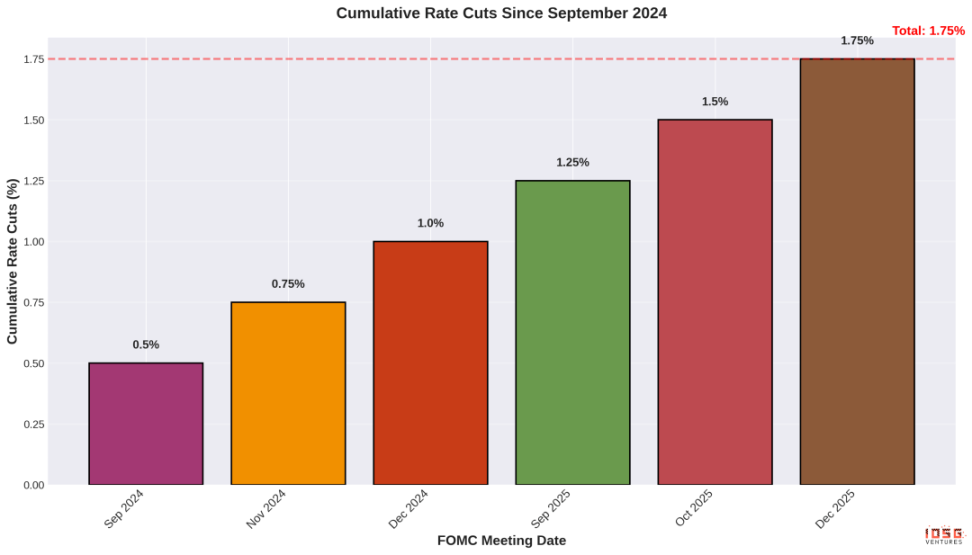
U.S. monetary policy directly shapes the onchain yield landscape.
▲ Source: FOMC
President Trump nominated Kevin Warsh to succeed Jerome Powell as Federal Reserve Chair. If confirmed, the transition is expected to be completed by May 2026.
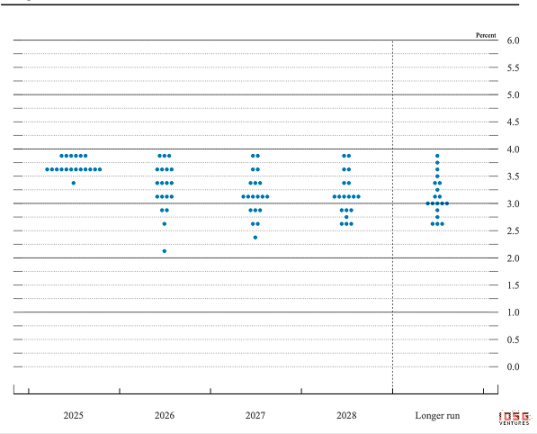
The nomination is expected to accelerate the Fed’s rate-cutting cycle, driving down U.S. Treasury bill yields.
▲ Source: FOMC participants' assessments of appropriate monetary policy: Midpoint of target range or target level for the federal funds rate; Dec 10th 2025
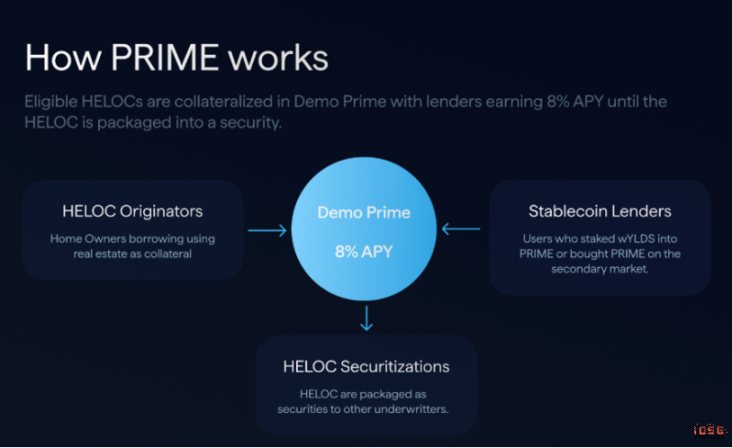
This will prompt stablecoins to diversify underlying assets beyond Treasuries into broader RWA classes. Figure’s PRIME exemplifies tokenizing HELOC (home equity line of credit) yields onchain. HELOCs allow homeowners to borrow against home equity, spend flexibly, and repay on demand. PRIME token holders fund HELOC loans and earn a fixed 8% yield.
▲ Source: Kamino
Another category brings real-world businesses onchain as yield sources. USDai tokenizes GPU financing. Its yield comes from borrower loan repayments—specifically, monthly repayments by GPU infrastructure operators who secured financing by pledging GPU hardware.
Private credit is gaining increasing attention as a compelling, resilient yield source. Projects like Craftt and Pareto enable onchain users to lend assets to institutions and enterprises—backed by tangible real-world business activity.
These examples demonstrate that real-world businesses and financial products can serve as durable yield sources. Even with weak frontend appeal, this becomes a distinctive advantage for yield protocols.
Crypto-native yield sources are also becoming increasingly valuable amid intensifying market competition. Products offering exclusive yield streams hold special value. For example, asBNB provides exposure to Binance Launchpad yields—a return stream available exclusively within the BSC ecosystem.
Similarly, revenue-sharing models become especially attractive when underpinned by transparent, verifiable revenue fundamentals. The success of JLP and HLP confirms users willingly allocate capital to products that share actual protocol revenue.
Institutional Adoption of Onchain Yield: End-to-End Services and Crypto Credit Products (Preferred Shares)
As institutional adoption accelerates, many institutions will seek exposure to onchain yield or crypto-native income. Success hinges on delivering end-to-end services.
End-to-End Services from DeFi Protocols
For example, Ether.fi offers institutional staking services centered on end-to-end asset management. It provides both non-custodial and custodial staking options, plus a “white-glove” service—a fully managed, end-to-end staking solution featuring a controlled environment, annual audits, KYC compliance, and monthly reporting. Its ETH fund is also registered with CIMA. Beyond staking, institutions can further participate in DeFi lending and other fixed-income protocols.
Preferred shares represent crypto-native “Treasuries”—a critical channel for institutional yield distribution
DAT’s preferred shares—as a vehicle for institutional onchain yield exposure—are widely underestimated. Fundamentally, they are crypto-native credit debt instruments analogous to government bonds. Just as Treasuries are debt obligations backed by national credit and fiscal capacity, DAT has built a credit market anchored in crypto assets—and preferred shares are credit debt products issued within that market. Preferred shares deliver crypto yield to traditional institutions via dividends, comprising two main components: long-term CAGR and DeFi yields (including staking).
Strategy’s STRC offers an 11.5% annualized dividend, paid monthly in cash and tradable on most major brokerage platforms. Its foundation lies in Bitcoin’s CAGR. The underlying assumption is that BTC serves as an inflation hedge, with an estimated real inflation rate of ~8%. STRF and similar preferred shares (e.g., STRD, STRK) pass through this inflation-hedge component to investors. Investors may also choose STRK, which offers an 8% yield and the option to convert into MSTR shares to capture additional upside from Bitcoin’s price appreciation.
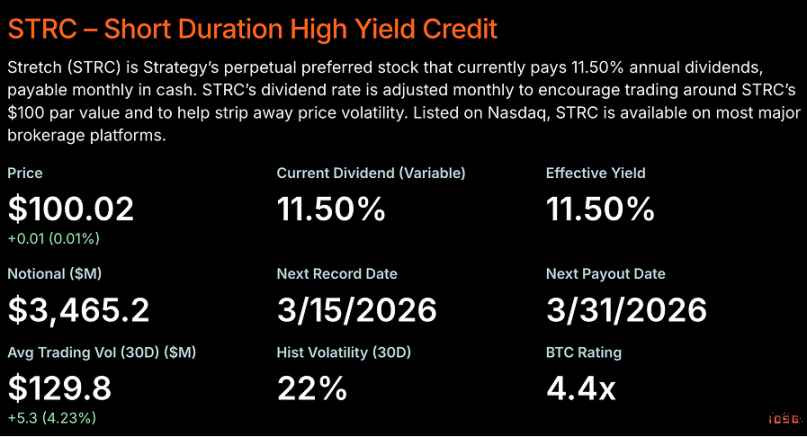
▲ Base information about STRC; Source: Strategy
Traditional finance features similar inflation-hedged products—such as TIPS (Treasury Inflation-Protected Securities), issued by the U.S. government. TIPS adjust principal upward with inflation (measured by CPI from the Bureau of Labor Statistics) and downward with deflation. Though TIPS nominal yields sit below inflation (e.g., 2.7%), the real yield—after inflation adjustment—is approximately 4%.
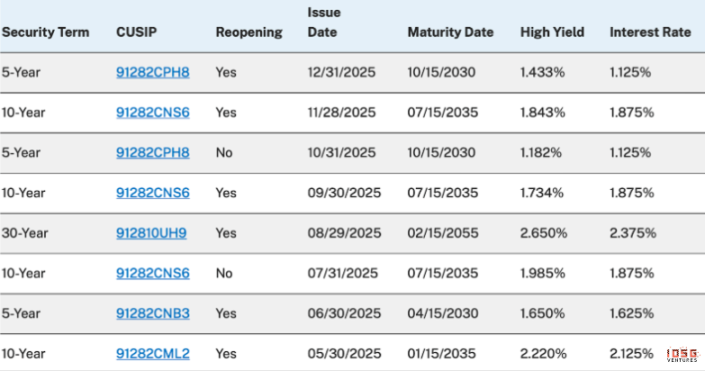
▲ Interest rate of TIPS; Source: Treasurydirect.gov
Interestingly, stablecoin projects like Saturn Labs are bringing DAT’s stable yields onchain as stablecoin yield sources. In the digital asset era—and amid the Fed’s rate-cutting cycle—this may emerge as a viable onchain Treasury alternative.
Preferred share dividends can also serve as vehicles for distributing aggregated onchain yield to equity investors. Solana DAT Forward Industries stakes nearly its entire SOL holdings (over 6.87 million SOL), earning ~7% staking yield. It also converts ~25% of its SOL into fwdSOL (an LST) to unlock enhanced DeFi liquidity and yield opportunities. While it hasn’t yet announced plans to distribute these yields via preferred shares, it possesses the capacity to offer ~7% yield—and potentially higher returns via onchain protocols. DeFi Development Company issues Series C perpetual preferred shares yielding 10% annually. Based on current onchain yields and SOL staking rates, it can comfortably sustain these dividends.
Join TechFlow official community to stay tuned
Telegram:https://t.me/TechFlowDaily
X (Twitter):https://x.com/TechFlowPost
X (Twitter) EN:https://x.com/BlockFlow_News
 IOSG Ventures