Miners' holdings hit cycle low + China-US tariff exemptions, Bitcoin enters狂暴 mode
TechFlow Selected TechFlow Selected
Miners' holdings hit cycle low + China-US tariff exemptions, Bitcoin enters狂暴 mode
100K USD is just the starting point?
 Navigating Web3 tides with focused insights
Author: Lawrence, Mars Finance
Part One: Bitcoin Miner Selling Pressure Drops to Lowest Since 2024 – Is the Market Building Momentum for a New High?
1. Shift in Miner Behavior: From Selling to Holding
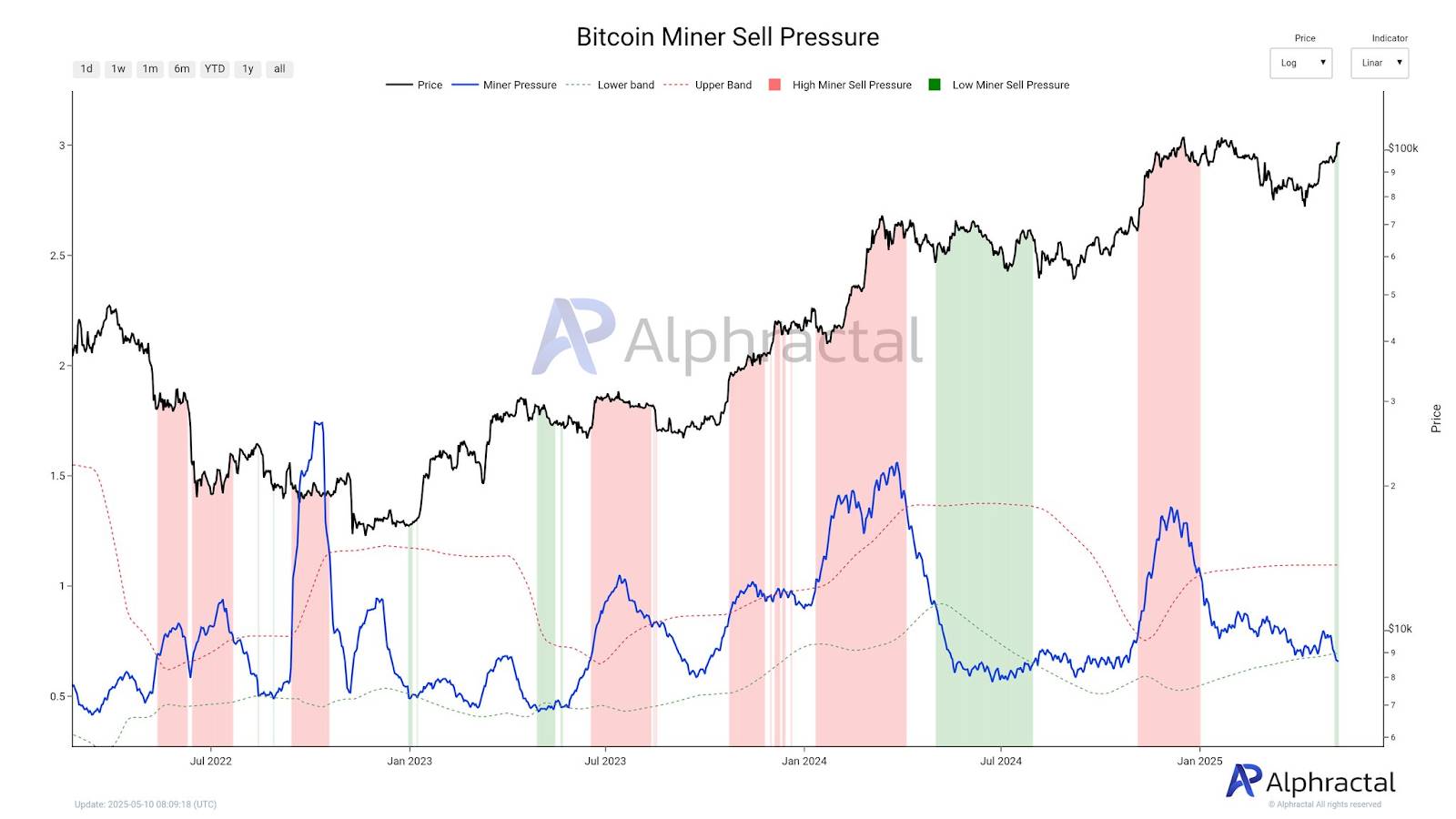
According to recent data from cryptocurrency analytics platform Alphractal, the Bitcoin miner sell pressure indicator (measuring the ratio of miners' 30-day outflows to reserves) has dropped below its lower band, reaching the lowest level since 2024. This suggests that miners are shifting from the previous model of "selling to cover operating costs" toward strategic accumulation.
This stands in sharp contrast to the post-2024 halving period when miner revenues were halved (with daily sell-offs increasing from 900 BTC to 1,200 BTC). However, changes in the current market environment have prompted miners to adjust their strategies:
-
Profit-driven accumulation: With Bitcoin recently breaking $100,000 and approaching all-time highs, miners now prefer holding Bitcoin for higher future gains rather than short-term cashouts.
-
Structural industry optimization: The scale-up of mining led by public companies (e.g., Bitfarms, CleanSpark) has reduced the risk of inefficient miners exiting, increasing industry concentration and easing selling pressure.
-
Lessons from past cycles: Excessive leverage and long-term holding by miners previously triggered liquidity crises (such as during the 2018 bear market), leading to greater focus on short-term financial stability today.
2. On-Chain Data Reveals Market Resilience
Alphractal's miner sell pressure metric shows that the current market structure is fundamentally different from the "panic selling" seen in early 2024:
-
Dominance of long-term holders: Over 80% of Bitcoin is currently held for more than six months, significantly lower than the proportion of short-term holders at previous cycle peaks, providing strong price support.
-
Exchange reserves at new lows: Declining Bitcoin exchange reserves indicate the market is in a "high-speed accumulation phase," with selling pressure dispersed through OTC trades or institutional holdings.
-
Risks in derivatives markets: Despite spot market stability, the $100,000–$110,000 range contains large highly-leveraged long positions, which could trigger multi-billion dollar liquidations if price volatility increases.
3. Price Trends and Future Outlook
As of May 12, 2025, Bitcoin is trading at $104,250, up 1% over 24 hours and over 30% in the past month. Market debate centers on the following factors:
-
Technical signals: RSI (75) indicates overbought conditions, but MACD continues to rise; a break below key support at $100,000 could trigger short-term holder sell-offs.
-
Macroeconomic influences: Fed rate cut expectations (if cuts exceed 100 basis points in 2025) could provide a "double whammy" boost to Bitcoin, though stagflation risks may weaken its safe-haven appeal.
-
Miner behavior dynamics: If prices surpass $110,000, miner selling pressure may rebound, but current low levels suggest the market might be entering a "calm uptrend phase."
Part Two: Market Skepticism Amid 'Substantial Progress' in U.S.-China Trade Deal
1. White House Statement and Agreement Framework

On May 11, U.S. Treasury Secretary Scott Bessent and Trade Representative Jamieson Greer jointly announced "substantial progress" in U.S.-China trade negotiations, with both sides reaching preliminary consensus on the following areas:
-
Market access: China commits to expanding imports of U.S. agricultural products; U.S. extends tariff exemptions on certain tech products.
-
Intellectual property protection: Establishment of cross-border enforcement cooperation mechanisms and reduced barriers to technology transfer.
-
Dispute resolution mechanism: Creation of a standing consultation platform to prevent escalation of trade disputes.
2. Market Reaction and Underlying Concerns
Despite positive official signals, lack of agreement details has led to cautious optimism among investors:
-
Residual uncertainty: The unpredictable nature of Trump administration policies (e.g., the 2024 one-day reversal on electronics tariff exemptions) undermines market confidence; risk assets remain under pressure until the deal is finalized.
-
Unresolved structural tensions: Competitive policies between the U.S. and China in semiconductors and artificial intelligence (e.g., "Trade War 2.0") may persist through non-tariff measures.
-
Divergent liquidity impacts: If the agreement drives down the U.S. Dollar Index (DXY), Bitcoin could benefit from renewed "anti-fiat" narratives; however, if talks collapse and trigger safe-haven demand, gold may divert capital flows.
3. Global Economic Ripple Effects
Potential systemic impacts of improved U.S.-China trade relations include:
-
Supply chain restructuring: The agreement could accelerate nearshoring trends, elevating manufacturing hubs in Mexico and Southeast Asia, and increasing demand for cross-border crypto payments.
-
Inflation relief expectations: Tariff reductions could ease U.S. CPI pressures, creating room for Fed rate cuts and indirectly benefiting risk assets.
-
Geopolitical risk shift: As U.S.-China cooperation strengthens, alternative crises such as the Russia-Ukraine conflict or Middle East tensions may become new sources of market volatility.
Part Three: Market Dynamics and Investment Strategy Amid Dual Drivers
1. Bitcoin and Macroeconomic Policy Convergence
-
Interest rate sensitivity and correlation: Bitcoin’s correlation with the Nasdaq (0.78) indicates it remains within the traditional risk asset framework; if the trade deal boosts tech stocks, Bitcoin may rise in tandem.
-
Miner behavior as a leading indicator: Historical data shows that after miner sell pressure hits bottom, Bitcoin often enters an upward cycle (e.g., the bull run following miner capitulation in 2023); current low selling levels may signal a similar trend.
2. Risk and Opportunity Assessment
-
Short-term volatility risks: Accumulated leverage in Bitcoin derivatives and unclear details of the U.S.-China deal may trigger price swings, with $100,000 acting as a key support and battleground level.
-
Long-term narrative strengthening: Daily accumulation by Bitcoin ETFs (800 BTC) still exceeds miner output (450 BTC), with institutional adoption offsetting some market shocks.
Conclusion: Finding Certainty in a Complex Market
The global market in May 2025 stands at a dual inflection point: post-Bitcoin halving cycles and U.S.-China trade relationship rebalancing. While low miner selling pressure and White House trade advances appear independent, they both point to a central theme: asset repricing amid liquidity restructuring. Whether Bitcoin breaks new highs or the trade deal materializes, the market will ultimately validate one truth – in the clash between macroeconomic realities and crypto narratives, only assets combining resilience and efficiency will achieve long-term success.
Join TechFlow official community to stay tuned
Telegram:https://t.me/TechFlowDaily
X (Twitter):https://x.com/TechFlowPost
X (Twitter) EN:https://x.com/BlockFlow_News