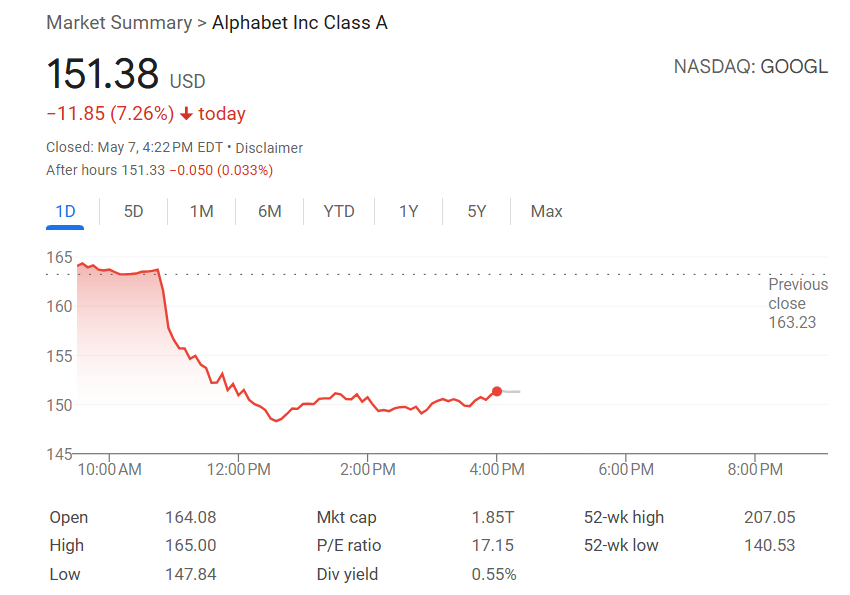
Apple considers revamping Safari to shift toward AI-powered search, Google's stock price一度 dropped more than 9%
TechFlow Selected TechFlow Selected
Apple considers revamping Safari to shift toward AI-powered search, Google's stock price一度 dropped more than 9%
The Google-dominated search era may be coming to an end.
 Navigating Web3 tides with focused insights
Author: Wall Street Horizon
During Wednesday's U.S. stock trading session, Alphabet, Google's parent company, saw its share price plunge, with losses rapidly widening to over 9% at one point. Apple's stock turned negative during the day, falling more than 2% in intraday trading. The declines in both Google and Apple dragged down the broader U.S. market, pushing the Nasdaq-100 into negative territory after rising as much as 1% in after-hours trading the previous day.
On the news front, Apple is "actively considering" a major overhaul of the Safari browser on its devices, shifting focus toward an AI-driven search engine. This decision could end the long-standing partnership between Apple and Google, triggering significant industry-wide changes and posing a serious challenge to Google's dominance in search. The era of Google-led search may be coming to an end.
Alphabet closed nearly 7.3% lower on Wednesday, ending at $151.38.
Eddy Cue, Apple’s senior vice president of internet software and services, revealed the above information while testifying on Wednesday in the U.S. Department of Justice’s antitrust lawsuit against Alphabet.
The core of the DOJ's case is a deal valued at approximately $20 billion annually between Apple and Google, under which Google remains the default search engine on Apple devices. A loss in this case could force the two tech giants to terminate their cooperation agreement, fundamentally altering the long-established operation model of devices like the iPhone.
AI Search Enters the Arena
Consumer acceptance of AI is also steadily increasing. Eddy Cue noted that Safari’s search volume declined for the first time in April this year, attributing this drop to users shifting toward AI tools.
Cue said he believes AI search providers—including OpenAI, Perplexity, and Anthropic—will eventually replace traditional search engines like Google. He expects Apple will add these companies to Safari’s search options:
We’ll add them to the list, but they probably won’t become the default. These products still need further improvement.
Before AI emerged, I didn’t think other search options were reliable. Now I see greater potential because new players are approaching the problem differently.
Currently, Apple offers OpenAI’s ChatGPT as an optional feature within Siri. The agreement with OpenAI allows Apple to incorporate other AI providers into its operating system, including its own.
Prior to selecting ChatGPT last year as part of iOS 18’s “Apple Intelligence,” Apple conducted a competitive review process that included Google. Cue said Google presented a list of terms, “many of which Apple couldn’t accept, unlike the terms in the OpenAI agreement.”
Cue added that Apple also evaluated Anthropic, Perplexity, China’s DeepSeek, and xAI’s Grok from Elon Musk. He specifically mentioned that Apple has held some discussions with Perplexity. Additionally, Cue expects Apple to integrate Google’s AI search product Gemini later this year.
Cue emphasized that AI search engines need to improve their search indexing to truly enhance performance. However, even if such improvements aren't achieved quickly, some of their other capabilities are already “strong enough to make users willing to switch.” Regarding the transition from traditional to AI search, Cue stated, “Now there’s ample capital and large players involved—I don’t see any reason why this shift wouldn’t happen.”
Cue also noted that large language models will continue to improve, further driving changes in user behavior.
Reviewing the Existing Partnership
Nonetheless, Cue believes Google should remain Safari’s default search engine and admitted he once lost sleep over concerns about losing the revenue-sharing arrangement. He said the current agreement between Apple and Google on standard search still offers the most favorable financial terms.
Last year, Apple and Google expanded their collaboration by integrating Google Lens into the latest iPhone’s “Visual Intelligence” feature, allowing users to take photos and analyze them using Google’s AI.
Cue also mentioned that Apple recently revised its agreement with Microsoft’s Bing to a yearly renewal basis. Bing remains a non-default option in Safari.
In court, Cue stated that the pace of technological change is so rapid that people might not even use today’s devices in a few years:
You might not even need an iPhone in ten years, although that sounds crazy. True competition only emerges when technology changes. Technological shifts create opportunities. AI is a new technological shift, creating fresh opportunities for new entrants.
How Is the Market Reacting?
Media analysis suggests that as a major shift, this carries significant implications for Apple and its ecosystem of over 2 billion active devices. Since the launch of the first iPhone in 2007, users have relied on Google’s search engine to browse the web. Now, they are entering a new search era led by multiple AI companies.
The market interpreted Eddy Cue’s testimony as a signal of challenges facing both Alphabet and Apple, as they may be forced to abandon this lucrative arrangement. This also explains why, apart from Google’s sharp decline, Apple’s stock also fell over 2% at one point on Wednesday.
Apple’s in-house AI technology has consistently lagged behind peers. The company does not yet possess its own AI search engine and was compelled to delay major upgrades to Siri—upgrades originally intended to leverage personal user data to assist with queries. Apple plans to unveil an improved version of its AI platform, “Apple Intelligence,” at its annual developer conference on June 9.
Join TechFlow official community to stay tuned
Telegram:https://t.me/TechFlowDaily
X (Twitter):https://x.com/TechFlowPost
X (Twitter) EN:https://x.com/BlockFlow_News