Interview with BlackRock's Chief Investment Officer: Bitcoin Will Eventually Be More Like Gold, 80% of Top 50 Tokens Lack My Confidence
TechFlow Selected TechFlow Selected
Interview with BlackRock's Chief Investment Officer: Bitcoin Will Eventually Be More Like Gold, 80% of Top 50 Tokens Lack My Confidence
"I believe there are some opaque practices among market makers, which is completely different from the top 50 companies in the stock market."
 Navigating Web3 tides with focused insights
Compiled & Translated: TechFlow
Key Takeaways
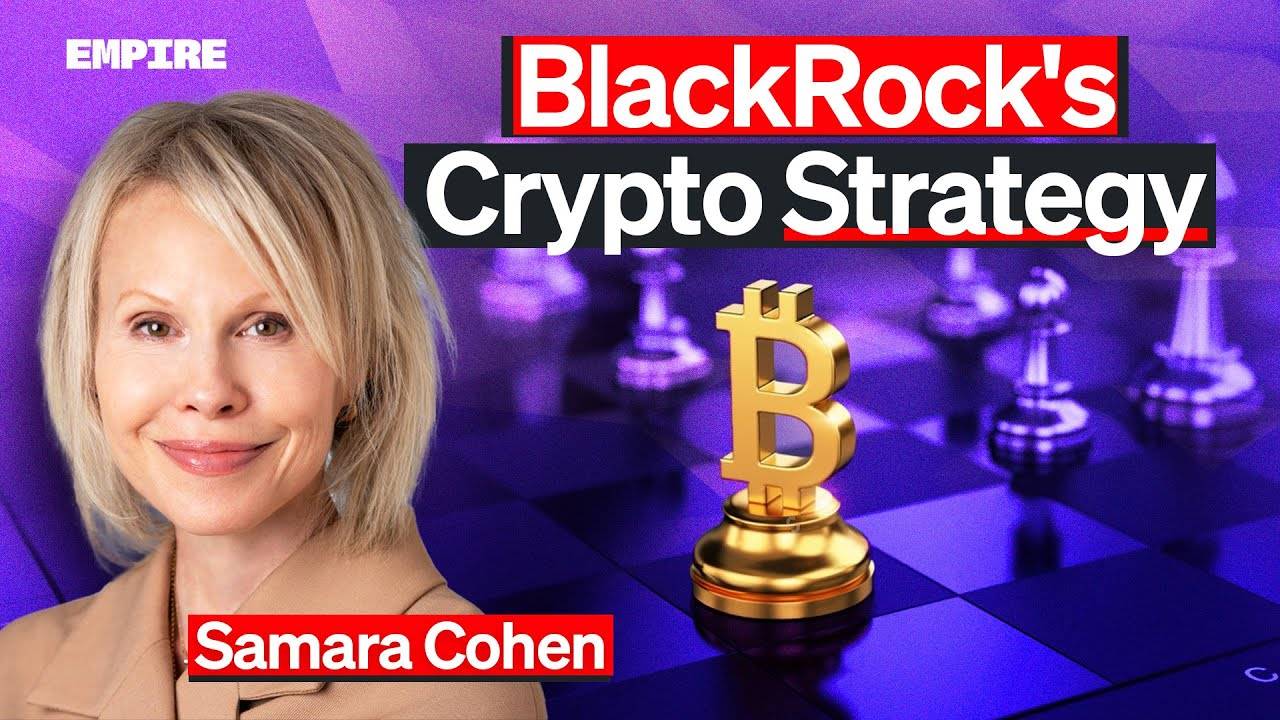
Guest: Samara Cohen, Chief Investment Officer for ETFs & Indexes at BlackRock
Host: Jason
Podcast Source: Empire
Original Title: BlackRock's Crypto Strategy In 2025 With Samara Cohen
Air Date: April 28, 2025
This episode features Samara Cohen discussing BlackRock’s cryptocurrency strategy in 2025. We dive deep into the reasons behind the success of Bitcoin ETPs, investor demand for crypto assets, why Samara is optimistic about tokenization, and how traditional assets can be moved on-chain.
Highlights Summary
-
Bitcoin is indeed a new asset class — as a borderless store of value, its end state resembles gold more than anything else.
-
Bitcoin tends to rally more intensely but corrects more gently.
-
In the Bitcoin ETP space, most buyers are still hedge funds.
-
We’re currently focused on tokenized money market funds and tokenized Treasury funds because cash and collateral liquidity in capital markets are inefficient — an area where blockchain technology clearly offers improvement.
-
I don’t think Layer 1 or Layer 2 projects need to pitch directly to BlackRock.
-
I don't find Ethereum's positioning more complex than other altcoins. In fact, I believe the entire crypto space struggles with data and standardization.
-
Of the top 50 tokens listed on platforms like CoinGecko or CoinMarketCap, I have little confidence in about 40 of them. There’s opacity among market makers that doesn’t exist among the top 50 public equities.
-
Stablecoins started by putting dollars on-chain. Then we began moving Treasuries and money market funds on-chain. Next, I expect on-chain credit — bringing credit onto the blockchain.
-
Finding technological applications that solve real-world problems is far better than simply making illiquid assets liquid.
-
In this post-crisis era, banks and governments have limited capacity to support funding — so we must expand capital markets to drive economic growth.
-
The collaboration between digital-native crypto firms and traditional financial institutions is crucial. We must rethink what constitutes a suitable portfolio, how to attract investors, how to build solutions, and how to market them — brand identity is becoming increasingly important.
Introduction
Jason:
Hello everyone, welcome back to Empire. I'm really excited about today’s conversation. I usually don’t read guest bios at the start of the show, but this time I feel it’s necessary — this might be one of the most impressive resumes we’ve had on Empire.
Our guest today is Samara Cohen, Chief Investment Officer for ETFs and Index Investments at BlackRock, overseeing market quality and investment integrity for BlackRock’s index portfolios and iShares ETFs, which manage approximately $7.8 trillion. Before joining BlackRock, Samara was a Managing Director in Goldman Sachs’ Securities Division.
She has been named one of the Most Powerful Women in Banking by American Banker and has made Barron’s list of the 100 Most Influential Women in U.S. Finance for four consecutive years. She also serves on the boards of SIFMA and the BlackRock Foundation. One fun fact I found interesting — she studied theater in college.
I’d love to understand your actual role at BlackRock. How do you see your position? And if possible, could you share some numbers — like the size of your team? Is that $7.8 trillion figure accurate? I’d love to hear your perspective on your own role.
Samara Cohen:
If I were to pick the most important number reflecting my role, it would be the number of global investors accessing markets through iShares ETFs and BlackRock index portfolios — over 100 million people. Our goal is to add another 100 million, ideally advancing retirement readiness and financial wellness. The more people participate, the more they benefit from global economic growth. ETFs and index investing have been disruptive technologies over the past 50 years, enabling broader market access.
My responsibility at BlackRock is to oversee how we translate indices into investable portfolios. About half our assets are in other fund structures — index portfolios — and half are in ETFs. So many ETFs package index portfolios, though increasingly ETFs are also used for non-index strategies.
Jason:
What do you think is BlackRock’s global role? What’s the core of your work?
Samara Cohen:
I have almost a “founding” perspective on this. Depending on who you ask, the timeline varies. Interestingly, BlackRock was actually my first job out of college.
You might find it interesting that there’s a film released a few weeks ago on YouTube about the history of index investing called *Tune Out the Noise*. Ironically, index investing didn’t truly mature until commercial microchips became available — because simultaneously buying thousands of securities required immense computing power.
At that time, BlackRock didn’t yet have an ETF or index business. I graduated with degrees in finance and theater — all my summer jobs were at regional theaters. I wanted to explore what I could do with finance, and I was drawn to this firm then known as BlackRock Financial Management, whose mission was to provide better risk management tools for investors in mortgage-backed securities — which was BlackRock’s original specialty. I didn’t fully grasp what that meant at the time, but I liked the idea of helping everyday investors manage risk better. That’s why I joined BlackRock — I was employee #134. Now we have over 20,000 employees, but I still believe the core mission — helping investors manage risk and access markets — remains just as true today as it did then.
Difference Between ETFs and ETPs
Jason:
Can you explain the difference between ETFs and ETPs? And how has BlackRock’s business evolved? How should we view BlackRock as a company?
Samara Cohen:
Let’s start with definitions. ETP stands for Exchange Traded Product — it’s an umbrella category. ETF, or Exchange Traded Fund, is a subcategory within ETPs. These terms are often confused in the industry. I’m glad you asked — especially since I didn’t know this was coming. But I think it’s helpful to distinguish them, especially as more products fall under the ETP label. Some products may be labeled ETPs, or even ETCs (Exchange Traded Commodities), but in the U.S., these aren’t widely accepted classifications. An ETC isn’t a fund, nor is it a diversified index portfolio or passively managed investment. So while the terms are often used interchangeably, ETF is more common, while ETP is the broader category.
BlackRock was founded in 1988. In 2009, BlackRock acquired Barclays Global Investors (BGI), bringing iShares into the fold and marking our strategic shift toward ETFs and index investing. At the time, this was controversial — many didn’t believe active and passive management could coexist.
Jason:
As a member of BlackRock’s Global Executive Committee, how does the leadership view the company’s business? Can you walk me through BlackRock’s different business lines and how you see the company evolving? Specifically, as you move into crypto and Bitcoin, where do these fit in BlackRock’s overall P&L picture?
Samara Cohen:
I’ve served on BlackRock’s Global Executive Committee for three years. I rejoined BlackRock ten years ago after spending 16 years at Goldman Sachs. Working at an asset manager like BlackRock is very different from my trading background at Goldman. We’re deeply mission-driven — our purpose is to help people invest better and achieve greater financial well-being. Every five years, we reevaluate our long-term goals, document them, and communicate extensively internally so everyone understands our direction. As you’ve seen, we’ve made several adjustments recently — identifying where we need to advance to help more people reach financial health.
We know we must scale further in private markets — which explains major announcements over the past year, including our partnership with GIP and the pending acquisition of HPS. Our work in digital assets, tokenization, and broader retirement and portfolio innovation is all aimed at adapting to the new macroeconomic environment.
New Market Regime
Jason:
How do you view the current macroeconomic environment?
Samara Cohen:
We’ve learned a lot about markets over the past year — it’s truly a unique regime. As someone with 30 years of market experience, I can recall several such periods in my career. But in the last five years, I’ve seen more of these moments than in the prior 15 combined.
I believe uncertainty has increased significantly in recent years, especially since the pandemic. I’ve been thinking a lot about what this means for market resilience, adaptability, and reallocation amid rapidly changing information. In fact, part of ETF growth stems from this rising demand — ETFs offer a simple, accessible way into markets. For example, we’re recording this shortly after new tariffs were announced, and we’ve seen record trading volumes in equity and fixed income ETFs. Typically, the share of ETF trading in U.S. equities correlates positively with the VIX (volatility index). Before April 2nd, it was around 27–28%, but in recent days it spiked to 40%. If you want to quickly adjust risk exposure, ETFs offer a transparent and straightforward mechanism. So I believe ETF growth is closely tied to providing greater access and flexibility in fast-moving markets.
Active vs. Passive Investing
Jason:
Let’s assume we’re entering an era broadly defined by high volatility. ETFs now represent over 50% of the fund complex, and account for 13% to 20% of equity market volume. Traditional thinking might suggest that in highly volatile environments, you’d want more active strategies and managers, whereas in calmer times, passive or index investing dominates. How do you see ETFs functioning in high-volatility markets?
Samara Cohen:
I’m an index portfolio manager, and my husband is an alpha-seeking active manager. But managing ETFs or index portfolios isn’t purely passive. More importantly, the decision by investors to use ETFs or adopt index strategies in their investment process is absolutely not passive — and that’s a critical point.
Looking back at BlackRock’s trajectory since acquiring BGI in 2009, active and passive investing exist on a spectrum. Investors use this spectrum to build portfolios — deciding when they need core beta building blocks versus high-conviction single securities. In the post-pandemic period, some of the largest institutions have adopted ETFs, including asset managers like BlackRock using them for portfolio allocation — particularly in fixed income ETFs.
Regarding your stats, your estimate on the percentage of equities in ETF/ETP wrappers is roughly correct, but the bond market figure is much lower — only about 1% to 2% of fixed income is in ETP wrappers. Of course, for those of us watching closely, Bitcoin sits around 5%, somewhere between stocks and bonds.
Launch of BlackRock’s Bitcoin ETP
Jason:
Let’s talk about Bitcoin. Prior to 2024, we discussed whether to launch a Bitcoin product. Was that decision driven by regulation, investor demand, or market structure? Did you feel the market structure was mature enough — sufficient exchange transparency? What ultimately drove the decision?
Samara Cohen:
All three factors played a role, but initially it was primarily investment rationale and client demand. Typically, the sequence is: investment case, client demand, market structure readiness, and regulatory backdrop. Ideally, regulation follows that path — once market structure is in place, regulators can respond. These elements influence each other.
It’s worth noting our first Bitcoin product wasn’t an ETP — it was a private trust launched in 2022. Although we formed our digital assets team in 2020 and did extensive work on blockchain investment applications, it wasn’t until the 2022 institutional product that we truly engaged with Bitcoin. That was a pivotal moment — it gave us deeper insight into workflows, risk management, and systems, laying the technical foundation for supporting ETPs later. As you mentioned, we filed and launched the ETP in 2024, but back in 2022, we already received strong client feedback — they wanted Bitcoin exposure and were dissatisfied with existing alternatives, forming their own investment thesis. This shift in demand compared to five years ago has been dramatic.
With ETPs, even with great tech and trading capability, you need a full market ecosystem. In Bitcoin ETPs, this becomes a fascinating exercise in assessing crypto market structure — and evaluating key interoperability, since Bitcoin ETPs bridge crypto and traditional ETP markets. Finally, let me say — this process took a long time. When we first discussed Bitcoin ETPs, I was surprised how seriously the crypto community viewed it. Both ETPs and cryptocurrencies are seen as disruptive technologies that make market access easier. It struck me when I first bought Bitcoin — understanding the ecosystem took less than two minutes, so I had to unpack the value proposition. While ETP packaging might seem to dilute Bitcoin’s native market structure promise, I realized the reality of crypto market structure leaves room for significant value-add from traditional finance — which explains the demand for ETPs.
Jason:
How does a company likeBlackRock make such decisions? I typically see three models: top-down — the CEO says, “We’re doing this.” Bottom-up — sales teams hear client feedback and escalate it. Or a passionate executive championing the cause, believing we must act in crypto.
Samara Cohen:
Ideally, all three happen. Our crypto journey unfolded publicly. Given our culture, we approach issues as students of the market — our views evolve. The client feedback we heard in 2020 and 2021 differs greatly from earlier years — clients began seeing crypto as potentially valuable for portfolio diversification. Interestingly, I always remember Bitcoin’s birth — my daughter was born October 10, 2008, just after the white paper dropped.
Though this asset class is young, evaluating its role in asset allocation requires both top-down interest and growing bottom-up demand. Internally, we also need educators and advocates who are patient. I think Robbie, our head of digital assets, exemplifies this — he’s done an exceptional job.
Why IBIT Was So Successful
Jason:
Why was the launch of IBIT so successful? It’s one of the most successful ETP launches ever.
Samara Cohen:
I learned a lot about the practicality of ETP wrappers and their bridging role between crypto and traditional finance. In 2024, we discovered massive demand from the crypto community for ETP wrappers. Overall, about half of IBIT holders are self-directed investors, and the other half are retail and advisor-served investors.
(TechFlow note: IBIT refers to The iShares Bitcoin Trust ETF, offering investment exposure similar to direct Bitcoin ownership.)
Jason:
So 50% are self-directed — say, someone with a TD Ameritrade or Charles Schwab account who just clicks “buy.”
Samara Cohen:
Yes, 50%. The other half is roughly split between advisors and institutions. Among self-directed investors, data shows three-quarters had never held an iShares product before. This suggests they hadn’t previously bought any iShares ETPs. Despite our broad product range, iShares is a leader in this space — so for many, opening a brokerage account and buying their first ETP via IBIT was appealing, likely due to institutional-grade custody and trading transparency. They probably didn’t want the hassle of constantly moving in and out of the crypto ecosystem.
Jason:
Right — maybe a “too big to fail” mentality. Many early-industry friends always advised self-custodying Bitcoin. Later, as Coinbase grew and began offering institutional custody, people thought: if Coinbase fails, we have bigger problems anyway — so they shifted there. Now, products like IBIT may be the next evolution — if BlackRock fails, it’s practically too big to fail. I’m trying to understand the psychology of those who choose this route.
Transferring Bitcoin into IBIT is simpler. Investors, especially those managing overall risk, want everything on one platform instead of switching ecosystems — which gets complicated. If you’re an iShares holder, note that BlackRock isn’t your counterparty. You’re a shareholder in the fund, which has its own governance. Our custody is provided by Coinbase, and we disclose every part of the ecosystem — but we carefully select partners to deliver Bitcoin to IBIT investors.
Investor Demand for Bitcoin
Jason:
BlackRock recommends allocating 1% to 2% of assets to Bitcoin for interested investors. What’s behind this guidance? It’s bound to draw attention — BlackRock advising 1% or 2% in Bitcoin. What drives this recommendation?
Samara Cohen:
First, we suggest that for investors wanting Bitcoin exposure, allocating 1% to 2% is reasonable — but this must be considered within the context of the overall portfolio.
Looking back at 2020, we aimed to do two things: educate existing iShares investors about Bitcoin, and simultaneously educate existing Bitcoin investors about ETPs and their wrappers. We wanted to bridge both worlds — initially focusing on Bitcoin education.
We explained what Bitcoin is, how ETPs work, and how to gain exposure. Then we explored Bitcoin’s potential as a unique diversifier, especially in today’s macro environment. We reviewed past stress events — like the pandemic and regional banking crisis — to observe Bitcoin’s behavior relative to other risk assets. We examined its diversification potential — a story that continues to unfold with new geopolitical volatility. As we gather more data, this narrative evolves.
After studying Bitcoin’s role as a potential diversifier, we turned to portfolio allocation — but this is difficult, just as it is with gold. When an asset’s value depends on adoption, analysis becomes complex.
One key insight — both externally understandable and internally aligned — is considering overall portfolio risk tolerance. Our view is that investors already accept concentration risk — for example, heavy exposure to “MAG 7” stocks in a broad U.S. equity portfolio. So we framed it this way: if I’m willing to take the same incremental risk in Bitcoin as I do in MAG 7 stocks, that’s a framework I can grasp — leading to our 1% to 2% guidance. Beyond 2%, the incremental contribution to overall portfolio volatility rises exponentially. So this is the constructive framework we find helpful.
Bitcoin Trading During Market Sell-offs
Jason:
Bitcoin trading has been fascinating. We’re recording this in mid-April — markets have been volatile lately, and it’s still unclear how exactly to trade Bitcoin.
I remember one day when Nasdaq sold off sharply, gold rallied, but Bitcoin stayed flat. We discussed this a week or two ago. Santi’s take was that investors aren’t sure whether Bitcoin should trade like Nasdaq or like gold.I saw Matt Hogan, CIO of Bitwise, tweet that Bitcoin trades differently from both — Bitcoin is Bitcoin, a new asset class. I’m curious what you think.
Samara Cohen:
Bitcoin is indeed a new asset class — as a borderless store of value, its end state resembles gold. But during adoption, this is hard to pin down. I’ve heard you or someone on Roundup say Bitcoin is 50% Nasdaq, 50% gold. I think that’s exactly what we’re seeing.
This is a pivotal moment — how will Bitcoin perform amid market volatility driven by cross-border tensions and supply chain complexity? Theoretically, this should be Bitcoin’s “moment.” Yet performance has been disappointing — it hasn’t shown the unique diversification we saw during previous stress events. Instead, correlation with equities actually increased this time.
There are additional observations. We’ve discussed these before — I’d love your thoughts. First, looking at Bitcoin and IBIT, there’s divergence. IBIT didn’t see the same massive outflows as Bitcoin — suggesting recent price moves were largely driven by retail and speculative traders, while many institutional positions were already unwound by late March. Also, IBIT can’t be leveraged like BTC — so we’re now seeing differences in investor bases, with IBIT showing stronger long-term holder presence.
Another point: Bitcoin’s volatility is interesting. It doesn’t exhibit high volatility on the downside — its volatility maintains a positive skew.
Volatility is evolving.Bitcoin rallies tend to be more intense, while declines are relatively mild. That’s generally favorable. By the way, this is why IBIT options are so important to the ecosystem — this volatility profile is typically attractive for options market makers.
Who’s Buying Bitcoin ETPs?
Jason:
We just discussed buyer types — 50% self-directed, 50% advisor-served. Among institutions, there’s another group.But there’s a new type of buyer — emotionless buyers. These include market makers or certain hedge funds who aren’t necessarily market makers but seek small profits from large trades. What do you think about these new market participants?
Samara Cohen:
I haven’t heard him discuss this specifically. But I do think among institutional investors, there’s a third group beyond self-directed and advisor-served — pure institutional buyers. While filings show sovereign wealth funds, pensions, and endowments buying Bitcoin, in this space, most buyers are still hedge funds. Much of the activity fits that pattern.
I think David’s “emotionless buyers” can be seen as investors or traders who only buy specific financial instruments (widget buyers), seeking relative value across asset classes. A key way they buy Bitcoin is through futures basis trades — an important dimension in every market.
Was the Ethereum ETP Launch Successful?
Jason:
Ethereum’s success clearly hasn’t been as pronounced. Why is that?
Samara Cohen:
I’ve grown accustomed to crypto community disappointment around ETH, but benchmarking against IBIT isn’t quite fair.
Clearly, Bitcoin’s investment framework is straightforward for investors — its role as a store of value is clear. But valuing Ethereum or other tokens is far more complex. I’ve noticed that while investor communities may appreciate Ethereum’s blockchain utility, they’re unsure how that translates into tangible value accrual for the token itself. That’s one issue. Additionally, investors are generally wary of concentrated exposure to big tech stocks — and see parallels with Ethereum allocations.
Jason:
What do you see as Ethereum’s main challenge today? If Bitcoin is digital gold, what is Ethereum? Is that identity too complex?
Samara Cohen:
I don’t think Ethereum’s positioning is more complex than other altcoins. In fact,I believe the entire crypto space has problems with data and standardization. Assessing different tokens and applications, understanding where value accrues and flows, and accessing analytical data — all are extremely complex. I don’t think this is simply a marketing problem.
Investor Demand for Crypto Products
Jason:
What about other crypto products? I know you can’t disclose upcoming ones, but what new crypto products do you think the market needs?
Samara Cohen:
Looking back at Bitcoin ETP development, the investment logic had to be clear first. Today, many altcoins lack a clear investment rationale. A key challenge in crypto is: which applications will win? Which problems will be solved, and how? We’re currently focused on tokenized money market funds and tokenized Treasury funds because cash and collateral liquidity in capital markets are inefficient — and blockchain clearly improves this. As these technologies mature, we’ll see which protocols, apps, or companies successfully solve real problems — allowing us to derive investment logic. But I believe we’re still in the early stages of application — we can’t yet identify ultimate winners or losers, and investing requires clarity on that front.
This brings me back to your comment about indices. If you’re bullish on applications but unsure how to pick winners, that’s where index investing shines. It gives investors exposure to a whole market or segment, defined by what we call an index methodology algorithm. So I ask you — how can we apply this market organizing technology to crypto? Because that depends on data and standards.
Jason:
I think data and standards are key. The industry focuses on the wrong metrics. In our Block Works, we argue the industry tracks incorrect indicators. So the core issue is data and standards. If I look at the top 100, 50, or 500 public companies, I may not know their exact business, but they’re real companies — with revenue, cash flow, P&L statements, and governance.
Samara Cohen:
The factors you mentioned can form the basis of index methodology.If you consider governance, team, cash flow — I’m not sure how many tokens meet those criteria.
Jason:
I think we need to focus on this — if you attend Block Works leadership meetings, this is what we constantly debate, because a core industry problem is that of the top 50 tokens on CoinGecko or CoinMarketCap, I lack confidence in about 40. I believe there’s opacity among market makers. This is completely different from the top 50 public equities — even if I don’t know exactly what they do, I can see their P&L, governance, and know their management team — none of which exists in crypto.
Samara Cohen:
Exactly — this is foundational for index investing, which involves two steps. First, how to build an algorithm and create an index methodology to describe a market or sector. Second, and equally challenging, how to turn that algorithm into a real-world investable portfolio while minimizing friction from trading and rebalancing.
Jason:
Yes — that’s the index I’d be willing to invest in. Maybe the top 50 protocols generating real revenue. But we can discuss that later.
Why BlackRock Believes in Tokenization
Jason:
You’ve spent roughly $15–30 billion acquiring various companies. Crypto is clearly a major asset class and industry of interest, as is the private market. Can you share how you view private market growth and why it’s so compelling? Where do data and standards fit in?
Samara Cohen:
At scale, data and standards are critical. Our mission is to expand capital markets to serve more savers and investors, and more companies — not just public firms raising capital for exciting projects, whether AI or infrastructure-related. We’re at a moment where expanding capital markets can fuel greater economic growth.
How do we expand capital markets? It starts with data and standards. I believe indexation is foundational — it will underpin crypto and private markets. Even before index investing, we need to understand performance: what’s your benchmark? How do you know if you’re outperforming or lagging? You need to define the market.
Driven by this mission, we need larger markets to serve more investors. We’re searching for the next 100 million. We have our digital asset strategy and are increasing investments in private markets — including acquiring Global Infrastructure Partners (GIP) and HPS (a private credit manager), though the HPS deal isn’t closed yet.
Also completed is the acquisition of Preqin — very important because Preqin is a data and analytics firm. I think our belief in transparency around data and standards is evident. This acquisition path brings transparency, scale, and ultimately broader market opportunities.
Jason:
I saw a CNBC headline: “World’s Largest Asset Manager Uses Nearly $28 Billion in Acquisitions to Reinvent Itself.” Not sure if that number is exact. Let’s say $28 billion in acquisitions to push private assets forward. Will you do the same in crypto?
Samara Cohen:
I’m not sure. I think we’re still early in our digital asset journey. As I said, we’re optimistic about tokenization’s potential to improve capital markets and make them function better. So we’re focused on more tokenization in markets and building bridges to investors. Whether bringing more crypto into traditional finance via ETPs, or launching tokenized money market funds — some of the largest consumers of tokenized money funds are crypto-native institutions seeking more sophisticated treasury management. So we’ll keep investing in building these bridge capabilities.
Regarding crypto — or rather, crypto as a broad term — if I say digitizing capital markets, people need to invest in capital markets. I’m interested in this. At what inflection point will more people shift investments on-chain rather than off-chain?
Jason:
In Block Works, we basically see it as creating a new financial market. You have all these legacy assets in traditional databases — we’re just moving them to a new, potentially more efficient database.
Samara Cohen:
I love that analogy. I think we must focus on this transition. If you and I sat down with a whiteboard to design a vision for global capital markets, it would certainly be more tokenized than today. But we have massive, functional legacy markets. Figuring out how to get from point A to B requires serious thought — and I spend a lot of time thinking about how these markets can interoperate as seamlessly as possible.
How to Move Assets On-Chain
Jason:
I think one of the most interesting developments recently has been your collaboration with IBIT — moving Bitcoin, a crypto asset, from the crypto track to traditional finance. We haven’t discussed BUIDL yet — that’s the reverse process, moving from traditional to crypto. Ethena seems to be a major holder of BUIDL.
I think there’s a major trend emerging this year — not fully public yet, but already underway behind the scenes.Stablecoins started by putting dollars on-chain. Then we began putting Treasuries and money market funds on-chain. Next, I expect on-chain credit — bringing credit onto the blockchain.
Before diving deeper into tokenization, I have a question about new products. From an institutional perspective, how many crypto assets do you think are truly investable today? Like Bitcoin and Ethereum?
Samara Cohen:
I don’t know much about other coins in the institutional ecosystem. But based on conversations with institutional investors, they’re primarily focused on Bitcoin — especially in the current environment. Ethereum remains secondary.
We’re talking about institutions typically in 60/40 portfolios, seeking new sources of yield and diversification. They want both — which is why they invest in private markets and Bitcoin, especially now, alongside other systematic alpha-generating strategies.
Jason:
From a valuation perspective, do you think we’ll apply existing corporate valuation methods? In today’s markets, we all look at the same metrics — EPS, P/E ratios, P&L statements. Will we apply these to crypto assets? Or do you think we’ll develop new, meaningful metrics for crypto?
Samara Cohen:
It depends on what you’re looking at. I think applying P&L statements to blockchains is feasible — though Ethereum may not fit. It might be more like a commodity than a company. Applications like Uniswap may be easier to evaluate with P&L — they have revenues and expenses.
I think that’s reasonable. You and I have had many discussions about digital asset policy and regulatory pathways. I think what’s complex but exciting now is that many existing regulations weren’t designed with blockchain’s potential in mind — 24/7 trading, atomic settlement, real-time transferability — none of these were considered. So I do believe a new set of standards and metrics will emerge as part of crypto’s lasting adoption.
Jason:
What’s your take on tokenization?
In 2018 and 2019, there was a lot of talk about “tokenizing the entire world,” and many companies jumped in. The initial idea was to make illiquid assets more liquid by putting real estate on blockchains — but nothing really happened, because illiquid assets didn’t magically become liquid. The new phase is that we’re actually moving relatively liquid assets on-chain — and there’s strong demand for that.
Samara Cohen:
Your answer to that is excellent. First, it can make infrastructure for securities trading, derivatives, and collateral management more efficient, reliable, and transparent. So I believe finding technological applications that solve real problems is far superior to simply making illiquid assets liquid.
I like that — as you said, many believe we can create markets for more assets. This happens often with ETFs too. I can’t count how many times an emerging market stock exchange approached me — they’ve done little work to make their local market investable, lacking transparency and data — yet they hold a myth that listing an ETF will magically modernize their market. But it won’t. Markets need certain standards to build investor confidence so buyers and sellers can converge. I think the same applies to tokenized assets. Undoubtedly, if we examine parts of the capital markets ecosystem, tokenization will improve them and unlock value for end investors.
BlackRock’s 10-Year Vision for Crypto
Jason:
What’s your view on BlackRock’s 10-year roadmap in digital assets?
Samara Cohen:
We’ve recently elaborated on this vision — publishing a paper titled *The Power of Capital Markets*, and releasing annual Chairman’s letters to share our thinking. We believe in capital markets — and in our research, we use the broadest definition: capital markets are where capital suppliers and consumers meet.
Capital suppliers are savers who don’t immediately need their funds and seek returns through investments — like company shares or bond yields. Capital consumers are companies and governments that want to use funds immediately for growth-oriented investments.
In this post-crisis era, banks and governments have limited capacity to provide funding — so we must expand capital markets to drive economic growth. Tokenization can play a vital role here, especially in liquidity and collateral ecosystems — key components of market functionality.
Jason:
When do you think we’ll see tokenized stocks emerge?
Samara Cohen:
I’m not sure. What do you think? I believe the IPO of a major crypto company will be a key moment to watch.
Jason:
That would be interesting. I predict crypto platforms like Coinbase, traditional brokers like TD Ameritrade and Schwab, and fintech brokers like Robinhood and public.com will begin converging. If traditional brokers don’t innovate, they may be displaced — while Coinbase may start offering stock trading, and Robinhood could roll out robust crypto products. That’ll be the first convergence.
Samara Cohen:
We need to see on-chain investors demanding broader investment opportunities. That will drive the tokenization of assets like stocks and bonds.
Jason:
In recent years, people in finance often talked about building permissioned blockchains — like JPMorgan’s Quorum. Now, many, including BlackRock, are building on public blockchains. How do you view the difference between public and private blockchains?
Samara Cohen:
I think future development may center more on permissioned blockchains — they help meet regulatory requirements and allow better control over information. My thinking is influenced by the post-financial crisis explosion of trading venues. While multilateral trading platforms are good in theory, too many led to system complexity and fragmentation — which isn’t ideal.
Using public blockchains’ transparency to avoid these issues feels like an important shift — not just for me personally, but for our strategic thinking. Building institutional-grade financial applications on public blockchains still faces many challenges — but I’m optimistic.
Jason:
For teams building L1s and L2s and trying to pitch to BlackRock, what advice would you give?
Samara Cohen:
I don’t think it’s necessary to pitch directly to BlackRock. We’re good at staying informed and self-educating. Rather than thinking about how to pitch, focus on major unsolved problems in the market. For me, 24/7 trading and its future is a critical topic — it’s fascinating, and I follow it closely.
24/7 trading will happen. In public markets, we’re already seeing the trend — especially in equities. Partly due to crypto’s “FOMO,” many investors are now accustomed to accessing markets anytime. There are other reasons too. Opinions vary on the benefits of 24/7 markets. To me, restarting a halted market is extremely difficult. Continuous liquidity enhances market resilience. But some periods carry higher risk. So how do we build 24/7 markets with transparency, resilience, and investor protections — that’s a major challenge blockchain must solve.
Does Speculation Drive Adoption?
Jason:
What’s your take on last year’s meme coin craze? Could that affect Solana’s image among institutional investors?
Samara Cohen:
I don’t have a strong opinion. But I find gamification in markets interesting. Anything that draws investors into markets could be beneficial
Join TechFlow official community to stay tuned
Telegram:https://t.me/TechFlowDaily
X (Twitter):https://x.com/TechFlowPost
X (Twitter) EN:https://x.com/BlockFlow_News
 深潮TechFlow