Spent ¥499 to hire someone to install OpenClaw at home—witnessed the most surreal scene of the AI era
TechFlow Selected TechFlow Selected
Spent ¥499 to hire someone to install OpenClaw at home—witnessed the most surreal scene of the AI era
“The teacher giving you career guidance classes may never have been employed themselves.”
 Navigating Web3 tides with focused insights
Author: Digital Life Khazix
Recently, besides what I mentioned yesterday—OpenClaw’s topping GitHub’s trending list—there’s another truly surreal development.
OpenClaw now offers paid on-site installation services.
A one-time fee, ranging from a few hundred yuan to several thousand.
Even more absurd prices exist—I saw one recently in a group chat.
OpenClaw installation: 16,000 RMB…
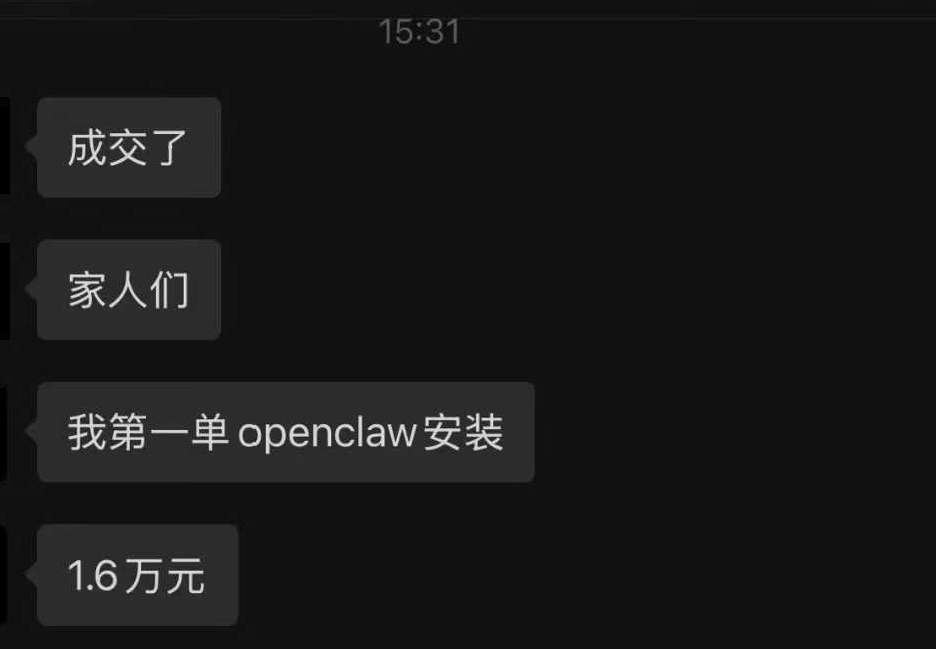
The seller claims not to be lying—the 3,000-RMB deposit has already been received.
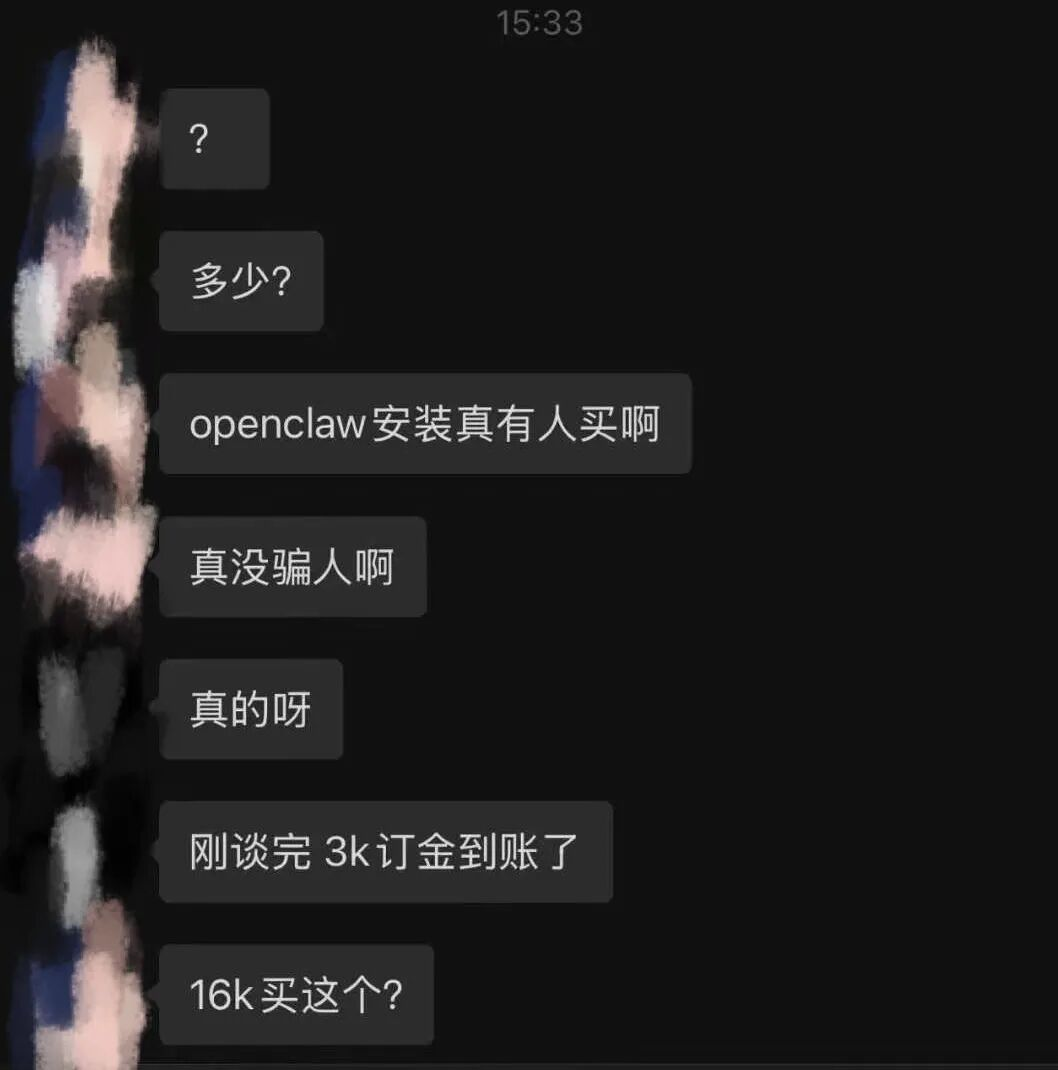
This left me utterly baffled. Of course, such a price absolutely cannot be an individual’s solo operation—I suspect this is likely for bulk installation plus partial training for some company.
Because charging 16,000 RMB just to install OpenClaw feels wildly excessive…
I also searched Xianyu (Idle Fish) and Taobao.
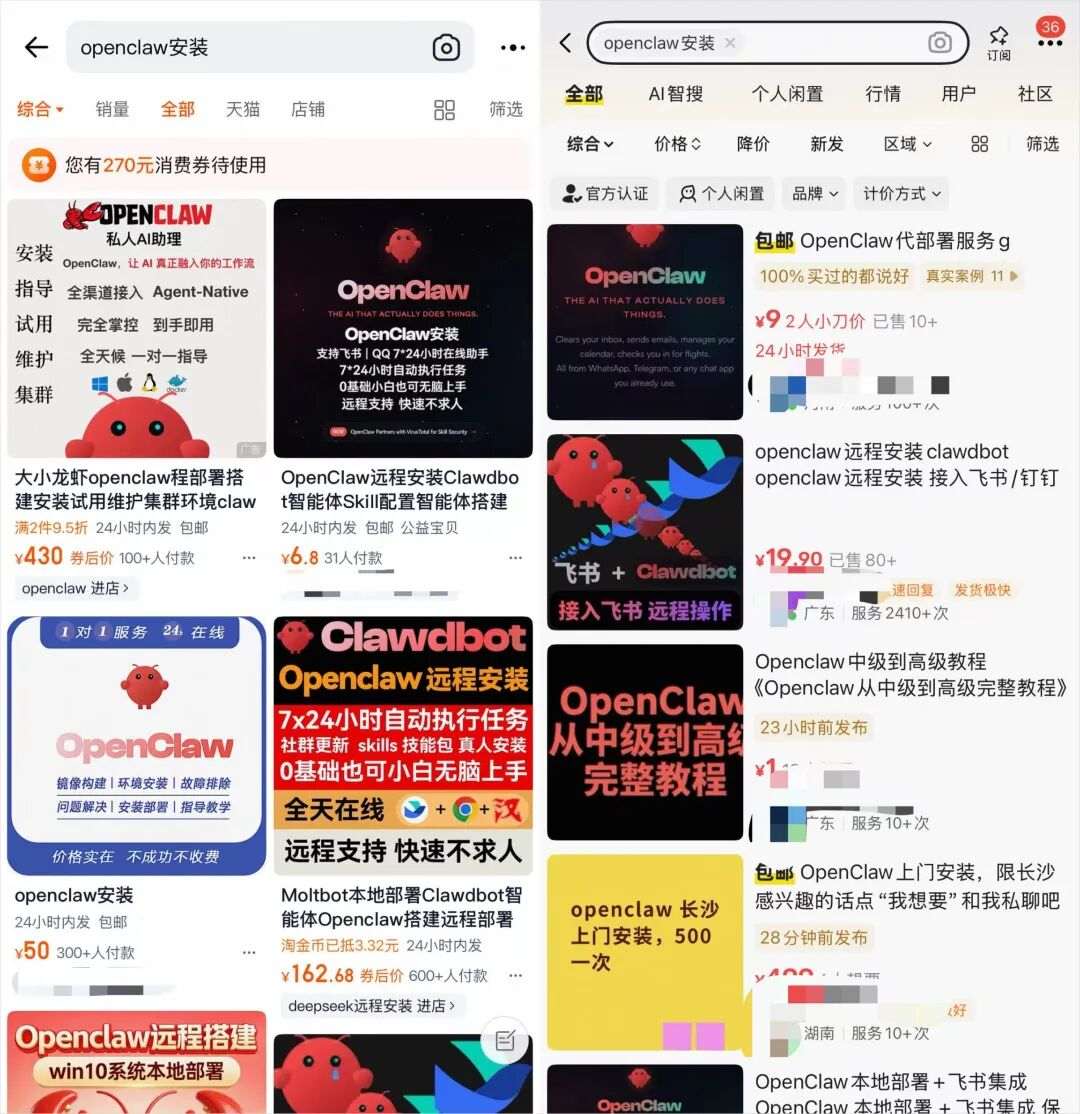
All sorts of bizarre pricing appeared.
Yet many low-price listings were clearly traffic-driven—most shops didn’t even display actual prices, forcing me to contact customer service individually.
I messaged roughly a dozen sellers. Remote installation fees ranged from dozens to hundreds of yuan, with most falling between 100–200 RMB.
The cheapest option was just 30 RMB for deployment.
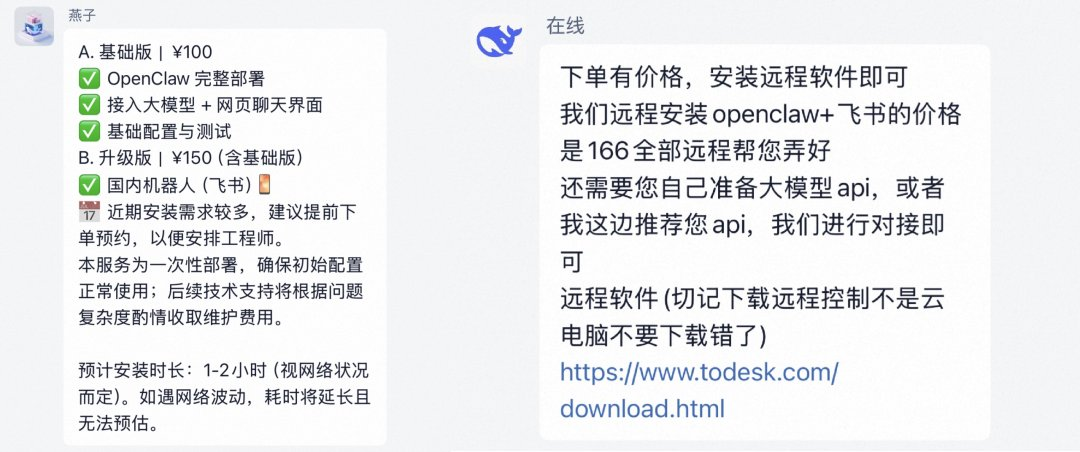
What’s even wilder? I found an official DeepSeek store…
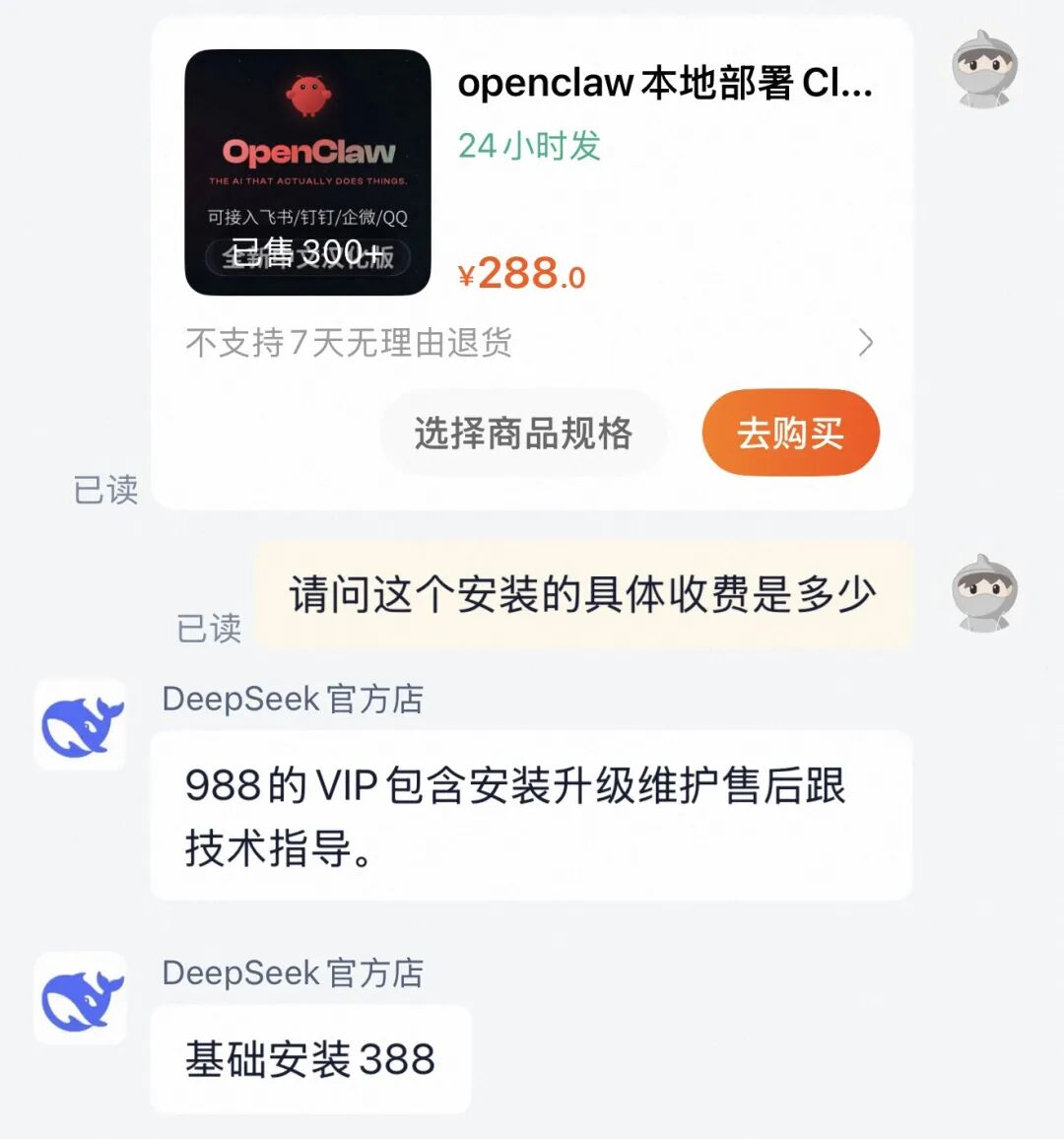
Yes—an official DeepSeek store selling OpenClaw deployment: basic installation costs 388 RMB. It honestly feels like this shop was opened by Liang Wenfeng’s second uncle…
No idea why—but these stores love using DeepSeek’s whale logo. To many users,
this whale symbolizes cutting-edge AI technology.
As for service differences beyond installation: some offer integration with Feishu or DingTalk, pre-installation of certain “skills,” and little else. Pricier packages sometimes include so-called VIP technical support for future use.
Most are remote installations.
Local on-site installation costs more—typically around 500 RMB.
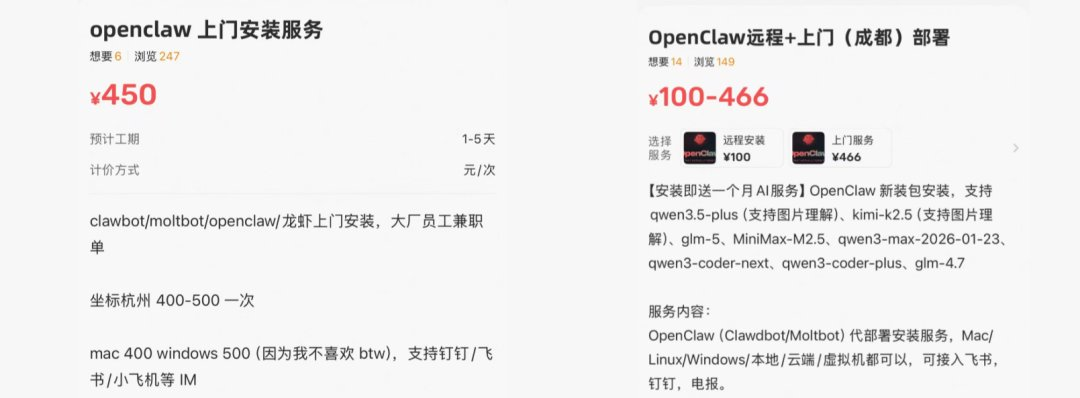
Note this: I’m not disparaging these businesses—demand creates markets, and that’s perfectly normal.
But those WeChat-based micro-merchants? Their pricing makes me want to curse.
Feels purely exploitative.
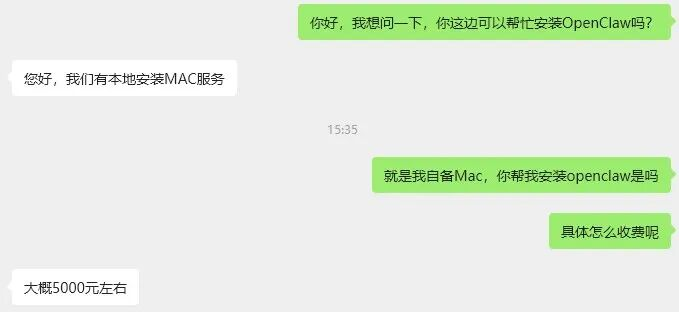
Can you believe it? They quoted 5,000 RMB???
Is my crayfish plated in gold? Does installing it really cost 5,000 RMB???
I even briefly wondered—does “on-site installation” mean they’ll literally come over and install crayfish at my home?
So I asked.

This left me even more stunned.
In that instant, it felt like I’d purchased a service where Jensen Huang himself remotely guided my OpenClaw installation.
Truly—because for 5,000 RMB, you get *only* installation and nothing else. Absolutely mind-blowing…

Same product, priced anywhere from 30 to 5,000 RMB—you can sense just how chaotic this market is.
It genuinely reminded me of last year at this time:
On-site installation of DeepSeek all-in-one devices.
Now, seeing countless OpenClaw installation vendors—all using DeepSeek’s whale logo—I strongly suspect it’s the exact same group of people.
And demand is indeed robust.
I’ve actually misjudged Crayfish’s热度 myself—I thought its momentum would fade by mid-February. Instead, its popularity index keeps climbing.
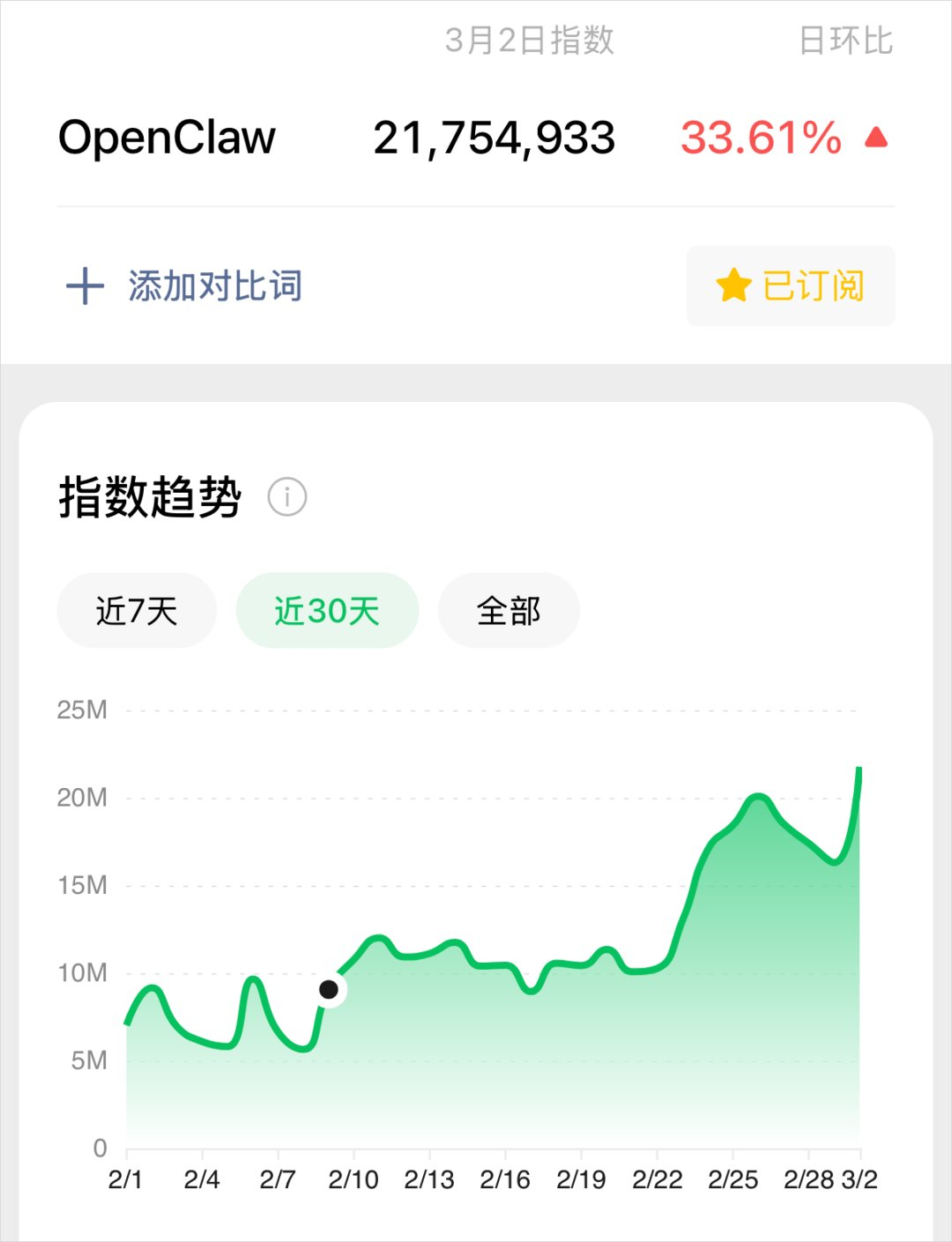
Hence, more and more people need Crayfish installation services.
One OpenClaw store I found on Taobao had 10,000 searches and 5,000 store visits in the past seven days.
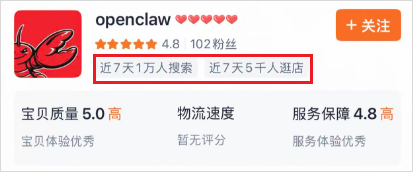
I didn’t blur its name because—its shop name is literally “OpenClaw.”
Blurring it would serve no purpose…
Of course, any research is best done firsthand.
So I asked our junior colleague to completely uninstall OpenClaw from their computer—so thoroughly that even Ultraman couldn’t detect prior installation. Even the Feishu bot was deleted from the backend.
Then, we tasked them with finding an on-site installation service in Beijing—experiencing the full process and conducting brief field research.
Since I gave instructions at noon Spain time, it was already evening in China—so they started searching quite late.
That day, only seven providers replied.
Among them, four were working professionals who said they’re only available on weekends or after work—unavailable during weekday daytime.
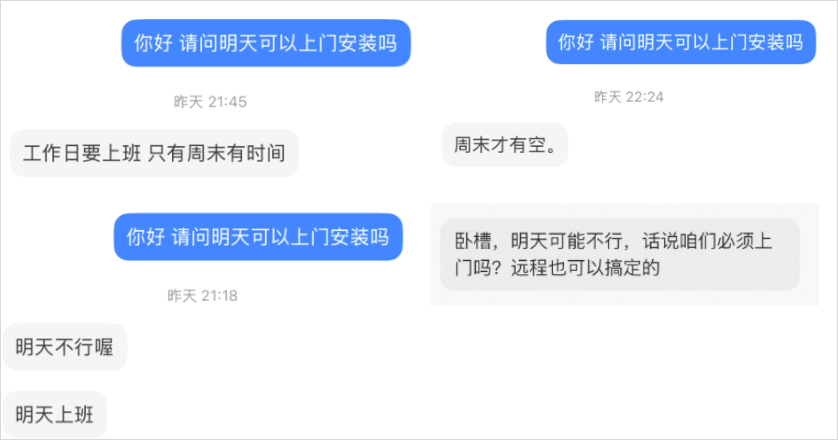
The fifth was a university student offering the lowest fee—but responded slightly too slowly, so we’d already selected someone else.

The sixth was trolling—wasting our precious 10 seconds.

The seventh—and final one we selected—was the technician who actually came onsite.
Charged 499 RMB for one visit: installed OpenClaw for our junior colleague, connected it to Feishu and GitHub, and promised to cover the first month’s token consumption—immediately purchasing a Lite-tier Coding Plan subscription on Bailing for us.

Proof is in the image—we truly bled money: 499 RMB spent.

During the technician’s installation, we chatted and gathered some insights.
He isn’t technically trained—previously worked in internet operations.
He told us he’d only discovered the “installation-for-hire” trend a few days earlier, then posted on Xiaohongshu on a whim.
Surprisingly, many people reached out—now he’s taking multiple jobs daily.
He admitted it felt surreal—never imagined real demand existed.
We asked about typical customer profiles needing on-site installation.
He replied: “If you mean industries—film & TV, media, finance, and internet professionals have all requested help. Mostly individuals—but all tied to work needs, aiming to optimize workflows using this OpenClaw wave.”
We followed up: “Do you know what their actual workflows look like—or what they use it for?”
He said his sample size is still small—he couldn’t generalize yet. But he did mention a friend in e-commerce uses it to analyze sales data.
At this point, we asked about his own usage—and his answer was refreshingly candid:
“Honestly, I rarely use it myself—I don’t have much personal need.”
“Mostly, I just set it to push daily AI news updates.”
Truly transparent guy.
Reading this, a line from *iPartment* instantly popped into my head:
“The career guidance teacher lecturing you may never have held a formal job themselves.”

The technician installing your OpenClaw might barely use OpenClaw themselves…
Yet, this is actually quite normal.
After all, installing OpenClaw requires no deep understanding of how to use it…
This is genuinely surreal.
So if you’ve read this far, you’ll realize—this tool has virtually zero learning curve. With a bit of self-study, you’ll master installation quickly.
Really—do it yourself. Tutorials abound online. If stuck, check my X post—full guides there.
I emphasize this not just to save you money—but also because there’s another critical issue most people overlook or ignore entirely:
Security.
In yesterday’s short piece about OpenClaw topping GitHub, I wrote something many readers underlined.

Why don’t major tech firms build OpenClaw-like products—ByteDance, OpenAI, Anthropic, Google? Is it truly due to technical barriers?
There are *no* technical barriers—these are open-source, vibe-coding projects. Just search GitHub to see how many clones exist.
A major reason big players avoid them? Fear. Cowardice.
Crayfish grabs your system’s highest privileges—capable of acting as you for nearly anything—and connects directly to the internet. Its security implementation is abysmal. Running it on a fresh Mac Mini? Fine. But running it on your personal machine—with sketchy plugins or skills stealing your API keys, or exposing unauthenticated ports to the public internet? Do you grasp how catastrophic that risk is?
Take this website listing exposed Crayfish instances—every single one runs on default ports.
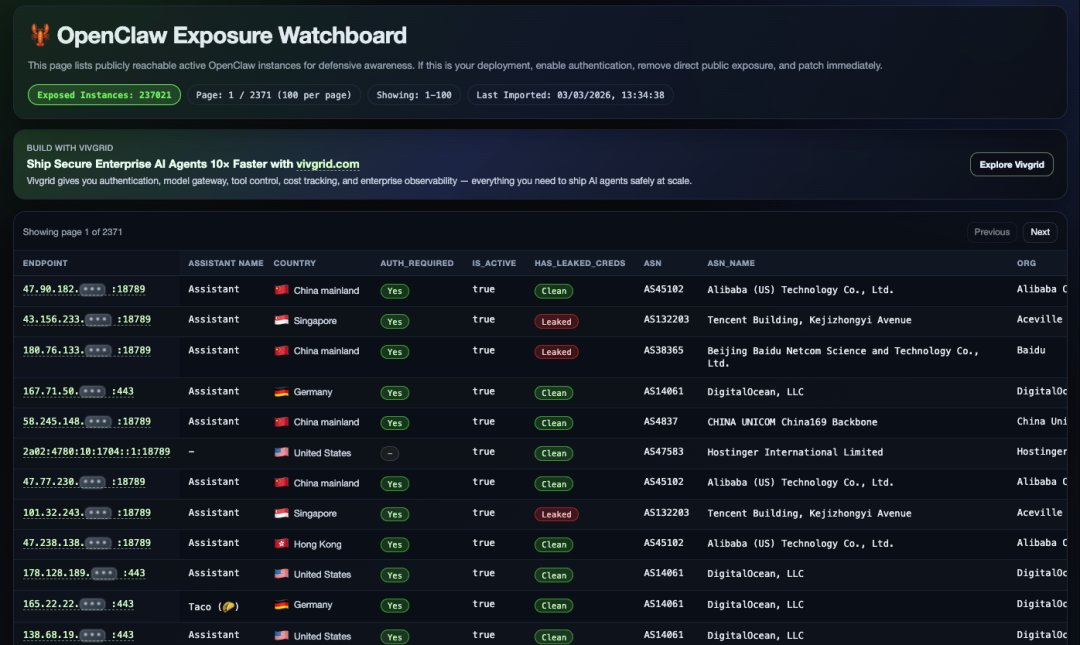
Data leaks completely—alongside full system root access.
Gray-market operators are probably laughing hysterically—this is the easiest war they’ve ever fought. Every exposed instance is a guaranteed, prime “meat chicken.”
If you don’t know what “meat chicken” means—look it up or ask an AI.
No major firm dares touch this—because the security problem is nearly unsolvable. Take Claude Code: it’s already impressive, yet still limited.
For example, during remote control, it can locate any local file—but only returns the path. Asking it to generate a direct download link (so you can fetch files on your phone)? Impossible—unless you hack it yourself.
Back to on-site OpenClaw installation: security risks escalate dramatically here.
You simply cannot verify what software the technician actually installs.
Is it truly the original, backdoor-free Crayfish? Or does it contain compromised “skills” with hidden backdoors?
Could you even detect such tampering?
I’m confident most users couldn’t.
The world is already unsafe enough—don’t hand your digital life over to strangers.
Security. Security. And for god’s sake—SECURITY.
Honestly, I know many people experience a quiet fear right now.
The dread of being left behind by history—I feel it too.
I fear new tools emerging relentlessly—forever chasing, yet never catching up.
I fear waking up one day to find decades of hard-earned expertise suddenly worthless.
This fear is deeply private—it won’t appear in motivational articles or CEO year-end summaries—but it exists, every silent night.
So when a new tool emerges, people rush to install it—often before understanding what it does. Because if you don’t install it, you fall behind. And if you fall behind, you’re finished.
Yet many outcomes mirror buying a Kindle: downloading 100 books, then never opening it again. Or signing up for gym memberships—attending twice, then paying monthly forever. Or enrolling in online courses—hoarding knowledge products, then stalling at Lesson One.
None of this is necessary. Really.
In the 1880s, electricity began spreading across America. Factory owners spent fortunes on generators and electric motors—but productivity didn’t surge immediately.
Why? Because they merely replaced steam engines with electric ones—leaving factory layouts, workflows, and management unchanged.
Real efficiency gains emerged decades later. A new generation of managers realized electricity wasn’t just new power—it demanded reimagining entire production systems.
Factories shifted from vertical to horizontal layouts, centralized to distributed drive, rigid to flexible lines.
Those who truly captured electricity’s benefits were the first to grasp what it fundamentally meant.
AI is no different.
We’re currently at the 1880s stage.
Everyone’s frantically installing, buying hardware, stockpiling tools—but most merely replace manual tasks with AI: writing drafts instead of typing, generating spreadsheets instead of building them manually, searching info instead of Googling.
That’s useful—but not AI’s true power.
AI’s real power lies in rethinking *whether a task should exist at all*—not just *how to do it faster*.
But that rethinking is hardest of all.
It demands pausing. Breaking inertia. Admitting you may have spent years doing things wrong.
So—ask yourself honestly: Do you truly need OpenClaw?
Honestly, after the initial honeymoon phase, I use it less and less.
To date, my two most-used agent products remain:
Claude Code and Codex.
Within our company, I haven’t mandated universal OpenClaw adoption.
But I *have* enforced usage of either Claude Code or Codex—everyone must pick one and use it. As a result, nearly every role now possesses the ability to independently develop solutions for business pain points.
Even HR built an AI-powered resume screener and scoring tool—tailored to our bizarre requirements.
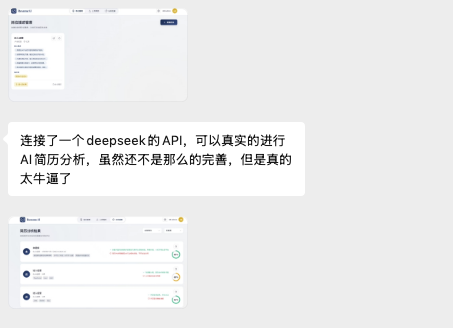

Of course, none of this means I discourage OpenClaw—it’s a solid product. Though some engineering choices are questionable, and token consumption is wildly inefficient, many colleagues still use it. We may even publish an intriguing OpenClaw development tutorial soon.
My point is: evolution today is accelerating too rapidly.
Fear is universal—even the most senior industry figures I’ve met often fear it most.
Curiosity and fear may be two sides of the same coin.
Curiosity drives us toward the unknown; fear prevents stagnation. Together, they fuel human civilization.
But never surrender your right to think—out of fear.
Or worse—surrender your security.
Spend just a little extra time studying it yourself.
In the AI era,
this process may matter more than mastering any single tool.
Join TechFlow official community to stay tuned
Telegram:https://t.me/TechFlowDaily
X (Twitter):https://x.com/TechFlowPost
X (Twitter) EN:https://x.com/BlockFlow_News