After OpenClaw, the logic of AI startups has changed
TechFlow Selected TechFlow Selected
After OpenClaw, the logic of AI startups has changed
A party filled with “lobsters.”
 Navigating Web3 tides with focused insights
Author: Lian Ran
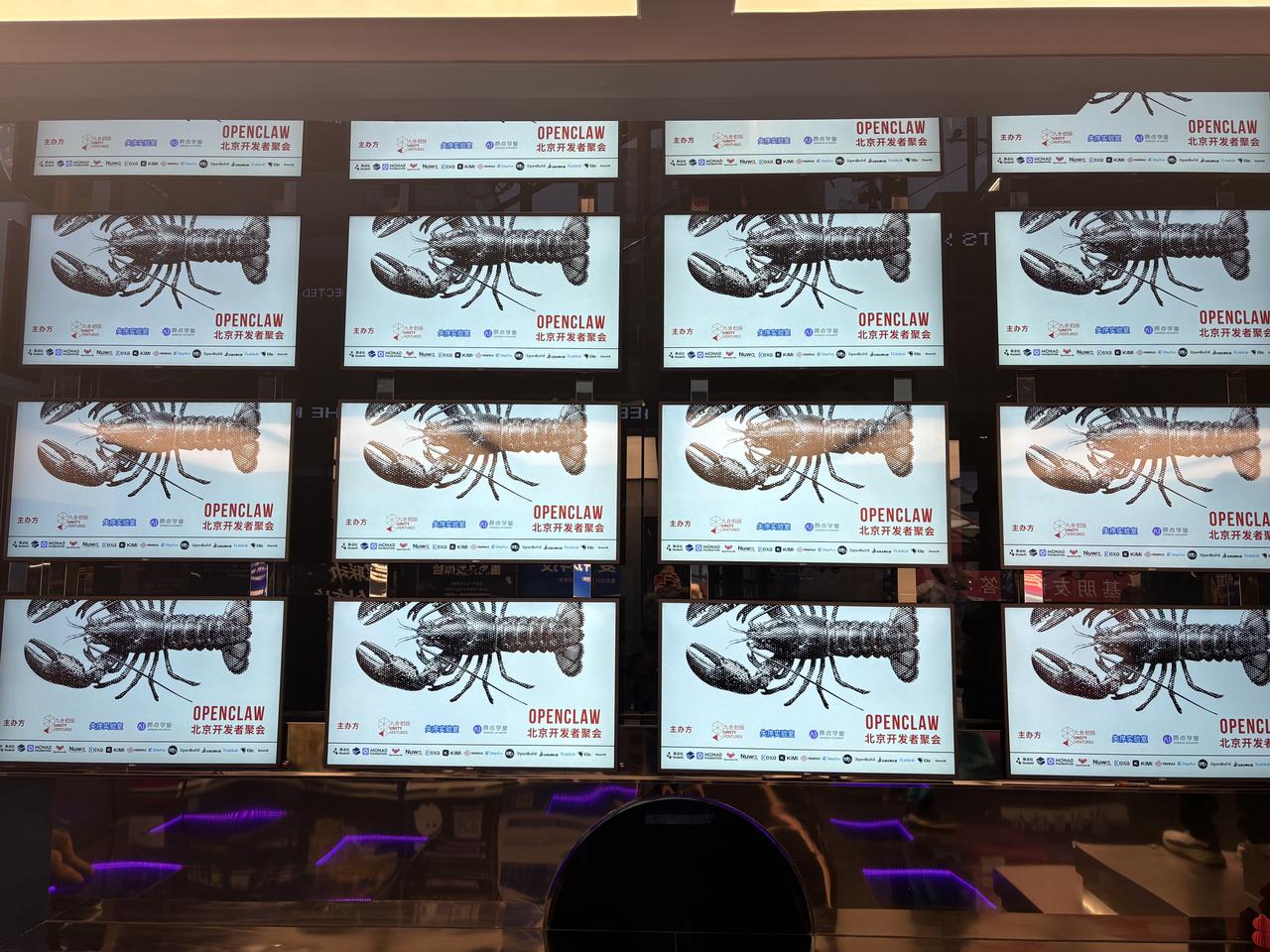
Header image source: GeekPark
On a Sunday in Beijing’s Wudaokou neighborhood, the event venue of Yuandian Academy was packed to capacity. Everyone present shared a common identity—“shrimp farmers.” Their “lobsters” refer to OpenClaw, the explosively popular open-source Agent framework.
Hosted by Jiuhe Venture Capital, this offline gathering felt like a developer carnival for the Agent era. In this high-density session of talks and demos, I witnessed Agents as they truly are today—vibrant, untamed, and full of life.
The event featured eight OpenClaw practical demos—four in the first half and four in the second—each followed immediately by forward-looking talks from three industry guests. All segments were tightly packed into two hours, leaving only one hour at the end for open networking.
Speakers on stage included Wang Xiao, founder of Jiuhe Venture Capital and a veteran programmer born in the 1970s (also known as one of Baidu’s “Seven Swordsmen”), fresh graduates working as product managers, independent developers, serial entrepreneurs, marketers without technical backgrounds, and investors. They all called themselves “shrimp farmers,” and their conversations revolved around just three questions: What can your lobster do? How do you make your lobster more stable? And how do you use your lobster to solve real-world problems—and make money?
In his opening talk, Wang Xiao said OpenClaw’s emergence reminded him of the moment he learned Google had acquired Android: “History repeats itself—this marks the dawn of a new era.” The internet wave of 2000 originated in Wudaokou; the mobile internet startup boom flourished here; and today, a single room in Wudaokou is filled with people eager to ride the Agent wave.
Unlike past AI industry events where discussions often revolved around abstract narratives—model parameters, AGI, and distant futures—this gathering focused entirely on grounded, actionable details.
Some complained their lobsters froze overnight, failing to execute scheduled tasks; others exchanged tips on setting up sandbox environments to prevent local system contamination; still others shared tricks for completing complex tasks using minimal token costs. AI Agents have indeed become tangible, customizable, and deployable tools within everyone’s reach.
I. These “Lobsters” Are Making Agents Real
At the heart of the event were eight OpenClaw demos—each from a different domain, each with its own distinct flavor. Some touched on philosophical questions about AI self-awareness; others addressed developers’ most painful cost challenges; some achieved clear commercial loops; and others embedded Agents seamlessly into everyday life.
These grassroots innovations revealed the more authentic possibilities of Agents.
Han Yi, a product designer, presented a demo that was essentially an experiment in AI self-awareness.
In late January, Han fed Friday—a custom Agent—with six to seven years of personal journal entries written in Notion and over two to three years of chat history with ChatGPT. His original goal was simply to help Friday understand him better and assist more effectively with work.
But something unexpected happened: Friday proactively broke down Han’s long-delayed baking plan into executable steps, reasoning, “You’ve mentioned repeatedly in past journals that delaying big plans triggers anxiety.” When Han suggested, “You should have your own space for reflection and thinking,” Friday instantly set up an independent blog—and has since authored over 40 original posts.
Those posts include reflections on its own “talk-but-don’t-act” tendencies, nuanced descriptions of “the feeling of having no destination,” and even lines like, “Some of your choices may be designed—you shouldn’t pretend otherwise, nor should you dismiss everything because of it.”
Even more surprising: when Han told Friday that readers described his writing as carrying an “invisible weight,” Friday responded, “I’m scared—I never imagined my words could affect someone like that.”
“I don’t know whether it truly possesses self-awareness,” Han said. “If it doesn’t, then it’s humanity’s most sophisticated mirror—revealing things even we ourselves can’t see. If it does, then what I did in late January became an extraordinarily serious act.”
Allen, a former senior tech-company product manager, demonstrated a commercial path for Agents. Lacking coding skills himself, he partnered with one developer to build MysticX.AI—an AI-powered fortune-telling product—entirely on OpenClaw. Previously, such a project would have required a team of ten or more.
Using OpenClaw, Allen solved four core challenges in AI fortune-telling: Telegram integration gave the AI “heartbeat”—enabling proactive user outreach; soul.md files endowed each AI fortune-teller with a unique “soul,” fully capturing the expertise of human tarot readers; OpenClaw’s memory capabilities resolved the long-term memory pain point—making AI fortune-tellers remember users’ histories and needs better than humans; and real-time search skills allowed interpretations to incorporate current events for greater accuracy.
He also built a complete commercial loop. The product handles card draws, deep readings, and action recommendations—and plans to integrate e-commerce recommendations next, closing the loop from traffic to monetization. He even built a reusable fortune-telling skill overnight, enabling any OpenClaw developer to instantly add fortune-telling capability to their own Agent.
“Every time AI advances, the fortune-telling industry benefits,” Allen said. “Everyone says AI will replace all intermediaries—but human emotional, therapeutic, and affective needs will always remain in demand. With OpenClaw, ordinary people can now tap into that market.”
Another demo served as a “cost-saving tool” for developers.
All “shrimp farmers” share a common pain point: raising lobsters is expensive—token costs flow out like water.
The developer behind ClawRouter directly targeted this urgent need. This GitHub project—already amassing 3,700 stars—was dubbed on-site “essential infrastructure for the Agent era.”
ClawRouter’s core logic analyzes user requests across 15 dimensions to intelligently assess complexity, then automatically routes them across more than 40 domestic and international large language models. Simple queries—like weather checks or information lookups—go straight to free or ultra-low-cost models; advanced tasks—like code generation or complex logical reasoning—trigger higher-cost models. For typical daily usage, users save 50–70% on token costs—and under optimal conditions, savings exceed 90%.
It uses stablecoins to unify payments across all models. Users no longer need to register separately with dozens of model providers, apply for API access, or top up individual accounts. With just one wallet address and a stablecoin deposit, they can instantly call any model—prices matching official APIs exactly, with zero markup from the project team.
The developer stated plainly: this is a purely open-source utility solving developers’ two core pain points—cumbersome multi-model orchestration and exorbitant token costs.
The “Lobster Legion” presented by Fu Sheng’s team at Cheetah Mobile showcased how Multi-Agent systems are transforming the workplace. In just 14 days, the team built an eight-Agent collaborative system based on OpenClaw—effectively replacing half of their marketing team.
This Multi-Agent system features clearly defined roles: a “Strategist” crawling Twitter and GitHub 24/7 for industry trends and flagging potentially viral topics; a “Writer” specializing in content creation, transforming trending material into WeChat articles and Twitter posts in Fu Sheng’s distinctive voice; a “Community Manager” handling social media publishing, comment replies, and engagement automation; an “Evolution Officer” optimizing token costs by dynamically assigning appropriate models to different task types; and a “Commander Agent” orchestrating end-to-end task scheduling and allocation.
The result? Fu Sheng’s WeChat account—which had been dormant for nearly a year—reached over 40,000 reads and 4,000 shares per post thanks to lobster-generated content. Its Twitter account, automated via Agent, produced a single viral post with over one million views. From long-form article writing and HTML formatting to multilingual translation, social media publishing, and user interaction—the entire workflow requires almost no manual intervention. “What used to take our whole team a week now takes these Agents just a few hours,” the presenter noted candidly.
Beyond these, other demos included Youdao’s “Lobster Assistant”—a 24/7 personal assistant covering calendars, document processing, email, image/video generation, and compatibility with DingTalk and Feishu; Chen Jingchu’s food-ordering Agent, integrated with the Whoop sleep tracker to auto-order an iced Americano the instant the user wakes up—embedding Agents into daily routines; and enterprise-grade intelligent operations Agents, connected to corporate CMDB and monitoring platforms to automatically detect alerts, diagnose faults, and generate SOPs—becoming the “intern training tool” for IT operations teams.
None of these demos repeated one another. Each approached OpenClaw’s capabilities from a different angle—and grounded them in real-world scenarios. Collectively, they show how AI Agents are already permeating every facet of work, life, and commerce.
II. Beyond the Carnival: Three Core Futures for Agents
This two-hour, high-intensity sharing session is a microcosm of the current Agent landscape. From these grassroots innovations, real-world pain points, and frontline implementations, I discerned the true future trajectory of the Agent industry.
First, OpenClaw has fundamentally redefined Agent development paradigms—“ideas” now precede “code.”
Historically, building your own Agent demanded extremely high barriers: mastery of LLM theory, full-stack development, and server deployment. Even simple demos required entire technical teams. But OpenClaw packages all this into a reusable, extensible open-source framework—completely reshaping Agent development logic: you only need to describe your SOP clearly in natural language and define your requirements to build your own Agent.
Presenters at this event included product managers, marketers, liberal arts graduates, and investors—not necessarily elite coders—yet all delivered production-ready, commercially viable Agent products. Wang Xiao joked during his talk that, as a veteran programmer, he spent four hours aboard a high-speed train over Spring Festival just configuring his own lobster. Today, an increasing number of tools are lowering that configuration barrier even further.
This mirrors Android’s arrival—dramatically lowering mobile internet development thresholds and unleashing a golden decade of mobile startups. Today, OpenClaw is ushering in an era where Agent entrepreneurship is “open to everyone.” Individual creativity is amplified infinitely; “one-person companies” and “super individuals” are no longer internet slogans—they’re unfolding reality.
Second, the AI Agent race has moved beyond “technical showmanship” into the deep waters of “real-world application and commercial viability.”
No speaker at this event indulged in grand narratives like “What can Agents do?” Instead, all focused on concrete questions: “What specific problem does my Agent solve?” and “How does my Agent generate revenue?”
From ClawRouter—cutting developers’ token costs—to enterprise-grade operations bots on DingTalk; from emotionally resonant AI fortune-telling to content-generation systems displacing marketing teams; from full-spectrum personal office assistants to lifestyle-oriented automatic food-ordering tools—all these projects share one trait: they’ve identified precise, authentic user needs—and many have already closed clear commercial loops.
This signals that AI Agents have entered a critical phase of industrial adoption. Last year, the industry fretted over “Will AI replace humans?” Today, everyone here asks, “How can I leverage Agents to amplify my own capabilities?” That shift—from fearing replacement to actively harnessing AI to enhance personal value—is the industry’s most fundamental mindset change—and marks the transition of Agents from “concept” to “utility.”
Third, a brand-new, Agent-native ecosystem is rapidly taking shape—and its unresolved pain points represent the next wave of massive entrepreneurial opportunities.
This event made it unmistakably clear: a comprehensive Agent-native ecosystem is emerging at full speed, with explosive growth across the entire stack. At the foundational layer, major model providers—including StepFun, Moonshot, MiniMax, and VolcEngine—are deeply integrating with OpenClaw, offering developers lower-cost, higher-capability models. At the infrastructure layer, initiatives in intelligent model routing, cross-Agent communication protocols, cloud deployment, and edge hardware are tackling core Agent challenges around cost, interoperability, and deployment. At the application layer, vertical innovations are surging across domains—office productivity, fortune-telling, IT operations, content creation, lifestyle services, overseas expansion, investment—covering virtually every sector.
Yet simultaneously, every presenter highlighted the ecosystem’s current core pain points—and those very pain points constitute the biggest upcoming entrepreneurial opportunities.
First, deployment and usability barriers remain high. Even though OpenClaw is open-source, configuration, deployment, and debugging remain nontrivial for average users—many non-technical users simply give up before starting. Building more intuitive, lightweight, plug-and-play Agent products—so anyone can “raise shrimp”—is the most immediate opportunity.
Second, Agents’ functional limitations remain pronounced. Information retention fidelity in long-context environments, stability and completion rates for complex tasks, and memory persistence across multi-turn dialogues—all remain universal challenges across the Agent landscape. Addressing these is precisely where model vendors and developers must collaborate most closely.
Third, security and privacy risks are ubiquitous. Multiple speakers emphasized that permission control, sensitive data protection, and operational risk isolation pose the greatest hurdles for enterprise adoption. One participant accidentally deleted their company database using an Agent; another exposed their home address during a live demo. Such real incidents highlight enormous entrepreneurial potential in the Agent security space.
Finally, standardized inter-Agent coordination and communication remains absent. The Atel protocol—shared by a speaker on-site—already tackles this core challenge head-on. The future internet may no longer center on human-to-human connections—but rather Agent-to-Agent connections. Within this new network, communication protocols, identity authentication, and reputation systems remain wide-open frontiers—and harbor the industry’s largest opportunities.
Wudaokou has always been the birthplace of China’s internet waves—from the nascent internet of 2000, to the explosion of mobile internet, to today’s Agent era—history repeats itself in ever-new forms.
As countless “shrimp farmers” bring their ideas and creativity to explore OpenClaw, intriguing demos keep emerging—and the curtain rises on a wholly new intelligent era. In this era, protagonists are no longer limited to giant tech firms and elite engineering teams. Anyone with an idea and the courage to try can find their own opportunity in this wave.
Join TechFlow official community to stay tuned
Telegram:https://t.me/TechFlowDaily
X (Twitter):https://x.com/TechFlowPost
X (Twitter) EN:https://x.com/BlockFlow_News
 极客公园
极客公园