









Data Analysis: Decline in U.S. Job Openings May Signal Bitcoin Price Increase
TechFlow Selected TechFlow Selected
Data Analysis: Decline in U.S. Job Openings May Signal Bitcoin Price Increase
If past patterns continue, Bitcoin could rise by mid-July and has the potential to reach $140,000 by October 2025.
 Navigating Web3 tides with focused insights
Author: Marcel Pechman
Translation: TechFlow
Today's JOLTS (Job Openings and Labor Turnover Survey) report shows a sharp decline in U.S. job openings, but this may not be bad news for Bitcoin.
Key Takeaways:
-
Weaker labor and consumer data often precede Bitcoin rallies, leading some analysts to anticipate potential economic stimulus measures ahead.
-
Job openings in March dropped to 7.2 million, below the expected 7.5 million, while consumer confidence fell to its lowest level since January 2021.
-
If historical patterns hold, Bitcoin could begin rising by mid-July and potentially reach $140,000 by October 2025.
Macroeconomic conditions are widely seen as a major influence on cryptocurrency prices. Typically, when investors grow concerned about weak employment and consumer data, Bitcoin and other cryptocurrencies tend to underperform.
According to the JOLTS report released by the U.S. Bureau of Labor Statistics on April 29, job openings in March hit their lowest level in nearly four years. Employers posted 7.2 million job openings in March, below economists’ expectations of 7.5 million. Meanwhile, U.S. consumer confidence declined for the fifth consecutive month in April, reaching its weakest point since January 2021.
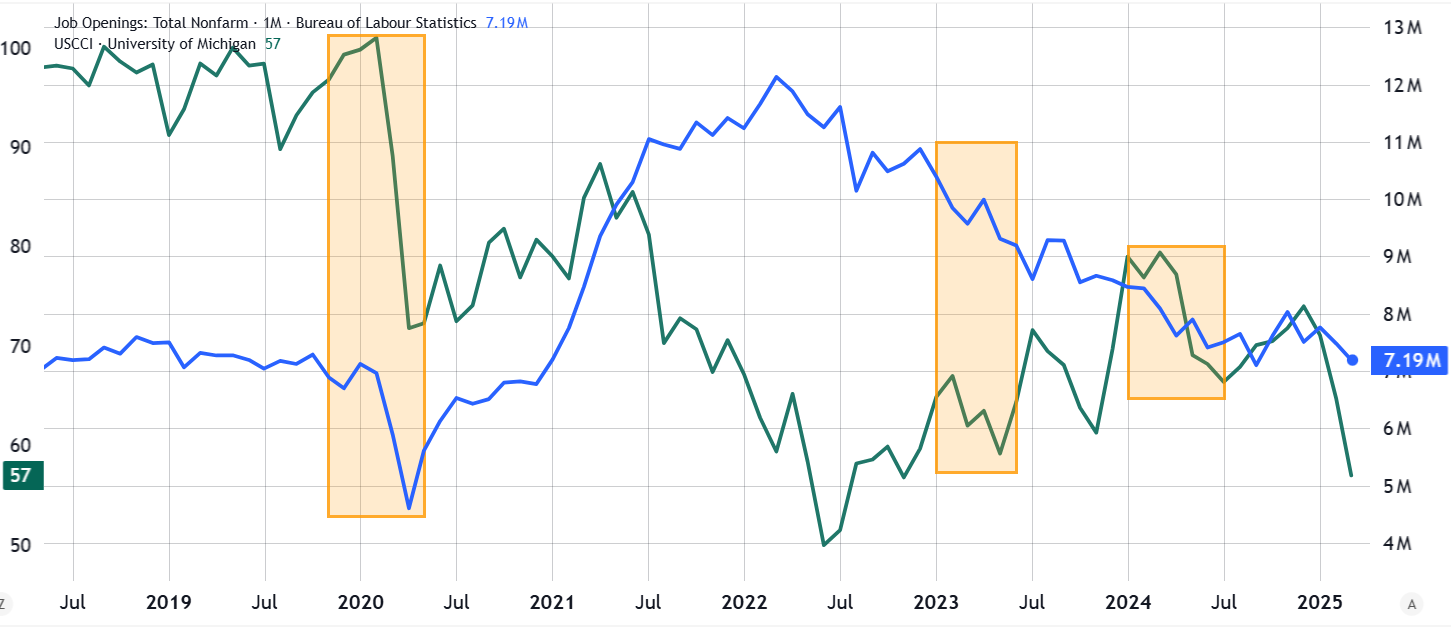
U.S. Consumer Confidence (left) vs. Total Nonfarm Job Openings in the U.S. (right)
Source: TradingView/Cointelegraph
Deteriorating conditions have increased the likelihood of central banks introducing economic stimulus measures, making the overall impact on crypto markets uncertain. Typically, additional liquidity encourages investment into risk assets like Bitcoin, as more capital flows into the economy.
Future Expectations Matter More Than Current Weak Economic Data
The last time the U.S. experienced declining job openings and weakening consumer confidence was between January and June 2024. Over the following three months, Bitcoin fluctuated between $53,000 and $66,000. Then, starting in mid-October, it surged 60%, pushing Bitcoin’s price above $100,000. The final outcome was positive—but this effect took over 105 days to materialize in the cryptocurrency market.
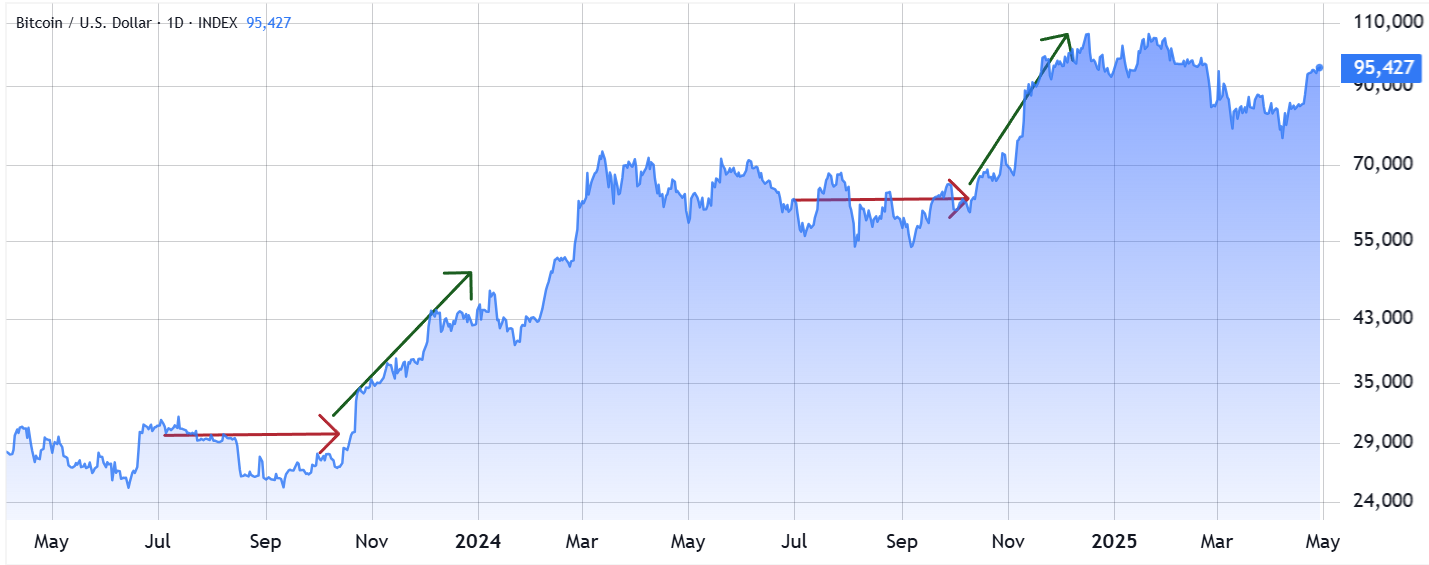
Bitcoin/USD, logarithmic scale
Source: TradingView / Cointelegraph
While these conditions may initially seem concerning, weak labor and consumer sentiment are typically lagging indicators. Financial markets and companies make decisions based on expectations for future economic growth, not just past data. Moreover, improved sentiment among crypto investors often follows confirmation that macroeconomic conditions have stabilized. This explains why a delay of 105 days is not unusual.
Prior to 2024, a similar situation occurred between January and June 2023, when both labor market metrics and consumer confidence declined. The next four months were difficult—Bitcoin dropped 18% to $25,000. Prices recovered to $30,500 after 115 days, by the end of October. However, the following two months were highly positive, with Bitcoin surging 45% to $43,900.
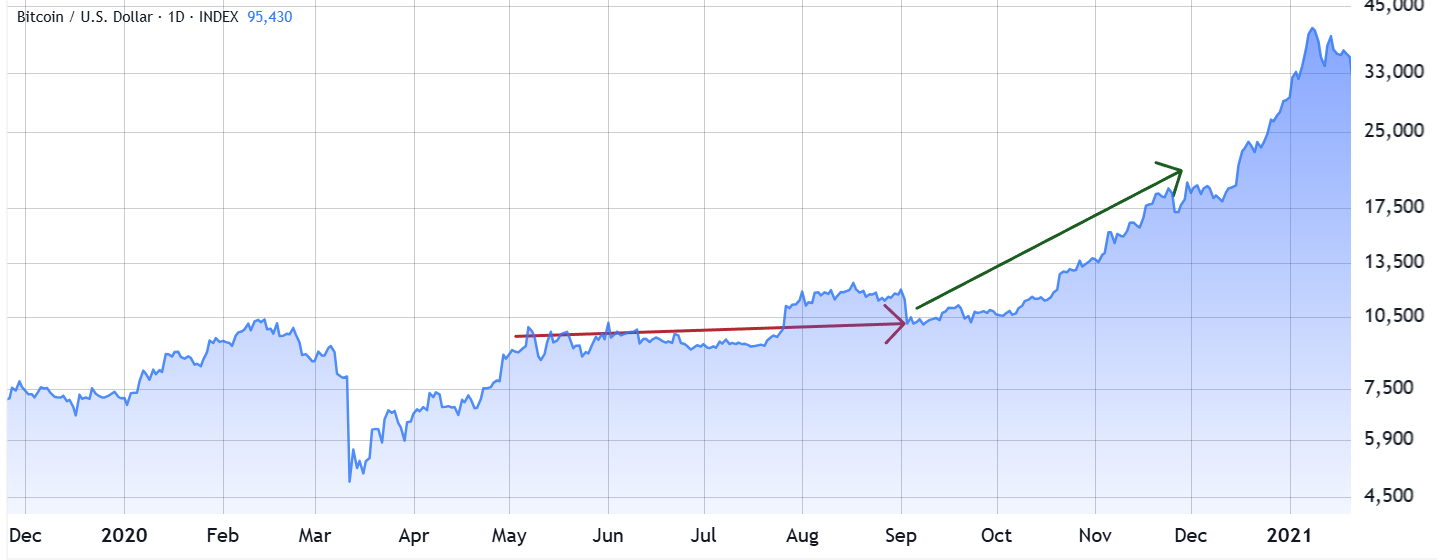
Bitcoin/USD in 2020, using logarithmic scale
Source: TradingView / Cointelegraph
The last time both the labor market and consumer confidence were significantly weakened within the past eight years was between February and May 2020, shortly after the onset of pandemic-related lockdowns. During this period, Bitcoin briefly dipped below $4,000 on March 13, 2020. As a result, market expectations pointed toward an extended consolidation phase before investor confidence in crypto markets could be restored.
Can Bitcoin Reach $140,000 Before October?
Looking back at macroeconomic data, from May to September 2020, Bitcoin was largely unaffected, rising from $8,900 to $10,600—a 20% gain. Yet within the next 60 days, it delivered an impressive 85% surge, reaching $19,700. This marked the third instance where weak labor and consumer sentiment appeared to precede a Bitcoin rally.
Although the time lag between the trough in economic conditions and Bitcoin’s subsequent rise ranged from 105 to 130 days, the outcome was clear in all three cases. Therefore, if U.S. job openings and consumer confidence begin improving from April 2025 onward, Bitcoin could start gaining momentum by mid-July. If history repeats itself, this could imply a minimum target of $140,000 by October 2025—though further positive macroeconomic data will be needed to confirm this outlook.
Join TechFlow official community to stay tuned
Telegram:https://t.me/TechFlowDaily
X (Twitter):https://x.com/TechFlowPost
X (Twitter) EN:https://x.com/BlockFlow_News
 @Cointelegraph






