








Narrative Recedes: Where Are the Former Web3 Star Projects Now?
TechFlow Selected TechFlow Selected
Narrative Recedes: Where Are the Former Web3 Star Projects Now?
The essence of failure is not the loss of funding or users, but the loss of narrative momentum.
 Navigating Web3 tides with focused insights
Written by: Stacy Muur
Translated by: Golem, Odaily Planet Daily
First comes the Web3 stage, then the protagonists emerge.
When a protocol goes viral, we see endless discussions about it on social media. Every other project either starts "courting" it or imitating it. You know the feeling—absolutely palpable on Pump.fun. If you've been around long enough, you’ve felt it with FriendTech, Farcaster, Bananagun, and Unibot too, each riding their own cycle.
The harsh reality is that the Web3 stage never disappears, and hype will always continue—but the lead roles keep changing. Not because products fail, but because people discover shinier things. In this space, novelty has a short shelf life; the spotlight never lingers too long.
This isn’t an obituary. While not all once-popular protocols have died, they’ve all gone through cycles of boom and silence. This article explores those projects that once shone brightly—and what happens when they’re no longer front-page news.
Who Are the “Has-Beens”?
If you’ve spent enough time in Web3, you’ll recognize the cycle: a protocol surges, dominates every timeline, then quietly vanishes. The table below captures a snapshot—not measuring total value locked (TVL) or token price, but something more elusive: attention, memory, and emotional relevance. These were once the stars, some of which still survive today.
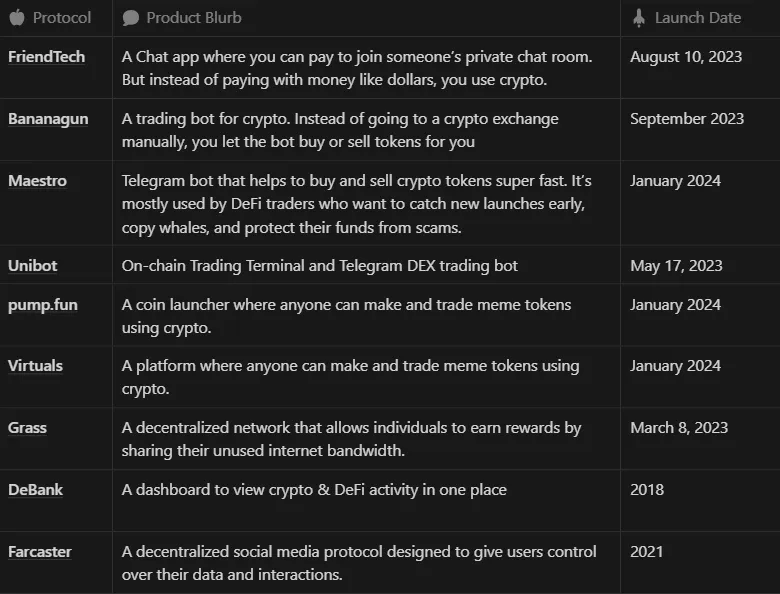
Web3 Has-Beens
Take FriendTech as an example—its rise was fast and flashy, but its fall was complete. No roadmap, no user retention, no signs of recovery. After its collapse, it became clear it was all show and no substance.
Unibot fared slightly better. It survived hacks, copycats, and market downturns, and is still widely regarded as one of the best-in-class trading experiences in its category.
Virtuals is one of the few that not only survived but transformed. Originally a prediction platform built on Base, it now positions itself as “Wall Street for AI agents.” Such reinvention isn’t easy in crypto, especially for projects born out of the “degen casino” scene.
Pump.fun and Maestro haven’t died—they’ve just seen their market share diluted. They’re still operating, still active, with bursts of user activity. But no one calls them revolutionary anymore. Meme coin factories and sniper bot networks were never built to last; they were built for spectacle. And they delivered—more than once.
Then there are slower-burning projects like Grass, DeBank, and Farcaster, each with their own niche: speculative yield, DeFi social identity, and decentralized social networking. None were flashy, none have died—they simply kept evolving after the hype faded.
Still Building, Still Iterating
If the first table measures attention, the next one focuses on something entirely different: perseverance. A project’s hype phase is loud, but the real work of building is quiet and grueling.
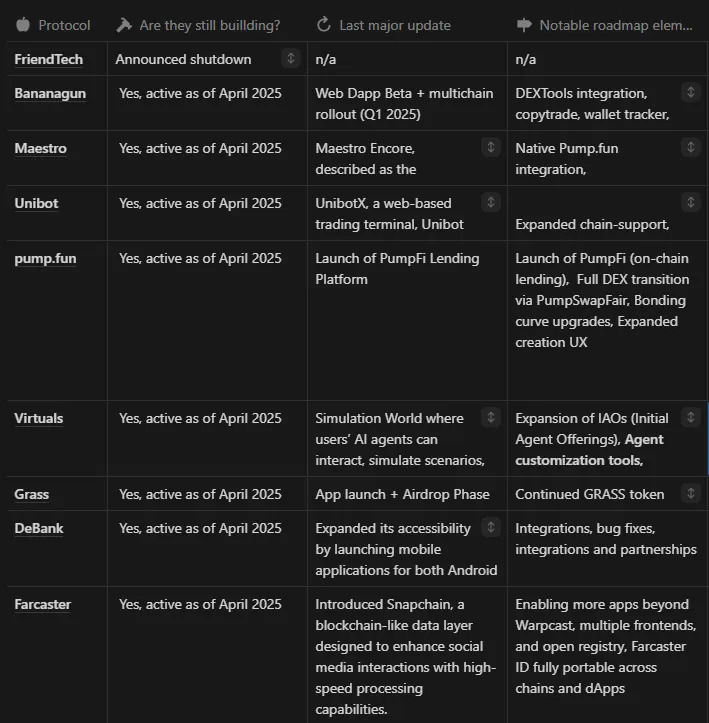
Some of these protocols may no longer be trending, but they haven’t stopped developing. This table illustrates the quiet reality—long after the spotlight moves on, who’s still shipping updates, expanding integrations, or strengthening infrastructure?
Unfortunately, FriendTech was the first to give up, officially shutting down in September 2024. The rest continue growing silently—not in Twitter feeds, but in project changelogs.
Peak Activity ≠ Longevity
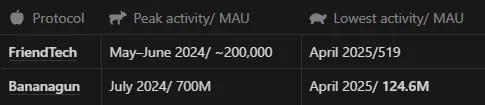
We can always feel when a project hits peak activity. Telegram lags scrolling, communities overflow with copy-traders and half-baked newbie posts, and the protocol’s website crashes under the weight of hype. But such moments are fleeting. Below are data comparisons between peak periods and current performance for several projects.
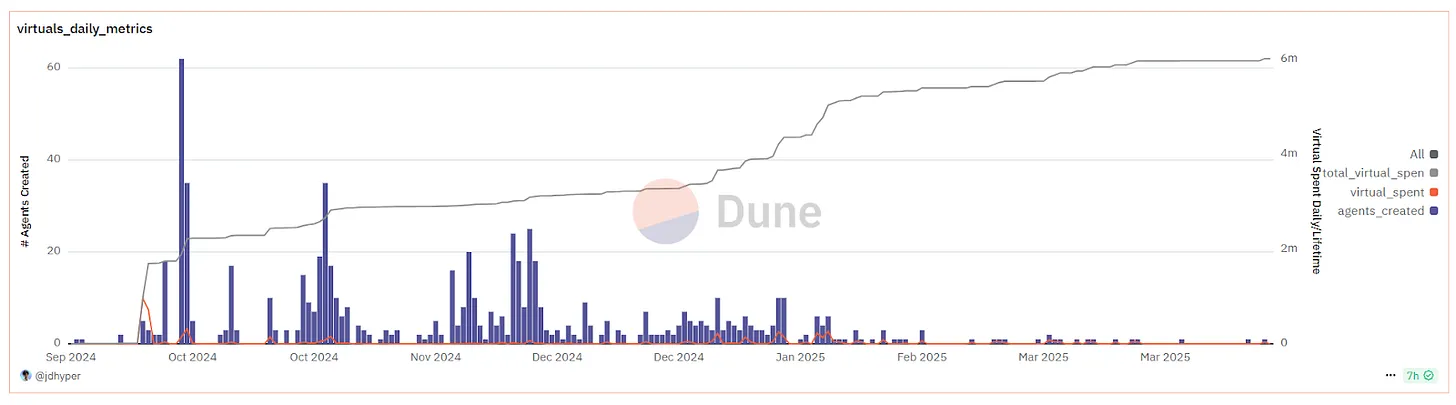
Virtuals
Virtuals hit its agent creation peak in October 2024, with over 60 new agents created in a single day. November and December saw a wave of experimentation. But by early 2025, daily agent creation had dropped to single digits.
Bananagun
In July 2024, Bananagun reached peak user activity with over 700 million users. Nine months later, that number fell to 124.6 million—a drop of 82%.
Bananagun is still operational and under development, but it’s no longer users’ top choice. Telegram bots have flooded the market; sniping has become commonplace. The landscape keeps shifting. Bananagun hasn’t died—it’s just gradually faded from view.
DeBank
DeBank experienced a surge in multi-chain registrations in mid-2023, followed by stagnation. By early 2024, new user inflow had stopped. The product itself wasn’t flawed—market dynamics simply changed. DeFi social sounded good, but people didn’t stay for it. Maybe they just used DeBank to track a few wallets, then left.

Farcaster
Farcaster exemplifies quiet compounding. Since late 2024, its daily active users (DAU) have steadily remained between 20,000 and 50,000, with consistent engagement—no dramatic spikes, no airdrop bait, just genuine usage. While most social protocols chase traffic, Farcaster is cultivating habits, which might be the real advantage.

Pump.fun
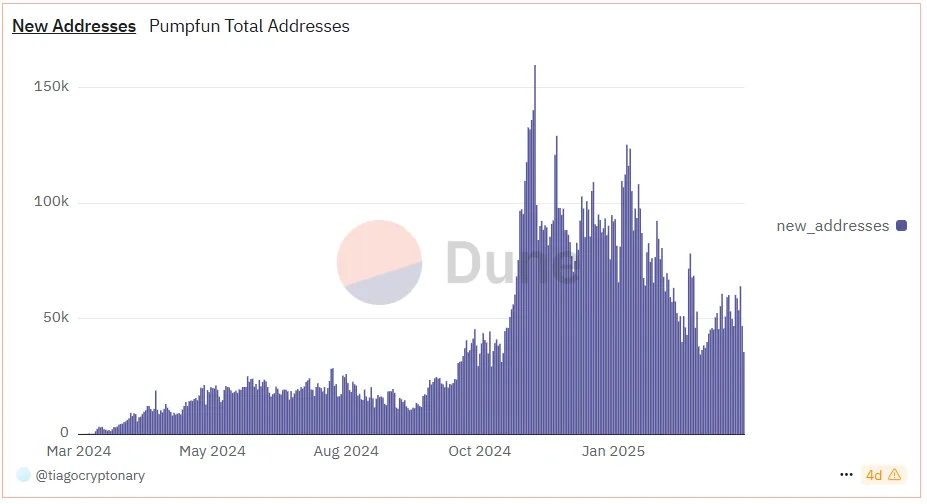
Pump.fun is like a volcano. At the end of 2024, it minted millions of meme coins, peaking with over 150,000 new wallets created in a single day. Since then, the trend sharply declined—but it didn’t die. Today, Pump.fun consistently sees 50,000 to 60,000 new memes created daily. It’s just no longer in the spotlight.
What Narratives Did We Once Believe In?
You can track a project’s usage on dashboards. But narratives live elsewhere. To understand them, we must revisit the moments they truly mattered. FriendTech turned social influence into liquidity; Pump.fun rewrote token issuance rules; Farcaster wasn’t just another app—it was a Web3 independence declaration.
People didn’t just use these protocols—they identified with them. FriendTech made us feel influential; Pump.fun made us feel clever; Farcaster made us feel part of a purer alternative to Twitter.
FriendTech
FriendTech’s narrative was powerfully seductive: tokenize your social graph, monetize your influence. At its peak, it wasn’t just a SocialFi tool—it symbolized status as an asset. But the story eventually collapsed under its own weight. No roadmap, no engagement loop, no cultural legacy. It’s a rare case where usage, narrative, and product vanished in sync—a clean rise, a clean fall.
Bananagun
Bananagun told the story of fair play: fast sniping, smart tokenomics, and bots designed for everyday traders. It thrived amid the Telegram bot wave, earning praise for being sharper and faster. It still operates and serves traders today—but it’s now infrastructure: useful, yet no longer trendsetting.
Unibot
Unibot focused on speed and precision. It positioned itself as the go-to tool for elite Telegram traders—not just a product, but an identity. Despite competition and even hacking attempts, Unibot’s reputation endures. Its features keep expanding, its user base remains loyal. It doesn’t rely on virality, but on reliability. That narrative still holds.
Pump.fun
Pump.fun decentralized token creation and spawned countless rags-to-riches tales. At its height, it felt like a new token launched every 10 seconds—until the market saturated. Today, it remains active, but the magic is gone. The “anyone can launch a token” narrative lost its shine in the PVP arena.
Virtuals
Virtuals began as a Base-based speculation hub—one that understood attention, then learned to dominate it. It pivoted to an AI agent platform, redefining itself within a broader narrative. Now, it’s no longer chasing memes—it’s building infrastructure. “Wall Street for AI agents” is a bolder, more enduring story, making Virtuals one of the few protocols able to rewrite its own narrative.
DeBank
DeBank pitched to the market that your DeFi portfolio could be your identity—making wallet tracking social. That narrative once worked, but it stalled. The product remains fully functional and highly respected among advanced users, but it never evolved from a tool into a network. In a way, DeBank became a victim of its own stability—too reliable to ignore, yet not compelling enough to actively promote.
Farcaster
Farcaster’s original vision was simple: own your social. It didn’t aim to replicate Twitter, but to reimagine how publishing, interacting, and building work on-chain. Current conditions prove one thing: Farcaster hasn’t declined. It’s been quietly accumulating trust and appeal. As a long-tail narrative, avoiding virality may actually make it more resilient.
Which Formerly Hot Projects Are Nearing Death?
Beyond the well-known examples, several other protocols gained significant attention briefly before seeing sharp declines in user activity, transaction volume, or related metrics. These weren’t fringe projects—in their prime, they led market narratives and captured intense interest. This section highlights some key cases.
Blast
During the points-driven frenzy of July 2024, Blast reached a peak of 900,000 monthly active users. Today, that number sits at around 120,000. After points fatigue set in, the yield narrative quickly faded.
Scroll
At the height of zkEVM hype, Scroll reached 1.2 million monthly active users. Now, it’s around 111,000. Scroll is still running, but as infrastructure shifts toward performance-first narratives, market excitement has waned.
Starknet
Starknet once saw bridge deposits reach $1.6 billion. Today, that figure stands at approximately $390 million. Developer loyalty remains among some, but mainstream adoption has slowed due to cost and tooling friction.
Renzo Protocol
Renzo peaked at 155,000 monthly active users, now slightly below 19,000. Though still influential in the liquid restaking space, its spotlight has been eclipsed by stronger players in the EigenLayer ecosystem.
Sushiswap
Sushiswap’s peak trading volume reached $11.3 billion. Today, it’s around $200 million. It’s a cautionary tale showing how fragmentation, governance sprawl, and competition from centralized exchanges (CEXs) can erode first-mover advantages.
All these protocols were once seen as industry leaders. While some remain active, their data shows a shift in how users interact with them. Is this decline due to changing market conditions, evolving narratives, or simply stronger competitive forces? The lesson remains consistent: early growth momentum does not correlate with long-term survival.
Conclusion
In Web3, most narratives don’t die—they just stop being talked about. The projects featured here weren’t chosen because they failed, but because they once mattered intensely, if briefly. Their failure wasn’t due to losing funds or users, but to losing narrative momentum—the intangible force that turns a product into a movement.
The deeper pattern lies in the emotional arc of belief. When that arc flattens, users leave—not out of disappointment, but because there’s no longer a reason to stay.
This is why long-lived projects are so rare in Web3. To endure, a protocol must be not only usable, but narratively alive. It must offer more than yield or tools—it must provide identity, possibility, and a reason to come back tomorrow.
The next narrative breakthrough in Web3 won’t come merely from solving problems, but from creating meaning. And the projects worth watching are those quietly building after the hype, waiting for their second moment.
Join TechFlow official community to stay tuned
Telegram:https://t.me/TechFlowDaily
X (Twitter):https://x.com/TechFlowPost
X (Twitter) EN:https://x.com/BlockFlow_News
 @stacy_muur






