Founder's Observations: The Price of Identity
TechFlow Selected TechFlow Selected
Founder's Observations: The Price of Identity
The most exceptional founders often exhibit remarkably low attachment to status.
 Navigating Web3 tides with focused insights
Author: YettaS

In our industry, there are always those go-to self-introductions: "I'm one of the earliest people in this space," "I come purely from a technical background," "I'm a true believer in this sector," "I graduated from an Ivy League school." These statements may seem like mere background information, but they quietly become anchors for some people's sense of value—and even part of their identity.
At the same time, do you feel shame when challenged with: "Didn’t you firmly support XX before? Why the change now?" Would you dare to revisit your own cringeworthy posts from years ago? Can you end a relationship that no longer serves you without invalidating your past judgment? Can you accept the version of yourself who was once “not smart enough, not mature enough”?
In today’s society, the most volatile discussions often revolve around three topics: gender, politics, and religion. As soon as these subjects arise, rational dialogue quickly devolves into hostility and division. This isn’t because these issues are inherently undiscussable, but because they are deeply tied to personal identity. Once a stance becomes part of “who I am,” discussion turns into self-defense. Arguments become defensive maneuvers; logic gives way to emotion; correction feels like a threat.
In contrast, debates about whether DeepSeek’s model architecture is superior or whether pretraining strategies are more advanced can also spark intense arguments—but usually stay at the level of “technical correctness.” That’s because people generally assume such questions can be verified, updated, or overturned. They’re debates grounded in facts and logic.
Opinions can be falsified—and therefore corrected. But the self cannot be falsified, so it becomes untouchable.
This psychological mechanism is especially critical in entrepreneurship. Whether a founder can rapidly pivot in response to market feedback or failure—without interpreting that pivot as a negation of self-worth—is often the deciding factor in whether they survive cycles and break through bottlenecks. We call this psychological trait Low Ego.
Strong Psychological Core
From long-term observation of entrepreneurs, we’ve found that truly exceptional founders don’t stand out due to any single talent or skill. Instead, what sets them apart is an inner psychological structure—integrated and stable—that shows up consistently when facing uncertainty, conflict, and volatility. This structure isn’t visible on a resume or LinkedIn profile; it runs beneath every decision and response as a deep internal order.
We’ve identified four key psychological traits that form a founder’s strong yet flexible core:
-
Low Ego — Low self-identification
-
High Agency — Strong sense of agency
-
Natural Curiosity — Innate curiosity
-
Strong Execution — High execution capability
Today, let’s focus on Low Ego.
One type of founder we deeply admire: someone with clear direction, yet unchained by identity labels; capable of holding convictions while remaining adaptable; possessing high self-respect without ego-driven arrogance. This might sound like an idealized persona, but it’s underpinned by a clear psychological framework—Low Ego. They have a firm yet relaxed grasp of “who they are.”
Defend Ideas, Not the Self
The founders we want to back are those who defend ideas—not themselves. How do we spot them?
When engaging with founders, we don’t just listen to their vision or scan their résumé. We probe deeper: how do they define themselves? Technical paths, industry labels, personal backgrounds—none of these are inherently problematic. But once a founder internalizes them as identity, cognitive path dependency forms. They stop evaluating right and wrong, and instead defend the statement “this is who I am.” When their beliefs are challenged, their reaction shifts from reflection to defense: “I must be right.”
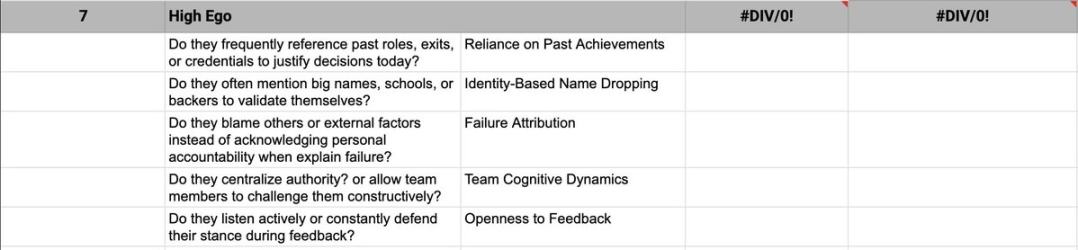
In our Founder Assessment Form, we deliberately observe several dimensions to identify whether a founder is prone to ego-driven decision-making:
-
Frequent emphasis on past achievements, especially early-career accolades
-
Regular name-dropping or reliance on labels, e.g., “We’re close friends with XX”
-
Habitual interruption, eager to defend positions rather than understand the core issue
-
Tendency to rationalize failures after the fact, avoiding acknowledgment of judgment errors
-
Team dynamics dominated by a single authority, lacking healthy tension or mutual challenge
Once ego takes over, a founder’s cognition loses flexibility. In crypto—a highly populist and transparent market—this rigidity is particularly fatal.
We’ve seen countless founders with polished products and smooth fundraising who still fail to truly unite their community. The root cause? The founder has already “locked in” their position. They’re closed off externally and unwilling to share power internally. Conversely, we’ve seen founders with unglamorous backgrounds and imperfect products earn community patience, trust, and loyalty—because they radiate a sense of shared purpose. They’re not telling people what to think; they’re inviting them to think together.
These differences may appear to stem from communication styles, but they actually reflect deeper contrasts in how founders relate to their own identity.
When a founder internalizes labels like “I’m technically trained,” “I’m a purist,” “I’m from a top school,” or “I’m contributing to the industry,” they struggle to genuinely absorb feedback or empathize with the community. In their subconscious, any critique of product direction feels like a rejection of “who they are.”
Identity Labels Stem from Deep Fear
Labels should be tools for external communication—ways for others to quickly recognize your position, expertise, background, or value proposition. They’re social symbols, useful for categorization and dissemination. But for many, labels morph into pillars for constructing the inner self.
Beneath this lies a profound fear: the collapse of the self.
In the past, identity was structural and deterministic. Who you were depended on where you came from, what you believed, and your profession. These elements formed a stable social order and a reliable source of selfhood. Today, as geography, occupation, and values decentralize, individuals must actively construct their identity. Labels become convenient substitutes, offering an illusion of certainty.
By saying “I’m a tech geek,” “I’m a liberal,” or “I’m an alum of X university,” you instantly gain understanding, recognition, or even admiration. This immediate social feedback acts like dopamine, reinforcing dependence on labels. Over time, labels cease to be tools—they become surrogates for the self.
Thus, the less internal order and stability a person has, the more likely they are to use labels as psychological crutches. They may repeatedly assert seemingly experiential statements—like the opening examples I mentioned. But these aren’t really about information exchange; they’re dependencies for building self-worth, anchors for existence.
They constantly reaffirm identity, defend existing positions, and resist cognitive updates—not because they truly believe in a specific viewpoint, but because if the label wavers, the entire illusion of “self” collapses. They aren’t protecting truth—they’re protecting a patchwork self assembled from external validation.
That’s why Dovey always says: “The hardest people to communicate with aren’t the uneducated. They’re those who’ve been fed definitive answers and believe the world revolves around them.”
Intellectual Freedom Begins with Identity Detachment
The best founders typically exhibit minimal attachment to identity. This doesn’t mean they lack self-awareness, but rather possess a highly integrated and stable internal sense of order. Their self-identity isn’t anchored in external markers—elite education, famous investors, or industry labels—but rooted in internal capabilities: insight into the world, psychological resilience amid uncertainty, and the ability to continuously update their mental models in dynamic environments. They don’t tie self-worth to positions, opinions, or role labels.
Conversely, the stronger the identity, the more it constrains thinking. When you fear “overturning your past self,” you begin building cognitive walls. You care more about whether others perceive you as “consistent” than whether your current judgment is correct. So you start justifying old views instead of seeking real solutions. This is the most dangerous blind spot in strategic thinking.
True cognitive evolution begins with admitting: “I am not my past statements.” A mentally free individual doesn’t say, “I’m type X but I understand Y.” They fully release the psychological need to “be type X.” They can change without anxiety, update without fear.
Only when you stop relying on labels to stabilize your self-concept—when you have genuine internal command over “who you are”—can you loosen attachments, step outside roles, and enter a free intellectual space. Perhaps this is the starting point of what Buddhism calls “no-self”: not erasing existence, but freeing cognition and action from being hijacked by the self.
Join TechFlow official community to stay tuned
Telegram:https://t.me/TechFlowDaily
X (Twitter):https://x.com/TechFlowPost
X (Twitter) EN:https://x.com/BlockFlow_News
 @YettaSing