Ethereum's Redemption? Can the Pectra Upgrade Bring ETH Back to Its Peak?
TechFlow Selected TechFlow Selected
Ethereum's Redemption? Can the Pectra Upgrade Bring ETH Back to Its Peak?
May 7 countdown: Ethereum Pectra upgrade could reshape the crypto market landscape.
 Navigating Web3 tides with focused insights
Author: Mark Dewolf
Translation: Baihua Blockchain
After a 45% price drop in the first quarter, Ethereum (ETH) may be preparing for a revival. On May 7, the highly anticipated Pectra upgrade is expected to pass its final test, paving the way for mainnet deployment.
This network upgrade combines two improvement packages—Prague and Electra—into one unified upgrade called Pectra, which includes nine Ethereum Improvement Proposals (EIPs). These changes aim to streamline onboarding for retail traders while making the world’s second-largest blockchain more attractive to institutional players.
Pectra increases the validator staking cap from 32 ETH to 2048 ETH, reducing the need to run multiple validator nodes. By simplifying the staking process, Ethereum’s stewards hope to achieve stronger liquidity locking and even encourage capital flows from large holders.
If user experience (UX) improves and large investors can participate more easily, on-chain activity should increase significantly—that’s their expectation. The post-upgrade price trajectory of Ethereum will be a key indicator for the crypto market in Q2. Let’s take a closer look at what lies beneath.
What is the Ethereum Pectra Upgrade?
Pectra is an upgrade to the Ethereum blockchain designed to enhance staking efficiency, improve user experience, continue advancing the rollup-centric scaling roadmap, and strengthen Ethereum's decentralization.
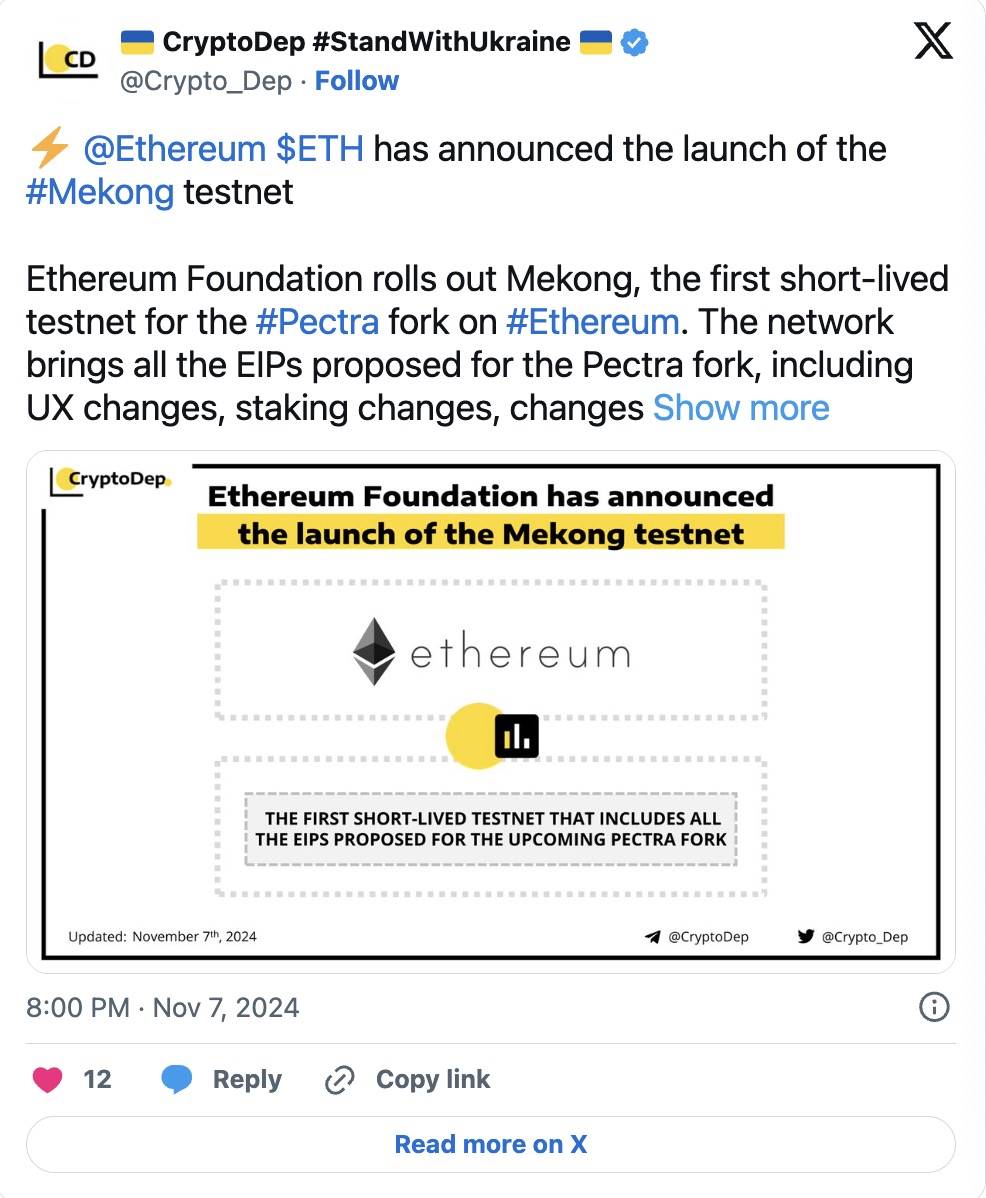
Prior to merging, Prague focused on improvements to Ethereum’s execution layer, while Electra concentrated on upgrades to the consensus layer.
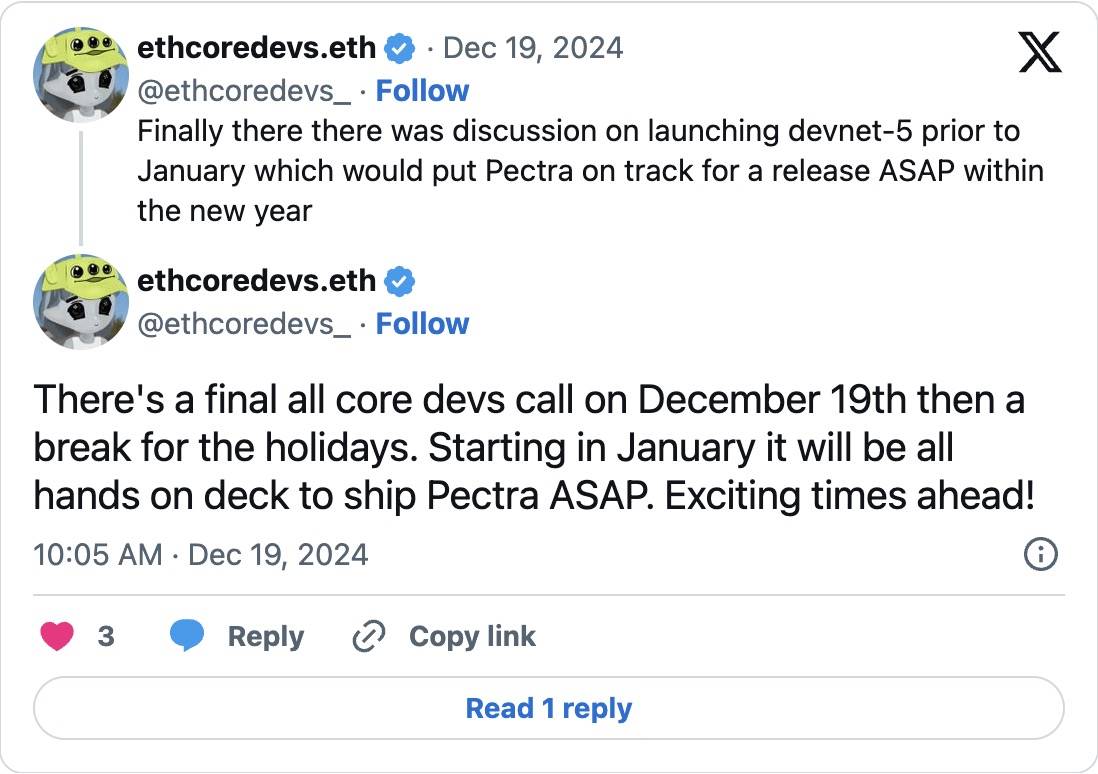
The Pectra upgrade has been eagerly anticipated for months and now has an official launch date: May 7, 2025. If everything goes according to plan, this will be the largest update in Ethereum’s history.
Key Proposals in Pectra
As of March 2025, the Pectra upgrade includes the following nine EIPs:
-
EIP-2537: Adds precompiles enabling operations with over 120-bit security, surpassing the current BN254 precompile’s 80-bit security level.
-
EIP-2935: Stores historical block hashes to support stateless clients.
-
EIP-6110: Enables validator deposits directly on-chain.
-
EIP-7002: Introduces a new mechanism allowing validators to trigger withdrawals and exits via execution-layer withdrawal credentials.
-
EIP-7251: Increases the maximum staking limit per validator from 32 ETH to 2048 ETH.
-
EIP-7549: Provides additional data availability for Ethereum Layer 2 (L2).
-
EIP-7685: A framework enabling validator smart contracts to perform specific actions.
-
EIP-7702: UX enhancements for externally owned accounts (EOAs).
-
EIP-7742: Decouples blob counting between the consensus and execution layers.
Among these, EIP-6110, EIP-7002, EIP-7251, EIP-7549, and EIP-7742 apply to Ethereum’s consensus layer; whereas EIP-2537, EIP-2935, EIP-6110, EIP-7685, EIP-7002, EIP-7702, and EIP-7742 affect the execution layer.
Key Features of Pectra
More Efficient Staking
Ethereum currently limits individual validator stakes to 32 ETH. For larger positions, this restriction forces entities to operate numerous validator nodes.
With EIP-7251, the maximum stake per validator node will increase from 32 ETH to 2048 ETH. However, the minimum requirement to become a validator remains at 32 ETH to avoid creating barriers for individual stakers.
Raising the cap allows large validators to consolidate operations across fewer nodes, thereby reducing the volume of peer-to-peer messages and digital signatures.
Smaller validators can also increase their stake without needing to accumulate in 32 ETH increments to activate additional validator instances.
As of December 2, 2024, Ethereum had over 1.07 million daily active validators. A high number of validators can lead to increased computational and bandwidth demands on the network.
User Experience Improvements
The Pectra upgrade includes several EIPs aimed at improving the user and developer experience on Ethereum.
EIP-7702 introduces a new transaction type that enables multiple actions by the same user to be executed within a single transaction. The upgrade will also allow one account to sponsor gas fees for another—a concept previously explored as "gas abstraction."
"Permission lowering," a new feature introduced by EIP-7702, allows users to authorize conditional spending—for example, authorizing payments only in specific ERC-20 tokens or limiting daily withdrawals to 2% of total balance.
EIP-2537 introduces new cryptographic functions used in zero-knowledge cryptography, while EIP-7002 enhances trustlessness in staking pools by enabling smart contracts to trigger validator exits.
Enhanced Rollup Scaling
Building upon the data blobs introduced by proto-Danksharding, the Pectra upgrade significantly reduces gas costs for Ethereum Layer 2 (L2) solutions.
EIP-7594 introduces a new protocol called PeerDAS, enabling nodes to verify L2 blob data availability by downloading only partial data.
How Might Pectra Impact ETH’s Value?
In a research report published in October last year, Galaxy Research Vice President Christine Kim wrote that as Ethereum advances its rollup-centric scaling roadmap, the impact of mainnet (L1) protocol upgrades on ETH’s value will gradually diminish.
She added that upgrades on Layer 2 (L2) could have the greatest influence on ETH’s value, since Ethereum’s future revenue may primarily stem from user activity occurring on L2s.
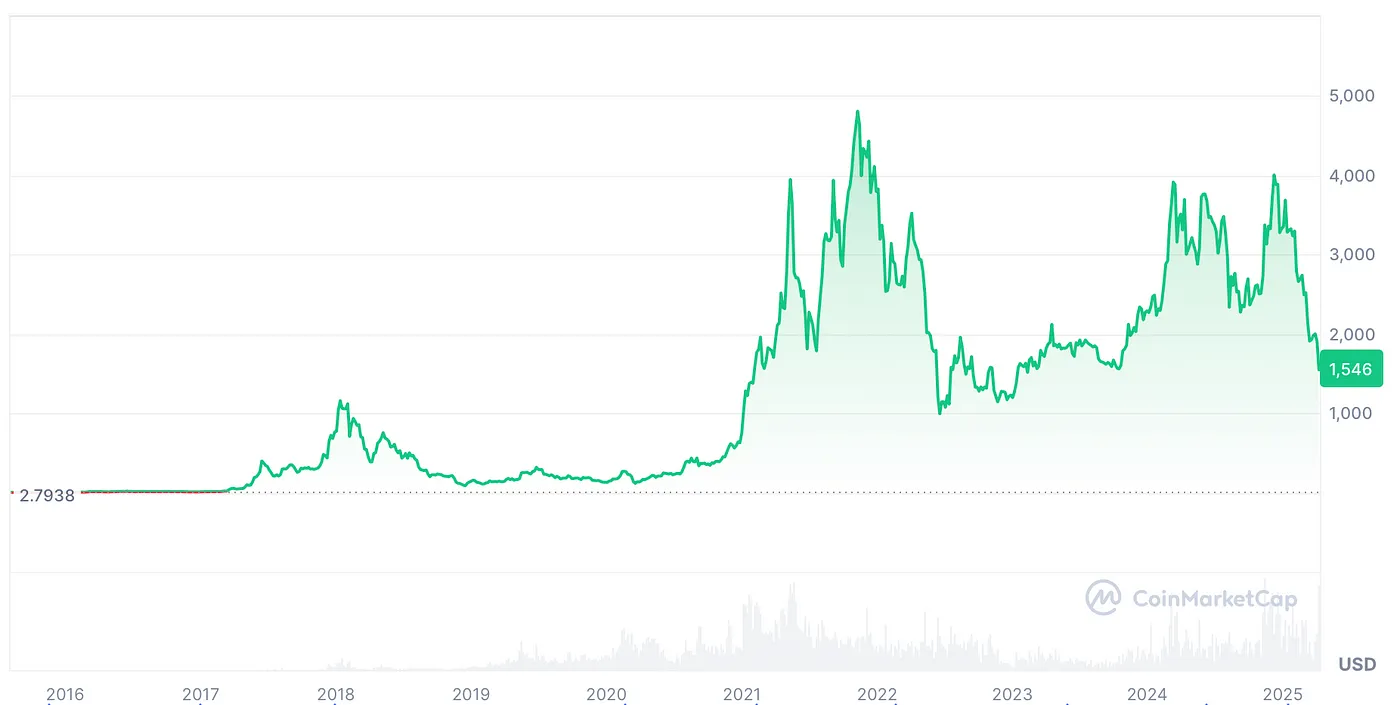
From $3 to $4,000 and back down: Ethereum price history as of April 6, 2025. Source: CoinMarketCap
Christine Kim noted: “Upgrades that enhance user experience, interoperability, decentralization, and security on L2 are more important to Ethereum’s value than optimizations and improvements at the base layer.”
Summary
Ethereum’s rollup-centric scaling strategy has sparked divided opinions among analysts, and the uncertainty surrounding it may have influenced market valuations over the past year.
However, network upgrades like proto-Danksharding and Pectra demonstrate strong planning and effort. Ethereum—the backbone powering decentralized applications (dApps), decentralized finance (DeFi), and much of today’s crypto ecosystem—will undoubtedly benefit from greater efficiency and flexibility.
Join TechFlow official community to stay tuned
Telegram:https://t.me/TechFlowDaily
X (Twitter):https://x.com/TechFlowPost
X (Twitter) EN:https://x.com/BlockFlow_News
 @introtocryptos