Can Bitcoin Hold the $70,000 Level Amid Escalating Trade War?
TechFlow Selected TechFlow Selected
Can Bitcoin Hold the $70,000 Level Amid Escalating Trade War?
The China-U.S. trade dispute has escalated into an "economic nuclear war."
 Navigating Web3 tides with focused insights
Bottom-fishing failed, and the market did not receive good news. Early this morning, the White House press secretary announced that the additional 104% tariffs on China have taken effect at noon Eastern Time, causing global financial markets to plunge again.
On April 3, when Trump's tariff policy was unveiled, U.S. Treasury Secretary Bessent posted suggesting that all countries refrain from retaliatory actions and wait to see if negotiations might occur before April 9. There was even a replay of the "fake news" scenario, hoping for a rebound based on speculation that Trump might be willing to negotiate over trade barriers imposed on multiple countries and specific products—briefly reviving global capital markets.
However, after several days of maneuvering, no positive developments emerged. From an initial 10% at the beginning of the year, rising to 20% in March, then 34% in early April, now叠加 with a further 50% "retaliatory increase," Sino-U.S. trade tensions have escalated into an "economic nuclear war."
With the U.S.-China trade war reigniting, can the stock market hold up?
Since the Trump administration announced its new round of tariff policies last week, international capital markets have experienced severe volatility, with U.S. equities hit hardest. As of Tuesday’s close, the S&P 500 index fell below 5,000 points for the first time in nearly a year, down 18.9% from its peak on February 19, edging close to the 20% threshold that defines a "technical bear market." According to estimates, the market capitalization of S&P 500 components erased $5.8 trillion over four trading sessions—the worst four-day decline since the index's inception in the 1950s.
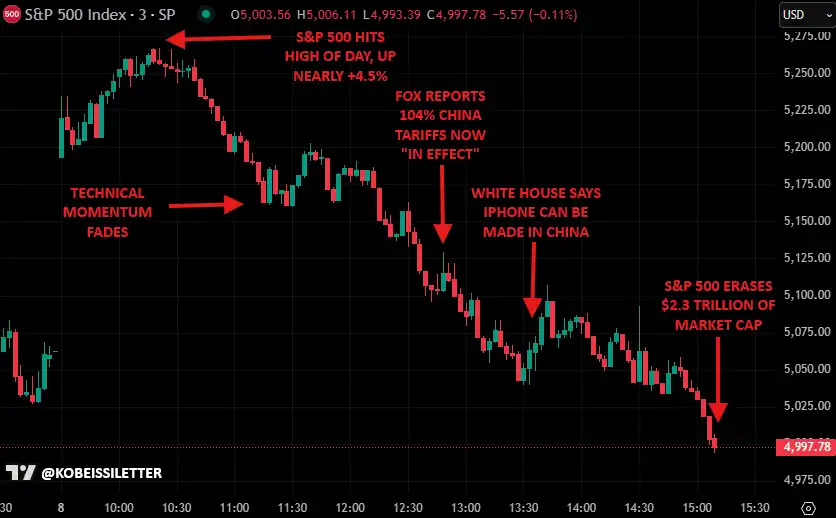
Meanwhile, U.S. tariff policies triggered a chain reaction across global capital markets. Bloomberg data shows that since Trump proposed so-called "reciprocal tariffs" on April 3, the total market value of global stocks has shrunk by $10 trillion—slightly more than half of the EU’s GDP. U.S. tech giants were especially hard-hit; the combined market value of seven major tech firms including Apple and Microsoft dropped by $1.65 trillion. Apple, heavily reliant on overseas supply chains, saw its share price plummet nearly 23% over four days—the largest weekly drop since the pandemic outbreak in 2020.
Previously, many thought leaders in the crypto space firmly believed that crypto assets would remain unaffected by traditional tariffs, as their transactions bypass borders and customs. They argued that in an era of renewed mercantilism and trade barriers, cryptocurrencies’ value proposition becomes even more pronounced. Michael Saylor, founder of Strategy, tweeted on April 3: “Bitcoin has no tariffs.”
Yet the total market cap of cryptocurrencies has declined 35% from its peak in December 2024, falling from $3.9 trillion to $2.5 trillion. The "Crypto Fear & Greed Index" stands at 17, indicating extreme fear and reflecting widespread market pessimism.
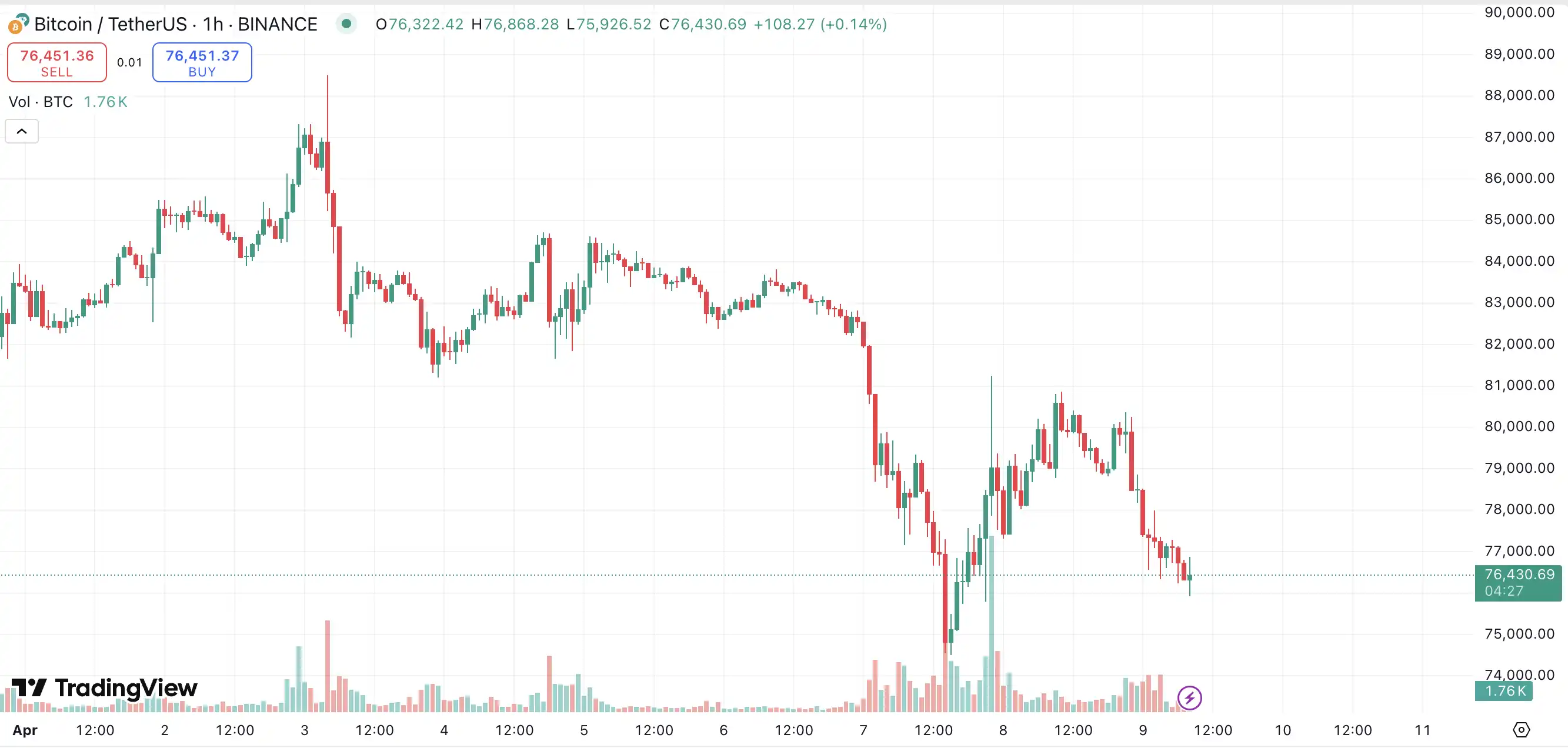
Last night, Bitcoin once again dropped below $75,000, while BTC dominance continued to rise. The altcoin market suffered badly, with Ethereum breaking below $1,400 again.
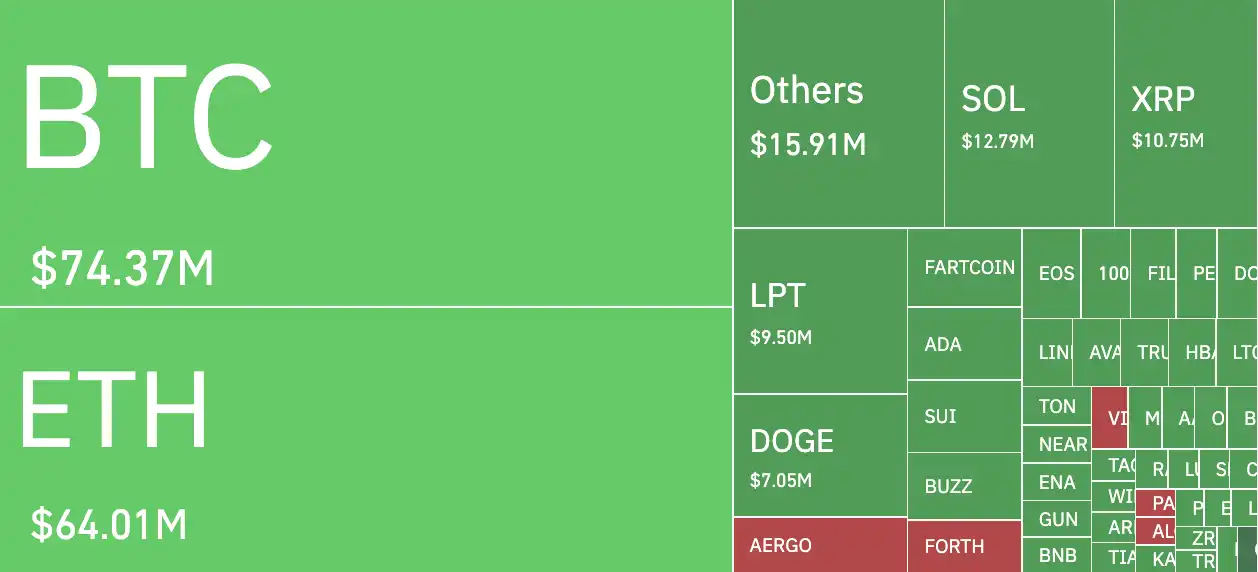
In the past 12 hours, the crypto market saw $243 million in liquidations, including $192 million in long positions and $51.03 million in short positions.
Continued declines in Bitcoin prices may force Strategy, known for relentless buying, to sell its holdings. According to an 8-K filing submitted to the SEC on April 7, if Bitcoin prices continue to fall, Strategy could be compelled to sell Bitcoin to repay debts—breaking Michael Saylor’s pledge to “never sell Bitcoin.”
Since Trump won the election in November 2024, Strategy has purchased 275,965 BTC at an average price of $93,228 ($25.73 billion), currently sitting on an unrealized loss of $4.6 billion.
Mounting pessimism—how analysts view the current market
Over the past week, multiple Wall Street banks, including Goldman Sachs and JPMorgan Chase, have warned that escalating trade wars could push the U.S. and global economies into recession this year, further diminishing financial market appeal.
Yet the White House team is celebrating victory. “We are really bottoming out now,” Trump’s chief trade advisor Peter Navarro said Monday night on Fox News. “It will reverse soon. Companies in the S&P 500 that move production back to America first will lead the recovery. It will happen quickly. I guarantee you, the Dow will hit 50,000—and there will be no recession.”
Navarro’s optimism, however, finds no support from JPMorgan CEO Jamie Dimon, who warned in his annual letter to shareholders on Monday that Trump’s tariffs will raise prices, slow the global economy, and weaken America’s geopolitical standing by undermining its alliance system. Even some of Trump’s allies, including Elon Musk and Bill Ackman, have recently cautioned that such tariff logic is deeply flawed and represents a wrong path.
Crypto analyst Phyrex believes that unless inflation clearly cools, even “defensive rate cuts” are unlikely to materialize quickly, judging by the Fed’s behavioral logic. The real turning point may come when U.S. Q1 GDP data is released at the end of April.
From a crypto market perspective, BTC turnover rates have declined today. URPD data indicates that despite prices falling below $77,000, investors in the $93,000–$98,000 range have barely reduced holdings, suggesting current selling pressure isn’t coming from high-cost holders. There has been no panic selling at the top, and on-chain structure remains relatively healthy. Provided policy shifts don’t keep swinging back and forth, BTC and risk assets may still find room for a partial recovery.
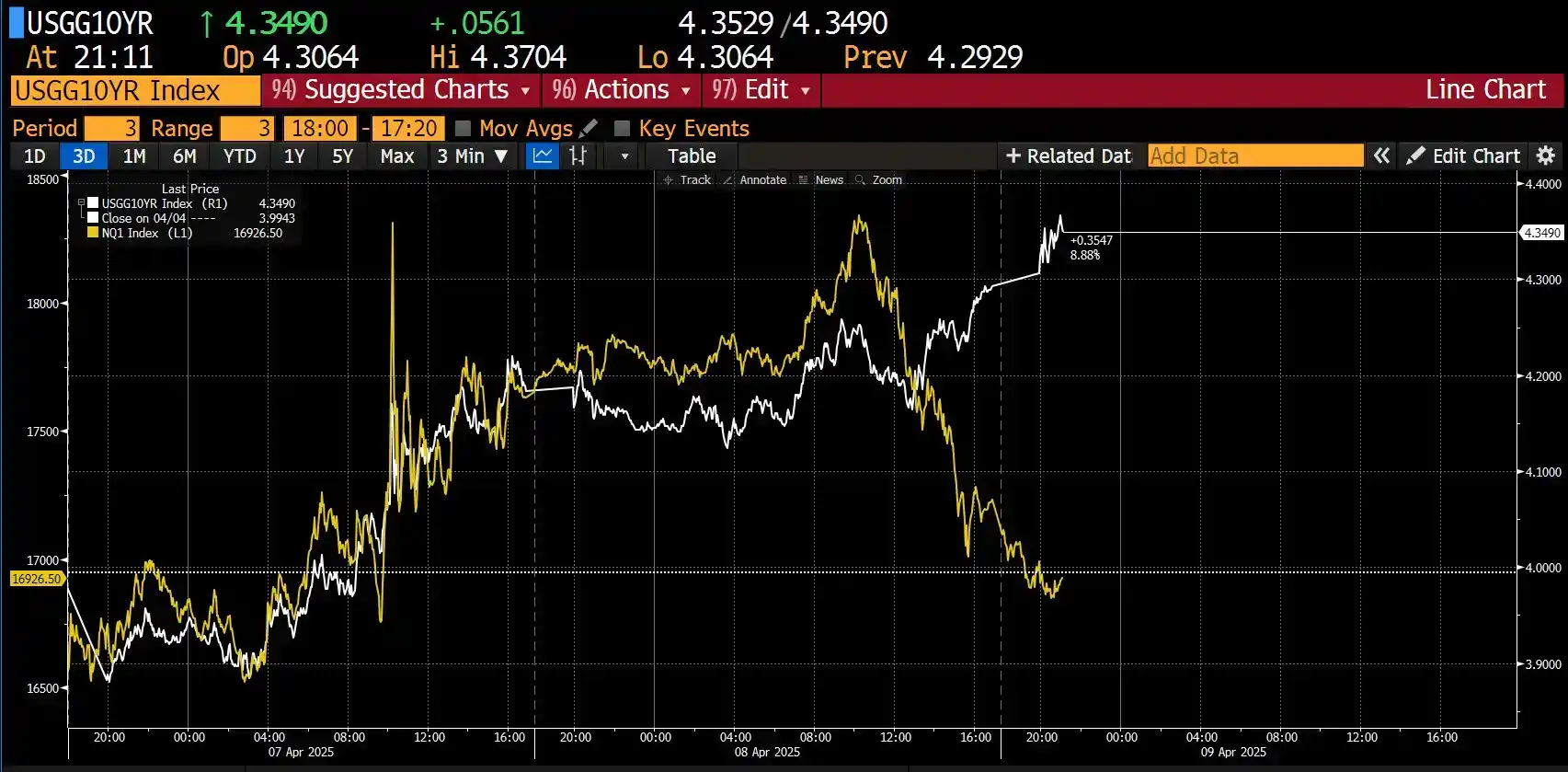
As U.S. Treasuries cease to function as a safe haven, the 10-year Treasury yield has risen back toward 4.3%, higher than late-March levels, increasing costs for mortgages and other loans. The 30-year Treasury yield closed at 4.76%, up nearly half a percentage point from Monday’s low. The spread between two-year and ten-year Treasury yields widened to 48 basis points—the steepest since May 2022.
Arthur Hayes, co-founder of BitMEX, wrote: “The Fed is running out of time—things are spiraling out of control. Previously, stock market declines led to falling U.S. 10-year yields, supporting risk assets. Now, falling equities coincide with rising yields—that’s bad. The market has finally realized: if dollar export revenues shrink, there won’t be buyers for Treasuries or stocks anymore. Game over.”
Pessimism continues to deepen. Trader Eugene posted: “The introduction of global trade tariffs marks a shift in world order unseen in over 50 years. Free trade has long been the engine driving productivity and economic growth, fueling the longest bull market in history. A shift from openness to protectionism will have profound consequences, unfolding gradually over years—unless Trump completely abandons his tariff plans, which I believe is highly unlikely. This will pose significant long-term headwinds for global risk assets.”
Regarding cryptocurrencies, the structural decline in active developers recently may be the most worrying sign. In the previous cycle, we could monitor developer activity and feel reassured, knowing our industry still benefited from long-term tailwinds. Fast-forward 2–3 years, and not only have we failed to produce anything particularly interesting or important, but the outlook ahead appears even worse than before.
In the last cycle, we looked forward to ETF approvals and a more favorable regulatory environment under pro-crypto governments as light at the end of the tunnel. Now those have arrived—but (once again) failed to meet expectations. I don’t see anything on the horizon that can lift crypto out of its natural “Ouroboros”—a self-referential, self-consuming loop.
At a broader level, the world is undergoing a transformation unseen in a century. Billionaire hedge fund manager and Bridgewater Associates founder Ray Dalio wrote that while attention to tariffs and the economy is important, deeper global forces should not be overlooked. He noted we are now in a “classic breakdown phase” of monetary, political, and geopolitical order—a rare event in one’s lifetime, though recurrent throughout history.
Dalio advises not being distracted by short-term events like tariffs, but instead focusing on the interplay of five key forces: economics, politics, geopolitics, nature, and technology. Studying historical parallels (such as past currency crises) can help predict future outcomes.
“The changes underway are part of a historic mega-cycle. Tariffs are merely symptoms. The true drivers are the structural collapse of monetary, political, and geopolitical orders. Only by understanding how these forces interact—and learning from history—can we better navigate what lies ahead.”
Join TechFlow official community to stay tuned
Telegram:https://t.me/TechFlowDaily
X (Twitter):https://x.com/TechFlowPost
X (Twitter) EN:https://x.com/BlockFlow_News
 BlockBeats