








From Treasure to Sharpnel, Web3 startups burn through funding and enter a winter
TechFlow Selected TechFlow Selected
From Treasure to Sharpnel, Web3 startups burn through funding and enter a winter
This bull market has been unfriendly toward altcoins, and the death list may grow longer.
 Navigating Web3 tides with focused insights
By Dingdang
The crypto market appears to be undergoing a profound winter. Just six months ago, we were immersed in the illusion of an impending bull run. Today, perhaps only Bitcoin remains worthy of faith—altcoins have been fundamentally damaged.
Recently, numerous altcoin projects have announced shutdowns due to funding shortages, user attrition, and operational pressures. From the gaming ecosystem Treasure DAO to the Web3 social app Phaver, and even the blockchain shooter game Shrapnel, these once-celebrated innovators are now exiting quietly. Their failures not only expose the rapidly deteriorating market conditions but also reveal deep-seated vulnerabilities in the technological and business models of crypto projects.
TreasureDAO: The Fading Star of Blockchain Gaming
TreasureDAO was once a shining star in the blockchain gaming space. Its NFT and MAGIC token ecosystem enjoyed immense popularity from 2023 to early 2024, hailed as the "Nintendo" narrative of the GameFi sector, drawing significant attention from users and investors alike. At its peak, it commanded momentum comparable to Axie Infinity.
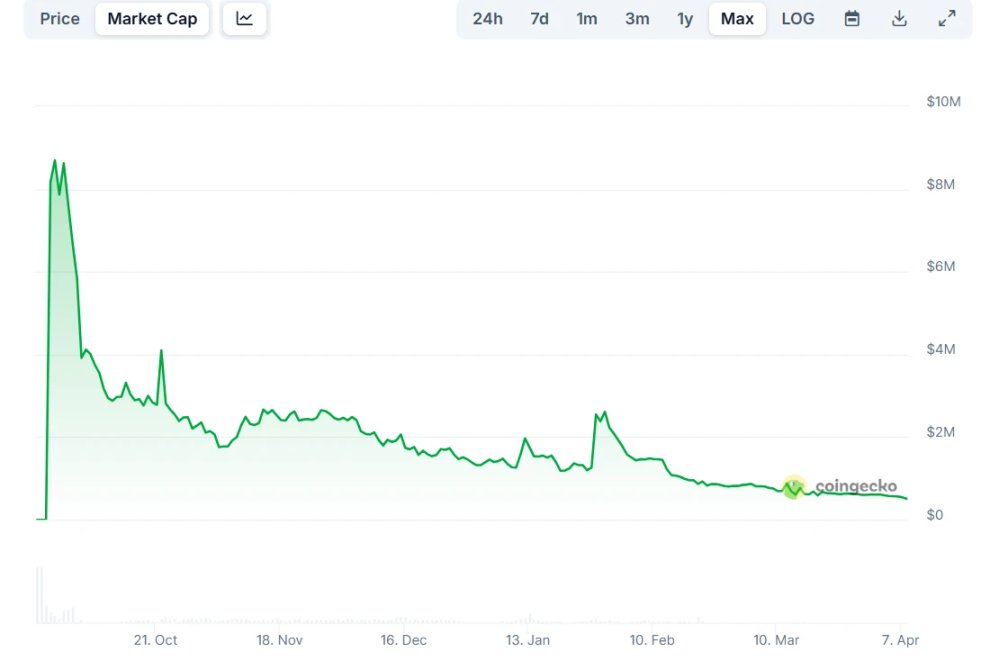
However, on April 3, its chief contributor John announced the termination of game operations and the Treasure Chain due to worsening financial conditions. According to the announcement, TreasureDAO’s annual operating expenses amount to approximately $8.3 million, while its treasury holds only $2.4 million—enough to last until July 2025. If $785,000 in idle funds can be reclaimed from market maker Flowdesk, operations might extend to February 2026. Additionally, the ecosystem fund still holds 22.3 million MAGIC tokens, currently valued at around $2.3 million. But if MAGIC suffers significant depreciation, the DAO could face financial distress as early as December 2024 to February 2025.
The core issue for TreasureDAO lies in its broken funding chain. A massive gap exists between high operating costs and limited treasury reserves, exacerbated by the risk of MAGIC devaluation and market apathy toward blockchain gaming—leaving the project with no viable path forward.
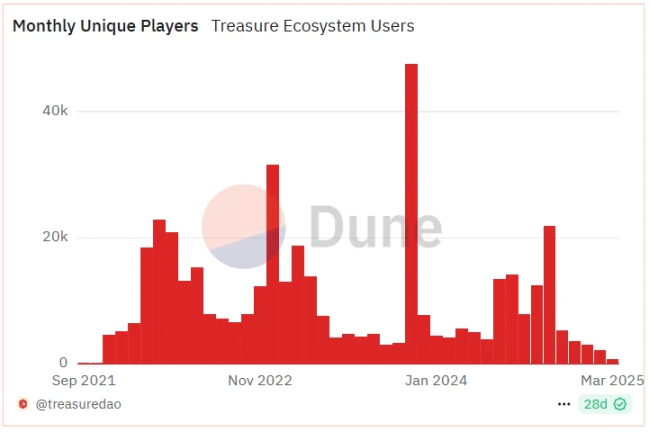
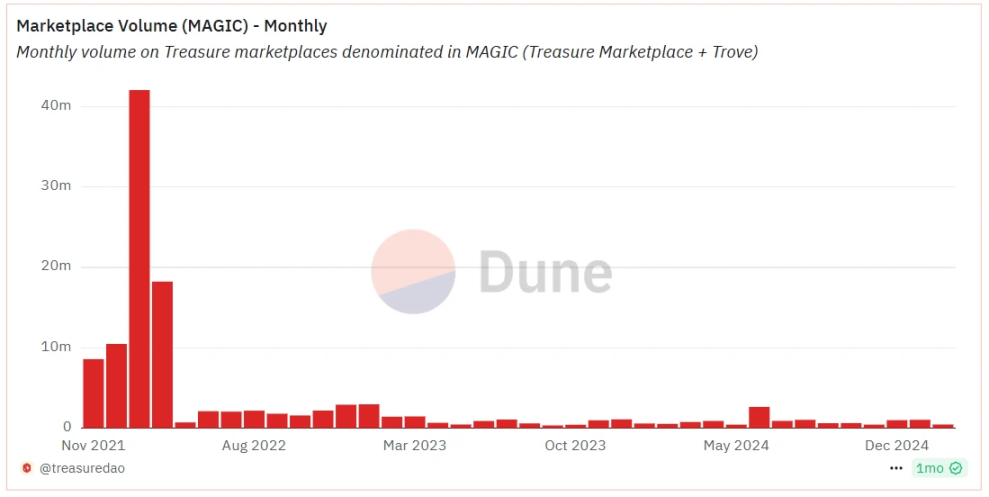
Data from Dune shows that the Treasure ecosystem had fewer than 1,000 monthly active users in March, just 1.5% of its peak. Trading volume has remained consistently low over extended periods.
Shrapnel: A Shooter's Financial Nightmare
Developed by Neon Machine, Shrapnel is a blockchain-based first-person shooter that gained market attention during the 2024 blockchain gaming boom. Fundraising-wise, Shrapnel performed impressively, securing a total of $37.5 million in funding from top-tier investors including Polychain Capital, IOSG Ventures, and Dragonfly. Ironically, despite this fundraising success, its token SHARP has never been listed on any major exchange—not even securing a “ticket” to enter.
On April 6, Blockworks reported that Neon Machine is facing severe financial difficulties. The company has cumulatively spent nearly $86.9 million in operating capital (not raised funds). In 2024 alone, it generated $21.7 million in revenue but incurred $33 million in operating costs, resulting in a net loss of $11.4 million. Currently burning through $2–3.5 million per month, the company has exhausted its cash reserves and owes millions of dollars to external suppliers. After at least three rounds of layoffs, staff numbers have plummeted from nearly 100 to just over ten, and its Seattle headquarters closed at the end of March.
Reports indicate that Shrapnel’s failure stems from massive losses and exorbitant operating costs, leading to widening deficits and dried-up cash flow. A planned fundraising round in early 2025 failed to materialize, as tightening market liquidity extinguished this “shooting star.”
Despite such dire finances, Neon Machine continues to claim that *Shrapnel* will launch globally by the end of 2025. Meanwhile, Lingjing·People’s Game Lab has reached a preliminary cooperation agreement with the *Shrapnel* team regarding the minting and distribution of in-game digital assets in the Chinese market. Let’s hope these aren’t just empty promises.
Phaver: The Fleeting Bloom of Web3 Social
Phaver was once the largest mobile social application on Lens, gaining notable traction in the Web3 social space. It raised $7 million in a seed round in October 2023 and entered the market via TGE in September 2024. Unfortunately, after the token launch, prices almost immediately collapsed.
According to DeFi researcher Ignas, Phaver has ceased operations. The team admitted that multiple issues led to its shutdown: technical failures during TGE and airdrops prevented users from claiming tokens on time, triggering a crisis of trust. Deteriorating market sentiment made Web3 social apps unattractive, rendering the high CEX listing fees (over $1 million) unrecoverable. Moreover, the team did not sell any tokens during TGE, leaving them without sufficient operating capital. As a Finnish company, Phaver is also required to pay 1–2 months of severance to laid-off employees. Under mounting pressure, the project eventually ran out of funds with no way back.
Some former team members are now developing SocialDAO, attempting to find new use cases for Phaver’s native token SOCIAL—but the outlook remains uncertain.
Rollup.Finance: The Stillborn Layer 2
Rollup.Finance was once an ambitious Layer 2 scaling solution. In December 2023, it announced the acquisition of automated market maker CherrySwap, aiming to expand its market footprint through integration. Yet no one expected this gamble to end in such disappointment. In July 2024, the team reluctantly announced it would cease operations. Despite surviving 16 grueling months in a bear market and achieving transaction volume growth, lack of support from the zkSync ecosystem and poor product-market fit rendered all efforts futile.
Users were given a final one-month window to close positions and withdraw funds. The platform officially shut down on September 21, 2024. Any open orders left unattended by the deadline were automatically liquidated, with affected users granted an additional month to retrieve their assets. Since then, Rollup.Finance’s email, official Twitter account, and Discord support channels have all gone silent—leaving behind only quiet ruins where ambition once stood.
Conic Finance: The Broken Link in DeFi
Conic Finance was an Omnipools protocol within the Curve Finance ecosystem, attracting attention during the early 2024 DeFi surge. Funding records show it raised $1 million in July 2023 from Michael Egorov, founder of Curve Finance.
In July 2023, Conic Finance suffered a flash loan attack, losing around $220,000. Then, on March 9, 2025, the project officially announced it would cease operations. All liquidity providers (LPs) were instructed to withdraw funds from the Omnipools, and Conic’s treasury returned the remaining portion of Michael Egorov’s 2023 investment to him. The project also discontinued all Votium bribes and incentives for the CNC/ETH Curve pool.
Conic Finance’s downfall stemmed from technical flaws, team instability, and worsening market conditions. The core team had been working on a new version of Conic. Despite collaborating with auditors, they failed to adequately address several critical issues in the update, ultimately lacking full confidence in releasing a newly audited version. During this period, key team members departed. The remaining members, after assessing the project’s viability, decided to liquidate assets.
The current Conic deployment remains functional with no security-related incidents reported. Conic’s contracts will stay open-source on GitHub, including the latest changes reviewed by ChainSecurity.
The collapse of these projects is not a series of isolated events, but rather a reflection of a broader market winter and the bursting of an industry bubble. From Treasure to Shrapnel, the collective downfall of altcoin projects is tragic—but it serves as a wake-up call for the entire sector. In this harsh winter, survival comes first.
Reducing operating costs, optimizing resource allocation, and focusing on core functionality development are now urgent priorities. Whether struggling at the edge of insolvency or stalled by technical bottlenecks, altcoin projects must learn to navigate adversity: strengthening community support, embracing transparent governance, partnering with mature ecosystems, or even boldly redefining their own value propositions.
The winter may be cold—but it is also a crucible for refinement.
Join TechFlow official community to stay tuned
Telegram:https://t.me/TechFlowDaily
X (Twitter):https://x.com/TechFlowPost
X (Twitter) EN:https://x.com/BlockFlow_News
 Odaily






