Learning from History: A Summary and Insights of U.S. Stock Market Bear Markets Over the Past 50 Years
TechFlow Selected TechFlow Selected
Learning from History: A Summary and Insights of U.S. Stock Market Bear Markets Over the Past 50 Years
A bear market bottom requires a "catalyst" to reverse the trend.
 Navigating Web3 tides with focused insights
Compiled by: Lord William
Under Trump's extreme trade policies, the Russell and Nasdaq indices have successively entered bear markets;
I've reviewed the causes, drawdowns, and turning points of all U.S. stock market bear markets over the past 50 years (defined as declines exceeding 20% from peak).
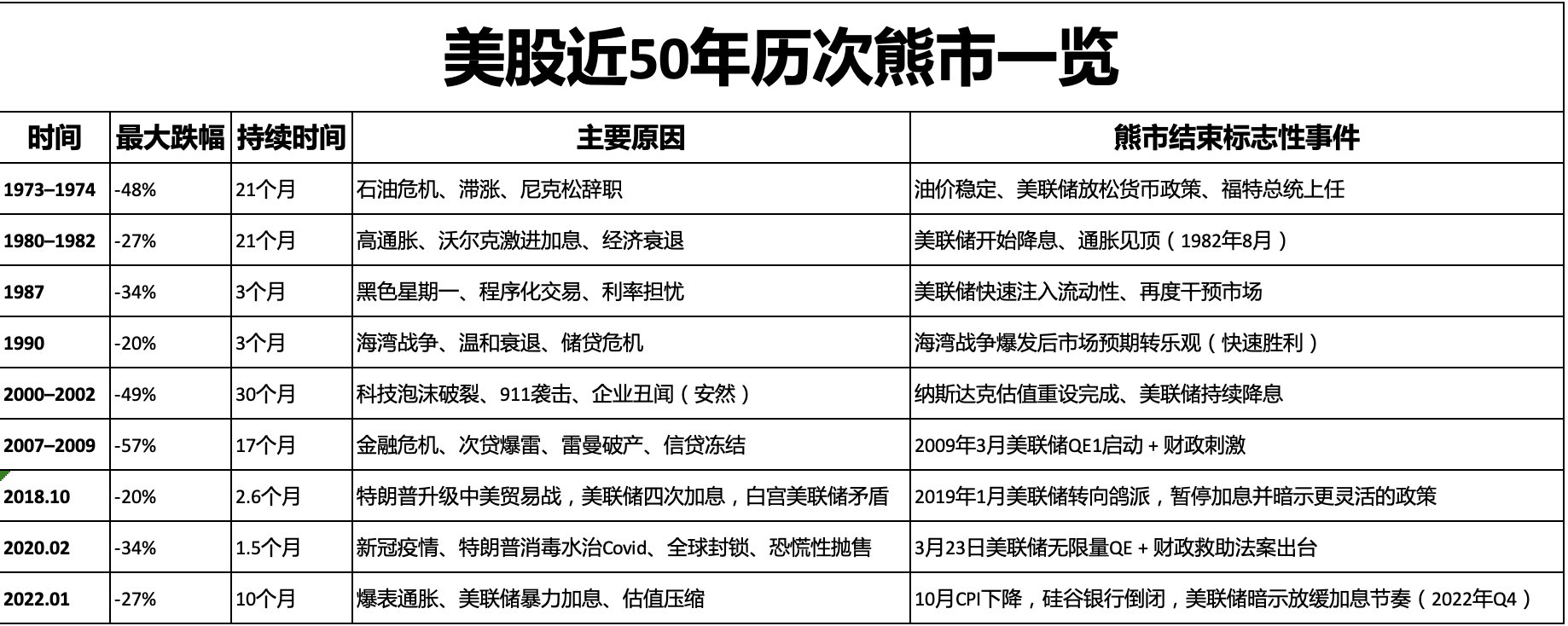
1973–1974 Bear Market
Duration: January 1973 – October 1974
Decline: Approximately -48% (S&P 500)
Causes:
Oil crisis (First oil crisis; OPEC embargo in 1973)
High inflation + Stagflation
Federal Reserve tightening monetary policy
Nixon administration scandals ("Watergate")
Bear-to-Bull Turning Point:
Oil prices stabilized, Fed eased monetary policy, Ford became President
1980–1982 Bear Market
Duration: November 1980 – August 1982
Decline: Approximately -27%
Causes:
Chairman Paul Volcker aggressively raised interest rates to combat inflation, pushing federal funds rate to 20%
Deep economic recession
High unemployment and declining corporate earnings
Bear-to-Bull Turning Point:
Fed began cutting rates, inflation peaked (August 1982)
1987 "Black Monday"
Duration: August 1987 – December 1987
Decline: Approximately -34% (S&P 500)
Causes:
Automated program trading (portfolio insurance) triggered technical sell-offs
Rising interest rates and concerns over trade deficit
Dollar volatility and global market interconnectivity
Bear-to-Bull Turning Point:
Fed rapidly injected liquidity and intervened in markets
1990 Recession Bear Market
Duration: July 1990 – October 1990
Decline: Approximately -20%
Causes:
Oil price surge triggered by the First Gulf War
Mild U.S. recession
Commercial real estate crisis + bank credit crunch
Bear-to-Bull Turning Point:
Market sentiment improved after outbreak of Gulf War (expectation of quick victory)
2000–2002 Tech Bubble Burst
Duration: March 2000 – October 2002
Decline: Approximately -49% (S&P 500), Nasdaq down over -78%
Causes:
Valuation bubble burst in internet and tech stocks
Uncertainty following the 9/11 terrorist attacks in 2001
Declining corporate earnings and loss of investor confidence
Bear-to-Bull Turning Point:
Nasdaq valuations reset; Fed maintained a prolonged period of rate cuts
2007–2009 Global Financial Crisis
Duration: October 2007 – March 2009
Decline: Approximately -57% (S&P 500)
Causes:
Real estate bubble burst
Subprime mortgage crisis → Lehman Brothers bankruptcy
Global credit freeze, banking crisis, Fed forced to intervene
Bear-to-Bull Turning Point:
March 2009 launch of Fed's QE1 + fiscal stimulus packages
2018 Bear Market
Duration: October 2018 – December 2018 (Trump’s first term)
Decline: Approximately -34%
Causes:
Trump escalated U.S.-China trade war; Fed raised rates four times that year; conflict between White House and Fed
Bear-to-Bull Turning Point:
January 2019: Fed shifted to dovish stance, paused rate hikes, signaled more flexible policy ahead
2020 Pandemic Bear Market
Duration: February 2020 – March 2020 (fastest bear market in history)
Decline: Approximately -34%
Causes:
COVID-19 pandemic led to global economic lockdowns
Supply chain disruptions + business shutdowns
Panic selling + initial policy delays
Bear-to-Bull Turning Point:
March 23, 2020: Fed launched unlimited QE + rollout of fiscal relief legislation
2022 Rate-Hike Bear Market
Duration: January 2022 – October 2022
Decline: S&P down ~-27%
Causes:
High inflation (CPI reached 9.1%)
Fed sharply raised rates (benchmark rate rose from 0 to over 4.5%)
Compression of tech stock valuations, soaring bond yields
Bear-to-Bull Turning Point:
October CPI decline; Fed hinted at slowing pace of rate hikes (Q4 2022); Silicon Valley Bank collapse
Summary
1. This current bear market resembles the two during Trump’s presidency—both were sharp, fast declines. After both prior bear markets ended, the recovery was a V-shaped rebound.
2. A turning-point “event” is required for bear markets to bottom out.
Response Strategy
1. Avoid leverage during the left-side downtrend;
2. Ensure your portfolio can withstand a -57% drop in the S&P (i.e., another -40% from current levels) without margin calls;
3. Stay disciplined on the left side—buy in batches, and only invest in index funds;
4. Keep cash ready for right-side accumulation;
5. On the right side, wait patiently for turning-point “events” and favorable technical patterns before buying.
Key “Events” or “Signals” to Watch
1. Possibility of Trump delaying implementation of additional reciprocal tariffs — within next week, 30% probability;
2. EU’s formal response on reciprocal tariffs — within next week, 50% chance they follow UK and Southeast Asia in compromise;
3. Further escalation or de-escalation in U.S.-China tariffs — between April 7 and 15; Trump has strong interest in TikTok, so negotiations likely;
4. Buffett’s market entry timing — May 3 Berkshire shareholder meeting may provide signals;
5. Fed’s potential rescue stance — unlikely in short term; possible in May-June if situation worsens;
If negative “events” occur, continue waiting; if positive “events” emerge, consider adding positions!
Finally,
The foundations of U.S. technological leadership, military power, and dollar dominance cannot be destroyed by four years of Trump.
Major bear markets孕育great opportunities. Survive first, then wait patiently for the moment to strike with full force!
Join TechFlow official community to stay tuned
Telegram:https://t.me/TechFlowDaily
X (Twitter):https://x.com/TechFlowPost
X (Twitter) EN:https://x.com/BlockFlow_News
 @LordWilliamUK