Yield-bearing stablecoins are booming—how can I earn returns from them?
TechFlow Selected TechFlow Selected
Yield-bearing stablecoins are booming—how can I earn returns from them?
As the U.S. gradually implements favorable legislation for stablecoins, the adoption rate of high-yield stablecoin products is expected to rise rapidly in the coming years.
 Navigating Web3 tides with focused insights
Author: The DeFi Investor
Translation: TechFlow
Just a few months ago, the crypto community was focused on memecoins and celebrity tokens, with many eager to guess which coin to invest in next. However, the spotlight has now quietly shifted. Stablecoins and real-world assets (RWA) have become central topics in industry discussions.
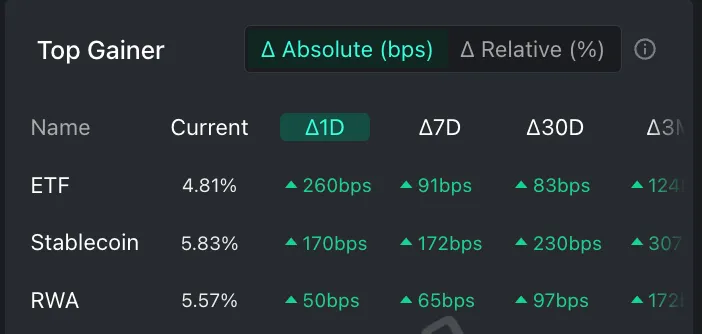
Image source: Kaito
Stablecoins are showing tremendous growth potential and could evolve into a trillion-dollar market. In this article, I’ll explain why I’m bullish on stablecoins and explore how to capture opportunities from this growing market.
Why Are Stablecoins Promising?
Currently, the stablecoin space is benefiting from several favorable developments:
-
More Supportive Regulatory Environment
The Trump administration plans to pass stablecoin-related legislation before August, aiming to further solidify the U.S. dollar’s global dominance. This will pave the way for stablecoin legalization and broader adoption.
-
Entry of Traditional Financial Giants
Fidelity Investments, a global asset manager with $6 trillion in assets under management, announced this week the launch of its own stablecoin. This marks significant recognition from traditional financial institutions and boosts confidence in the stablecoin market.
-
High-Yield Stablecoin Products
Some yield-bearing stablecoins offer highly attractive annual percentage yields (APYs) through decentralized applications (dApps), reaching as high as 20%–30%. These products are not only attracting crypto investors but also gaining attention from traditional finance.
In addition, stablecoins have a clear advantage in cross-border payments. International transfer fees charged by traditional payment companies remain high, while such costs are nearly negligible when using stablecoins. As the U.S. continues to implement stablecoin-friendly regulations, adoption is expected to rise rapidly in the coming years.

How to Capture Growth Opportunities in the Stablecoin Market?
-
Invest in Tokens of Stablecoin-Related Protocols
Although major stablecoin issuers like Circle and Tether have not yet provided direct investment avenues for retail investors, protocol tokens tied to stablecoins remain compelling options—such as Ethena ($ENA) and MakerDAO/Sky ($MKR). These protocols have attracted billions of dollars in total value locked (TVL) and stand to benefit from the expansion of the stablecoin market. That said, both tokens come with caveats. $ENA currently has only 34% of its supply circulating, suggesting potentially high future inflation. Meanwhile, MKR has seen little TVL growth over the past few years and has failed to capitalize on the rapid growth of the stablecoin market. Nevertheless, on-chain data shows that “smart money”—investors with market insight—is accumulating ENA and MKR, indicating these tokens may deliver strong performance ahead.
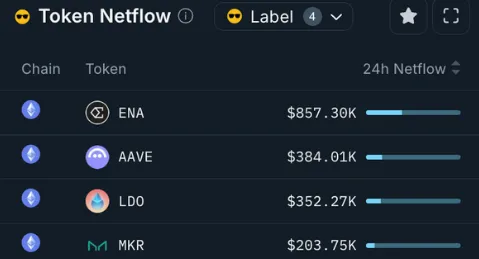
Image source: Nansen
Additionally, projects like Aave and dApps such as Pendle could also benefit from stablecoin market growth. A significant portion of their TVL comes from stablecoins. If stablecoin supply continues to expand, these protocols’ TVL, revenue, and transaction fees are likely to grow in tandem.
-
Participate in Airdrops from Stablecoin Protocols That Haven’t Launched Tokens Yet
Many emerging stablecoin protocols have introduced point reward programs offering generous incentives to early users. Below are several notable protocols and strategies:
-
Resolv: A risk-neutral stablecoin using a dual-token model.
Resolv’s dual-token system consists of its stablecoin USR and vault token RLP. RLP acts as an insurance token backing USR, providing risk coverage while offering users higher rewards.
Users can exchange USDC for USR via the Resolv app and deposit it into the HyperUSD vault. HyperUSD is a new type of vault that automatically optimizes liquidity deployment across Hyperliquid DeFi. By depositing funds into the HyperUSD vault, users earn 30x points plus additional points from the Hyperliquid ecosystem.
-
Level Finance: An interest-bearing stablecoin supporting native DeFi yields.
Level Finance’s stablecoin lvlUSD is backed by USDC and USDT, which are automatically deposited into DeFi protocols like Aave to generate yield. Users stake lvlUSD to receive slvlUSD, beginning to earn returns—for example, supplying slvlUSD to Pendle’s liquidity pool earns up to 14% APY and 20x Level points.
Level Finance is backed by two prominent crypto VCs, Dragonfly and Polychain, increasing the likelihood of a future token launch.
-
Coinshift: An on-chain treasury management solution delivering institutional-grade yields.
Its yield-generating stablecoin csUSDL earns returns through U.S. Treasuries and cash equivalents. Just four months after launch, csUSDL’s supply grew from zero to $35 million. Recently, Gearbox launched leveraged looping mining for csUSDL, allowing users to loop up to six times and earn up to 46% APY while receiving 6x SHIFT points.
However, users should exercise caution when using Gearbox to manage risk and avoid liquidation due to excessive leverage.
-
OpenEden: A platform focused on tokenizing real-world assets (RWA).
OpenEden recently launched USDO, an interest-bearing stablecoin that delivers real yields through tokenized U.S. Treasuries. Its points program is now live. Users first swap USDC or USDT for cUSDO on ParaSwap, then provide cUSDO to liquidity pools on Spectra—a yield-trading protocol similar to Pendle. This strategy enables users to earn 18% APY and 5x OpenEden bill points. To participate, users must sign a message on OpenEden’s points program page to begin accumulating points.
-
Use Stablecoins for Daily Expenses
Stablecoins are no longer limited to earning yield. Today, multiple solutions allow users to spend stablecoins directly on everyday purchases without converting to fiat.
Compared to traditional debit cards, crypto cards offer several advantages:
-
Self-custody: Users maintain full control over their assets without relying on third parties.
-
No fees: To attract early adopters, many crypto cards currently offer zero fees—including no transaction fees, no foreign exchange fees, and no withdrawal fees—making them especially suitable for overseas travel.
-
Solving banking restrictions: Crypto cards provide a convenient alternative for users who face difficulties cashing out crypto assets through traditional banking channels.
Looking ahead, as more stablecoin projects roll out points programs, the adoption of crypto cards and stablecoins as payment methods is expected to increase further. The stablecoin market is undergoing an unprecedented transformation. Whether driven by improved regulation, the entry of traditional financial institutions, or the appeal of high-yield products, the growth potential of stablecoins is impossible to ignore. Interest-bearing stablecoins, in particular, are poised to become one of the fastest-growing sectors in the coming years.
Join TechFlow official community to stay tuned
Telegram:https://t.me/TechFlowDaily
X (Twitter):https://x.com/TechFlowPost
X (Twitter) EN:https://x.com/BlockFlow_News
 The DeFi Investor