








Interview with SOL Strategies CEO: With the launch of the first Solana futures ETF, we're more than just a "Solana version of MicroStrategy"
TechFlow Selected TechFlow Selected
Interview with SOL Strategies CEO: With the launch of the first Solana futures ETF, we're more than just a "Solana version of MicroStrategy"
In the early history of cryptocurrency, the largest holders were often individual investors.
 Navigating Web3 tides with focused insights
Compiled & Translated: TechFlow
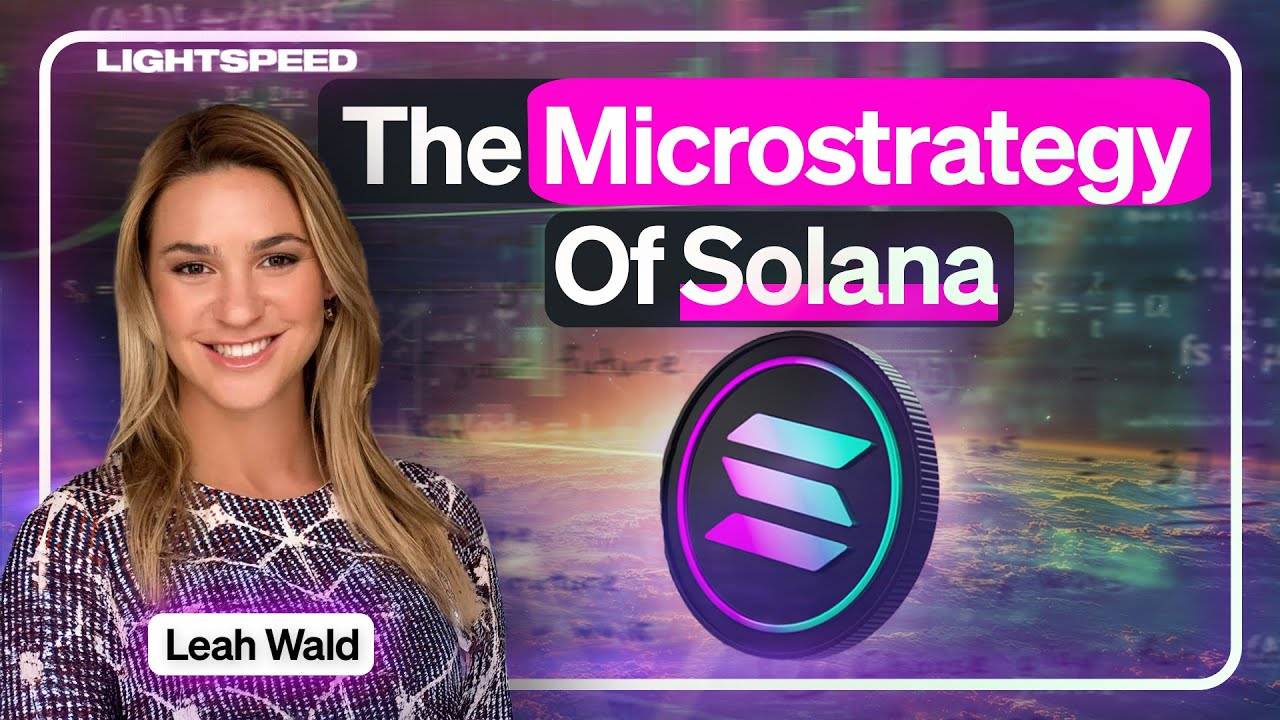
Guest: Leah Wald, CEO of SOL Strategies
Host: Jack Kubine
Podcast Source: Lightspeed
Original Title: The Solana Playbook With Leah Wald
Air Date: March 27, 2025
Key Takeaways
In this special episode, we're joined by Leah Wald live from DAS NY 2025. The discussion centers on the launch of Solana futures ETFs in 2025, a deep dive into SOL Strategies’ strategic playbook, and Leah’s unique insights into the current crypto market. We also explore Solana's long-term vision and its latest industry developments.
Highlights of Key Insights
-
In the early history of cryptocurrency, the largest holders were often individual investors.
-
Institutional adoption of Solana is still in its early stages, with broader discussions only beginning.
-
One of Solana’s strengths lies in its ability to engage various institutions and encourage them to consider building blockchain projects on its platform.
-
Comparing SOL Strategies to MicroStrategy for Solana is an incomplete analogy.
-
A fairer approach is to build a real technology company.
-
One thing I love about the Solana community is seeing diverse types of startups pushing innovation.
-
Bitcoin took a long time to establish itself as “digital gold.” Similarly, Solana and SOL are more speculative and will require time to find their own identity.
The Launch of Solana Futures ETF
Jack: We’ve just seen the first U.S.-listed Solana ETF begin trading. As an expert in this space, what are your thoughts on the debut performance of Volatility Shares’ futures ETF? How was the trading volume? And what key metrics should people be watching during this rollout?
Leah Wald:
This is extremely significant. None of us expected things to move this quickly. This launch came right after the CME futures product release, with surprisingly fast approval and the introduction of A2X leverage mechanics.
I think Volatility Shares’ decision to launch a futures product was strategically smart. Monday’s market performance was very strong—regardless, it was a successful demonstration showing both market demand and execution success. For a 2x leveraged product especially, this is undoubtedly a major win. From the perspective of institutional adoption and market efficiency, it’s highly meaningful for the entire ecosystem.
As for trading volume, there’s clearly substantial room for growth—but it’s only day one. Many market participants typically avoid entering on the first day, so what matters more is observing performance over the next three months: volume trends, participation levels, and overall interest.
Jack:
If I recall correctly, when you were at Valkyrie, you helped launch a Bitcoin futures ETF. Can you share that experience? How did the first-day volume look? When did you start seeing large inflows? And what lessons from Bitcoin futures ETFs can be applied to Solana’s case?
Leah Wald:
We launched the Valkyrie Bitcoin futures ETF in October 2021, just two days after ProShares. They listed on the NYSE; we chose NASDAQ. ProShares achieved over $1 billion in trading volume on day one, while we reached around $50 million. Still, that was a solid result given it was the first-ever Bitcoin ETF in the U.S.
Launching a futures ETF is complex, particularly in coordinating with market makers and ensuring smooth operation across the futures ecosystem. Compared to spot ETFs, futures ETFs involve more moving parts. Since they’re based on paper trading via CME, there’s a structural disconnect from the underlying spot asset, which introduces additional considerations like tracking error.
Despite Bitcoin’s larger AUM and volume, the context is different. There was more preparation time back then. It appears the SEC approved the ETF just two days after the CME futures launch. So Volatility Shares still has time to ramp up marketing efforts.
Jack:
How long do you think it will take to meaningfully assess the trading volume of the CME futures and Volatility Shares’ ETF? Given that first-day volumes are usually low, do we need a longer observation window?
Leah Wald:
Many firms cannot directly invest in futures due to internal portfolio restrictions. Additionally, the participant pool for futures trading is relatively narrow. Therefore, first-day performance rarely reflects the product’s full potential.
I believe we need at least three months to properly evaluate these ETFs—looking at volume trends and participation depth. Typically, Chicago-based trading firms are key players whose behavior significantly impacts market dynamics. Thus, a timeframe of three to nine months is reasonable for assessing whether these products succeed.
Jack:
What’s your outlook on the prospects for a spot ETF in 2025?
Leah Wald:
I see it as a pivotal moment worth anticipating. Historically, futures ETFs precede spot ETFs. While we can’t predict timing precisely, the launch of the futures ETF is undoubtedly a positive signal. Multiple firms have already filed applications for spot ETFs, and their operational track records are strong. So, I’m optimistic about the chances of a Solana spot ETF launching in 2025.
Are Institutions On Board?
Jack:
Let’s broaden the conversation on futures ETFs. We’re here at DAS, which feels more like an institutional investor gathering. But as you and I discussed earlier, many people tend to treat “institutions” as a monolithic group when talking about crypto.
I have two questions: First, have institutions started entering Solana? And second, what does that mean for the market? Also, how should we define “institution”? Who counts, and who doesn’t? Based on your observations, which sectors or sub-markets are most likely to bring institutional capital into Solana in the near term?
Leah Wald:
This is a thought-provoking question. We often categorize participants into retail and institutional investors, distinguishing them by capital size. But in crypto’s history, it hasn't been that straightforward. If we define retail investors as individuals managing their own wealth, and institutions as entities managing others’ capital, then these represent fundamentally different types of capital flows—not necessarily differing in scale. In fact, in the early history of cryptocurrency, the largest holders were often individual investors.
As Bitcoin gained recognition as a novel store of value, institutionalization began to emerge. Giants like BlackRock and Fidelity actively launching Bitcoin ETFs mark a significant shift. However, for altcoins like Solana, individual investors remain the primary holders. Though legally classified as retail, their capital size and market influence rival those of traditional institutions.
To your second question—what does institutional entry mean, and are they already involved? For Solana, the current dialogue focuses more on *how* institutions might participate in its ecosystem. We’re seeing early signs—Franklin Templeton launched a blockchain-based fund exploring operations on Solana. The arrival of futures ETFs offers new tools for institutional investors, potentially attracting more capital. In Bitcoin, we’ve observed institutions allocating through endowments, pension funds, and sovereign wealth vehicles. With similar investment instruments now available for Solana, we may see increased institutional involvement.
Overall, however, institutional adoption of Solana remains in its infancy—the broader conversation has only just begun.
Solana’s Ultimate Vision
Jack:
A potentially overlooked distinction is between institutions buying SOL assets versus running money market funds directly on the Solana network. Compared to a future on-chain NASDAQ, I think pension funds holding SOL assets is far more realistic.
Leah Wald:
Your point is well taken. Observing different project trajectories is fascinating. I believe one of Solana’s successes lies in its ability to engage diverse institutions and invite them to consider building on its blockchain. Solana has demonstrated strong persuasive power here, thanks to its clear advantages. But once capital enters the Solana ecosystem, how it gets allocated—and where it flows—is a critical question that needs deeper exploration. Fortunately, as we discussed recently, these topics are starting to gain traction.
Jack:
You mentioned the difference between institutions and retail investors, but capital scale isn’t always the dividing line—there are so-called "retail whales" (individuals holding massive positions). Does SOL Strategies frequently interact with long-term, high-net-worth Solana holders like Joe? After all, he controls a significant amount of capital.
Leah Wald:
Absolutely, this is an interesting phenomenon. Part of my role involves engaging investors and sharing our vision and narrative. Investors like Joe may be perfectly content holding SOL long-term—similar to many Bitcoin holders who enjoy holding BTC and discussing the importance of ETFs. That choice is valid because investors should have diversified options.
Currently, we are the only option offering retail investors stock-like exposure through IRAs or similar accounts. This was also a notable topic during the development of Bitcoin ETFs. However, I think someone like Joe would likely prefer to hold and stake his Solana directly rather than immediately buy our stock. Unless our shares become more attractive or he becomes more active in equity markets, such a transition may take time.
Laine’s Acquisition Strategy
Jack:
Talking about your validators, I recently saw an interesting news item about SOL Strategies. You acquired Laine’s Solana validator—his name is Michael, and he runs stakewiz.com. This acquisition stands out. How did those conversations start? Why did you choose this specific validator, and why appoint Michael as Chief Operating Officer? Can you share the story behind this?
Leah Wald:
To be honest, this acquisition was largely driven by Michael’s personal capabilities. He’s an exceptionally talented and intelligent entrepreneur with a strong engineering background—someone truly rare. Discussing the acquisition of Laine’s validator, stakewiz.com, and other related assets aligned perfectly with our next-phase external expansion strategy. This deal increased our stake to approximately 3.3 million SOL.
Jack:
That nearly doubled your stake, and seemingly in a short period.
Leah Wald:
Yes, exactly. Michael’s impact since joining has been significant. He’s widely respected in the Solana community—not just for his skills and intelligence, but also for his genuine commitment to the ecosystem. You can see this same community focus reflected in our CTO’s work. For example, we recently supported the SIMD02,2,8 proposal—even though it didn’t fully align with our economic interests as a validator, we backed it because it benefits the broader Solana network.
Our goal is to build a company deeply integrated into the Solana ecosystem and contribute meaningfully to its long-term development. That’s one of the core motivations behind acquiring Laine’s validator.
Is SOL Strategies the MicroStrategy of Solana?
Jack:
Was acquisition-driven growth always part of SOL Strategies’ plan? When I first heard about SOL Strategies, it was described as the “MicroStrategy of Solana.” I assumed you’d follow MicroStrategy’s model—issuing debt to buy large amounts of SOL, possibly earning yield through staking on platforms like Jito or Helius. That’s what I heard on the Lightspeed podcast. But now, you’re deeply involved in the validator space—acquiring validators, with Max regularly tweeting about SIMD proposals. And Michael, a well-known figure in the Solana validator community, has joined your team. Did you always plan to go down this path, or has this strategy evolved organically over time?
Leah Wald:
Describing SOL Strategies as the MicroStrategy of Solana is an incomplete comparison. In my view, that model has limitations—it essentially plays a net asset value (NAV) game, increasing company value purely through asset accumulation. But that’s not enough. I must also consider how to run a real business and create long-term value for shareholders. If the market perceives us merely as passive holders waiting for SOL to appreciate, that wouldn’t be fair to our investors. I believe a fairer approach is to build a real technology company.
Our strategy emphasizes slow but steady growth. Initially, we rely on external acquisitions (inorganic growth), such as buying validators and related assets. Over time, we’ll transition toward organic growth—expanding using our own capabilities. Our ultimate goal is to become an infrastructure company for Solana.
Along the way, we are accumulating SOL and staking it through our validator nodes. But this is only one component of our broader strategy—similar to how Bitcoin miners grow their balance sheets through financing while operating mining businesses. I believe this model is stronger and more meaningful because we’re not just “buying SOL”; we’re actively contributing to Solana’s infrastructure ecosystem. With help from Max and Michael, we’re also engaging institutions to advance this vision.
Jack:
Beyond running validators, are you considering expanding into other infrastructure areas? Is your ambition limited to validation, or are there broader technological directions you could explore?
Leah Wald:
Yes, we are exploring opportunities beyond validator operations, particularly in supporting technologies that strengthen the Solana ecosystem. We’re currently in discussions with multiple parties to evaluate potential avenues.
Solana’s Investment Philosophy
Jack:
What is Solana’s current investment thesis? You seem to maintain some connection with MicroStrategy. Michael Saylor played a pivotal role in Bitcoin—he became its de facto “spokesperson.” I feel you’re attempting something similar. Now seems to be a turning point: recent hype around meme coins appears to be cooling—for instance, Fire Dancer, once extremely popular, has faded from attention. So, for the remainder of 2025, what is your investment philosophy? How do you view the Solana network today, and how are you promoting it?
Leah Wald:
That’s a profound question—let me break it into three parts. I believe Solana is currently searching for its identity. As a blockchain still in its early stages, it’s working to clarify its role and value proposition. Solana has clear advantages and foundational strengths that demonstrate superior efficiency compared to other blockchains. But the key question is: who finds these advantages compelling? Who chooses to build on it? Who becomes its user?
Within the Solana ecosystem, there’s vibrant discussion around product development—concepts like “structured products,” for example. Could Solana become a platform for on-chain mutual funds? Or evolve into a payments system? These are all possible paths. One thing I truly appreciate about the Solana community is seeing a wide variety of startups driving innovation. This year, I hope Solana further clarifies its niche. It has built core strengths, but hasn’t yet fully discovered its unique positioning.
This process takes time. Bitcoin took years to solidify its role as “digital gold.” Solana and SOL are inherently more speculative and will likewise need time to find their footing. In 2025, I’ll be closely watching Solana’s evolution, hoping to see it carve out a distinctive market segment.
Final Thoughts
Jack:
Regarding other ecosystems—Sui, other Layer 1s, and Ethereum. Honestly, I think there are similar investment opportunities like SOL Strategies within those ecosystems. Why haven’t we seen more holding companies adopt this strategy? Do you expect such companies to emerge within the next 18 months?
Leah Wald:
I believe such companies will indeed emerge, and I’ve already spoken with several interested teams. Overall, I expect many of these firms to go public in the U.S., possibly via SPACs. In Canada, some may explore RTOS-based structures.
However, as more of these companies appear, the key question becomes: how do we define success? Going public alone doesn’t equal success. True success depends on multiple factors—market engagement, investor interest, and robust trading volume within the stock ecosystem. This support can come from token communities or capital markets. So while I expect more listings, these companies must adopt comprehensive strategies rather than pursue IPOs for their own sake.
I welcome competition. I hope to see companies with deeper thinking—not just focused on going public, but committed to long-term vision and active ecosystem contribution. Only then can we drive sustainable, healthy industry growth.
Join TechFlow official community to stay tuned
Telegram:https://t.me/TechFlowDaily
X (Twitter):https://x.com/TechFlowPost
X (Twitter) EN:https://x.com/BlockFlow_News
 深潮TechFlow


