ArkStream Capital: 4 Strategic Upgrades Behind Particle
TechFlow Selected TechFlow Selected
ArkStream Capital: 4 Strategic Upgrades Behind Particle
Particle Network is a Layer-1 blockchain supporting chain abstraction, seamlessly unifying users and liquidity in Web3.
 Navigating Web3 tides with focused insights
Author: ArkStream Capital
Particle Network is a Layer-1 blockchain enabling chain abstraction, seamlessly unifying users and liquidity across Web3. At its core are universal accounts that provide users with a single account and unified balance across all chains. These accounts are coordinated and secured by Particle Network, ensuring a smooth experience throughout the entire Web3 ecosystem. By unifying all blockchains, Particle will enable billions of users to seamlessly join and interact with dApps on every chain, serving as foundational infrastructure for mass adoption and playing an indispensable role in a unified open network.
As one of ArkStream’s strategic investments, Particle launched its token on Binance yesterday—an event backed by a story of four strategic upgrades.
2022: Origins in MPC WaaS
In 2022, I met Pengyu in Singapore. At the time, Particle Network was building Wallet-as-a-Service (WaaS) development tools centered around MPC and TSS, positioning itself against Multicoin-backed Web3Auth and Magic Link, which had reached a $500 million valuation.
We were deeply impressed by the team's ability to close loops and iterate rapidly. We made our investment decision at the end of 2022, reaching a consensus: after solidifying their MPC foundation, they should shift from wallets and developer tools toward infrastructure or protocols to capture greater value.
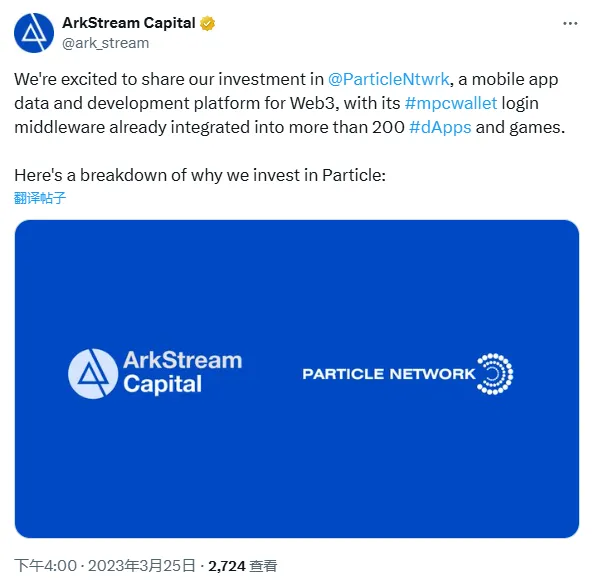
From late 2022 to mid-2023, thanks to relentless business development efforts, Particle integrated with over a hundred Dapps, covering most of Asia’s next-generation projects—including GameFi (Era7, Ultiverse, FunPlus), DeFi (DODO, Izumi Finance), and Layer-2s (zkSync Era, Linea, opBNB). Within just six months, Particle secured a top-three position in the MPC WaaS space.
2023: Moving Toward Intent-Centric Architecture
In 2023, Paradigm published research emphasizing how intent-centric architectures could solve issues like cross-chain fragmentation and poor user experience (UX) during user-chain interactions. Leveraging its accumulated advantages on the "supply side" (MPC/TSS), Particle launched its V2 product—the Intent Fusion Protocol—officially entering the intent-centric arena alongside Anoma, UniswapX, and DappOS.
At the time, Particle’s strategy involved brand and volume exchanges with leading projects such as Linea, developed by MetaMask, and Biconomy, a leader in account abstraction. This year also marked the beginning of Particle’s international expansion. With the addition of Ethan Francis, a brilliant young DevRel lead, Particle began gaining visibility in the English-speaking world. In 2023, we doubled down on our investment, making Particle one of the top three portfolio companies in ArkStream Fund II.
2024: Evolving into a Chain Abstraction Layer-1
In the spring of 2024, just before EthDenver, Pengyu and I had three consecutive late-night calls discussing the next funding round. We reached two key agreements: enhancing consumer-side awareness and repositioning as infrastructure.
A week later, Pengyu messaged me privately: “We’ve decided to pivot to becoming a ‘Layer-1 for Chain Abstraction.’” What a bold move! When we met again two weeks later at a café in Denver, the financing round valuing the project at $150 million had already attracted significant interest—and closed quickly. Five months later, Binance joined the investment.
Chain abstraction means using blockchains without needing to understand operational details (such as switching networks, creating separate wallets per chain, bridging assets, or managing gas fees). Through unified accounts, asset management, and cross-chain operations, the user experience becomes as simple as using Binance—even a street-market vendor needs only know a token ticker or contract address (CA) to buy any cryptocurrency on-chain.
In this domain, Particle holds unmatched advantages: not only does it have three years of technical accumulation in AA/MPC, but it also has integrations with dozens of chains and hundreds of Dapps built over the past two years. Thus, Particle evolved from a development tool to a protocol, and now to building chain-abstracted infrastructure akin to a “universal Binance,” establishing a complete and highly compelling growth trajectory.
2025: UniversalX – Consumer Breakthrough
Consumer reach and protocol revenue represent the final frontier. As meme mania surged, on-chain trading tools experienced explosive demand, prompting the launch of Particle Network’s consumer-facing product: UniversalX.
On-chain trading demands primarily revolve around three aspects: security (protection against hacks and asset loss), multi-chain access, and trading functionality (including speed, candlestick charts, mempool monitoring, take-profit, and stop-loss features). While industry players like GMGN, Photon, and Banana Gun each excel in certain functionalities, the first two often go underappreciated.
Non-Custodial Security
Two months ago, while hiking with Pengyu and Mailingzhi, he joked: “In this dark forest of blockchain, I just want to run a business where I can sleep soundly.” At that moment, dexx had just announced a payout, Bybit hadn’t yet been hacked—but hacking had already become the unspoken Sword of Damocles hanging over every exchange and bot. UniversalX’s non-custodial private key solution, powered by MPC and similar to multisig, ensures that even if Particle or a personal device is compromised, private keys cannot be stolen.
One-Click Multi-Chain Access
Last year, Solana saw countless “golden dog” tokens emerge. Early this year, CZ-led BSC surged forward; Base, led by virtuals, presented frequent opportunities; followed closely by Sonic led by AC and Bera’s Proof of Liquidity quietly rising. If each chain required separate account creation, asset storage, and constant network switching, it would be impossible for anyone—not even a FOMO-driven retail trader—to confidently make large bets. With UniversalX’s universal account (AA), you can instantly activate accounts across all chains using just Google or your email. Its universal liquidity acts like a super-intelligent “trading bot,” automatically aggregating liquidity across chains and executing cross-chain trades in the background—typically settling within 3 seconds.

I initially deposited $10,000 into UniversalX—first buying $TST at 15M FDV and $Shell at 200M FDV, then purchasing $shadow on Sonic, losing some $libra on Solana along the way, and recently acquiring $quq at 500K and $bnbcard at 3M FDV.
Just over two months after launch, UniversalX has achieved over $400 million in trading volume, 1.5 million total trades, and 30,000 registered users. At this pace, it will catch up to GMGN in just three months. Going forward, UniversalX will aggressively improve its trading feature set—including limit orders, take-profit/stop-loss, monitoring, copy trading, and execution speed—to build real technological moats in the on-chain trading赛道.
Winning Through Business Closure
Over these four years, Particle’s success stems fundamentally from its exceptional ability to create business closure. As Pengyu summarized, the team starts with core user needs and skillfully assembles technology, product, talent, competitive strategy, and business models like interlocking building blocks—forming a self-sustaining, mutually reinforcing ecosystem. The moment UniversalX launched, this closed-loop effect became unmistakably evident.
Peter Pan, Particle’s CTO, and Pengyu are both Tsinghua University alumni who previously co-founded a gaming platform together, growing it to serve tens of millions of users. Beyond his technical excellence, Pantao possesses a rare “court vision” akin to Nikola Jokić—keenly aware of both macro trends and granular details in the industry.
In executing its business closure strategy, the Particle team demonstrates not only passion but also precision. Take their KOL strategy: Chandler, our post-investment lead, told me that among all our portfolio companies, Particle’s selection process for KOLs is the most rigorous—carefully vetting through hundreds of candidates to ensure precise alignment.
Binance Launch Is Just the Beginning
2024 marks a pivotal turning point in crypto. The valuation paradigm of Web3’s first cycle—driven by attention economics, narratives, and expectation management—has come to an end. The leaders of the second cycle must be pragmatic, supported by products, revenue, and sustainable business models.
UniversalX aims to become the “on-chain universal Binance,” rebuilding Binance’s full suite of features—IDO, lending, futures trading, yield-bearing stablecoins—entirely in a multi-chain DeFi format. $PARTI, as the Layer-1’s gas and LP token, is poised to develop a robust token economy combining protocol revenue and utility. The Binance listing is merely the beginning. The team’s ambition extends far beyond: chain abstraction unlocks the blue ocean market of daily active on-chain users growing from 300,000 to 3 million. Let party be joined.
The emergence of the HTTP protocol in the 1990s abstracted away complex command-line operations like FTP and Telnet into a simple address—just type http://google.com—to easily access the internet. This innovation dramatically lowered the barrier to entry for ordinary users, accelerating the internet’s global adoption from just a few million users in the 1990s to billions today.
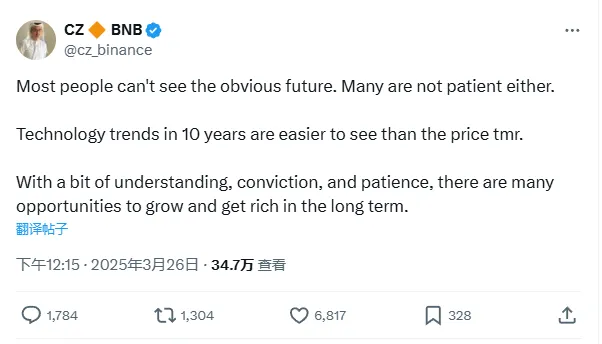
Quoting CZ’s recent tweet: “A ten-year tech trend is easier to predict than tomorrow’s price. Most people fail to see the obvious future and lack patience.”
ArkStream Capital is a cryptocurrency fund founded by native crypto practitioners, operating both primary market investments and liquidity strategies. It focuses on investing in Web3-native and cutting-edge innovations, dedicated to supporting the growth of Web3 founders and unicorns. The ArkStream Capital team entered the cryptocurrency space in 2015 and hails from institutions including MIT, Stanford, UBS, Accenture, Tencent, and Google. Its portfolio includes over 100 blockchain companies such as Aave, Sei, Manta, Flow, Fhenix, Merlin, Avail, Space and Time, and others.
Join TechFlow official community to stay tuned
Telegram:https://t.me/TechFlowDaily
X (Twitter):https://x.com/TechFlowPost
X (Twitter) EN:https://x.com/BlockFlow_News
 Arkstream Capital