








Particle Network: Can Universal Accounts, Universal Liquidity, and Cross-chain Gas Truly Simplify Web3 Chain Abstraction?
TechFlow Selected TechFlow Selected
Particle Network: Can Universal Accounts, Universal Liquidity, and Cross-chain Gas Truly Simplify Web3 Chain Abstraction?
Particle Network solves the problem of managing multiple gas tokens across multi-chain ecosystems, delivering a more consistent and seamless user experience.
 Navigating Web3 tides with focused insights
Author: Teahouse Assistant, Chain Teahouse
Particle Network is a full-stack middleware platform that unifies asset storage and transactions across different blockchain networks, supporting a wide range of Web3 infrastructure products and services to make Web3 more accessible.

At the end of 2021, when Particle Network was first founded, the team realized that most Web3 onboarding processes and technical complexities often led to poor user experiences, easily discouraging new users.
For example, users need seed phrases to create wallets, along with traditional browser extensions and third-party wallet redirects—these requirements greatly complicate the user experience and operations. Additionally, after creating a wallet, users must pay gas fees to use Web3 DApps, which requires buying cryptocurrency via OTC and transferring it back to their wallets. For newcomers, this presents a significant barrier to entry.
Therefore, Particle Network developed an authentication and wallet-as-a-service solution, enabling developers to integrate user-friendly Web2 authentication methods into their DApp development.
1. How It Works
Particle Network achieves chain abstraction through its modular L1 blockchain, providing users with unified cross-chain accounts and liquidity management. This design aims to simplify user interactions with blockchains, making operations within multi-chain ecosystems seamless and intuitive.

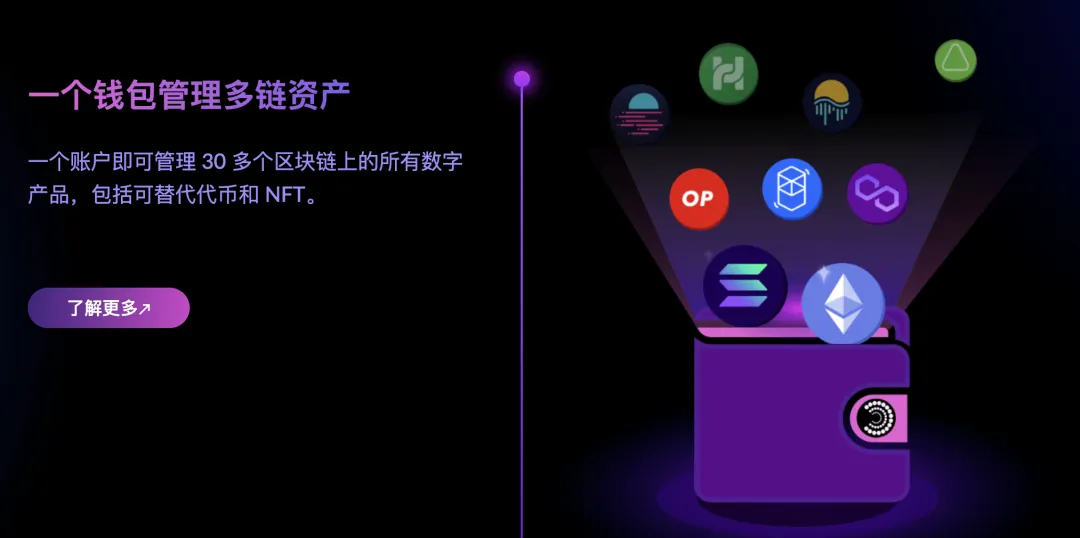
Particle Network creates unified accounts, giving users a single address and interaction point across all chains. This account structure simplifies the management and use of smart contract wallets, supporting both EVM and non-EVM networks such as Bitcoin and Solana. Users can create and manage these accounts via social logins or Web3 wallets, ensuring easy operation across different chains.
Particle Network's unified liquidity enables aggregation of liquidity across all chains by optimistically executing atomic cross-chain transactions and swaps. This allows users to seamlessly interact with new blockchains even if they don’t hold tokens on the target chain. For instance, users can purchase ETH with USDT across different chains to acquire an NFT on a specific chain—the process is transparent to the user, with all operations automatically completed in the background.
Particle Network allows users to pay gas fees for cross-chain transactions using any token, with all transactions ultimately settled in $PARTI, Particle Network’s native token. This solves the problem of managing multiple gas tokens in a multi-chain ecosystem, delivering a more consistent and smooth user experience.
2. Core Services and Products
2.1 Authentication Service
Particle Network leverages Multi-Party Computation (MPC) and Threshold Signature Scheme (TSS) technologies to offer a novel key management and security solution. Combined with social login functionality, it significantly simplifies and secures the Web3 user experience.
Key Management
-
Particle Network’s key management follows three core principles: exclusive user control, secure account recovery, and elimination of single points of failure. Using MPC-TSS technology, sensitive keys and secrets are split into two parts, stored by two separate entities, ensuring that even if one entity is compromised, the key cannot be leaked—thus avoiding single points of failure.
Multi-Party Computation (MPC) and Threshold Signature Scheme (TSS)
-
MPC-TSS requires multiple parties to participate in cryptographic operations throughout the key lifecycle without ever combining the two key fragments, adding an extra layer of security. Key shares are regularly rotated without changing the actual key, forcing potential attackers to compromise both entities almost simultaneously to access the key material.
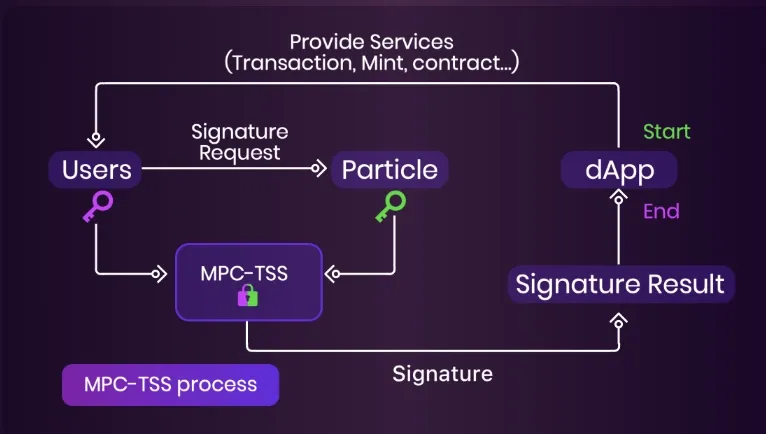
Particle Auth, a project within the Particle Network ecosystem, supports multiple authentication methods including phone number, email, Google, Facebook, Twitter, and other social logins, allowing users to choose the most convenient option. The social login feature enables users to access their accounts using familiar methods (e.g., Google or Facebook login), eliminating the need to manage complex key management processes during wallet creation. This simplifies onboarding and promotes broader adoption of cryptocurrency. Users can manage their key shares through familiar platforms while benefiting from the robust security provided by MPC-TSS.
Additionally, integration is seamless across any web, native mobile app, or game, compatible with various blockchain ecosystems and cryptographic standards. Particle Network integrates functionalities from numerous partners including TRON, Gameta, Biconomy, 1inch, and Ultiverse, enabling Particle Auth to integrate with various types of wallets, platforms, chains, and social media login credentials.

Particle Network’s authentication service addresses the complexity and friction of traditional authentication schemes through its comprehensive infrastructure, effectively lowering the entry barrier for Web3 applications.
2.2 Wallet Service
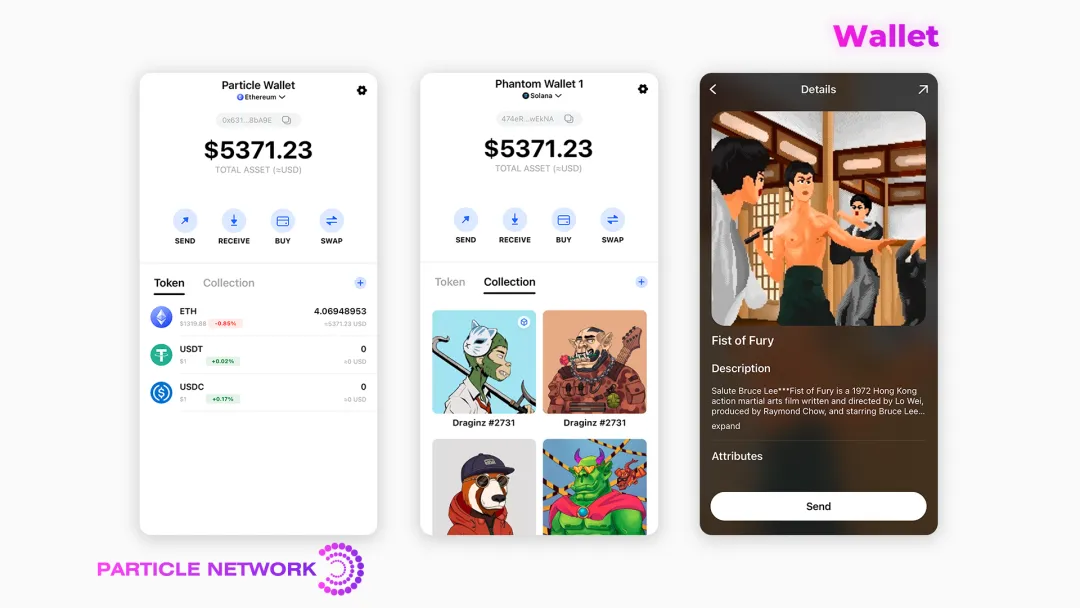
Particle Network offers an innovative "Wallet-as-a-Service" (WaaS) solution with Particle Wallet, enabling users to quickly and easily conduct transactions and token conversions, while also simplifying Web3 application development and enhancing user experience.
Regarding simplified development, Particle Wallet supports cross-platform compatibility across desktop, iOS, Android, Flutter, Unity, Unreal, React Native, and more, offering developers broad choice and flexibility.
Moreover, Particle Wallet provides highly flexible and customizable solutions, allowing developers to freely create unique and tailored experiences for their users, helping their Web3 applications stand out in a competitive market. Developers can customize the appearance of email and SMS designs, login and verification pages, transaction pages, and configure design elements such as background and button colors, border styles, logos, fonts, and select between light or dark mode. Additionally, WaaS allows developers to configure platform features based on user needs—selecting supported transaction tokens, included chains, highlighting specific tokens or NFTs, default pricing currency, enabling WalletConnect, and offering multilingual support.
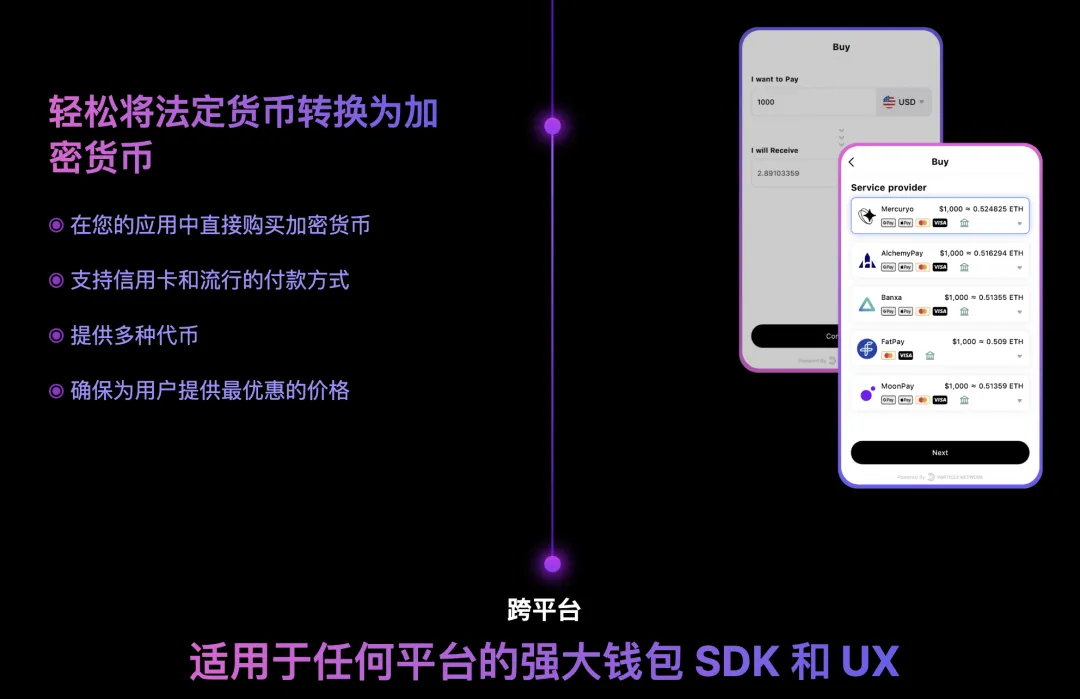
To help users easily enter the Web3 ecosystem, Particle Wallet integrates fiat on-ramping services, supporting seven different providers across 156 countries and covering 36 fiat currencies. Users can easily select the best exchange rate to buy cryptocurrency without complex procedures. Notably, Mercury’s KYC-free on-ramp service allows users to purchase up to $700 worth of cryptocurrency without undergoing cumbersome identity verification, greatly simplifying the onboarding process and offering unprecedented convenience for new users.
Particle Wallet also integrates multiple decentralized exchanges (DEXs), ensuring users receive optimal token swap rates. Partnerships with leading providers like 1inch guarantee users access to the latest innovations and deep liquidity in the DeFi space. Developers can leverage industry-leading solutions without building their own DEX, enabling in-app token swaps, encouraging active user participation, and increasing overall DApp success rates.

2.3 Node Service
Particle Network's node service provides robust node infrastructure for blockchain and cryptocurrency applications. Developers can leverage shared node capabilities via the Particle Network API to enhance performance across their projects. Particle Network offers globally distributed node services to ensure scalability, stability, and security within the ecosystem. Operating 24/7, this service provides reliable support anytime, anywhere. Startups can confidently delegate node management to the platform, allowing them to focus on business growth.
Particle Network’s node service is highly scalable, dynamically adjusting resources based on demand to ensure stable network operations—especially critical for applications handling large transaction volumes and high-concurrency requests. Furthermore, these nodes support multiple blockchain networks, including all EVM-compatible chains and non-EVM chains like Solana, enabling developers to flexibly deploy and manage applications across diverse blockchain ecosystems. Additionally, Particle Network provides easy-to-use APIs and SDKs, streamlining the developer integration process. Developers can easily access node services to perform data queries, send transactions, and invoke smart contracts.
Notably, Particle Network’s node service adopts a pay-as-you-go model, where developers only pay for the resources they actually use, avoiding high upfront investments and long-term maintenance costs. For payments, Particle Network resolves fragmented on-chain gas fees through its native Paymaster, allowing users to pay gas fees with any token, ultimately settling transactions on the Particle Network L1.
2.4 NFT Service
The NFT service is designed for enterprise use, meeting all NFT-related needs.

Particle Network offers simple NFT minting—developers can create new NFTs via API and store them on the blockchain. Users can securely and efficiently buy and sell NFTs through the Particle Network platform. Developers can query NFT-related data such as ownership and transaction history via API, simplifying data management and analysis. Particle Network’s NFT service supports cross-chain operations, enabling NFT transfers and trades across different blockchain networks.
Through this product, investors can access NFTs by collection, ownership, creator, etc. Leveraging APIs, Particle Network displays all major chains in a simple and unique format. Its super data storage system facilitates NFT requests and transactions via original URLs, ensuring buyers receive full NFT value and reducing potential risks during transactions.
2.5 Abstracted Accounts
Particle Network introduces intent-centric abstracted accounts: improving user experience by simplifying user operations and enhancing transaction efficiency. The core idea of abstracted accounts is to lower the entry barrier by transforming how users interact with the network. By simplifying the process of creating and interacting with contracts, it offers greater flexibility and a simpler experience.
Currently, the abstracted account ecosystem is nearing maturity, encompassing layers such as public chains, private key management, abstracted account stacks, and application layers. Many well-known projects have adopted abstracted accounts to optimize user experience. However, despite some success in simplifying user operations, their full potential has yet to be unlocked—mainly because efforts still focus on solving developer needs rather than being fully user-centric.
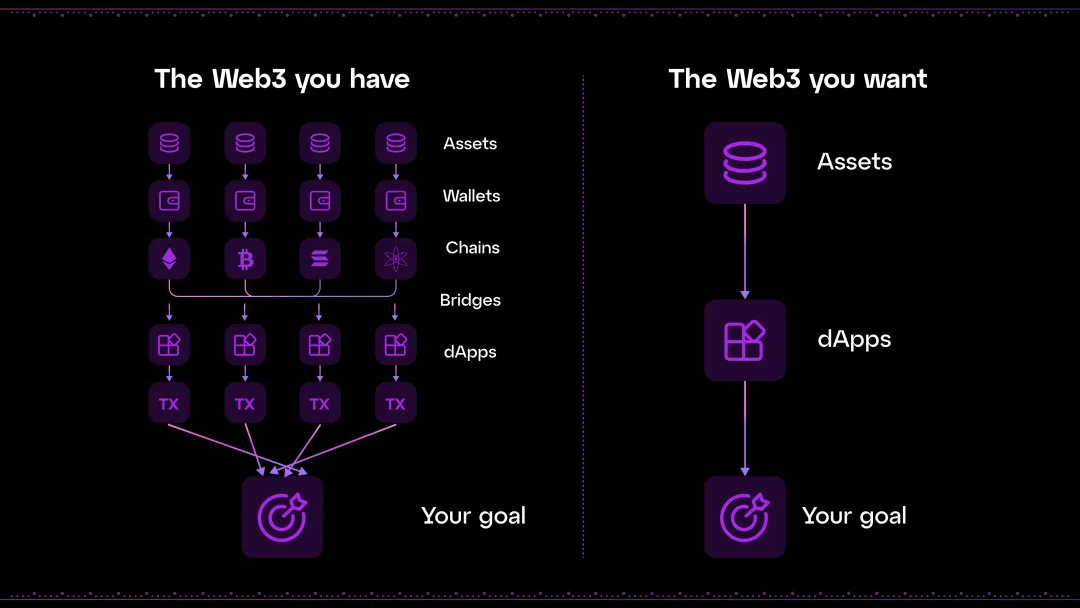
Particle Network’s V1 product simplified user onboarding into Web3 products and improved transaction efficiency through social login and multi-chain signature computation. With the launch of V2, Particle Network introduced the Intent Fusion Protocol, further enhancing user experience. The Intent Fusion Protocol includes a unified language and framework from expression to intent conversion, a development toolkit for composite demand coordination, and Particle Network’s proprietary zkEVM for full-chain abstracted account management and computation. This protocol enables users to access application-layer products via zero-knowledge login while preserving privacy.
Based on this, users can easily deposit ETH into yield-generating products on any L1/L2 via the Intent Fusion Protocol and automatically redeem once earnings reach a certain threshold, then reinvest into Lido for risk-free returns. This design prioritizes user needs, ensuring users achieve their true intentions with minimal cognitive and operational cost.
2.6 Testnet Points Campaign
In May this year, Particle Network launched the testnet for its modular L1 blockchain, aiming to achieve chain abstraction in multi-chain ecosystems through universal accounts and universal gas functionality. Users can complete testnet tasks to earn $PARTI points and qualify for airdrops and other rewards.
Access Particle Pioneer
-
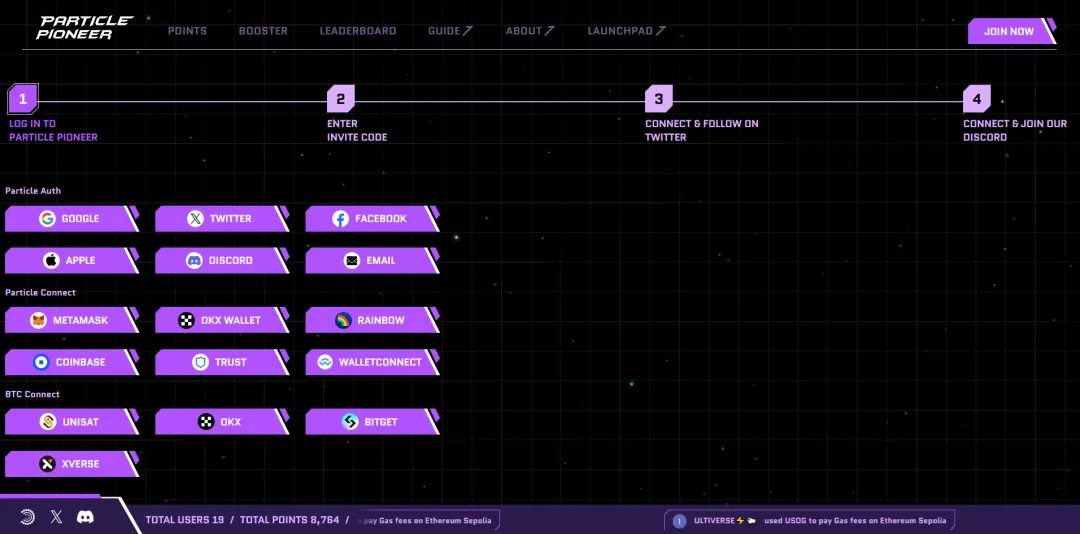
Visit Particle Pioneer and register an account. Users can register via social accounts, Web3 wallets, or native Bitcoin wallets.
Obtain Invitation Code
-
Invitation codes can be obtained through friends or official Particle channels (such as Discord and Twitter). After completing account creation, connect your Twitter and Discord accounts and join Particle’s channels.
Deposit Universal Gas
-
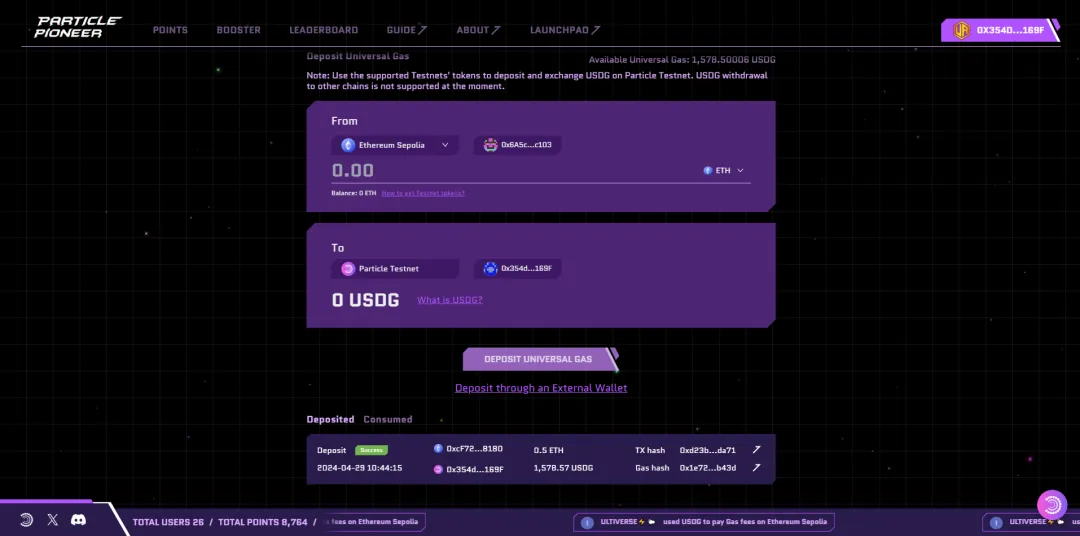
Deposit native tokens (e.g., ETH, BNB, BTC) to obtain universal gas (USDG), which can be acquired for free via public faucets. Deposited test tokens will be automatically converted into USDG, which users can spend for transactions on any chain.
Ways to Earn Points

-
Invite friends to participate in testing.
-
Daily check-in and send one transaction.
-
Deposit universal gas.
-
Use universal gas for transactions (up to 100 times per day).
Extra Rewards
-
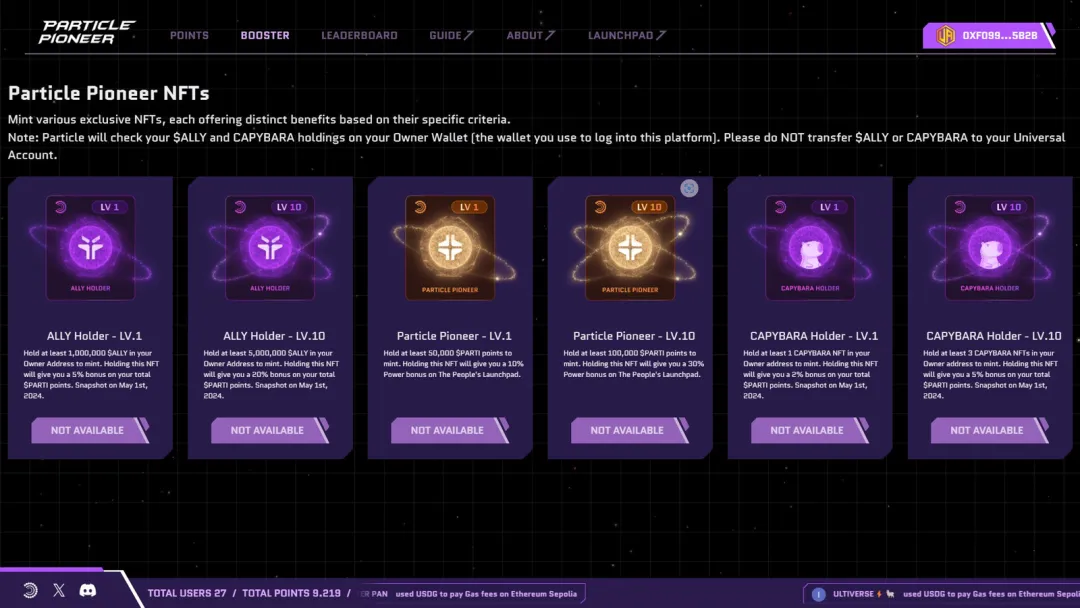
Holding $ALLY or Capybara NFT grants additional rewards. These can be obtained on Peoples Alliance’s official marketplace.
3. Team and Funding
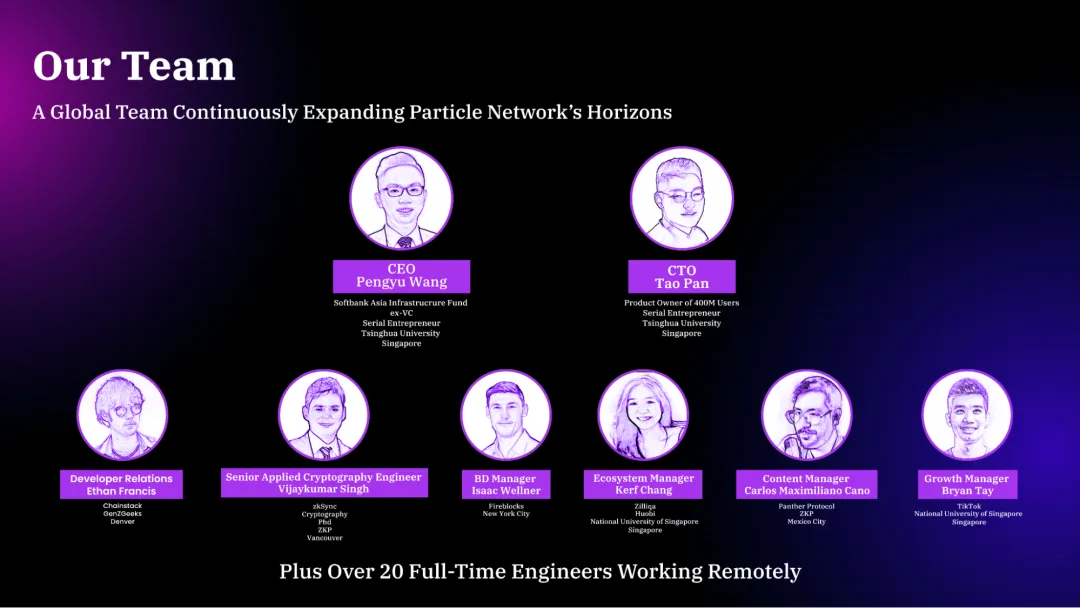
Pengyu Wang, co-founder and CEO of Particle Network, holds a bachelor’s degree from Tsinghua University, one of China’s top institutions. He previously served as Investment Lead at SoftBank’s SAIF Fund, focusing on early-stage startups in Asia, and was formerly CEO of MiniJoy.
The other co-founder and CTO, Tao Pan, previously served as CTO and head of overseas operations at Tongzhuo Games. A graduate of Tsinghua University, he built the social gaming platform Minijoy and successfully raised $15 million from Alibaba.

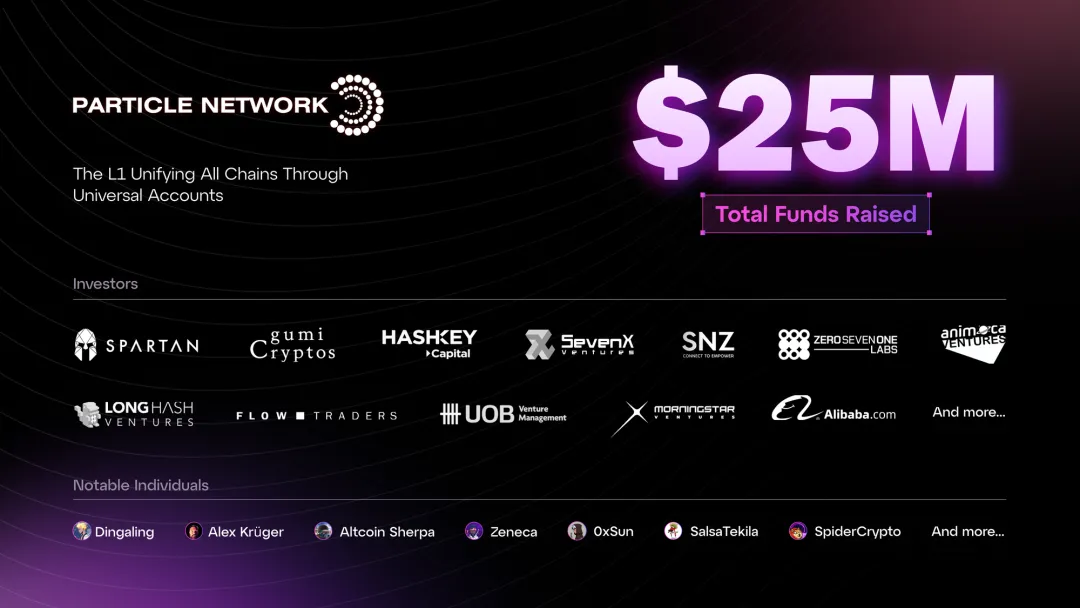
Particle Network has successfully completed three funding rounds. The first was a seed round completed on May 5, 2022, raising $1.5 million from participants including Insignia Ventures Partners, CyberConnect, BitCoke Ventures, 7 O'Clock Capital, FSC Ventures, and Monad Labs. The second seed round closed on March 29, 2023, raising $7 million led by ABCDE, Animoca, Longhash Ventures, GSR Ventures, HashKey, and other investment funds.
On June 20 this year, Particle Network completed a $15 million Series A round co-led by Spartan Group and Gumi Cryptos Capital, with participation from SevenX Ventures, Morningstar Ventures, Flow Traders, HashKey Capital, among others. This round was conducted via a Simple Agreement for Future Tokens (SAFT).
4. Project Evaluation
Particle Network belongs to the blockchain infrastructure and chain abstraction sector. This sector aims to improve user experience by simplifying user interactions with blockchains and solving interoperability issues in today’s multi-chain ecosystems.
Other projects in this space include Polkadot, Cosmos, and Avalanche. Specifically, Polkadot offers cross-chain interoperability and shared security through its relay chain and parachain architecture, enabling seamless communication between multiple chains. However, its complex architecture and high development costs may present barriers to new projects. Cosmos achieves interoperability between blockchains via IBC (Inter-Blockchain Communication protocol) and its modular architecture enables developers to easily build independent blockchains. Yet, despite Cosmos’ emphasis on decentralization, its security model relies on individual chains’ own security, potentially introducing risks.
In contrast, Particle Network’s strong technical foundation and market support give it tremendous growth potential. Its modular L1 design and zero-knowledge EVM technology demonstrate leadership in blockchain innovation. Moreover, Particle Network’s efforts to simplify user experience through universal accounts and universal gas make blockchain technology more accessible to ordinary users. Additionally, its strong investor backing and strategic partnerships provide crucial support for long-term success, with these collaborations and funding rounds offering solid foundations for sustained development.
However, as a relatively new project, Particle Network’s ecosystem and developer community are not yet fully established. Our suggestion is to seize the opportunity to participate in the testnet, gaining future rewards and an excellent chance for early involvement in the project.
Join TechFlow official community to stay tuned
Telegram:https://t.me/TechFlowDaily
X (Twitter):https://x.com/TechFlowPost
X (Twitter) EN:https://x.com/BlockFlow_News






