How can Particle build an intent-centric modular access layer by integrating zkWaaS?
TechFlow Selected TechFlow Selected
How can Particle build an intent-centric modular access layer by integrating zkWaaS?
zkWaaS addresses privacy issues for off-chain and on-chain users through confidential authentication and confidential transactions.
 Navigating Web3 tides with focused insights
September 13th, 2023 | Kris
Particle Network is an infrastructure for Web3 designed to improve developer efficiency and accelerate mass adoption of Web3. Its wallet login and wallet middleware solutions have become the industry’s leading wallet and authentication middleware—by a significant margin.
Since launching its product in late October 2022, Particle Network has onboarded hundreds of clients, including Xter.io, Hooked Protocol, ApeX, 1inch, and CyberConnect. In April 2023, Particle Network launched its MPC+AA wallet solution with cross-platform SDKs, establishing a product matrix combining MPC+EOA and MPC+AA account abstraction wallets.
Particle Network is about to launch its V2 product, with the theme of "Intent-Centric, Modular Web3 Access Layer." In V2, Particle will introduce zkWaaS (Zero-Knowledge Proof Wallet-as-a-Service), which includes two key components:
-
Integrating zero-knowledge proofs (zkp) into MPC-AA to enable private logins and transactions;
-
Launching the Intent Fusion Protocol, building intent-centric products to enhance end-user experience.
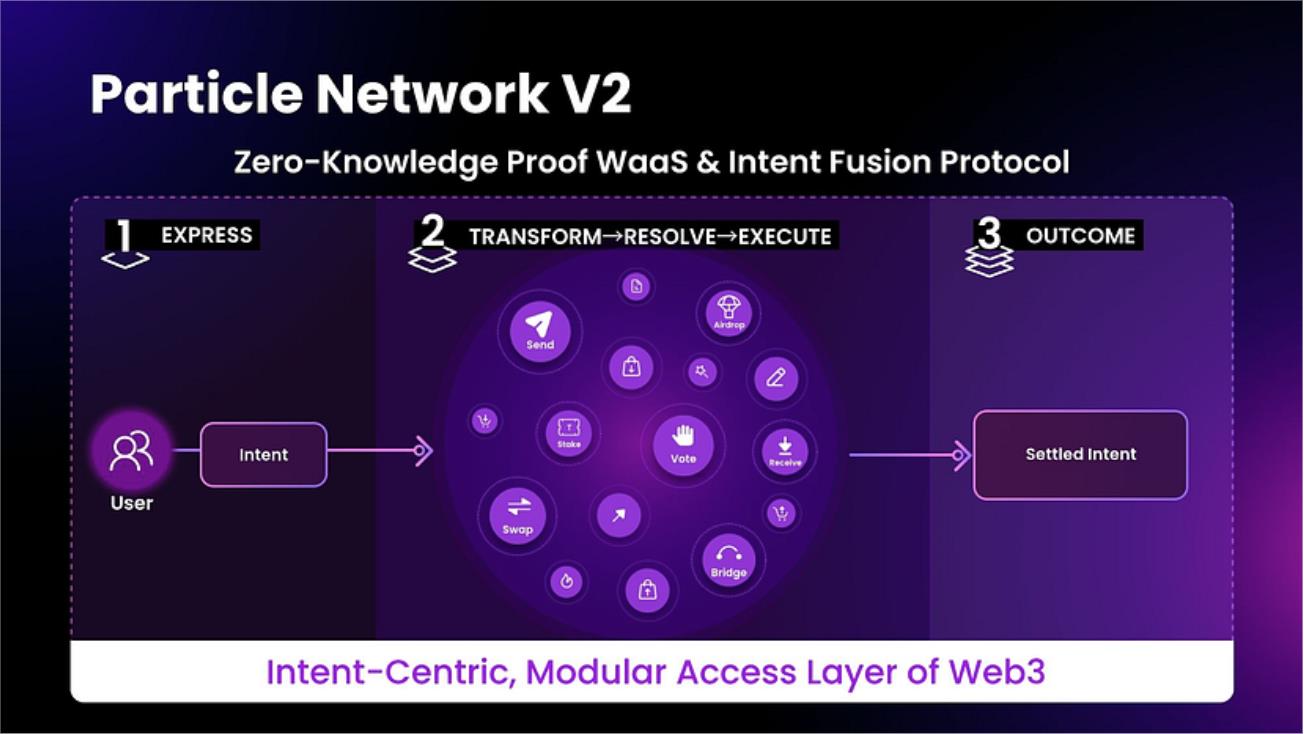
1. Product Architecture of Particle V2:

What kind of user experience will V2 deliver?
Users log in via applications enabled by Particle Network’s zkWaaS (enjoying the convenience of social logins while preserving their Web2 identity privacy). V2 enables users to fulfill complex needs—for example, automatically allocating ETH to the best-yielding on-chain products across any L1/L2, and when returns reach a certain threshold, automatically cashing out and depositing funds into Lido for risk-free yield.
With the Intent Fusion Protocol, Particle Network v2 will focus more on user intentions and expectations, rather than simply offering a set of complex features and configurations. This allows users’ true intents to be fulfilled at minimal cognitive and operational cost.
2. Design and User Experience of Intent Interpretation:
To ensure users can freely interact within the complex Web3 world, user experience is critical. Unlike early blockchain systems where users had to understand technical details, today's focus is on providing simple guidance for interacting with decentralized systems. In Web3, a user-friendly experience must be built upon intent-driven interactions, centered around these keywords:
-
Result-oriented: Users only need to express desired outcomes, not worry about implementation details.
-
Conditional authorization: Users authorize asset transfers and fees only after confirming the intended outcome has been achieved.
-
Competitive solvers: In an intent-driven world, both on-chain and off-chain solvers compete to fulfill user intents and earn rewards. The fiercer the competition, the higher the efficiency.
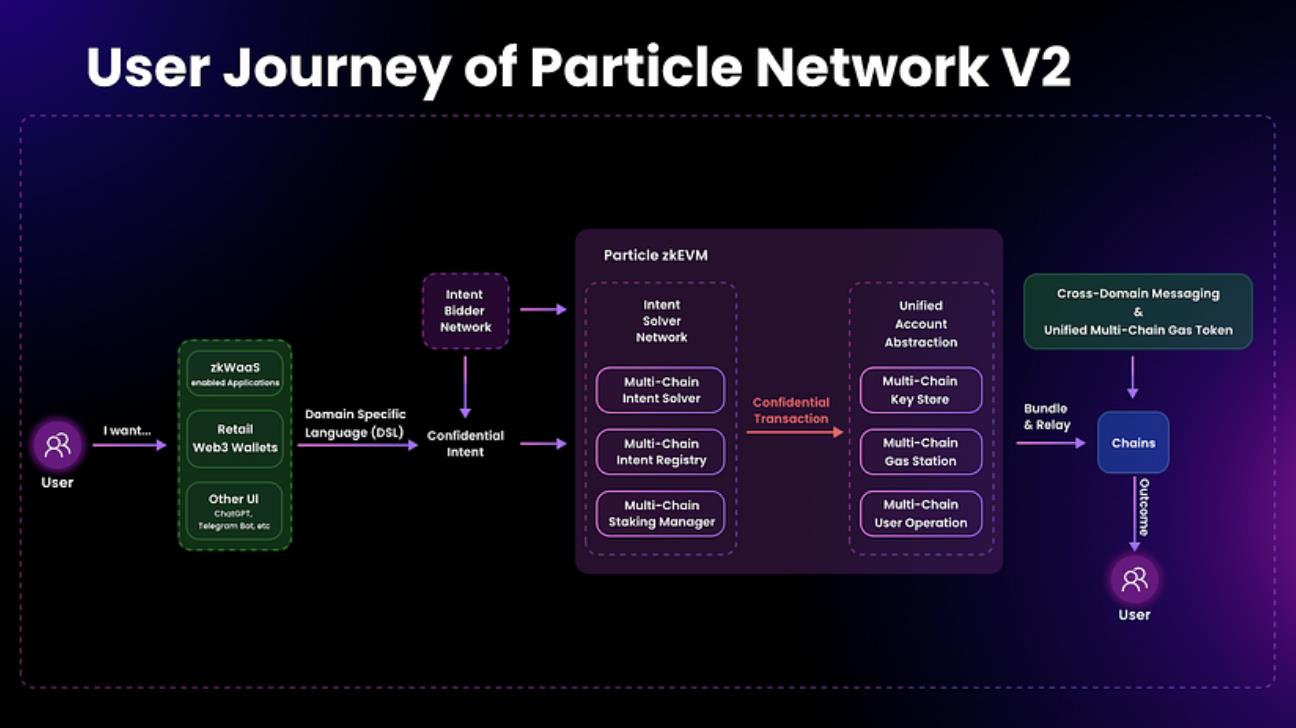
3. Full User Flow for Using Intents:
-
Users send their intent through ZKwaas, retail wallets, or bots like ChatGPT or Telegram.
-
The intent is parsed from natural language or templates, analyzed, converted into a standardized, machine-readable DSL, and developers are provided with a DApps Intent Framework to easily build support for any user intent.
-
The confidential intent, encrypted and privacy-preserving, is sent to the intent bidder network. Structured intents are deconstructed and combined with on- and off-chain bidders to create optimized, confidential intent objects.
-
The optimized intent proposals are sent to Particle’s ZKEVM, which handles two aspects: processing intents via the intent solver network, and executing transactions via AA wallets.
-
Solvers identify and classify user intents, plan optimal execution paths, construct required transactions, and forward them to the account abstraction wallet.
-
The AA wallet executes transactions, composed of a bundler and a paymaster. The bundler receives and schedules transactions from solvers, while the paymaster manages associated gas fees. The bundler simulates the wallet’s validateOp method off-chain to determine whether to accept or reject the transaction, then sends it to the AA system’s entry point to invoke handleOp. This process also bundles multiple user operations to optimize gas costs and extract MEV. Particle’s AA accounts allow one signature to trigger multi-chain operations.
-
The AA system’s entry point verifies and processes on-chain operations, ensuring all requirements and security checks are met before execution. Once successful, the entry point refunds ETH from the wallet’s deposit to the bundler, compensating them for their work and prepayment.
5. Finally, transactions derived from the intent are bundled and relayed to different chains, involving cross-chain messaging and unified multi-chain gas tokens.
6. Users sign the confidential intent object, and the intent solver network executes it, delivering the desired result.
From the end-user perspective, they simply interact with a button or express their intent through a ChatGPT-like interface. The structured intent is automatically deconstructed and executed by intent bidders and solvers, making it feel as if they just clicked a button or sent a message.
4. Notable Innovations in Particle’s Intent Workflow:
1. Intent Expression and Authorization:
-
How users express intent—from the end-user perspective, they simply click a button or use a ChatGPT-style interface;
-
What types and levels of intent users can express;
-
What level of authorization users grant.
2. DSL: A standardized intent language that makes it easier for solvers to understand and reason about user intent.
3. Standards for the Intent Bidder Network:
-
The intent bidder network is permissioned—participants must stake Particle tokens to join, and malicious bidders are subject to slashing;
-
The bidding process is competitive: the bidder who delivers the best trade outcome fastest wins and gets their proposal executed.
4. Solver Network:
-
Is it permissioned or permissionless? What are the criteria for becoming a solver?
-
Are there different types of solvers specialized in specific domains?
-
Winner-takes-all or distributed competition model?
-
How is solver performance verified? How do users and solvers settle payments?
5. How is intent completion verified?
-
Oracles are needed to transmit transaction results.
6. How is intent privacy ensured?
7. Why did Particle design a zkEVM, and what components does it include?
-
Particle’s zkEVM provides a decentralized key management system and a unified multi-chain AA architecture;
-
It enables cross-chain account abstraction, allowing users to execute multi-chain operations with a single signature;
-
Through IntentVM, it creates a unified Intent Mempool, passing structured confidential intent objects to solvers for transaction construction and execution;
-
The Accounting Manager and Intent Registry lay the foundation for secure on- and off-chain consensus collaboration.
These details will be revealed in Particle’s upcoming whitepaper, unveiling even richer technical insights.
5. Differentiation and Advantages of Particle’s Intent System:
Several projects are exploring intent-based systems with different approaches—Cow Swap, 1inch Fusion, UniswapX, Anoma, and Flashbots’ SUAVE have made progress, each with distinct deployment strategies and focuses. However, a unified “universal intent fusion protocol” is still needed to simplify operations for developers and users alike.
For more general-purpose intents, new architectures—including new intent languages and new VMs—are required. Particle already leads in AA wallets, with a broad customer base and strong B2B presence, and since wallets are closest to users, Particle enjoys a unique advantage. Moreover, Particle’s intent fusion layer will adopt an open approach, allowing other wallets and third-party dApps to connect (sharing the intent pool), giving it a significant first-mover advantage in the intent market.
-
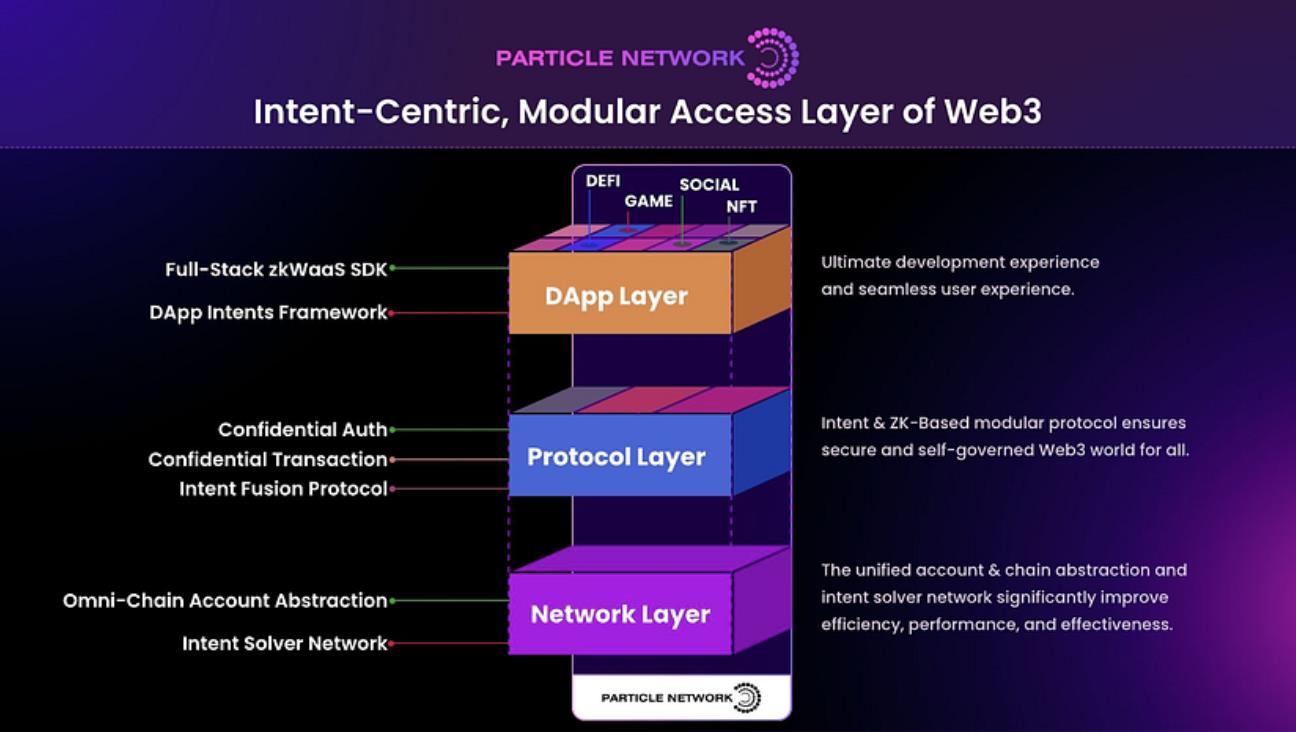
Particle’s Modular Intent Stack:
We observe that the Web3 industry has undergone major evolution in content delivery. The breakthrough lies in improving user interaction and transaction efficiency. Particle Network’s intent-centric, modular Web3 access layer can accelerate the transition of Web3 from an engineer-friendly financial sector to a consumer-grade, mass-market industry.
6. Private Transactions:
Private transactions consist of two parts:
-
How Particle protects users’ Web2 identity privacy;
-
How Particle protects users’ on-chain addresses and transaction privacy.
Web2 Identity Privacy:
Private transactions are a crucial milestone for mainstream Web3 wallet adoption. If users want to buy a coffee or receive salary payments on-chain, having such transactions publicly visible would severely hinder widespread usage. Efficiently enabling private transactions will be a breakthrough for Web3 to go mainstream and attract new users.
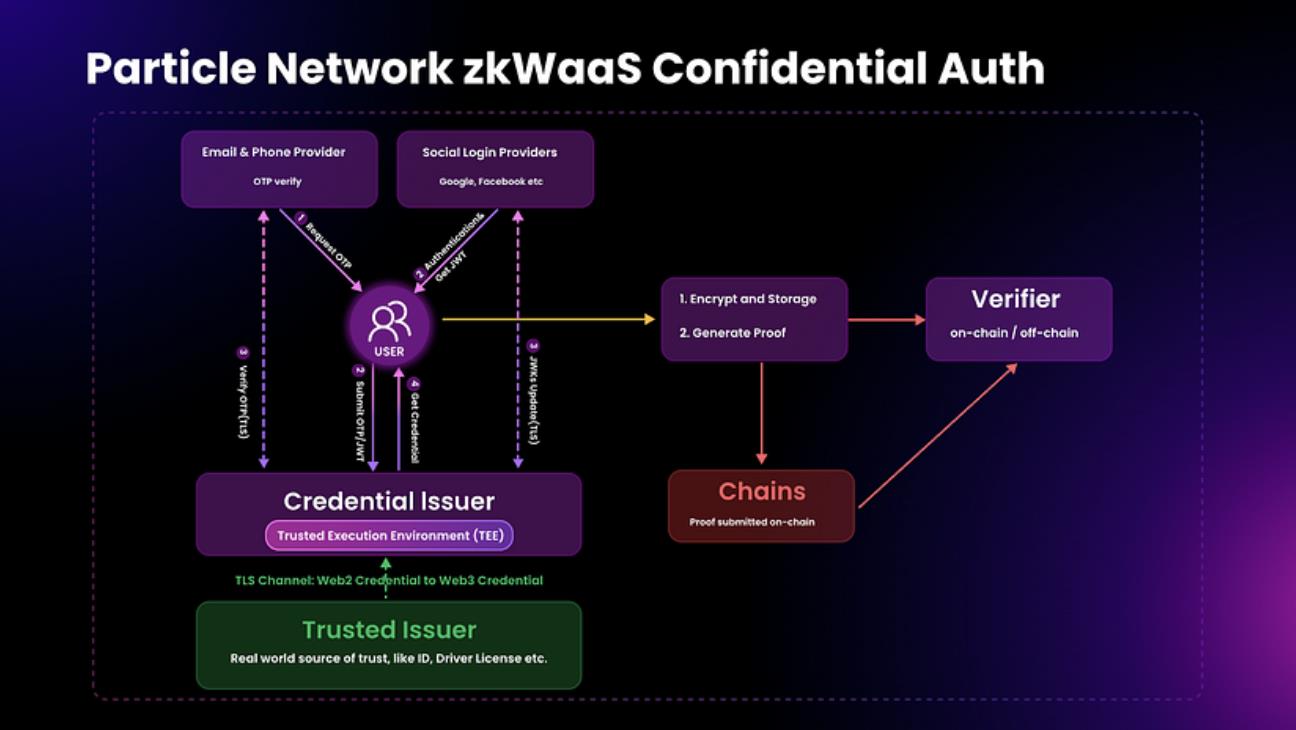
Particle v2 integrates zero-knowledge proofs (zkp) into its existing MPC-AA framework to achieve identity privacy, allowing users to hide their Web2 identities during login. This ensures login credentials and wallet addresses cannot be linked, enabling truly private authentication.
The industry has explored ZK-based identity solutions such as Holonym, Polygon ID, and Chainlink’s CanDID. By combining ZK, MPC, and Oracles, Web2 credentials can be transformed into verifiable Web3 attestations. Users only need to safeguard their Web3 credentials and generate corresponding ZK proofs when needed for on- or off-chain verification.
However, Particle’s zkWaaS faces challenges beyond credential generation and management—it must also balance user experience.
Particle does not want users to sacrifice the frictionless experience of Web2, so it introduces a fast mode using TEE, while supporting familiar, non-credential-based login methods like email and phone number.
In Particle’s design, users create wallets using fast mode (note: even in fast mode, no privacy is compromised), and silently generated Web3 credentials are persisted. Throughout this process, users incur no additional cognitive load—zkWaaS gradually helps manage Web3 credentials during user interactions.
In summary, zkWaaS ensures private logins, helps users generate and manage Web3 credentials, and preserves a seamless user experience.
The developer experience is equally straightforward. Compared to traditional WaaS, this new design also handles user data management, going beyond just providing signing capabilities.
This represents the future responsibility of any Web3 wallet or wallet infrastructure: expanding from private key and MPC shard management to broader user Web3 data management.
Web3 Stealth Addresses:
Particle adopts Vitalik’s design for stealth addresses, generating a temporary, private account address for each transfer. However, such temporary stealth accounts cannot send funds without gas—this is where AA wallets come in.
As a solution, Particle designed smart stealth addresses. User interactions occur through smart stealth accounts, elegantly solving the gas issue in coordination with paymasters.
In summary, zkWaaS addresses both off-chain and on-chain user privacy through confidential authentication and confidential transactions. It achieves this while maintaining full user control and regulatory compliance, laying a true foundation for mass Web3 adoption.
This perfectly aligns with the broader vision of enabling seamless integration for Web2 users without compromising privacy or security—achieving both user-friendliness and privacy protection. It demonstrates that building a Web3 infrastructure that is both secure and easy to use is entirely feasible, paving the way for broader public participation in decentralized networks.
Join TechFlow official community to stay tuned
Telegram:https://t.me/TechFlowDaily
X (Twitter):https://x.com/TechFlowPost
X (Twitter) EN:https://x.com/BlockFlow_News
 ABCDE
ABCDE