Tiger Research: Robinhood and Coinbase's Asian Ambitions – Western Exchanges Accelerate Expansion into the East
TechFlow Selected TechFlow Selected
Tiger Research: Robinhood and Coinbase's Asian Ambitions – Western Exchanges Accelerate Expansion into the East
This article analyzes the strategies of Western cryptocurrency exchanges expanding into Asian markets, their localization approaches, and the competitive landscape with regional players.
 Navigating Web3 tides with focused insights
Authors: Chi Anh, Ryan Yoon, and Yoon Lee
Translation: TechFlow
Brief Summary
-
Western centralized exchanges (CEXs) targeting Asia: Companies like Robinhood and Coinbase are expanding into Asia by leveraging regulatory-friendly hubs and localized strategies.
-
Regional platforms maintain strong positions: Local exchanges retain competitive advantages due to their entrenched market presence, presenting significant challenges for Western entrants seeking dominance in Asia.
-
Localization is key to success: Winning strategies involve partnerships with financial institutions, compliance with regulations, and launching customized products and services aligned with local user behaviors.
1. Exploring East-West Dynamics in the Crypto Market
Asia dominates the global crypto landscape across three dimensions: 1) leading trading volumes, 2) widespread retail adoption, and 3) active institutional innovation. Its dynamic economies and high retail participation make it a central force within the global crypto ecosystem.
As a result, many Western exchanges—whose domestic markets are nearing saturation—are increasingly turning to Asia as their next frontier for expansion. For instance, Robinhood plans to establish its headquarters in Singapore, while Coinbase is entering Southeast Asia via localized stablecoins—highlighting Asia’s strategic importance.
However, this market is far from blank. Local centralized exchanges (CEXs) already enjoy extremely high user penetration, and global players like Binance remain widely popular. These factors indicate that Western newcomers will face intense competition.
This report analyzes the evolving competitive landscape of Asia’s crypto market, exploring strategic moves by Western and regional participants, the challenges they face, and emerging opportunities for collaboration within this rapidly developing ecosystem.
2. How Western Players Are Entering the Asian Market
2.1 Robinhood's "Compliance-First" Strategy

Robinhood’s move into Singapore marks a strategic positioning within Asia’s fast-growing digital asset market. The company announced the acquisition of Bitstamp, a European digital asset exchange, for $200 million—aimed at securing regulatory approvals and integrating into Singapore’s crypto-friendly framework. Bitstamp has received in-principle approval from the Monetary Authority of Singapore (MAS), giving Robinhood a significant regulatory advantage and streamlining its market entry.
According to Bloomberg, Robinhood plans to launch crypto products in Singapore in 2025 through a newly formed entity. Although the acquisition of Bitstamp remains pending, the in-principle approval from MAS provides a solid foundation for Robinhood’s compliance strategy.
By prioritizing regulatory compliance, Robinhood distinguishes itself from offshore platforms operating in legal gray areas. The company aims to attract compliance-conscious retail traders and institutional investors by ensuring safety and regulatory adherence.
Robinhood’s expansion into Singapore is part of a broader international growth strategy. It has already launched crypto trading in Europe and introduced stock options in the UK. As licensing expands, Robinhood is working to offer comprehensive services across multiple regions, spanning both digital and traditional finance.
Selecting Singapore as a regional base is no accident—the country offers a transparent regulatory framework, concentrated institutional capital, and a growing base of crypto users. These factors make Singapore an ideal springboard for Robinhood to test and scale its Asian crypto operations.
This strategic foothold reflects a broader trend among Western CEXs: entering Asia through regulated hubs like Singapore before gradually expanding into more complex markets. As regulatory clarity improves across the region, Robinhood is expected to extend its services beyond Singapore, using it as a launchpad for wider growth.
2.2 Coinbase’s Stablecoin and Infrastructure Strategy
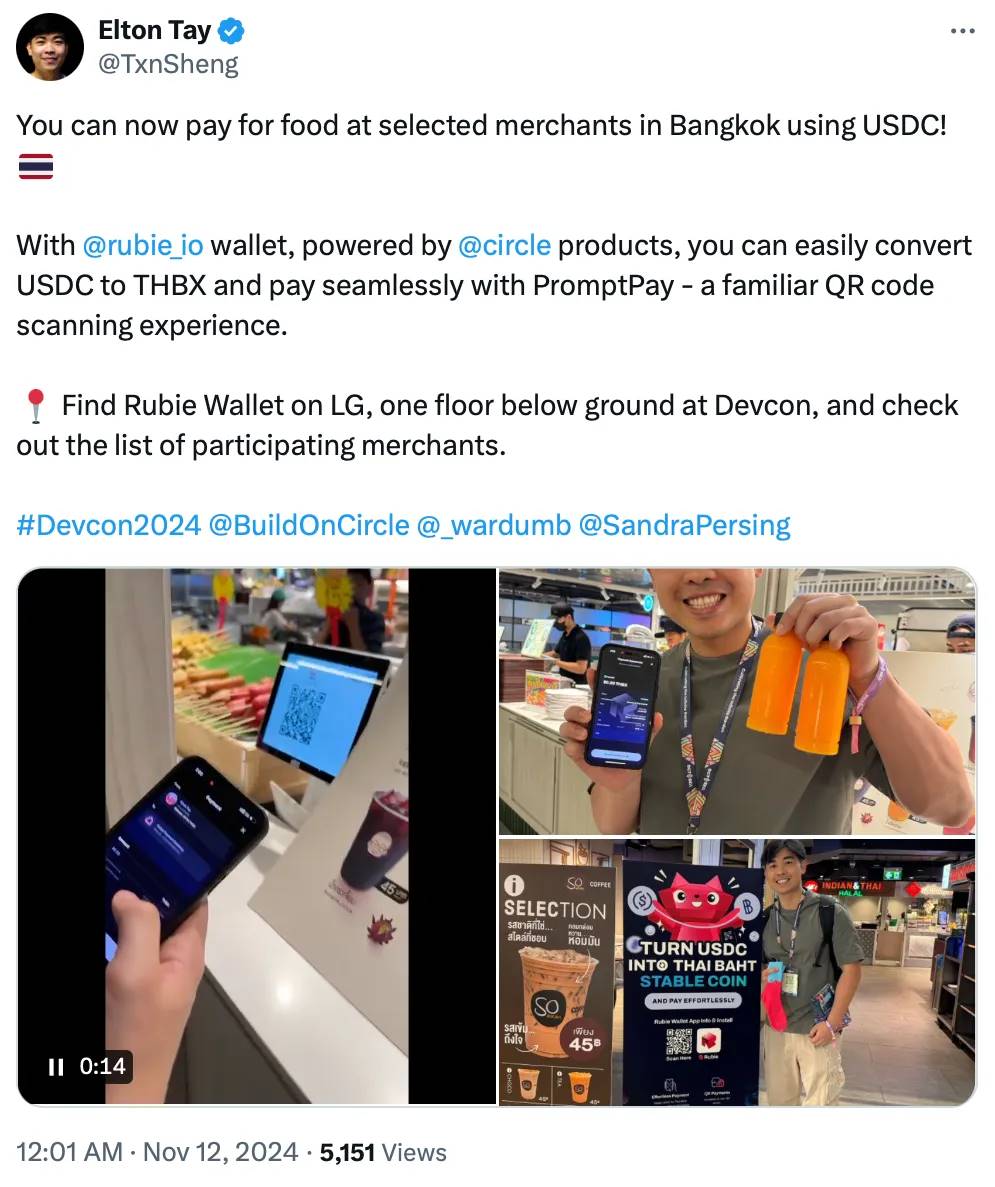
Coinbase is expanding into Southeast Asia with a strategy centered on stablecoins. Thailand and the Philippines are advancing projects for local currency-pegged stablecoins—a direction closely aligned with Coinbase’s goals. Thailand is testing stablecoins through its Phuket Sandbox Initiative (Phuket Sandbox Initiative), while the Philippine central bank has approved a pilot program for a peso-pegged stablecoin—both indicating openness from local regulators toward such innovations.
Source: X (@TxnSheng)
To support this trend, SCB 10X recently launched the Ruby Wallet, built on Base and powered by Fireblocks’ “wallet-as-a-service” infrastructure. This wallet supports Thai Baht ($THBX) and USD stablecoins, contributing to the development of local infrastructure that aligns with Coinbase’s overall objectives—especially in promoting the use of Base and THB stablecoins.
In addition, Coinbase integrated Transak into its wallet in 2022, enabling users to purchase cryptocurrencies using local currencies and payment systems. This reflects Coinbase’s broader market-entry strategy: rather than directly expanding its exchange business, it focuses on wallet services and Base, aligning with government-leddigital currencyinitiatives. This approach contrasts sharply with Robinhood’s direct exchange expansion model.
Through these strategic partnerships, Coinbase is gradually embedding itself into Asia’s evolving digital economy. This method illustrates how Western firms aim to grow by building infrastructure rather than directly competing with dominant regional exchanges.
These two cases represent different market entry models: Robinhood emphasizes regulatory compliance and attracting institutional investors, while Coinbase focuses on financial infrastructure and the practical utility of stablecoins. Both strategies hold growth potential, but their success will depend on how well these companies navigate Asia’s complex regulatory and competitive environment.
3. Market Dynamics: Regional Powerhouses vs. Western Newcomers
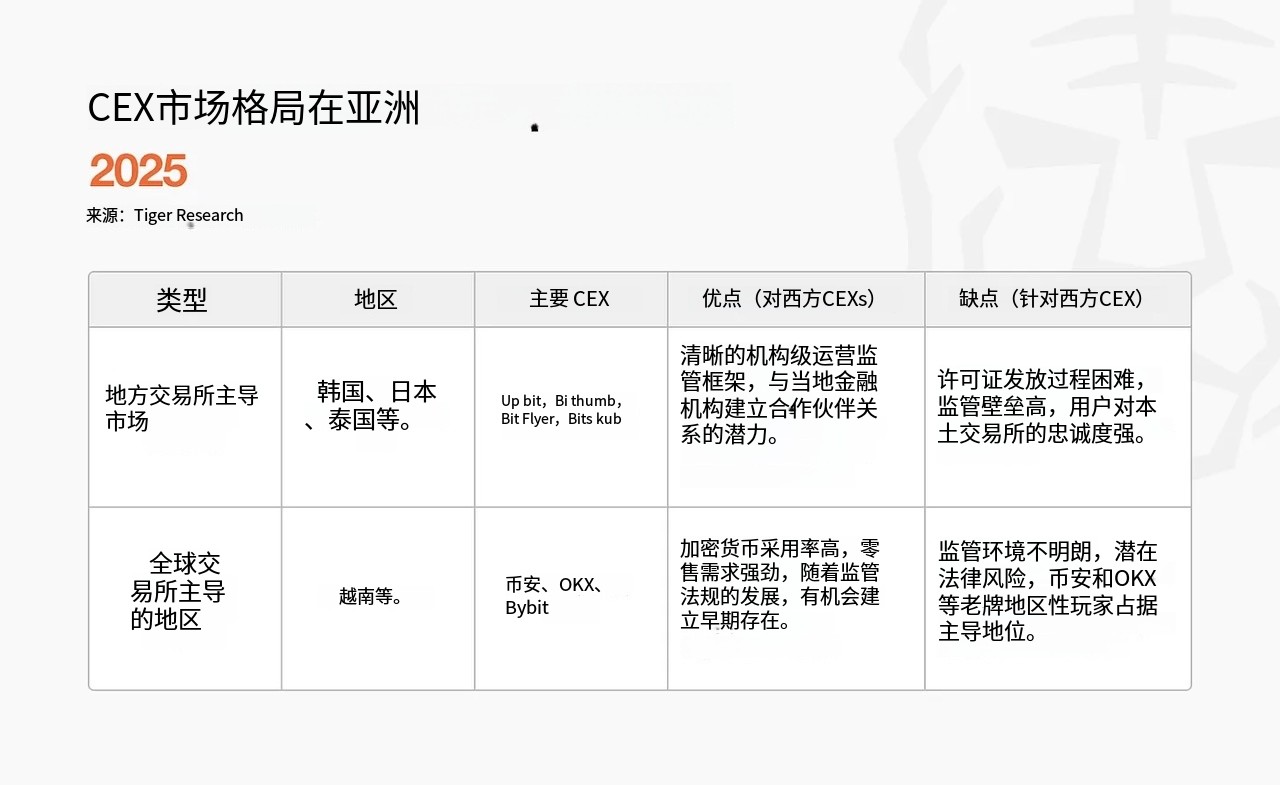
Asia’s diverse regulatory landscape has led to local exchanges dominating in certain regions, while creating opportunities for global CEXs elsewhere. For Western CEXs aiming to expand in Asia, understanding these differing market structures is crucial.
(Note: AI translation applied to original image; minor textual inaccuracies may exist.)
3.1 Local Exchanges Dominate Key Markets
South Korea exemplifies a market dominated by local exchanges, where strict regulations have enabled platforms like Upbit and Bithumb to thrive. These platforms gain advantage by complying with rigorous requirements—including Travel Rule compliance and financial reporting obligations. Such regulations create high barriers to entry, making it difficult for Western CEXs to enter without substantial licensing and compliance investments.
Japan similarly features a highly regulated environment where local exchanges such as BitFlyer and Coincheck maintain dominance. The Financial Services Agency (FSA) enforces strict licensing rules, allowing only highly compliant entities to operate. Foreign exchanges like KuCoin and Bybit have received regulatory warnings, further highlighting the hurdles Western firms face when entering Japan.
On the other hand, Binance successfully entered Thailand through a strategic partnership with Gulf Energy, a major Thai conglomerate. They formed a joint venture to launch a regulated digital asset exchange. This collaboration secured Binance licensing approval from the Thai Securities and Exchange Commission (SEC), ensuring compliance while leveraging Gulf Energy’s deep business networks in Thailand.
By partnering with influential local companies, Western exchanges can find compliant and scalable pathways into restricted markets. Such alliances reduce regulatory friction and provide access to established commercial networks. Rather than directly challenging dominant local players, Western exchanges may achieve greater success by forming local partnerships, focusing on institutional services, or offering specialized financial products tailored to regional needs.
3.2 Global Exchanges Dominate Other Markets
Countries like Vietnam present a contrasting market structure. Due to the lack of clear regulations for crypto exchanges, local platforms struggle to develop. Even where local exchanges exist, high taxes push investors toward global alternatives.
In this regulatory vacuum, global exchanges such as Binance, OKX, and Bybit have significantly expanded their influence. By offering low-fee policies and peer-to-peer (P2P) services, they effectively meet user demand—gaining market share especially in areas underserved by local platforms.
As part of their market entry strategy, global exchanges actively employ grassroots marketing to rapidly acquire users. Tactics include launching localizedTelegramcommunities, referral reward programs, and enhanced local language support. These initiatives build direct communication channels with users, effectively boosting market penetration.
However, many platforms typically operate in legal gray zones due to unclear regulatory frameworks. With increasing global regulatory scrutiny, compliance with local laws has become essential. This shift is prompting major operational changes among global exchanges.
Notable examples highlight this trend. In January 2024, Indian financial enforcement authorities blocked IP addresses of nine foreign exchanges including Binance—only restoring access after Binance committed to regulatory compliance. In November 2023, the Philippine SEC issued a warning to Binance over unauthorized operations, officially ordering the blocking of its website and app in March 2024. These actions clearly signal tightening regulatory oversight.
In response, global exchanges are gradually abandoning operations in legal gray areas and adapting their businesses to fit explicit legal frameworks. Compliance is no longer optional—it is now foundational to sustainable, long-term operations. As the crypto industry matures, this trend is expected to intensify.
4. Market Penetration Strategies

OKX billboard in Vietnam. Source: OKX
Success in Asia’s crypto markets requires deep localization—not just simple language translation. Exchanges must integrate local currencies, follow regional asset trends, and connect with local payment systems.
In Vietnam, supporting Vietnamese Dong (VND) via P2P services and running strategic outdoor advertising campaigns have helped CEXs establish strong market positions. Similarly, hosting events aligned with local festivals enhances brand awareness and visibility.
Understanding user behavior is another critical factor. In remittance-heavy economies like the Philippines, platforms such as Coins.ph have attracted large user bases by offering crypto-based remittance solutions. Coinbase follows a similar path, introducing stablecoins pegged to the Thai Baht and Philippine Peso to improve fiat-to-crypto conversion efficiency. These tailored financial products address localized needs and drive retail adoption.
Finally, forming strategic partnerships with local financial institutions is vital for building trust and expanding reach. For example, in Thailand, collaborations with banks have facilitated fiat onboarding, lowering the barrier to entry for retail investors.
To compete effectively in Asia’s complex and fast-changing crypto landscape, Western CEXs must prioritize regulatory compliance, ecosystem collaboration, and localized innovation.
5. Future Outlook: Cooperation Over Competition
Rather than trying to displace market leaders, Western CEXs may achieve greater success through cooperation. They could partner with local exchanges instead of competing directly—positioning themselves as compliance allies or infrastructure providers working in coordination with regulators.
Today, Asia represents both immense opportunity and challenge. Success here demands not only operational scale but also deep understanding of regional market dynamics, user behavior, and evolving regulatory frameworks.
Crypto regulation is rapidly evolving across nations—particularly in Asia, where changes are especially swift. Western exchanges planning to expand must adopt a “compliance-first, collaboration-driven” strategy. For any CEX eyeing the Asian market, the most important lesson is clear: this is not a market to conquer, but one to integrate into.
Join TechFlow official community to stay tuned
Telegram:https://t.me/TechFlowDaily
X (Twitter):https://x.com/TechFlowPost
X (Twitter) EN:https://x.com/BlockFlow_News
 @tiger_research