OKX Wallet APP's Independent Split: From Super App to App Matrix, OKX ushers in a New Development Phase and Strategic Approach
TechFlow Selected TechFlow Selected
OKX Wallet APP's Independent Split: From Super App to App Matrix, OKX ushers in a New Development Phase and Strategic Approach
OKX has officially transitioned from a "super app model" to an "app matrix model."
 Navigating Web3 tides with focused insights
By Yue Xiaoyu
OKX won't leave competitors much time. After a week of overtime work, the brand-new OKX Wallet app has already launched.
This marks OKX’s official transition from a "super app" model to an "app matrix" model.
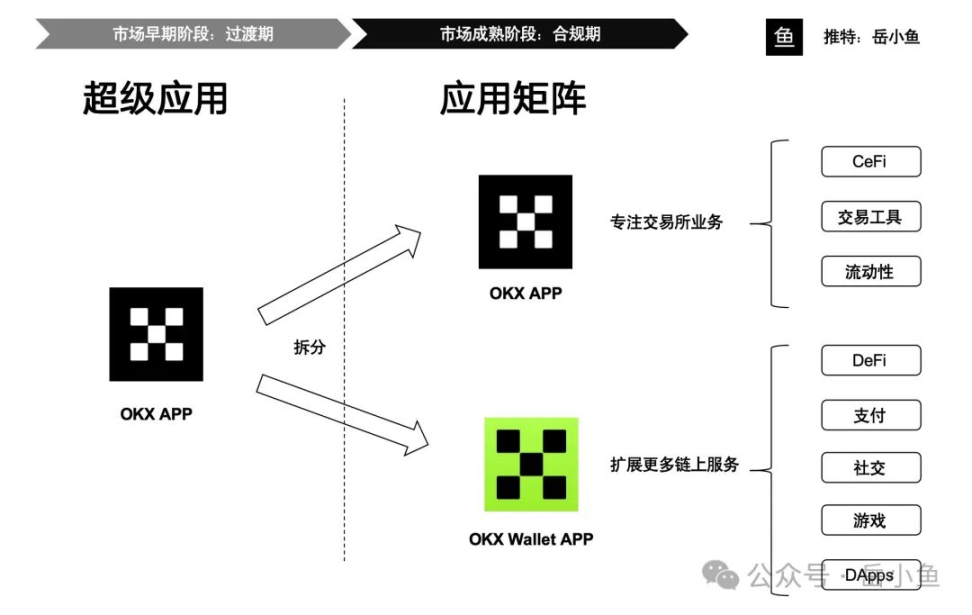
1. Why shift from a super app to an app matrix?
Every product model has its boundaries and lifecycle.
We need to understand OKX's product evolution within the broader context of industry development.
Initially, the "super app" model was a natural choice.
The entire industry has been transitioning from off-chain to on-chain—a slow process that has lasted for years.
During this transitional period, OKX Exchange App effectively met users’ diverse needs through one-stop services.
Web3 user bases were still immature, with extremely high market education costs. A "full-service" app could quickly attract traffic, lower user barriers, and leverage internal ecosystem synergies for user retention and growth.
At that stage, no other project had OKX’s resources, and no other exchange had OKX’s single-minded determination.
By fully committing its resources, OKX naturally became a leader and infrastructure provider in the Web3 world.
However, as the crypto industry matures, user demands are becoming increasingly diversified and specialized—revealing the limitations of the super app model.
Firstly, stacking features brings convenience but also leads to bloated user experiences, making it hard for users to focus on core tasks within a single interface.
Secondly, tightening regulations place high compliance demands on super apps—especially when decentralized finance (DeFi) coexists with centralized services, creating uncontrollable risks.
The temporary suspension of OKX DEX was precisely such a conflict coming to a head.
Now, by spinning off OKX Wallet, OKX is directly responding to market changes and proactively addressing future compliance issues.
In summary, the "super app" model has fulfilled its historical mission; the "app matrix" model is now inevitable.
OKX Wallet has not only completed cold-start growth and drawn substantial users from the OKX Exchange, but also spent considerable time shaping user mindsets, while the overall market has gradually matured.
Shifting to an “app matrix” model at this point is therefore a natural progression.
2. Is the app matrix truly better?
We can draw insights from the evolution of product models in Web2.
An interesting observation: Chinese apps are mostly super apps—like WeChat and Alipay—while overseas apps tend toward app matrices, with each focusing on a single function.
This stems from various historical and market factors:
First, different paths of internet evolution;
China achieved a "leapfrog" in the mobile internet era, skipping the prolonged PC internet adoption phase and moving directly into smartphones.
Convenience is paramount on mobile devices—users prefer fulfilling all needs within one app rather than switching frequently between apps.
WeChat, for example, evolved from instant messaging to include payments, ride-hailing, shopping, and even government services—allowing users to complete most daily tasks without leaving the app.
In contrast, Western markets (especially North America and Europe) experienced a gradual shift from PC to mobile.
On PCs, users were accustomed to single-function software (e.g., Outlook for email, PayPal for payments), a habit carried over to mobile, leading to today’s preference for specialized, focused applications.
Second, differing technical ecosystems;
China’s highly centralized infrastructure (such as QR code payments and logistics networks) supports super apps, enabling seamless integration across multiple scenarios.
Abroad, mobile ecosystems heavily rely on OS-level integration (iOS, Android), where users handle multitasking via system notifications, search, and cross-app collaboration instead of depending on one single app.
For instance, Apple’s Siri and Google Assistant seamlessly connect multiple standalone apps—eliminating the need for a “super entry point.”
This stands in stark contrast to China’s super apps acting as central hubs of their ecosystems.
Third, differing regulatory environments;
Relatively lenient early-stage regulation in China provided fertile ground for super app expansion.
WeChat and Alipay broke through traditional financial constraints in payments, rapidly integrating online and offline services.
But strict data privacy and financial service regulations in Western markets limit such cross-domain integration.
Payment services require separate licenses, and social platforms venturing into finance face significant compliance risks.
Hence, Western companies prefer splitting functions into independent apps to reduce legal risks and increase flexibility.
In short, we see differences across cultures, behaviors, markets, and regulations between East and West.
OKX’s shift from super app to app matrix reflects a strategic adjustment—from a “China-centric approach” to a more “globalized strategy.”
In China, OKX’s super app model—integrating trading and wallet functions—quickly attracted users in line with local habits.
But globally—especially in Western markets—regulatory requirements and user preferences push international products toward app matrices to meet compliance, specialization, and open-ecosystem demands.
OKX’s future is clearly global.
3. How do strategies differ between super apps and app matrices?
The strategic approaches of app matrices and super apps are vastly different—OKX must now adjust its product growth strategy accordingly.
Implementing an app matrix means OKX must completely move past its previous growth model.
In the super app era, OKX relied heavily on centralized traffic distribution—leveraging the main app’s massive user base for internal cross-conversion across its ecosystem.
Now, the app matrix requires OKX to shift from a “traffic mindset” to an “ecosystem mindset,” building a more open and diverse ecosystem through synergy among multiple products.
From a product manager’s perspective, OKX Wallet’s growth strategy can focus on several directions:
First, shifting from traffic concentration to ecosystem collaboration;
Previously, OKX leveraged the exchange app’s massive traffic, guiding users internally to wallet features—the growth logic centered on “traffic distribution.”
Now that OKX Wallet is independent, the closed traffic loop is broken, requiring a shift toward ecosystem collaboration.
For example, partnering with top-tier DApps and public chains to attract native Web3 users.
Second, shifting from feature integration to product excellence;
Previously, OKX pursued comprehensive functionality—its exchange app handled trading, wallets, and DeFi simultaneously, leading to scattered resources.
Now, each product can focus deeply on its domain.
OKX Exchange should enhance trading efficiency (e.g., low latency, high liquidity), while OKX Wallet focuses on superior decentralized experiences (e.g., multi-chain support, optimized on-chain transaction flow).
Third, shifting from unified operations to precise targeting;
Previously, OKX operated under a unified brand and user experience, catering to general user needs.
Now, different products can implement targeted strategies for distinct user segments.
The wallet targets native Web3 users, emphasizing decentralization and security; the exchange serves traders, highlighting efficiency and reliability.
In short, OKX Wallet now has a more independent brand and clearer positioning—opening up far more possibilities.
The wallet’s future extends beyond asset management and trading—it can explore new opportunities in payments, social interactions, gaming, and more, breaking out of traditional crypto user circles and achieving true mass adoption.
Of course, for existing users accustomed to the super app, OKX still needs incentive mechanisms (e.g., airdrops, loyalty points) to reduce migration friction and cultivate new usage habits.
Meanwhile, the relationship between OKX Exchange and OKX Wallet needs redefining—they are no longer hierarchical entities, but collaborators exploring different domains.
Through APIs, brand collaborations, and joint marketing initiatives, OKX can maintain independence while enabling resource complementarity and sharing.
In Summary
OKX’s transformation from super app to app matrix is a major milestone in its development journey—and necessitates a recalibration of future strategic direction.
The super app has fulfilled its historical mission, laying a solid market foundation for OKX.
The launch of the app matrix now signals OKX entering a more complex, yet full of greater possibilities, new phase.
The next round of wallet wars is already heating up.
Join TechFlow official community to stay tuned
Telegram:https://t.me/TechFlowDaily
X (Twitter):https://x.com/TechFlowPost
X (Twitter) EN:https://x.com/BlockFlow_News