








Decoding Binance Research's Airdrop Report: From Simple Distribution to Complex Game Theory, Where Is the Future of Airdrops Heading?
TechFlow Selected TechFlow Selected
Decoding Binance Research's Airdrop Report: From Simple Distribution to Complex Game Theory, Where Is the Future of Airdrops Heading?
Project teams need to listen more to the community's voice.
 Navigating Web3 tides with focused insights
Author: TechFlow
If there are still newcomers entering the industry, airdrops will likely remain their first stop.
From simple "free money" farming to complex games of strategy between projects and users, airdrops have gradually become something people both love and hate.
For users, the appeal lies in the massive returns successful airdrops can bring—but frustration arises from complicated rules, tedious tasks, and opaque distribution mechanisms.
For projects, airdrops still generate short-term traffic and attention, but issues like botting and declining community trust are major headaches.
People change.
After multiple market cycles, crypto users still dream of “free lunches,” but their behavior has become more rational. Meanwhile, projects are realizing that simple airdrops no longer meet community-building needs, turning instead to more sophisticated and transparent distribution models.
For example, Hyperliquid’s airdrop was highly praised for rewarding early users, while Redstone’s airdrop sparked strong backlash due to last-minute changes in allocation ratios.
It's 2025—can airdrops still deliver value?
Recently, Binance Research released a report titled "Where Are Our Airdrops Going?", offering deep insights into the current state, challenges, and potential improvements of airdrops—perhaps paving the way for better solutions for both projects and users.
TechFlow has summarized the core content of this report. Key takeaways are as follows:
Key Takeaways
-
Despite many shortcomings, airdrops remain a significant force in the industry.
-
Two popular types of airdrops:
-
Retroactive Airdrops: Reward existing users based on past activity, aiming to strengthen community loyalty.
-
Engagement Airdrops: Announce upcoming token events in advance and set tasks to incentivize participation—ideal for early-stage projects seeking market share and initial user growth.
-
-
Areas for improvement:
-
Clear allocation rules and criteria help reduce user dissatisfaction and confusion.
-
Projects should listen more closely to community feedback.
-
Avoid over-allocating tokens to insiders or whales, which harms ordinary users.
-
The use of on-chain monitoring tools and "proof-of-humanity" technologies could reduce sybil attacks, making airdrops fairer and more efficient.
-
These key points provide a clear framework for understanding the current state and future direction of airdrops.
From Simple Distribution to Complex Game Theory
Counting from the first airdrop in 2014, airdrops have been around for a decade.
The first notable airdrop was Auroracoin in 2014, aimed at distributing a national cryptocurrency to Icelandic residents. Back then, users simply entered their permanent resident ID on the Auroracoin website to claim tokens.
In contrast, Hyperliquid’s HYPE airdrop (November 2024) may be one of the largest and best-received airdrops to date, reinforcing the role of airdrops as powerful tools for user engagement. At its peak valuation exceeding $10 billion, the HYPE token airdrop surpassed Uniswap as the largest airdrop by peak price.
However, to combat rising sybil attacks, projects have increasingly raised the complexity of eligibility requirements.
Unlike early airdrops, today’s campaigns often require users to complete multiple tasks—such as using testnets, engaging on social media, participating in governance, downloading mobile apps, or transferring funds across chains. These actions directly benefit the project by increasing on-chain revenue/activity or boosting social visibility.
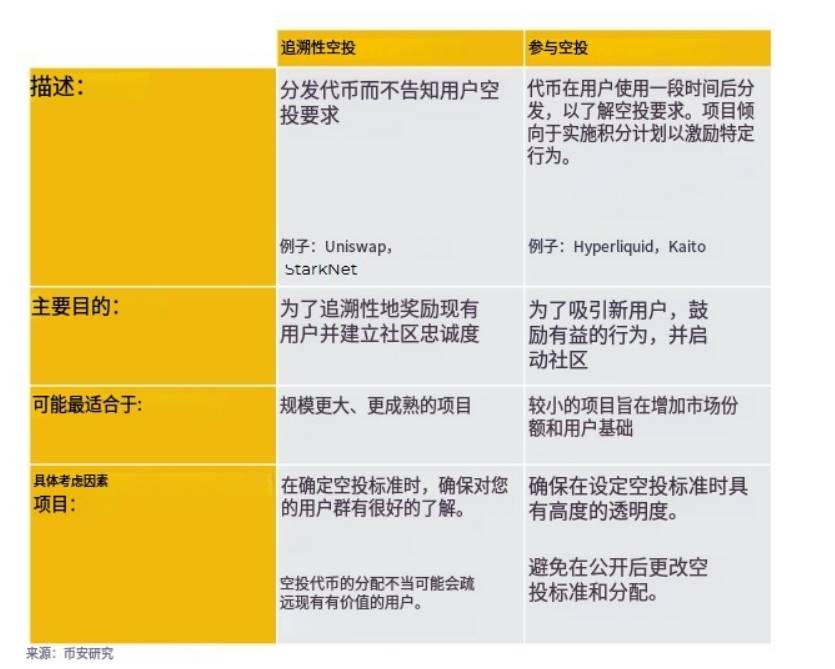
Modern airdrops can be broadly categorized into two types:
Type 1: Retroactive Airdrops
Early examples like Auroracoin, Uniswap, and StarkNet did not publicly announce their airdrops beforehand—the goal being to reward existing users and boost loyalty.
Characteristics:
-
User-centric
-
Typically executed by protocols already possessing large user bases and market share.
-
No need to rely on airdrops to bootstrap an initial user base.
Best suited for: Mature protocols looking to reward existing users and solidify community relationships.
Type 2: Engagement Airdrops
Projects announce upcoming token generation events and incentivize users to perform specific activities.
Characteristics:
-
Project-centric
-
Primarily used to attract new users and capture early market share.
-
Often employ point systems or gamified incentives to drive user behavior.
Notable examples: Redstone, Kaito, and Hyperliquid.
Best suited for:
New projects needing to stay competitive with rival protocols—many of which also use token-based incentives.
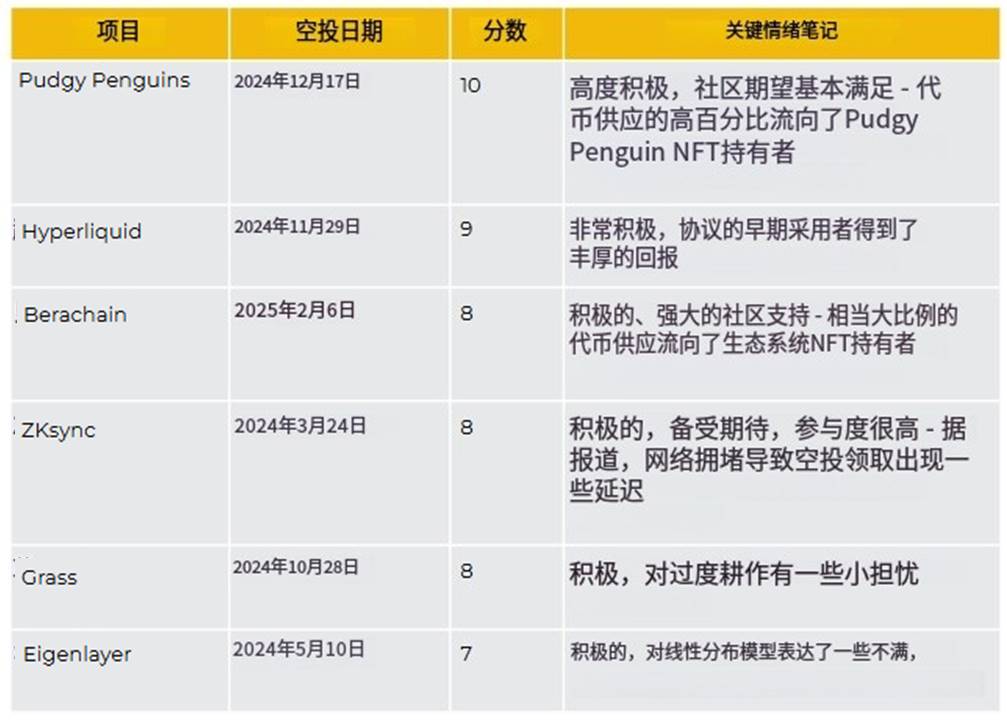
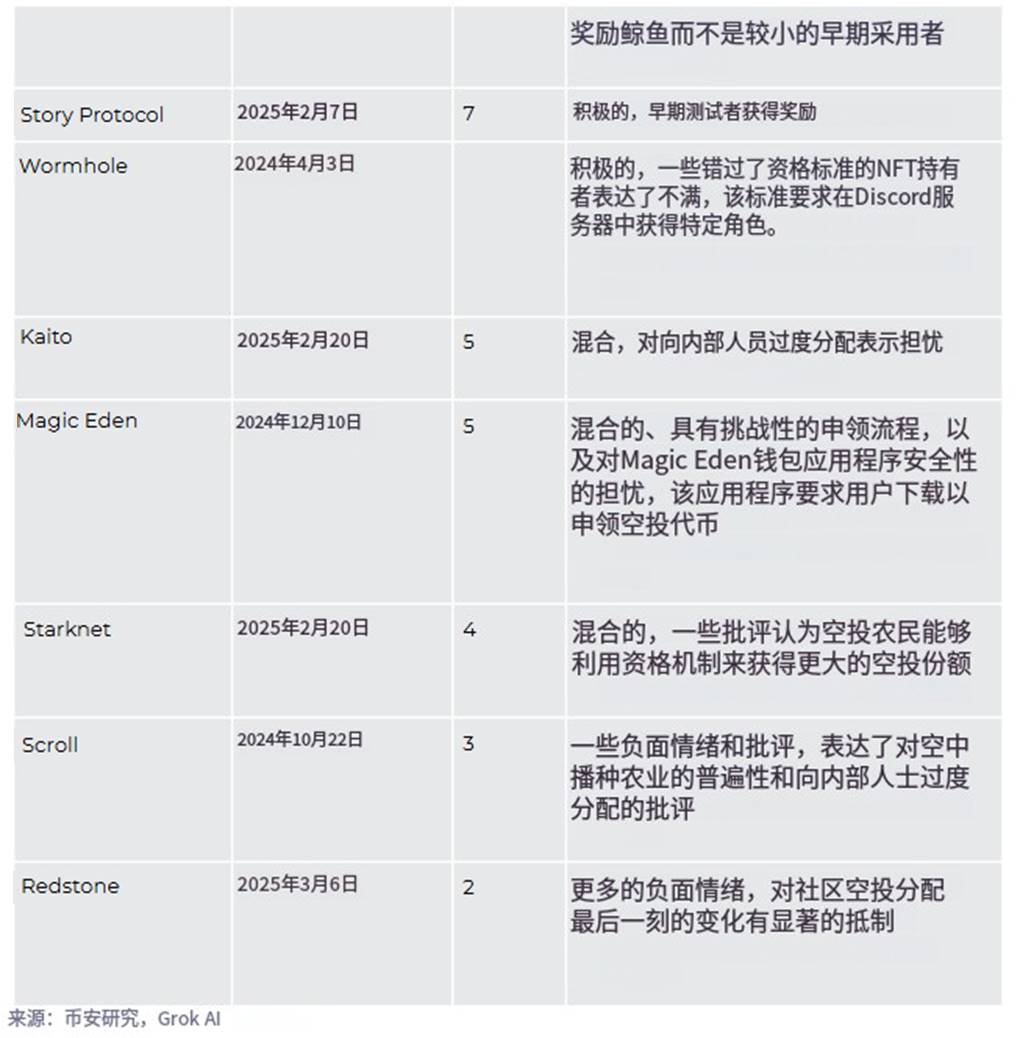
Sentiment Analysis of Token Airdrops Over the Past Year
To better understand recent developments, the report uses Grok AI to conduct a brief sentiment analysis of several prominent airdrops over the past year, assigning scores based on public reaction.
Data sources: Posts on X (formerly Twitter), including community feedback—both positive and negative comments, engagement levels, and specific praise or criticism.
Grok also reviewed official announcements, tokenomics designs, and airdrop eligibility criteria from online articles. Sentiment is classified as positive, negative, or mixed based on dominant reactions.
The following table is sourced directly from the report and translated via AI—some wording may carry ambiguity. However, the numerical scores reflect real community perceptions, with higher scores indicating more favorable sentiment.
Lessons Learned from Past Airdrops
Last-Minute Reduction in Allocation Ratios
Some crypto projects initially promise a certain percentage of tokens to the community, only to later reduce it—reallocating those tokens to insiders or treasury funds. Recently, Redstone faced strong community opposition after reducing its community allocation from 9.5% to 5% just before token distribution. Many community members viewed this as unfair.
Lessons:
-
Clearly define allocation ratios upfront: Communicate token distribution plans clearly before the Token Generation Event (TGE).
-
Avoid last-minute changes: Refrain from making ad-hoc adjustments to allocations.
-
Negotiate with stakeholders when necessary: If changes are unavoidable, avoid unilateral decisions. Engage key stakeholders—including investors, community members, and exchanges—in discussions with full transparency.
Unclear Eligibility Criteria and Mismatched Expectations
Some projects communicated unclear eligibility standards, leading to uneven rewards that failed to accurately reflect actual user activity. Scroll’s October 2024 airdrop—which distributed 7% of its total SCR supply (70 million tokens)—was criticized for its arbitrary snapshot mechanism and hidden rules.
Lessons:
-
Communicate rules clearly: Ensure transparency so users don’t have to guess—misaligned expectations lead to disappointment.
-
Combat sybil attacks: Consider using on-chain monitoring tools or proof-of-humanity verification to reduce abuse.
Over-Allocation to Insiders and KOLs
Many projects allocate a disproportionately large share of tokens to teams, investors, and VCs, leaving little for the community. For instance, during KAITO’s February 2025 airdrop, 43.3% of tokens went to team and investors, while only 10% was allocated to the community—sparking public debate on X.
Some projects heavily allocate tokens to influencers (KOLs), who may dump immediately upon TGE, diluting value and harming genuine users. KAITO reportedly faced controversy for allocating large amounts to influencers who sold shortly after launch, negatively impacting price and eroding community trust.
Lessons:
-
Carefully consider allocation ratios: Learn from similar projects’ distribution outcomes and monitor market reactions.
-
Implement vesting and lock-up mechanisms: Apply vesting schedules and token locks for insiders and influencers to reduce immediate post-TGE sell pressure and better align their interests with long-term project goals.
Technical Barriers in Claim Process
Complex or buggy claim processes can prevent users from receiving tokens, effectively reducing payouts and undermining the entire purpose of the airdrop.
For example, Magic Eden’s December 2024 airdrop aimed to promote its mobile wallet app, but reports of bugs and unclear instructions led to user frustration rather than excitement on X.
Lessons:
-
The claim process is often a user’s first meaningful interaction with a project. Ensuring a smooth and user-friendly experience increases the likelihood of user retention.
How Can Airdrops Improve?
Increase Transparency
-
Set clear objectives: Project teams should define clear goals for each airdrop or token incentive program, ensuring alignment with the project’s long-term vision.
-
Communicate goals clearly: Transparent communication helps align user behavior with project goals, reducing dissatisfaction caused by mismatched expectations.
Enhance Community Involvement
-
Community is a project’s core competitive advantage: Technology and products can be quickly copied, but building a loyal community takes time and care. Long-term success depends on a strong, committed community.
-
Balancing transparency and participation: Transparency is essential, but not sufficient. Teams must create feedback loops and interactive channels to deeply involve the community in development, fostering ownership and loyalty.
-
Challenge of user mobility: The open nature of crypto lowers switching costs. Projects must counter this with stronger community bonds and a sense of belonging to retain users.
Strengthen Monitoring Mechanisms
Some projects (e.g., LayerZero) have partnered with on-chain analytics firms like Nansen to analyze transaction data, identify sybil attackers, and revoke their airdrop eligibility.
As technology advances, on-chain monitoring tools will become more sophisticated and widely adopted, enabling teams to detect and exclude bad actors more efficiently.
Proof-of-Humanity tools hold promise for preventing airdrop abuse in the future, while preserving user anonymity and privacy. Such tools may become key to solving the “gaming” problem inherent in modern airdrops.
Join TechFlow official community to stay tuned
Telegram:https://t.me/TechFlowDaily
X (Twitter):https://x.com/TechFlowPost
X (Twitter) EN:https://x.com/BlockFlow_News
 深潮TechFlow


