Understanding the Key Differences Between Ethereum, Solana, and Aptos in the Lifecycle of a Transaction, Made Simple
TechFlow Selected TechFlow Selected
Understanding the Key Differences Between Ethereum, Solana, and Aptos in the Lifecycle of a Transaction, Made Simple
This article will focus on Aptos, analyze its unique design, and compare its differences with Ethereum and Solana.
 Navigating Web3 tides with focused insights
Author: Kevin, the Researcher at Movemaker
Comparing technical differences between Move language, Aptos, and other blockchains may seem tedious depending on the depth of analysis. A high-level overview risks being superficial, while diving into code can lead to losing the forest for the trees. To quickly and accurately understand how Aptos differs from other blockchains, selecting an appropriate anchor point is crucial.
The author believes that the lifecycle of a transaction is the best entry point. By analyzing the full journey of a transaction—from creation to final state update—including initiation, broadcasting, ordering, execution, and state finalization—one can clearly grasp a blockchain’s design philosophy and technical trade-offs. From this foundation, stepping back allows understanding of each chain’s core narrative; moving forward enables exploration of how to build market-attractive applications on Aptos.
As shown in the figure below, all blockchain transactions revolve around these five steps. This article will center on Aptos, dissect its unique design, and compare key differences with Ethereum and Solana.

Aptos: Optimistic Parallelism and High-Performance Design
Aptos is a high-performance blockchain whose transaction lifecycle resembles Ethereum’s but achieves significant improvements through unique optimistic parallel execution and mempool optimization. Below are the key stages in a transaction's lifecycle on Aptos:
Creation and Initiation
The Aptos network consists of light nodes, full nodes, and validators. Users initiate transactions via light nodes (such as wallets or apps), which forward them to nearby full nodes. Full nodes then relay the transactions to validators.
Broadcasting
Aptos retains a mempool, although after QuorumStore, mempools do not share data across nodes. Unlike Ethereum, its mempool serves more than just a transaction buffer. Once transactions enter the mempool, they are pre-sorted according to rules (e.g., FIFO or gas fees) to avoid conflicts during subsequent parallel execution. This design avoids the high hardware requirements of Solana, which requires upfront declaration of read/write sets.
Ordering
Aptos uses AptosBFT consensus. In principle, proposers cannot freely reorder transactions—though AIP-68 grants proposers limited rights to include delayed transactions. Since conflict avoidance has already been handled by mempool pre-sorting, block production relies more on collaboration among validators rather than being driven solely by the proposer.
Execution
Aptos employs Block-STM technology to enable optimistic parallel execution. Transactions are assumed to be conflict-free and processed simultaneously. If conflicts are detected post-execution, affected transactions are retried. This approach leverages multi-core processors to boost efficiency, achieving TPS up to 160,000.
State Update
Validators synchronize state, and finality is confirmed through checkpoints—similar to Ethereum’s Epoch mechanism, but more efficient.
Aptos’ core advantage lies in combining optimistic parallelism with mempool pre-sorting—reducing node performance requirements while significantly increasing throughput. As illustrated below, Aptos’ network architecture clearly supports this design:
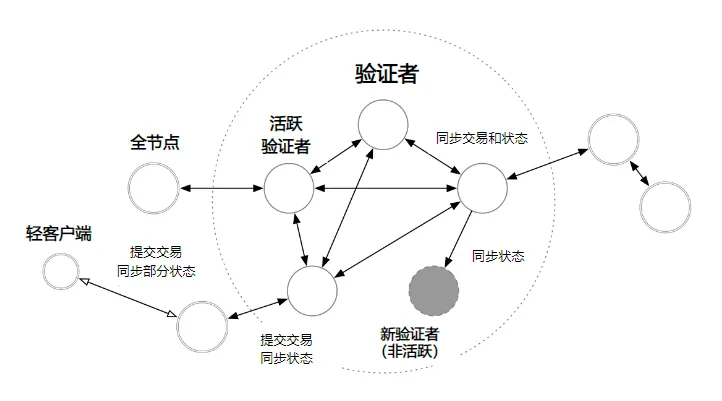
Source: Aptos Whitepaper
Ethereum: The Benchmark of Sequential Execution
As the pioneer of smart contracts, Ethereum serves as the origin point for public blockchain technology, providing a foundational framework for understanding Aptos.
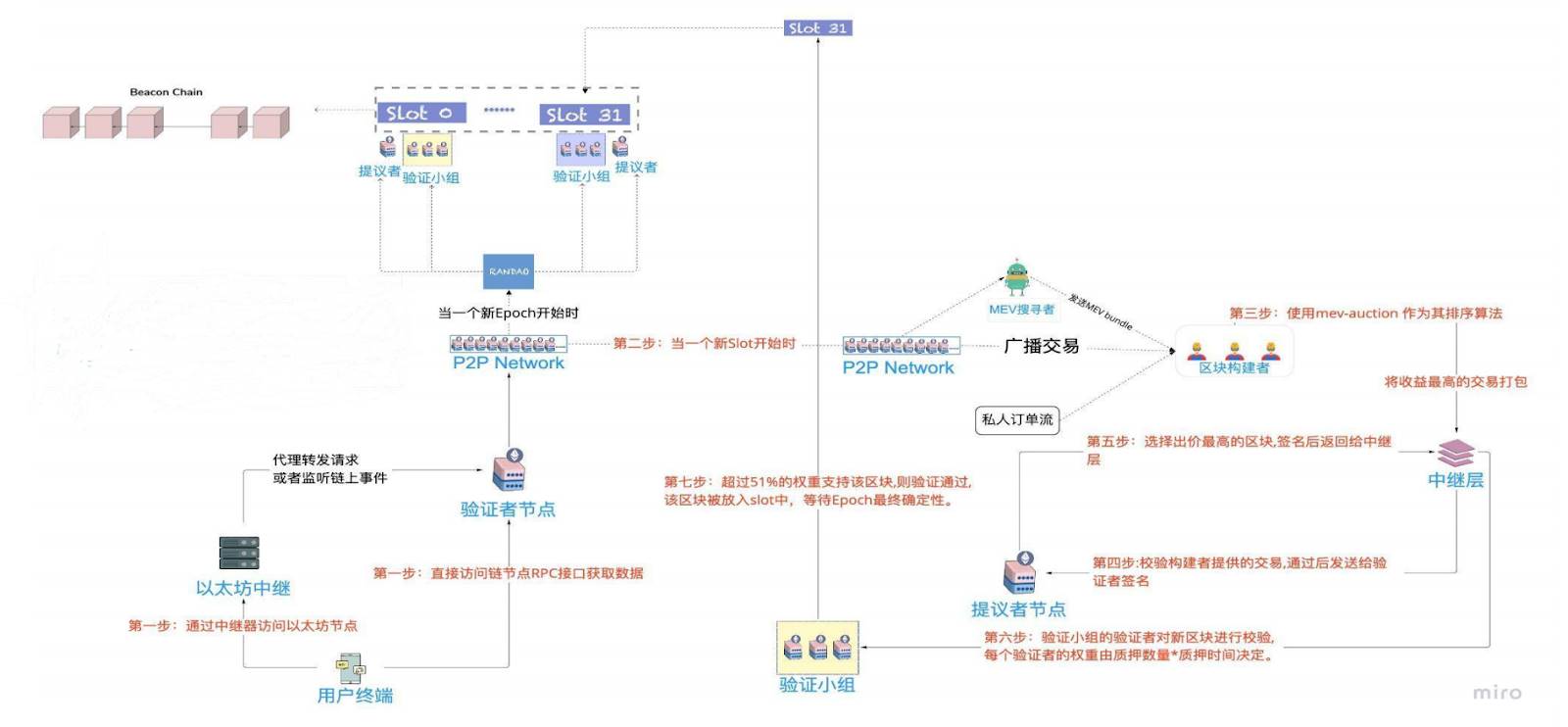
Ethereum Transaction Lifecycle
-
Creation and Initiation: Users send transactions via wallets through relay gateways or RPC interfaces.
-
Broadcasting: Transactions enter a public mempool, awaiting inclusion in a block.
-
Ordering: After the PoS upgrade, block builders order transactions to maximize profit, with relays bidding before submitting to proposers.
-
Execution: The EVM processes transactions sequentially, updating state in a single thread.
-
State Update: Finality requires confirmation through two checkpoints.
Ethereum’s sequential execution and mempool design limit performance, with a block time of 12 seconds per slot and relatively low TPS. In contrast, Aptos achieves a qualitative leap through parallel execution and mempool optimization.
Solana: Deterministic Parallelism and Extreme Optimization
Known for high performance, Solana exhibits significant differences from Aptos—especially in mempool architecture and execution model.
Solana Transaction Lifecycle
-
Creation and Initiation: Users initiate transactions via wallets.
-
Broadcasting: No public mempool; transactions are sent directly to the current and next two leaders.
-
Ordering: Leaders package blocks based on PoH (Proof of History), with a block time of only 400 milliseconds.
-
Execution: The Sealevel VM uses deterministic parallel execution, requiring upfront declaration of read/write sets to prevent conflicts.
-
State Update: BFT consensus enables rapid finalization.
Solana omits the mempool because it could become a performance bottleneck. Without a mempool—and thanks to Solana’s unique PoH consensus—nodes rapidly agree on transaction order, eliminating the need for queueing. Transactions can settle almost instantly. However, during network overload, transactions may be dropped instead of waiting, requiring users to resubmit.
In contrast, Aptos’ optimistic parallelism does not require read/write set declarations, resulting in lower node requirements while achieving higher TPS.
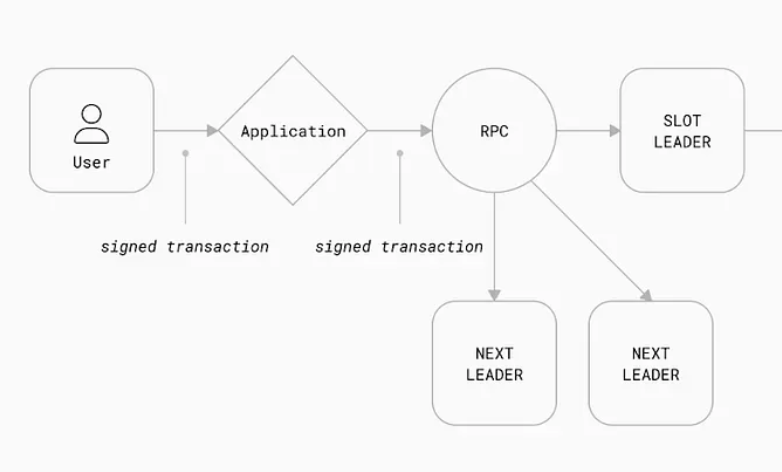
Source: Shoal Research
Two Paths to Parallel Execution: Aptos vs Solana
Transaction execution represents the process of updating block state—the transformation of user instructions into finalized network states. How is this change interpreted? Nodes assume successful execution and compute the impact on network state; this computation is the execution phase.
Thus, parallel execution in blockchains refers to multiple processor cores simultaneously computing state changes. In today’s landscape, parallel execution falls into two categories: deterministic and optimistic. The divergence stems from how each ensures no conflicts occur between parallel transactions—that is, whether dependencies exist among transactions.
Accordingly, the timing at which dependency conflicts are identified within the transaction lifecycle determines the split between deterministic and optimistic parallel execution. Aptos and Solana have chosen different paths:
-
Deterministic Parallelism (Solana): Read/write sets must be declared before broadcast. The Sealevel engine processes non-conflicting transactions in parallel, while conflicting ones run sequentially. Advantage: high efficiency. Disadvantage: high hardware demands.
-
Optimistic Parallelism (Aptos): Assumes no conflicts; Block-STM executes transactions in parallel and validates afterward. Conflicting transactions are retried. Mempool pre-sorting reduces conflict likelihood, easing node burden.
Example: Account A has a balance of 100. Transaction 1 sends 70 to B; Transaction 2 sends 50 to C. Solana detects the conflict upfront via declared sets and processes sequentially. Aptos runs both in parallel, and if insufficient funds are found, retries one. Aptos’ flexibility offers better scalability.
Optimistic Parallelism Uses the Mempool to Pre-Resolve Conflicts
The core idea of optimistic parallelism is to assume transactions won’t conflict, so applications don’t need to submit declarations beforehand. If conflicts arise during validation, Block-STM re-executes affected transactions to ensure consistency.
However, in practice, failing to preemptively detect dependencies would result in frequent errors during execution, causing network stalls. Therefore, optimistic parallelism doesn’t merely assume no conflicts—it mitigates risk at an earlier stage: during transaction broadcasting.
On Aptos, once transactions enter the public mempool, they are pre-sorted based on rules (e.g., FIFO, gas price) to ensure intra-block transactions won’t conflict during parallel execution. Thus, Aptos proposers effectively lack transaction ordering power, and there are no dedicated block builders. This pre-sorting is key to enabling optimistic parallelism. Unlike Solana, which requires explicit transaction declarations, Aptos eliminates this step, greatly reducing node performance demands. The overhead of ensuring non-conflict is far lower on Aptos—mempool inclusion impacts TPS much less than Solana’s declaration mechanism. Consequently, Aptos achieves up to 160,000 TPS, more than double Solana’s. One side effect is that MEV extraction becomes harder on Aptos—a trade-off with mixed implications for users, beyond the scope of this discussion.
Security-Centric Narrative as Aptos' Development Direction
-
RWA: Aptos is actively advancing tokenization of real-world assets and institutional financial solutions. Compared to Ethereum, Aptos’ Block-STM can parallel-process multiple asset transfers, avoiding title registration delays caused by network congestion. On Solana or Sui, despite fast transaction speeds, the absence of a mempool may lead to dropped transactions under load, undermining RWA settlement stability. Aptos’ mempool pre-sorting ensures transactions proceed orderly into execution, maintaining reliable asset records even during peak times. RWA requires complex smart contracts—for asset partitioning, yield distribution, and compliance checks. Move’s modular design and security features make it easier for developers to build reliable RWA applications. In contrast, Ethereum’s Solidity is complex and prone to vulnerabilities, increasing development costs. Solana’s Rust-based programming is efficient but steep for new developers. Aptos’ developer-friendliness could attract more RWA projects, creating a positive feedback loop. Aptos’ potential in RWA lies in combining security and performance. Going forward, it could focus on partnering with traditional financial institutions to bring high-value assets like bonds and stocks on-chain, leveraging Move to create compliant tokenization standards. This “secure + efficient” narrative positions Aptos uniquely in the RWA market.
-
In July 2024, Aptos announced the integration of Ondo Finance’s USDY into its ecosystem, including major DEXs and lending platforms. As of March 10, USDY had approximately $15 million in market cap on Aptos, about 2.5% of its total. In October 2024, Aptos announced Franklin Templeton launched its on-chain U.S. government money market fund (FOBXX) represented by BENJI tokens on Aptos Network. Additionally, Aptos partnered with Libre to advance securities tokenization, bringing investment funds from Brevan Howard, BlackRock, and Hamilton Lane on-chain, enhancing institutional access.
-
-
Stablecoin Payments: Stablecoin payments require strong finality and asset security. Aptos’ Move language prevents double-spending via its resource model, ensuring accuracy in every stablecoin transfer. For example, when using USDC on Aptos, transaction state updates are strictly protected against contract bugs leading to fund loss. Moreover, Aptos’ low gas fees (due to high TPS spreading costs) make it highly competitive for microtransactions. Ethereum’s high fees limit its use in payments, while Solana, though low-cost, risks transaction drops during congestion, hurting user experience. Aptos’ mempool pre-sorting and Block-STM guarantee payment stability and low latency.
-
PayFi and stablecoin payments must balance decentralization with regulatory compliance. AptosBFT’s decentralized consensus reduces centralization risks, while its modular architecture allows embedding KYC/AML checks. For instance, a stablecoin issuer can deploy compliant contracts on Aptos, ensuring adherence to local regulations without sacrificing efficiency. This improves upon Ethereum’s centralized relay models and addresses Solana’s proposer-driven compliance gaps. Aptos’ balanced design makes it more attractive for financial institutions.
-
Aptos’ potential in PayFi and stablecoin payments lies in the “secure, efficient, compliant” trifecta. Going forward, it can drive mass adoption of stablecoins, build cross-border payment networks, or partner with payment giants to develop on-chain settlement systems. High TPS and low cost also support micropayments—such as real-time tipping for content creators. Aptos can position itself as the “next-generation payment infrastructure,” attracting both enterprise and consumer traffic.
-
Aptos’ security advantages—mempool pre-sorting, Block-STM, AptosBFT, and the Move language—not only enhance attack resistance but also lay a solid foundation for its RWA and PayFi narratives. In RWA, its high security and throughput support asset tokenization and large-scale transactions. In PayFi and stablecoin payments, low cost and high efficiency drive real-world adoption. Compared to Ethereum’s reliability at low speed and Solana’s speed at high cost, Aptos carves a new path through balance. Moving forward, Aptos can leverage these strengths to shape a “security-driven value network” narrative, bridging traditional finance and blockchain.
Conclusion: Aptos’ Technical Distinctions and Future Narrative
Through the lens of transaction lifecycle, we can clearly compare Aptos with Ethereum, Solana, and Sui in terms of technical design and uncover their respective core narratives. The table below summarizes their similarities and differences in broadcasting, ordering, and execution phases, highlighting Aptos’ unique strengths:
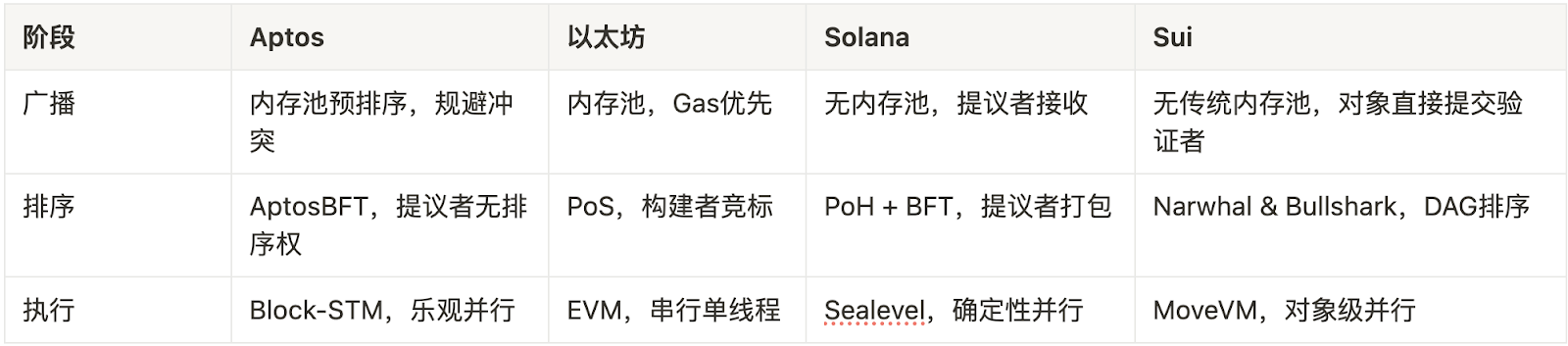
Aptos strikes a clever balance between performance and security. Its combination of mempool pre-sorting and Block-STM’s optimistic parallelism lowers node requirements while achieving 160,000 TPS—surpassing Solana’s deterministic parallelism and Sui’s object-level parallelism. Compared to Ethereum’s sequential execution, Aptos delivers a qualitative leap in parallel capability. And unlike Solana and Sui’s radical removal of the mempool, Aptos retains pre-sorting, ensuring stability under high load. This “steady yet fast” approach, combined with Move’s resource model, gives Aptos superior security—better resisting DDoS attacks and preventing contract exploits than Ethereum’s legacy architecture or Solana’s hardware-heavy model. The divergence between Aptos and Sui—both built on Move—is particularly instructive. Sui centers on objects, using DAG ordering and object-level parallelism for extreme performance, ideal for high-concurrency asset management. Aptos, centered on accounts, leverages mempool and optimistic parallelism to balance general-purpose usability and ecosystem compatibility. This reflects not only technical choices but also divergent application directions: Sui may excel in complex asset operations, while Aptos dominates in security-driven use cases. It is precisely this blend of security and performance that empowers Aptos’ potential in RWA and PayFi. In RWA, its high throughput supports mass asset onboarding. Recent collaborations with Ondo Finance (USDY ~$15M), Franklin Templeton, and Libre show early traction. In PayFi and stablecoin payments, Aptos’ low cost, high efficiency, and compliance support micropayments and cross-border settlements, positioning it as a strong candidate for “next-generation payment infrastructure.”
In summary, Aptos integrates considerations of security and efficiency into every phase of the transaction lifecycle—distinguishing itself from Ethereum’s reliable inefficiency, Solana’s high-performance-high-barrier model, and Sui’s object-driven extreme optimization. Going forward, Aptos can leverage its “security-driven value network” narrative to bridge traditional finance and blockchain, pushing forward in RWA and PayFi to build a new public chain paradigm grounded in trust and scalability.
About Movemaker: Movemaker is the first official community organization authorized by the Aptos Foundation and jointly initiated by Ankaa and BlockBooster. Focused on advancing the Aptos Chinese-speaking ecosystem, Movemaker serves as the official representative of Aptos in the region, connecting developers, users, investors, and ecosystem partners to foster a diverse, open, and thriving Aptos ecosystem.
Disclaimer: This article/blog is for informational purposes only and represents the author’s personal views, not necessarily those of Movemaker. It is not intended to provide: (i) investment advice or recommendations; (ii) offers or solicitations to buy, sell, or hold digital assets; or (iii) financial, accounting, legal, or tax advice. Holding digital assets, including stablecoins and NFTs, involves high risk, significant price volatility, and the potential for total loss. You should carefully consider whether trading or holding digital assets is suitable for your financial situation. For specific questions, please consult your legal, tax, or investment advisor. Information provided herein (including market data and statistics, if any) is for general reference only. While reasonable care has been taken in compiling such data and charts, no responsibility is accepted for any factual inaccuracies or omissions.
Join TechFlow official community to stay tuned
Telegram:https://t.me/TechFlowDaily
X (Twitter):https://x.com/TechFlowPost
X (Twitter) EN:https://x.com/BlockFlow_News
 @MovemakerCN