
Gold hits a record high, while Bitcoin is still struggling through its "adolescence"
TechFlow Selected TechFlow Selected
Gold hits a record high, while Bitcoin is still struggling through its "adolescence"
Bitcoin behaves more like an overhyped tech stock than digital gold.
 Navigating Web3 tides with focused insights
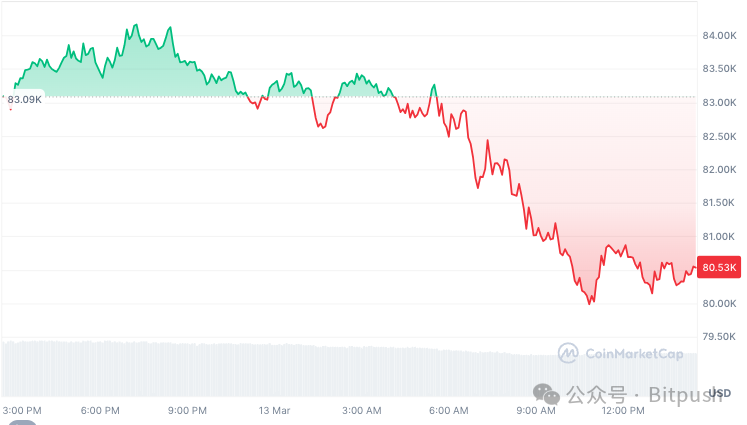
After a modest rebound on Wednesday following tame inflation data, U.S. stocks dropped sharply again on Thursday, seemingly dragging Bitcoin (BTC) lower along with them. By market close, the Nasdaq fell nearly 2%, while the S&P 500 declined 1.39%. After briefly touching nearly $85,000 the previous day, Bitcoin has since retreated below $81,000, losing nearly 3% over the past 24 hours.
Yet once again, gold demonstrated its safe-haven appeal, with spot gold prices hitting a new record high. At the time of writing, it was just shy of breaking $3,000 per ounce for the first time.
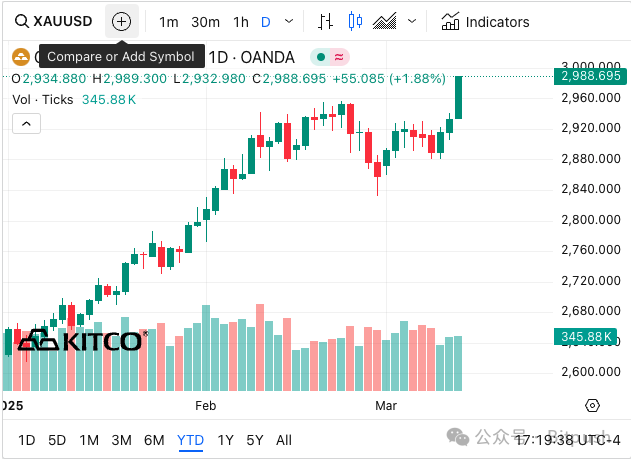
Since the Nasdaq peaked three weeks ago, the index has fallen nearly 15%. Over the same period, gold has risen about 1%, while Bitcoin has dropped nearly 20%.
A Familiar Scene
The current performance of gold may remind investors of 2024, when cryptocurrencies and U.S. equities traded sideways while gold hit new highs. Between March and October, Bitcoin oscillated between $50,000 and $70,000, while gold surged nearly 40% to $2,800. Then, following Trump’s election victory, Bitcoin briefly soared above $100,000, while gold’s rally stalled as capital shifted from safe-haven assets to riskier ones.
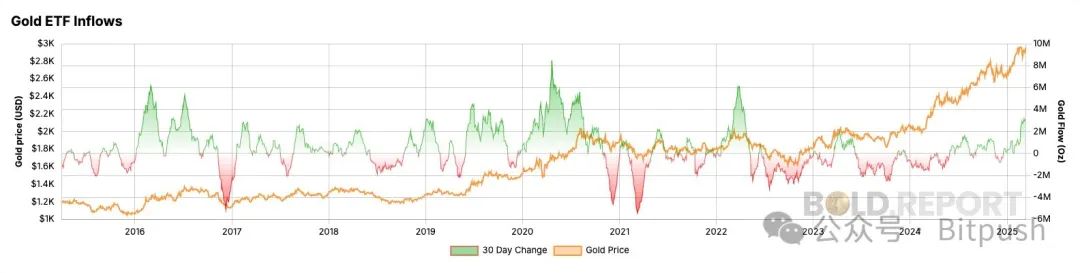
Now, the tide appears to be turning. According to Bold.report, gold ETFs have seen their largest inflows since early 2022 over the past 30 days, adding 3 million ounces of gold holdings.
In contrast, SoSoValue data shows that U.S. spot Bitcoin ETFs have lost $5 billion since February, marking the most severe outflows in a year.
Trading volume and futures activity across the crypto market have both declined significantly. According to CoinDesk statistics, trading activity on centralized exchanges (CEX) has plummeted, with combined spot and derivatives volumes dropping 20.6% to $7.20 trillion—the lowest level since October last year.
Bitcoin futures volume on the Chicago Mercantile Exchange (CME) also fell 20.3% to $175 billion, bringing CME’s total cryptocurrency trading volume down 19.9% to $229 billion. This marks the first decline in five months, consistent with the downward trend in BTC CME annualized basis, which has now dropped to 4.08%—its lowest level since March 2023.
Bitcoin = Adolescent Gold?
This isn’t the first time Bitcoin has decoupled from the definition of a safe-haven asset. During the market crash triggered by COVID-19 in 2020, Bitcoin plunged more than 50% in just two days. Nevertheless, the notion of "digital gold" has continued to circulate in recent years.
Notably, the Trump administration referenced Bitcoin’s potential as a hedge against financial instability in an executive order, proposing the creation of a national Bitcoin reserve—a rationale similar to holding reserves of gold and oil.
However, some remain cautious. Bloomberg Intelligence analyst Eric Balchunas likened Bitcoin to “hot sauce” in investing—something that adds flavor to traditional stock and bond portfolios. What draws him to Bitcoin, compared to other high-risk assets, is “the narrative around hedging against dollar depreciation.”
Balchunas said: “To me, Bitcoin is like adolescent gold.”
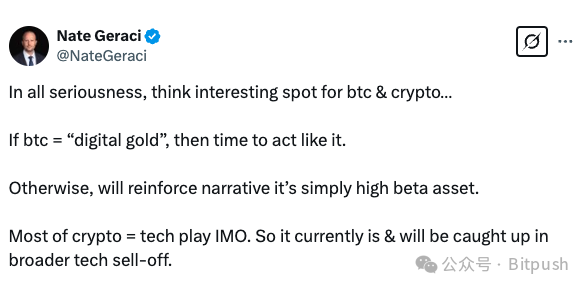
Some market observers argue that Bitcoin behaves more like an overhyped tech stock than digital gold. Nate Geraci, president of ETF Store, stated on X: “If Bitcoin equals ‘digital gold,’ then it should act like gold. Otherwise, it reinforces the idea that Bitcoin is simply a highly volatile asset. In my view, most cryptocurrencies are equivalent to tech stocks, so they will continue to be affected by tech stock sell-offs.”
Balanced Allocation
It's no surprise that gold is outperforming Bitcoin, given gold’s centuries-long history of wealth preservation and its global recognition as a safe-haven asset. While Bitcoin has underperformed recently, its long-term potential still warrants attention. For investors seeking to diversify risk, allocating to both may be an effective strategy.
Gold’s appeal lies in its low volatility and role as a hedge against economic uncertainty. Data shows that gold’s long-term volatility was only 15% last year, compared to Bitcoin’s 40%. Still, Bitcoin’s volatility has significantly decreased from levels near 100% several years ago. As the market matures, Bitcoin’s price movements are expected to stabilize further.
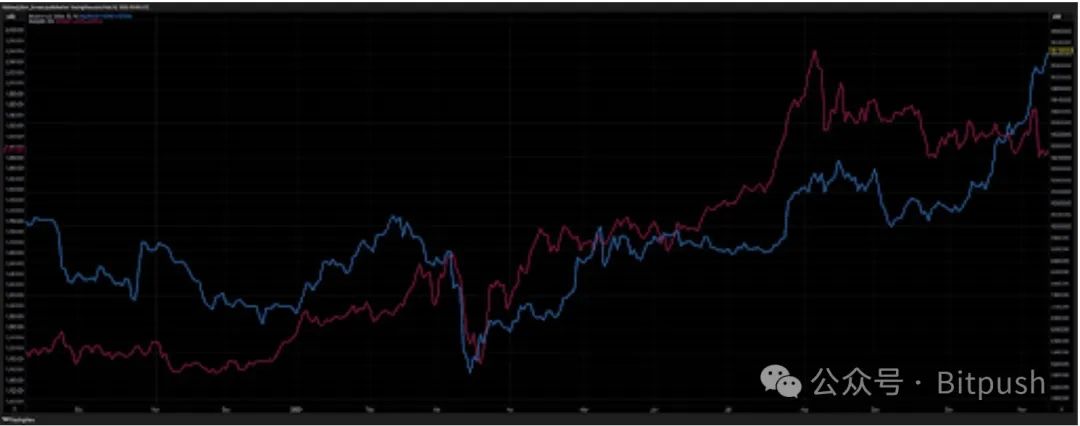
Moreover, U.S. spot Bitcoin ETFs have only been available for just over a year, and in many countries, Bitcoin is still not recognized as an investable asset. Nonetheless, Bitcoin’s market standing continues to rise. From being banned by banks initially, to the rise of stablecoins, the use of renewable energy in mining, and the launch of investable ETFs, Bitcoin has gradually overcome numerous challenges.
Regarding Bitcoin’s position in the current market cycle, market analyst @AxelAdlerJr suggests watching the BTC-to-Gold ratio (BTC/Gold Ratio), which indicates how many ounces of gold one Bitcoin can buy.
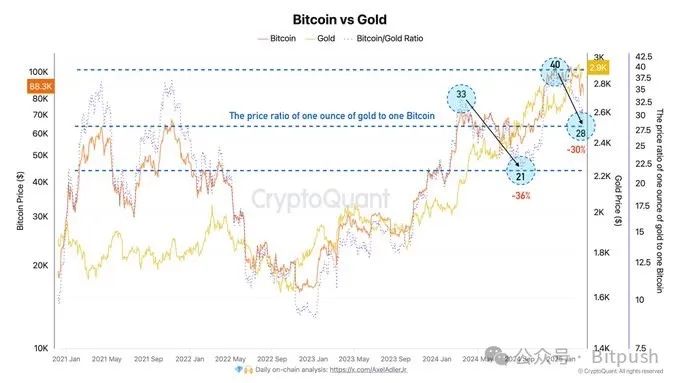
The analyst notes that although the current macroeconomic environment is unstable, gold prices have remained relatively steady. Drawing from the previous cycle’s experience (a 36% decline), if the current BTC-to-gold ratio falls a total of 36% from its historical peak (it has already dropped 30%, needing just another 6%), this could signal that Bitcoin is approaching or has reached a local bottom in this macro cycle—potentially serving as a buying opportunity.
Overall, while Bitcoin’s recent performance appears immature compared to gold, failing to fully replace gold as the ultimate safe haven, this may simply reflect the growing pains of what some call “adolescent gold.” Gold maintains its edge during turbulent times thanks to its long and reliable history—a value built over time. Yet Bitcoin’s journey is far from over. It just needs a little more time.
Join TechFlow official community to stay tuned
Telegram:https://t.me/TechFlowDaily
X (Twitter):https://x.com/TechFlowPost
X (Twitter) EN:https://x.com/BlockFlow_News
 比推 BitpushNews