
Wall Street Sells Coins, Old Wallets Take Over: BTC Ownership Is Being Reshuffled
TechFlow Selected TechFlow Selected
Wall Street Sells Coins, Old Wallets Take Over: BTC Ownership Is Being Reshuffled
ETF funds are withdrawing, but long-term holders are absorbing the sell-offs, and BTC ownership is being redistributed.
 Navigating Web3 tides with focused insights
Author: Gino Matos
Compiled by: TechFlow
TechFlow Editor's Note: ETF funds are retreating, but long-term holders are absorbing the sell-off, and BTC ownership is being redistributed. Glassnode data shows that 10.83 million BTC are already underwater, but it is precisely under this pressure that experienced buyers are starting to rebuild positions. For investors, the real question is not when prices will rebound, but whether this turnover can be completed under the pressure of continuous institutional outflows.
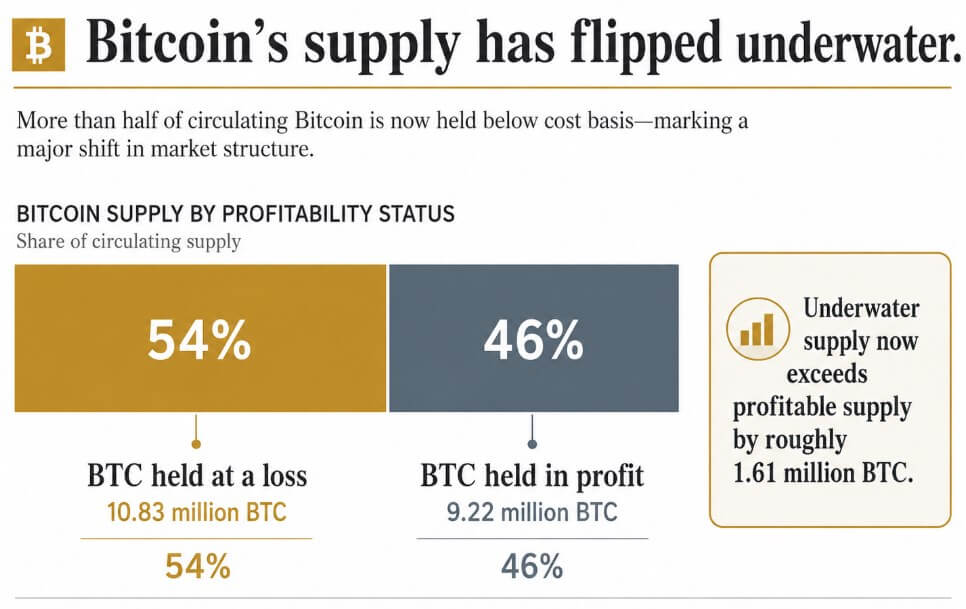
Glassnode's latest Week Onchain report shows that currently about 10.83 million BTC are underwater, while only 9.22 million are still in profit.
Supply in loss now accounts for about 54% of the measured total, while supply in profit is 46%, meaning there are about 1.61 million more BTC underwater than in profit.
Glassnode describes this as one of the sharpest deteriorations in investor profitability since the start of this bull market, a threshold with real psychological weight.
Previously, crossing this threshold was often accompanied by true capitulation by new buyers, pressure that would form a structural correction.
Underwater holders are most likely to sell in panic or exit near breakeven when prices recover, forming a layer of resistance above the market.
However, if patient capital is willing to absorb these coins, they may also transfer to buyers with stronger conviction, and Glassnode's data is showing that such buyers have begun to appear.
Under this pressure, the seller profile has begun to change; Glassnode states that long-term holders have started to rebuild positions, a reversal from the continuous distribution phase, with net position changes returning to positive territory.
This pace remains moderate, far short of the buying waves seen in previous accumulation cycles, but the direction has shifted. The first sign of a bottom often appears here—experienced holders consider the correction worth buying, far earlier than prices themselves confirm any signals.
Glassnode's accumulation trend score rose this week across multiple groups, with wallets holding less than 1 BTC and entities holding 100 to 1000 BTC showing the strongest readings.
Wallets in the range of 1000 to 10000 BTC also turned into net buyers. Bitcoin's underlying buying pressure is spreading across the entire ownership ladder, from the smallest wallets to medium-sized entities.
US-traded spot Bitcoin ETFs remain in a state of continuous net outflow; even as on-chain conviction builds in the opposite direction, this selling pressure continues. The ETF story explains why prices remain weak, while the on-chain story explains who is absorbing the supply.
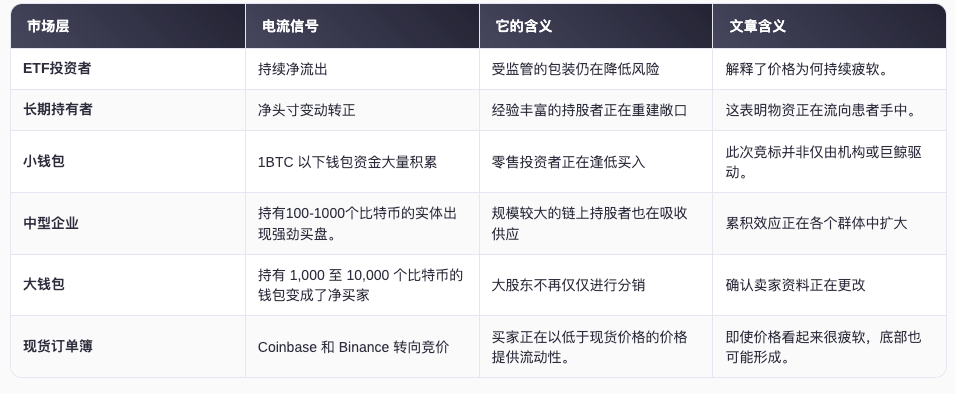
Order books on both Coinbase and Binance show a shift towards the buy side, with buyers adding liquidity below spot. This buying appears very patient, which is why prices may still look weak even as the bottom starts forming below.
Hyperliquid traders hold the highest level of long bias tracked by Glassnode, using leveraged exposure to bet on a rebound before spot conviction is fully confirmed. The cash market attempts to build a bottom, while the derivatives market attempts to front-run.
Options traders have started paying for protection: the 14-day put-call volume ratio climbed above 1.0, the highest reading in a year. Implied volatility is also rising; although recovering from low levels, Glassnode does not call it a panic reading.
The market carries enough fear to start bottoming, although the fear needed to confirm completion of capitulation may still be accumulating.
Taken together, this pattern appears unusual for a bottoming process; Bitcoin may be finding a bottom through an unusual mechanism: ETF investors are selling, while stronger, more patient hands are absorbing exits in real time.
Glassnode defines this as an early, still-developing bottoming process and points out that a final capitulation-driven volatility spike is still possible.
The volume of buying by long-term holders also lags far behind the scale of previous accumulation waves, keeping the accumulation recovery fragile.
Bitcoin may bottom before ETF fund inflows return, as long as outflows slow down enough to stop overwhelming on-chain accumulation, while crowded long positions on Hyperliquid are gradually unwound through price increases.
How This Will Unfold
In a bull case scenario, ETF outflows continue but slow down, while long-term holders and broader wallet groups continue to accumulate throughout the summer.
Buy-side dominated order books continue to absorb supply from new underwater holders, while aggressive long positions on Hyperliquid get resolved through a real rebound.
Bitcoin's correction becomes a controlled migration, transferring from ETF sellers and short-term holders into the hands of patient on-chain capital; the transfer phase becomes the bottom.
In a bear case scenario, crowded long positions on Hyperliquid get washed out, ETF outflows continue, and underwater holders capitulate at lower prices.
Implied volatility spikes to true panic levels; as the correction deepens, long-term holder accumulation slows down. Bitcoin still eventually transfers into stronger hands, but through one last capitulation event.
Bitcoin's next bottom may start with an unusual sequence: institutions exit, weaker holders capitulate, and stronger hands quietly take over. The bottom begins with the turnover of supply ownership, far earlier than visible on price.
Join TechFlow official community to stay tuned
Telegram:https://t.me/TechFlowDaily
X (Twitter):https://x.com/TechFlowPost
X (Twitter) EN:https://x.com/BlockFlow_News
 @CryptoSlate