








Macro cycle has peaked—have you prepared for a decade-long bear market?
TechFlow Selected TechFlow Selected
Macro cycle has peaked—have you prepared for a decade-long bear market?
A million-dollar bitcoin is possible, but you must remain patient and first endure a harsh bear market.
 Navigating Web3 tides with focused insights
Author: mikeykremer, Research Analyst at Messari
Translation: Lüdong BlockBeats ChatGPT
Editor's Note: The author reflects on the U.S.-led global economy from the outbreak of World War II in 1939 to Trump’s re-election in 2024—a super bull market driven by one-time events such as America's rise as a postwar superpower, women and minorities entering the labor force, and victory in the Cold War. However, the author argues this era has ended due to deglobalization, irreversible labor expansion, and limited room for further rate cuts. The future will bring financial asset liquidation, capital controls, and fiscal repression. Traditional markets are unlikely to regain their former glory, while gold and Bitcoin—non-traditional assets resistant to government control—will emerge as safe havens. Bitcoin, in particular, may leverage its digital advantages to gain traction among smaller nations, potentially reaching a million-dollar valuation—but only after enduring a harsh bear market.
Below is the original content (slightly edited for clarity):
TL;DR
-
Globalization is over. Your financial assets have already been liquidated.
-
Non-traditional assets are your salvation.
-
Bitcoin could reach $1 million.
From the start of WWII (1939) to Trump’s second electoral victory (2024), we experienced an unprecedented super bull market. This sustained rally shaped generations of passive investors who came to believe reflexively that “the market never fails” and “the market only goes up.” Yet I believe this feast is now over—and many are about to face reckoning.
How Did We Get Here?
The super bull market between 1939 and 2024 was no accident. It resulted from a series of structural transformations that fundamentally reshaped the global economy—with the United States at the center.
Rise as the Global Superpower After WWII
World War II elevated the United States from a mid-tier power to the undisputed leader of the "free world." By 1945, the U.S. produced more than half of the world’s industrial output, controlled one-third of global exports, and held roughly two-thirds of the world’s gold reserves. This economic dominance laid the foundation for decades of growth.
Unlike after WWI, when the U.S. retreated into isolationism, after WWII it actively embraced global leadership—helping establish the United Nations and launching the Marshall Plan, which injected over $13 billion into Western Europe. This wasn’t just aid—it created new markets for American goods and cemented U.S. cultural and economic influence worldwide.
Labor Force Expansion: Women and Minorities Joining the Workforce
During WWII, around 6.7 million women entered the labor force, increasing female labor participation by nearly 50% in just a few years. While many women left the workforce after the war, this large-scale mobilization permanently changed societal views on women working.
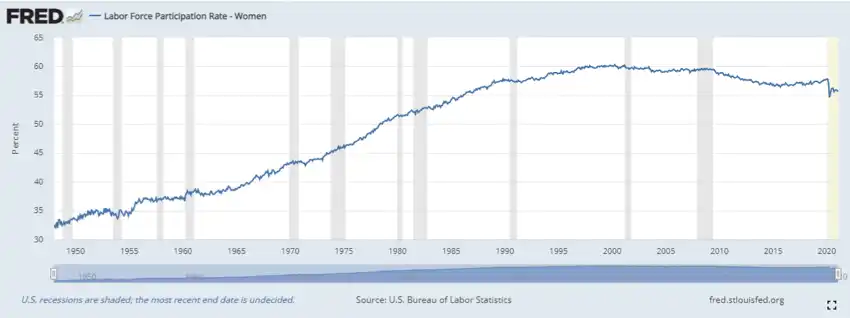
By 1950, married women’s employment became increasingly common, with female labor participation rising by an unprecedented 10 percentage points across most age groups. This wasn’t just a wartime anomaly—it marked a fundamental shift in the American economic model. Bans on employing married women were lifted, part-time work expanded, household technologies advanced, and education levels rose—all turning women from temporary workers into permanent participants in the economy.
Similar trends occurred among minority groups, who gradually gained greater economic opportunities. This labor force expansion significantly boosted U.S. productive capacity, fueling decades of economic growth.
Cold War Victory and the Wave of Globalization
The Cold War defined America’s political and economic role after WWII. By 1989, the U.S. had military alliances with 50 countries and stationed 1.5 million troops across 117 nations—not only for security but also to extend its economic influence globally.
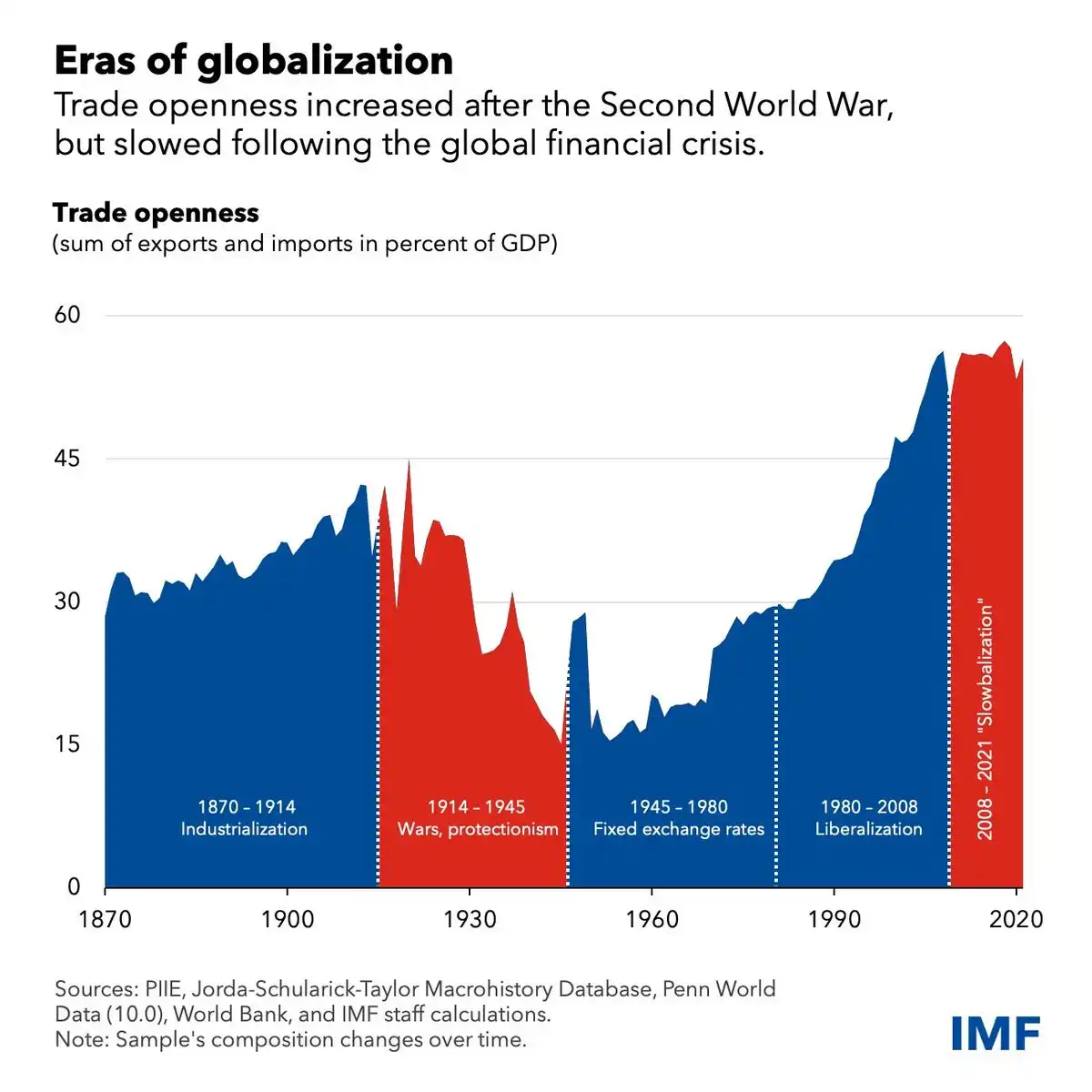
After the Soviet Union collapsed in 1991, the U.S. emerged as the world’s sole superpower—a unipolar moment celebrated not only ideologically but also economically through the opening of global markets under American-led trade frameworks.
From the 1990s to the early 2000s, American corporations aggressively expanded into emerging markets—not organically, but through long-term policy choices. For example, U.S. imports surged in countries where the CIA had intervened, even in sectors without clear American competitive advantage.
Western capitalism defeated Eastern communism not merely through military or ideological superiority. The liberal democratic system proved more adaptable—surviving shocks like the 1973 oil crisis and restructuring effectively. The 1979 "Volcker Shock" restored U.S. financial hegemony, transforming global capital markets into a new engine of growth in the post-industrial era.
These structural shifts—the rise of the U.S. as a superpower after WWII, the inclusion of women and minorities in the workforce, and victory in the Cold War—collectively powered an unprecedented bull market in financial assets. But here’s the core issue: these were all one-time events. You can't make women enter the workforce again. You can't defeat the Soviet Union twice. Now both parties are pushing deglobalization—we’re witnessing the final pillar of this long-cycle growth being dismantled.
What Comes Next?
I love Tom—he’s my TradFi sentiment barometer in the crypto space.
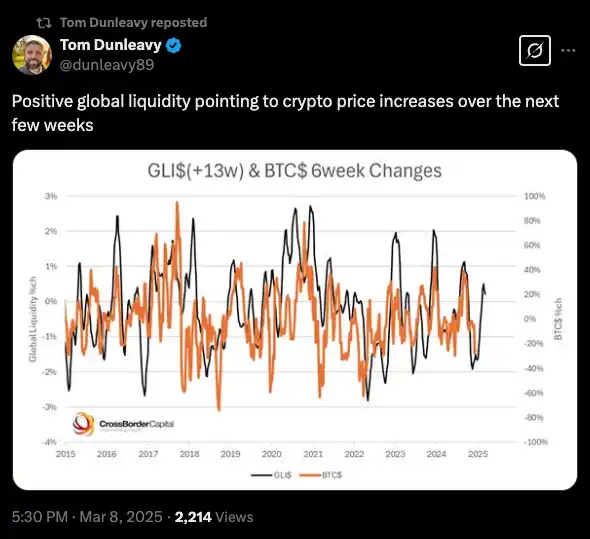
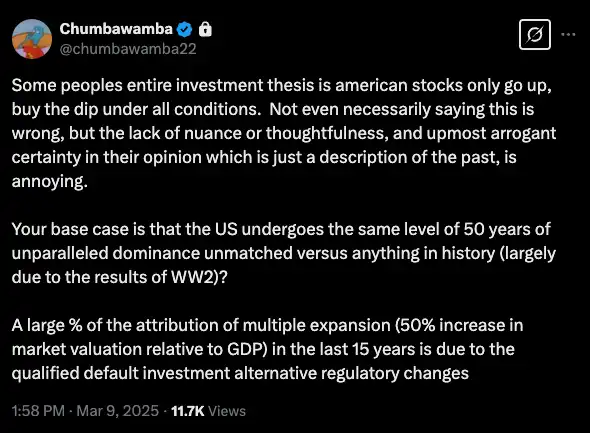
Unfortunately, everyone keeps praying for markets to return to historical norms. The consensus belief is: things will get worse, then central banks will print again, and we’ll keep making money… But reality is: these people are walking straight into the slaughterhouse.
A century-long bull market built on non-repeatable events (and some now reversing) cannot continue.
-
Women won’t re-enter the labor force en masse: In fact, with figures like Musk and pro-natalist elites pushing higher birth rates, female labor participation may decline.
-
Minorities won’t be absorbed into the workforce again: Democrats’ immigration stance is now nearly as hardline as Republicans’, forming a bipartisan consensus.
-
Interest rates won’t fall again: Every elected leader knows inflation is the biggest threat to re-election. Governments will avoid rate cuts and reigniting inflation at all costs.
-
We won’t become more globalized: Trump is moving in the opposite direction—and I expect Democrats to copy this policy next election (remember, Biden largely copied Trump’s first-term policies).
-
We won’t win another world war: In fact, we might lose the next one. Either way, I’d rather not test that hypothesis.
My point is simple: every major global macro trend that drove stock market gains over the past century is now reversing. So tell me—where do you think markets are headed?
Goblin Town
When an empire declines, life gets tough—just ask Japan. If you bought the Nikkei 225 at its 1989 peak and held until today, after 36 years, your return would be about -5%. Classic “buy and hold, suffer forever.” I think we’re heading down the same path.
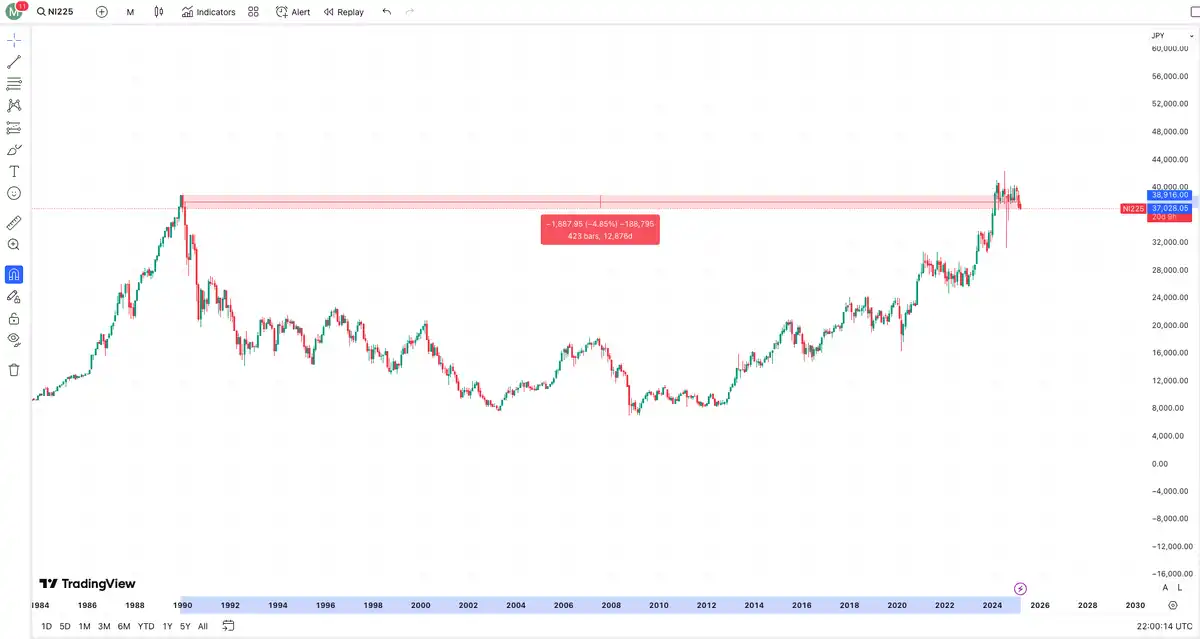
Even worse, prepare for capital controls and financial repression. A stagnant market doesn’t mean governments will accept it. When traditional monetary policy fails, they turn to direct financial control.
Coming Capital Controls
Financial repression refers to policies that deliver returns below inflation to savers, allowing banks to lend cheaply to businesses and governments while reducing debt burdens. It’s particularly effective for governments looking to erode domestic currency debt. Stanford economists first used the term in 1973 to criticize growth-suppressing policies in emerging markets—but today, these tactics are increasingly adopted in advanced economies like the U.S.
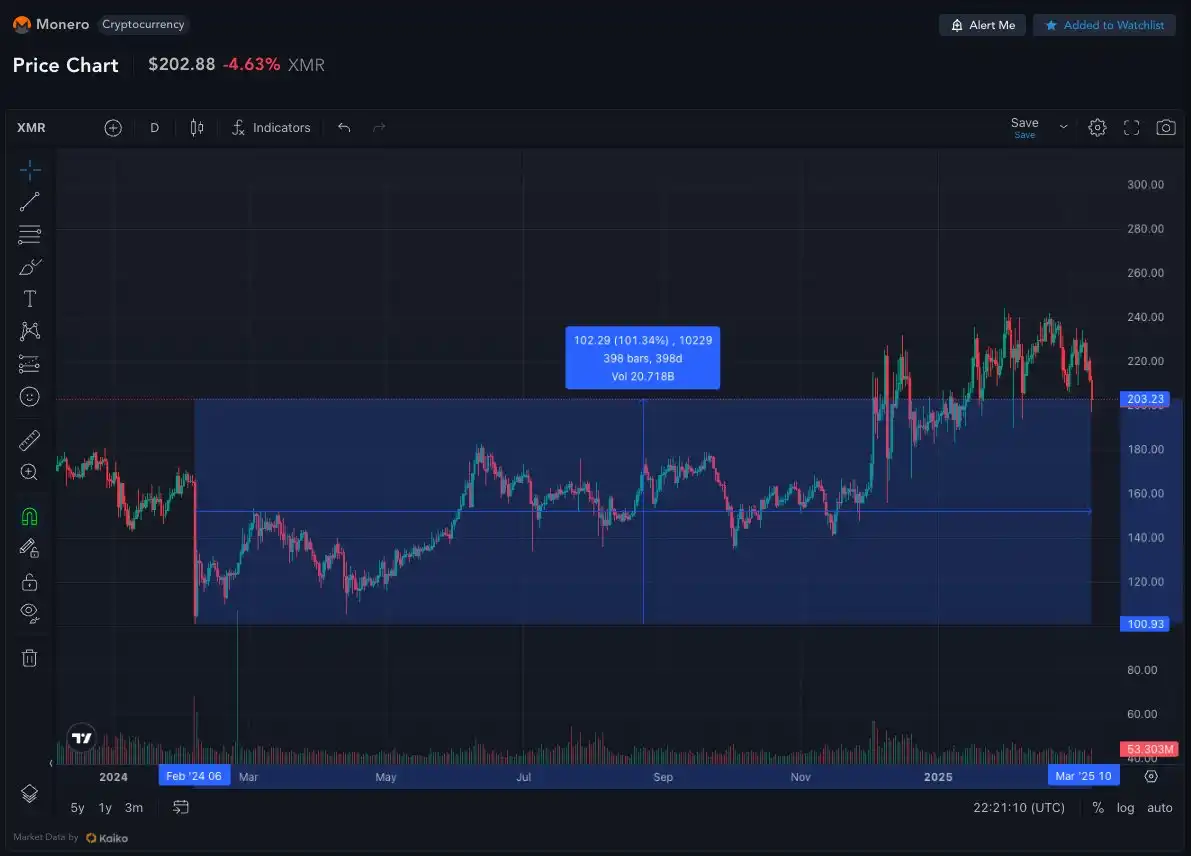
This might sound far-fetched, but consider why Monero’s chart looks so perfect right now.
With U.S. debt exceeding 120% of GDP, repaying via conventional means grows less likely. The playbook for financial repression is already being tested:
-
Direct or indirect caps on government debt and deposit interest rates
-
Government control over financial institutions and creation of entry barriers
-
High reserve requirements
-
Creation of closed domestic debt markets forcing institutions to buy government bonds
-
Capital controls restricting cross-border asset flows
This isn’t theoretical—it’s happening. Since 2010, the U.S. federal funds rate has spent over 80% of the time below inflation, effectively transferring wealth from savers to borrowers—including the government.
Your retirement account: the government’s next target
If governments can’t rely on printing money to buy bonds and suppress interest rates during a debt crisis, they’ll go after your retirement savings. I can easily envision a future where tax-advantaged accounts like 401(k)s are mandated to allocate increasing portions to “safe and reliable” government bonds. No need to print—they can simply redirect existing funds within the system.
This is exactly the script we’ve seen unfold in recent years:
-
Asset freezes: In April 2024, Biden signed a law authorizing the seizure of Russian assets in the U.S., setting a precedent that foreign reserves can be frozen at will. Such actions may not remain limited to geopolitical adversaries.
-
Canada’s Freedom Convoy protest: Authorities froze about 280 bank accounts without court approval. Treasury officials admitted the goal was not just cutting off funds but “deterring” protesters and ensuring they “made the decision to leave.” When asked how innocent families were affected, the response was: “They just need to leave.”
Gold Confiscation and Surveillance
This shouldn’t surprise anyone—U.S. history is full of similar episodes:
In 1933, FDR issued Executive Order 6102, requiring citizens to surrender gold holdings under penalty of imprisonment. Enforcement was patchy, but the Supreme Court upheld the government’s right to confiscate gold. This wasn’t a “voluntary purchase program”—it was forced wealth expropriation disguised as a “fair market price” transaction.
Surveillance capabilities exploded after 9/11. The FISA Amendments Act granted the NSA near-unlimited authority to monitor international communications of U.S. citizens. The Patriot Act enabled daily collection of phone records for all Americans. Section 215 allowed gathering your reading lists, study materials, purchase history, medical records, and personal finances—without any reasonable suspicion.
The question isn’t whether financial repression will come—it’s how severe it will be. As deglobalization intensifies economic pressure, government control over capital will only grow more direct and aggressive.
Gold & Bitcoin
The monthly gold chart since 1970 is currently the strongest chart in the world.
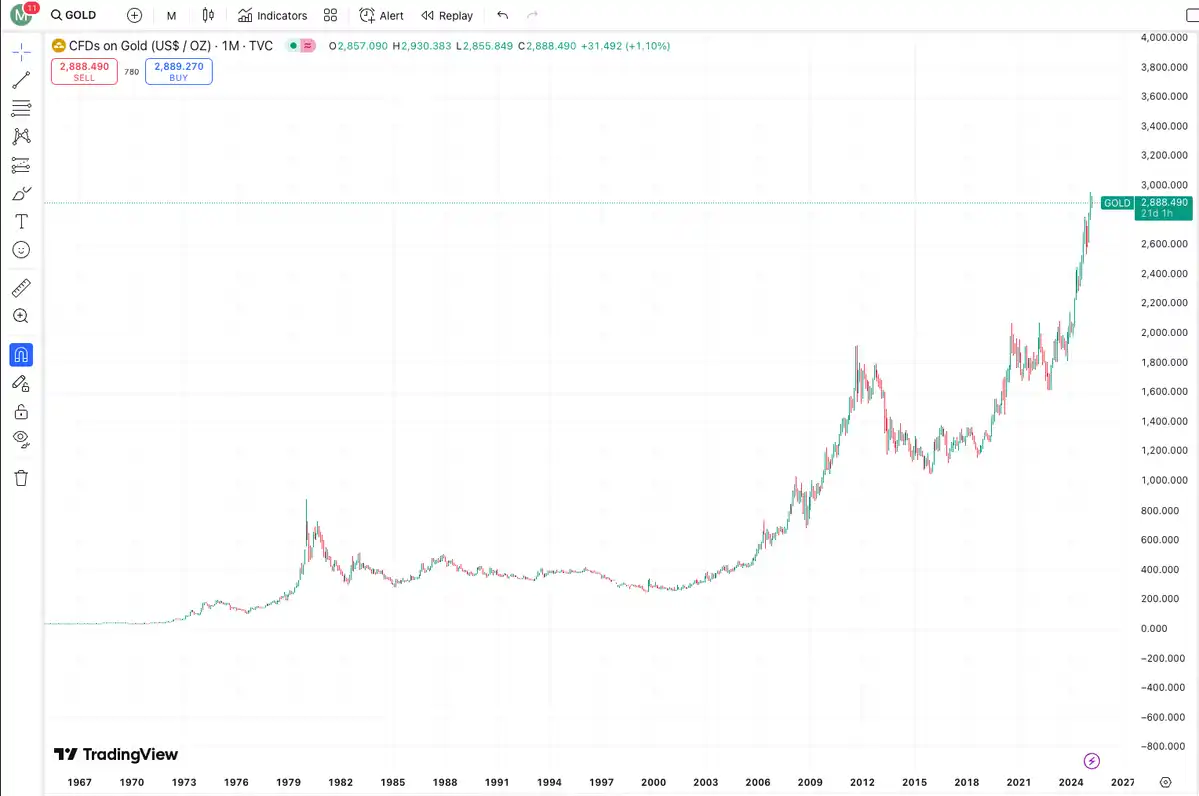
By process of elimination, the best financial assets to own are now obvious: something with no historical correlation to markets, difficult for governments to confiscate, and outside Western governmental control. I can think of two—and one of them added $6 trillion in market cap over the past 12 months. That’s the clearest bull signal imaginable.
Global Gold Reserve Race
Countries like China, Russia, and India are rapidly accumulating gold amid shifting global dynamics:
-
China: Purchased 5 tons in January 2025 alone, marking three consecutive months of net buying, bringing total holdings to 2,285 tons.
-
Russia: Holds 2,335.85 tons, ranking fifth globally in gold reserves.
-
India: Eighth globally with 853.63 tons, continuing steady accumulation.
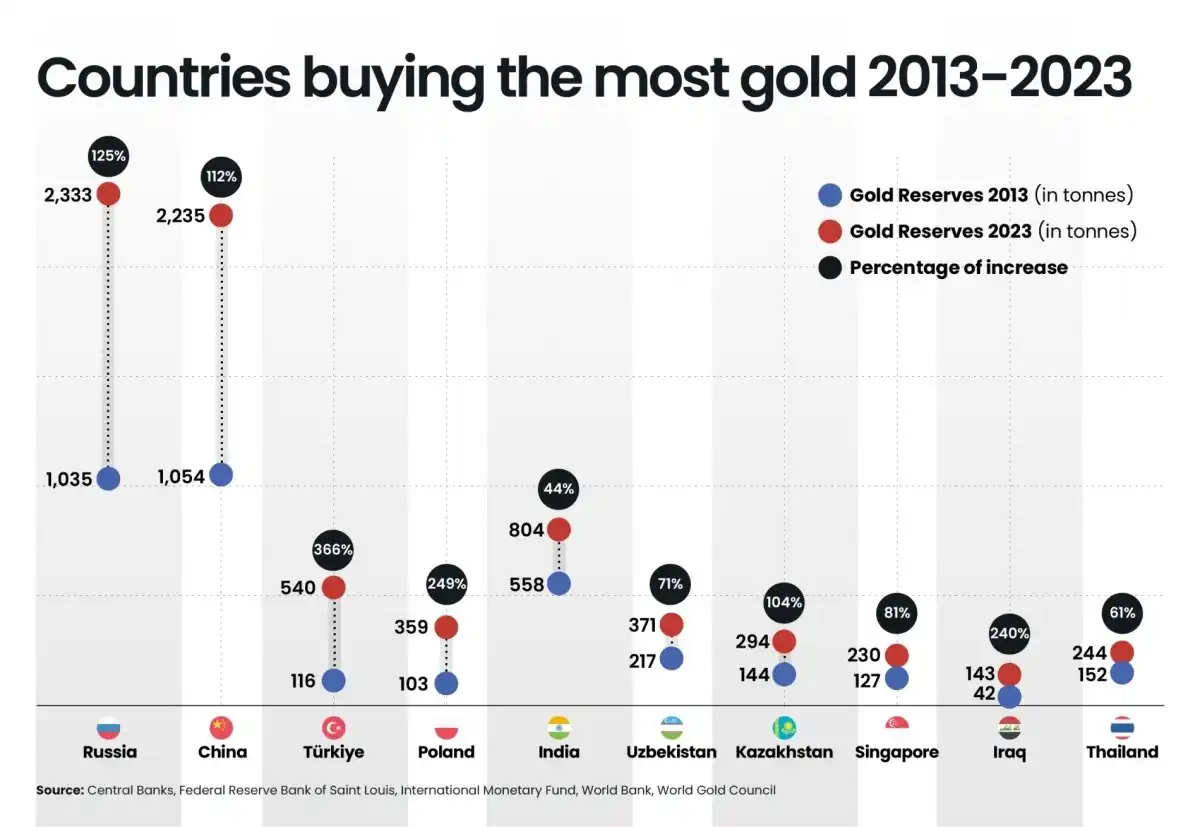
This isn’t random—it’s strategic. After the G7 froze Russia’s foreign exchange reserves, central banks worldwide took note. A survey of 57 central banks found 96% cited gold’s reliability as a safe-haven asset as a key motivation for continued investment. When dollar-denominated assets can be erased with a single executive order, physical gold stored domestically becomes highly attractive.
In 2024 alone, Turkey added 74.79 tons—up 13.85%. Poland increased reserves by 89.54 tons—nearly 25%. Even Uzbekistan, a small nation, added 8 tons in January 2025, bringing its total to 391 tons—82% of its foreign reserves. This is no coincidence. It’s a coordinated effort to escape a weaponized financial system.
Central banks trust gold because they’ve already built systems to use it for reserves and trade settlement. BRICS central banks collectively hold over 20% of global official gold reserves. As Kazakhstan’s central bank governor stated in January 2025, they are transitioning toward “currency neutrality in gold purchases,” aiming to boost reserves and “protect the economy from external shocks.”
Bitcoin
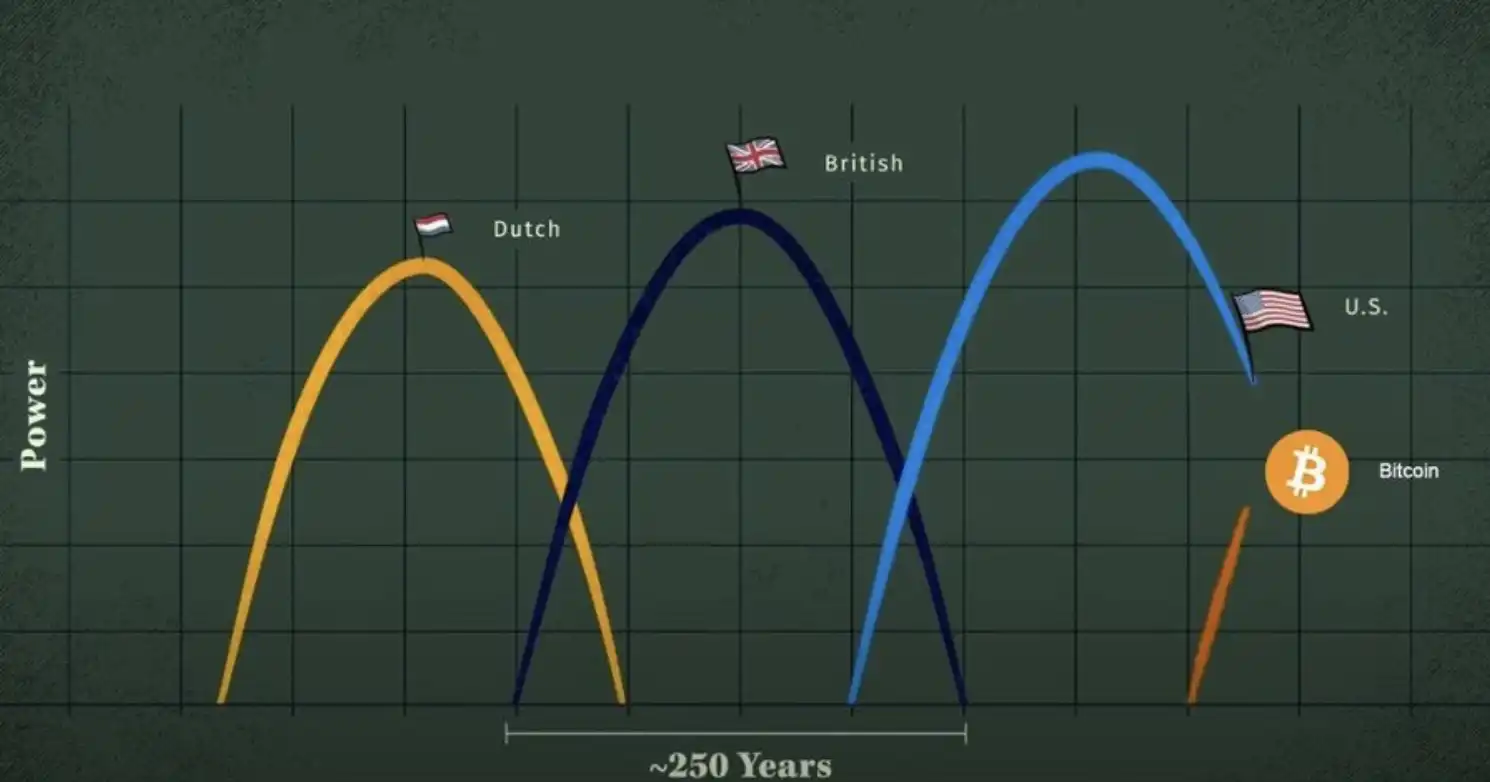
This gold-dominated era may last months or even years—but eventually, gold’s limitations will surface. Many small and medium-sized countries lack the banking infrastructure or naval power to manage global gold logistics. These nations may become the earliest adopters of Bitcoin as a substitute.
-
El Salvador: Became the first country to adopt Bitcoin as legal tender in 2021. By 2025, its Bitcoin holdings exceeded $550 million.
-
Bhutan: Using hydropower for mining, its Bitcoin reserves surpassed $1 billion—equivalent to one-third of its GDP.
As the world grows more chaotic, countries will be reluctant to entrust gold to allies. The risk of seizure is too high—the failed attempt by Venezuela to retrieve its gold from the Bank of England proves that. For smaller nations, Bitcoin offers a compelling alternative: no need for physical vaults, no ships for transport, no army for protection.
This transition period will propel us into the next phase of Bitcoin adoption—but patience is essential. The world won’t change overnight, nor will monetary systems. By 2025, we’re already seeing the beginning: growing Bitcoin adoption in Argentina, Nigeria, and Vietnam as people seek protection against inflation and financial instability.
The path forward is clear: first gold, then Bitcoin. As more nations recognize the limitations of physical gold in an increasingly digital and fragmented world, Bitcoin’s case as digital gold becomes stronger. The question isn’t whether this shift will happen—it’s when, and which countries will lead it.
A $1 million Bitcoin is coming—but you must stay patient. Prepare yourself—first, endure a brutal bear market.
Join TechFlow official community to stay tuned
Telegram:https://t.me/TechFlowDaily
X (Twitter):https://x.com/TechFlowPost
X (Twitter) EN:https://x.com/BlockFlow_News
 Messari






