Opinion: Tokenizing stablecoins could be a shortcut to putting government bonds and stocks on the blockchain
TechFlow Selected TechFlow Selected
Opinion: Tokenizing stablecoins could be a shortcut to putting government bonds and stocks on the blockchain
The encapsulation pattern is a very common technical paradigm for asset management and migration in the cryptocurrency space.
 Navigating Web3 tides with focused insights
Author: Huang Shiliang
Judging from recent industry developments, the RWA (real-world asset tokenization) sector may be entering a phase of substantive implementation—Coinbase recently announced plans to map stocks onto the blockchain.
However, upon closer inspection, Coinbase's approach still relies on synthetic assets rather than directly tokenizing stocks through custodial 1:1 backing with two-way pegging between shares and tokens.
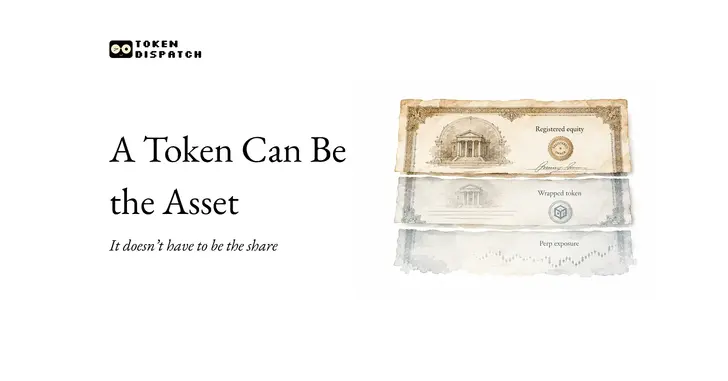
In my view, current asset-on-chain projects have yet to grasp the essence of crypto. The crypto space actually possesses a highly refined, mature, and reliable method for asset tokenization: the wrapping model.
The wrapping model is a common technical paradigm in crypto for asset management and migration.
For example, native BTC can be wrapped into WBTC (an ERC-20 token) on Ethereum, effectively bringing BTC assets "on-chain" to the Ethereum network.
Lido wraps stETH into wstETH, converting a yield-bearing asset into a standardized ERC-20 token, enabling easier on-chain management of equity-like assets.
The WBTC and wstETH cases exemplify precisely the two core technologies needed for RWA tokenization: (1) asset wrapping and on-chain representation; and (2) encapsulation of asset entitlements.
Let’s briefly review several major on-chain asset projects today—Ondo, MakerDAO, and Coinbase’s proposed approach.
Ondo’s model is straightforward: real-world assets are held in custody by centralized institutions, while corresponding tokens are minted on-chain.
In fact, USD stablecoins like USDT and USDC represent the most successful examples of asset tokenization. They use a 1:1 two-way peg mechanism, where fiat dollars are custodied by centralized entities and digital tokens circulate on-chain.
USDT and USDC are thus the most successful RWA projects to date.
However, Ondo-style asset wrapping is heavily burdened by legal and regulatory complexities, making it difficult to gain broad traction in the crypto ecosystem, which traditionally resists heavy regulation.
MakerDAO’s U.S. Treasury bond tokenization essentially involves third parties holding Treasuries and distributing yields to sDai holders (users who deposit Dai into a specific contract become sDai holders). It feels more like a way to provide extra incentives to Dai holders than a true asset tokenization effort.
Coinbase’s planned stock tokenization, meanwhile, fundamentally uses synthetic asset technology—similar to how Synthetix operates—to create stock representations on-chain.
In my opinion, the simplest and most effective approach would be to wrap existing stablecoins like USDT and USDC to achieve Treasury tokenization.
This would require cooperation from the companies behind USDT and USDC. Taking USDC as an example:
Create a deposit smart contract that allows users to deposit USDC and receive wUSDC tokens in return—these serve as receipts representing their right to redeem deposits.
wUSDC fully complies with the ERC-20 standard and can freely circulate in the market.
Circle, the issuer of USDC, would use the deposited USDC (and the underlying fiat dollars) to purchase U.S. Treasury bonds. The bond yields would then be distributed back to wUSDC holders by injecting additional USDC into the deposit contract.
This would effectively tokenize U.S. Treasuries. Buying Treasuries would simply mean purchasing wUSDC.
All actual Treasury purchases and yield collection would be handled off-chain by Circle.
The same wrapping technique could apply to equities: wUSDC would represent proportional ownership in a stock portfolio, and arbitrageurs would naturally align the price of wUSDC with the underlying stock value through trading activities.
Join TechFlow official community to stay tuned
Telegram:https://t.me/TechFlowDaily
X (Twitter):https://x.com/TechFlowPost
X (Twitter) EN:https://x.com/BlockFlow_News