









US crypto reserves fail to stem market downturn as Bitcoin falls below $90,000 again
TechFlow Selected TechFlow Selected
US crypto reserves fail to stem market downturn as Bitcoin falls below $90,000 again
The market is at a critical juncture intertwined with multiple policy shocks and uncertainties.
 Navigating Web3 tides with focused insights
By ChandlerZ, Foresight News
On the evening of March 3 through the morning of March 4, amid darkening global macroeconomic clouds, Trump’s announcement to include crypto assets in the U.S. Strategic Reserve failed to reverse the overall bearish market trend. The news initially triggered a brief market rally, but optimism quickly faded. Bitcoin briefly rose before plunging 13%, nearly erasing all gains; Ethereum surged to $2,550 only to fall below $2,000, even dropping below recent lows. Other previously leading tokens such as SOL also gave back most of their gains.
At the same time, U.S. equities sharply declined: the S&P 500 dropped 1.76%, the Nasdaq fell 2.64%, and the Dow Jones swung from up nearly 200 points to down over 600 points. Tech stocks, representing risk assets, faced intensified selling pressure—Nvidia plunged nearly 9%, while the "Magnificent 7" index of America's top tech giants fell 3.45%. Capital rapidly rotated out of high-risk assets into traditional safe-havens, forming a classic risk-off trading pattern.
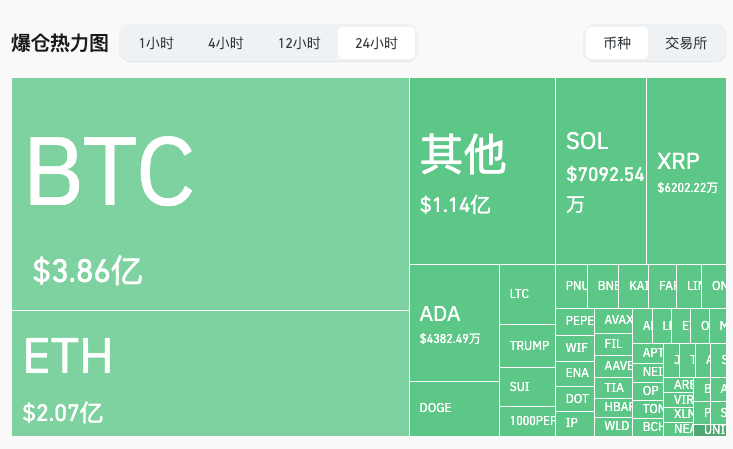
Data from CoinMarketCap shows that total cryptocurrency market capitalization has once again fallen below $3 trillion, hitting its lowest level since November 2024. Derivatives market liquidations expanded significantly: Coinglass reported $1.068 billion in total liquidations across markets within 24 hours, including $38.6 million in Bitcoin contracts and $20.7 million in Ethereum contracts.
Tariff Turmoil Triggers Market Panic
Trump reiterated plans to impose 25% tariffs on Canada and Mexico starting March 4, stating there was “no room for negotiation.” He also warned that countries levying tariffs on American goods would face equivalent retaliatory measures starting April 2. In response, Canada is preparing retaliatory tariffs on $155 billion worth of U.S. goods. Buffett rarely speaks out publicly against policy, but called these tariffs “in a sense, an act of war,” warning they would fuel inflation and hurt consumers.
The U.S. economy now faces a rare state of macroeconomic fragility. The Atlanta Fed's GDPNow model slashed its Q1 GDP growth forecast from -1.5% to -2.8%—a near doubling in projected contraction far beyond typical forecast adjustments—indicating accelerating deterioration in economic fundamentals. Meanwhile, manufacturing activity has nearly stalled, while raw material price indices hit a two-year high, creating classic pre-stagflation signals. This combination of stagnant growth and rising inflation has long been a policymaker’s nightmare, undermining the effectiveness of conventional monetary tools. Against this backdrop, Bridgewater founder Dalio warned that the U.S. could face a debt crisis within three years if it fails to reduce its deficits.
U.S. Pauses Military Aid to Ukraine, Adding Uncertainty
According to U.S. media reports cited by Xinhua, Trump has ordered a halt to all military aid to Ukraine until Ukrainian leadership demonstrates “sincere intent” to reach a peace agreement with Russia.
This decision follows a heated confrontation between Trump and Zelenskyy in the Oval Office. The Wall Street Journal reported that the Trump administration has stopped funding new arms sales to Ukraine and is considering freezing weapons shipments from U.S. stockpiles—a move that could severely impact Ukraine’s combat capabilities at a critical stage in its war with Russian forces.
In response to shifting U.S. policy, European leaders met in London and agreed to form a “coalition of the willing” to draft a Ukraine peace plan for submission to Trump, including commitments to provide ground troops and military assets. The UK also announced new military support measures, including £1.6 billion for air defense missile procurement and a £2.26 billion defense loan agreement.
This policy shift may signal a fundamental change in U.S. policy toward Ukraine and a potential realignment of the international security order. As expectations rise for further escalation of geopolitical conflict, investors are pulling capital from risky assets like U.S. equities and cryptocurrencies and moving into safe havens, causing both markets to decline simultaneously.
Moreover, this evolving security landscape suggests traditional macroeconomic crises may now intertwine with geopolitical risks, forming a multi-layered risk system. The U.S. suspension of military aid to Ukraine could trigger additional defensive actions across the region, while resulting political and economic uncertainty will further roil global financial markets. Investors, facing a deteriorating external environment, struggle to identify which asset classes can effectively hedge against risk, leading many to adopt a wait-and-see stance. Declining market liquidity exacerbates the synchronized downturn in both U.S. equities and crypto markets.
Market at an Inflection Point
Markets currently stand at a critical juncture shaped by overlapping policy shocks and deep uncertainty. Investor expectations of global risk have risen sharply under the dual pressures of tariff tensions and the suspension of U.S. military aid to Ukraine. This has amplified risk-averse sentiment, driving simultaneous declines in traditional risk assets such as U.S. equities and crypto markets, severely damaging market confidence. At the same time, escalating geopolitical tensions have cast doubt on the macroeconomic outlook, constraining liquidity and pushing risk premiums higher—casting a shadow over the near-term trajectory of crypto assets.
Under these conditions, multiple scenarios lie ahead for crypto markets. On one hand, the U.S. is set to host its first-ever crypto summit on March 7, where Trump’s remarks and further clarification on the proposed national strategic Bitcoin reserve could reignite market enthusiasm and deliver positive signals to select digital assets. On the other hand, while Trump’s previously floated idea of a “national strategic Bitcoin reserve” captured attention, the actual implementation mechanism remains unclear, and its internal logic and feasibility continue to draw widespread skepticism. If the U.S. moves forward by retaining seized Bitcoin assets to build the reserve, this could gradually bolster market support. However, whether such an approach can balance political maneuvering with organic market development remains uncertain and will depend heavily on policy details and execution strength.
Overall, the future path of crypto markets will hinge on a delicate balancing act between policy shifts, international security dynamics, and the broader global macroeconomic environment. In the medium to long term, if global economic conditions stabilize and policies gain clearer direction, crypto assets may gradually recover from current volatility. But for now, markets face elevated uncertainty, with risk premiums and volatility remaining at high levels.
Join TechFlow official community to stay tuned
Telegram:https://t.me/TechFlowDaily
X (Twitter):https://x.com/TechFlowPost
X (Twitter) EN:https://x.com/BlockFlow_News
 Foresight News






