








From High School Teacher to Chair of the Ethereum Foundation, Aya and Her Infinite Garden
TechFlow Selected TechFlow Selected
From High School Teacher to Chair of the Ethereum Foundation, Aya and Her Infinite Garden
For Aya, Ethereum is not just a technical project, but an "infinite garden" embodying the ideal of decentralization.
 Navigating Web3 tides with focused insights
By TechFlow

On February 25, amid widespread skepticism toward Ethereum, Aya Miyaguchi—once at the center of public controversy—assumed the role of new Executive Director of the Ethereum Foundation.
This transition was not impulsive. The shift from her current executive director position to leading the Ethereum Foundation (EF) had been planned for a year.
In a blog post, Aya Miyaguchi stated, “Ethereum belongs to everyone. Precisely because it belongs to no one, we allow a culture of dissent—not merely tolerating disagreement, but becoming stronger through it. The Ethereum Foundation has never been meant to control or own every aspect of Ethereum. Our responsibility lies in safeguarding Ethereum’s values.”
From a Japanese classroom to the infinite garden of the crypto world, Aya Miyaguchi’s journey is not just a unique career transformation, but also a story of defending core values amid conflict.
From Japanese Classroom to Crypto World
Aya Miyaguchi's professional journey did not begin in technology, but in education.
She once taught at a high school in Nagoya, Japan, where she passionately designed creative curricula to foster students’ independent thinking and critical spirit.
However, after more than a decade of teaching, she began to feel uneasy—teaching textbook knowledge alone could no longer satisfy her deeper pursuit of educational meaning. She wanted to help students become individuals capable of independently exploring the world, rather than mere exam machines.
“As a teacher, I often told my students they should leave their home country at least once in their lives.”
Eventually, she led by example, choosing to resign from her teaching position and move to the United States to pursue an MBA.
This decision unexpectedly led her into the world of blockchain and cryptocurrency.
While studying in the U.S., Aya developed a strong interest in financial inclusion, believing that addressing inequality was crucial for businesses.
Through a chance encounter, she met Jesse Powell, founder of the cryptocurrency exchange Kraken, and joined the company as Managing Director for Japan.
Yet, her career path was far from smooth.
In 2014, during the collapse of Japan’s leading exchange Mt. Gox, cryptocurrencies fell into deep public distrust. Facing panic and skepticism, Miyaguchi proactively engaged government agencies, participated in regulatory discussions, and collaborated with industry groups—laying groundwork for Japan’s cryptocurrency regulatory framework introduced in 2017.
An interesting side note: in 2013, she met Vitalik Buterin, then just 19 years old and not yet known as "V God," at Kraken’s office. At the time, he was a writer for Bitcoin Magazine, working on the Ethereum whitepaper.
Looking back, Aya admitted she didn’t fully grasp Ethereum’s technical details at the time, but recognized its world-changing potential. She was drawn to Ethereum’s vision, particularly appreciating its nonprofit nature and the community’s commitment to core values. To her, Ethereum was not just a technology, but a new worldview capable of challenging existing centralized power structures.
In 2018, after leaving Kraken, Aya was invited by Vitalik to join the Ethereum Foundation.
The foundation faced numerous challenges at the time, including coordinating internal and external activities and establishing non-research functions. Despite the difficulty, she accepted the role, seeing it as an opportunity to realize her personal ideals.
“At that time, the crypto industry was beginning to feel like a get-rich-quick space. I felt Ethereum might be my last hope to fulfill my original vision—using decentralized technology to achieve financial inclusion and help the unbanked access financial services. I had to step in and help.”
As Executive Director of the Ethereum Foundation, Aya adopted a unique leadership approach she called the “subtraction principle”—actively reducing her own authority, avoiding centralized decision-making, while preserving Ethereum’s open culture and decentralized ethos.
She described Ethereum as an “infinite garden,” emphasizing its organic growth and the importance of long-term thinking over short-term gains.

“Infinite Garden” and Zen-Like Management
For Aya, Ethereum is not merely a technical project, but a “infinite garden” embodying ideals of decentralization.
This metaphor comes from James P. Carse’s book *Finite and Infinite Games*. She believes Ethereum’s mission is not about winning short-term gains, but about continuously advancing and spreading the idea of decentralization.
She compares the Ethereum community to an unmanicured natural park, full of diversity and vitality. Though there may be radical voices or strange ideas, these too may become sources of future innovation.
“The Ethereum ecosystem didn’t start with clear goals or milestones set by the Ethereum Foundation. It grew organically as people from diverse backgrounds joined the community. That’s what ‘garden’ means. But rather than a neatly trimmed garden, it’s more like a national park—a place rich in biodiversity, with caterpillars and things that might eat some plants, unlike a place dependent on heavy pesticides.”

Of course, some in the Ethereum community say overly radical or even absurd things. Yet they can also come up with useful and original ideas. The key is not to suppress them, but to let nature take its course. I use the word ‘garden’ to describe this natural balance, though I don’t think any single word perfectly captures it.”
In her view, decentralization is not only a technological challenge, but a shift in mindset. Centralization’s risks—privacy violations, data monopolies, and abuse of power—have profoundly impacted our lives. The decentralized thinking promoted by Ethereum allows us to re-examine social structures and transform the relationship between people and technology.
Aya’s leadership style is deeply influenced by Zen philosophy—somewhat akin to the Daoist concept of “governing through non-action”—a sharp contrast to traditional top-down management.
She sees herself as a Zen teacher, guiding teams and community members to uphold Ethereum’s spirit within a decentralized environment.
She cited “The Merge” upgrade as an example, emphasizing that this major technical transformation was achieved without a “boss” or central authority, showcasing the Ethereum community’s self-coordination capability.
Under her leadership, the Ethereum Foundation supported numerous public goods and open-source tools, such as the Etherisc project. Additionally, she participated in the World Economic Forum’s Global Blockchain Council and served on the board of the Enterprise Ethereum Alliance, expanding Ethereum’s enterprise collaborations.
Criticism and Persistence
Aya’s values and management style have earned support and recognition from Vitalik, but also sparked external criticism.
In summary, criticism toward Aya mainly falls into five areas:
Qualification Controversy
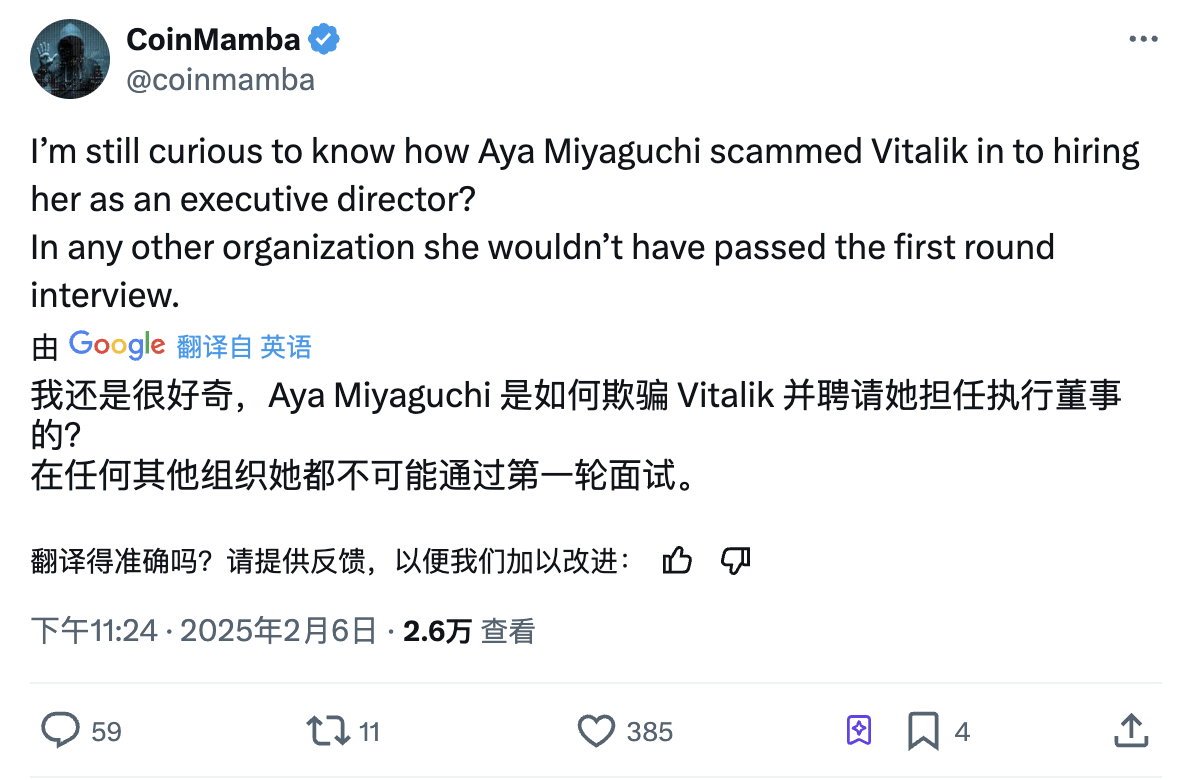
Some industry KOLs argue that her background (e.g., English literature and prior experience as a high school teacher) makes her unfit for the role of executive director, questioning her professional competence.
For instance, crypto KOL CoinMamba claimed she wouldn’t even pass the first interview round at other organizations.
Slow Progress
Ethereum’s scalability has long been a community concern. Some users believe that under Aya’s leadership, scalability solutions have progressed slowly, causing Ethereum to fall behind competitors like Solana in market competition.
Spending Issues
The foundation’s financial management has also drawn criticism. Some users argue that despite holding $800 million in reserves, the foundation spends heavily while delivering insufficient results.
Hands-Off Management, Insufficient Developer Support
The Ethereum Foundation has been criticized for being overly “hands-off,” failing to actively support developers in the ecosystem. Community members feel the foundation is too passive in technical support and resource allocation, forcing developers to shoulder more responsibilities themselves.
Poor $ETH Performance
Some criticism targets the underperformance of Ethereum’s token in the market, expressing disappointment that under Aya’s leadership, Ethereum has lost its competitive edge.
Despite these criticisms, Vitalik Buterin publicly defended Aya on X, highlighting her contributions to Ethereum upgrades, Devcon events, and cultural preservation, and criticizing community attacks as “distasteful.”
A New Chapter for the Infinite Garden
On February 26, 2025, Aya Miyaguchi announced her transition from Executive Director to Chair, publishing an article titled “A New Chapter for the Infinite Garden,” serving as her manifesto for the future.
Aya emphasized guiding principles rooted in philosophy to protect Ethereum’s values:
Major technical advances in Ethereum (such as The Merge and the shift to proof-of-stake) reflect a philosophy of leading without controlling.
The foundation’s goal is to support Ethereum’s long-term sustainability, not short-term profits or traditional corporate expansion.
Ethereum’s uniqueness lies in the interplay between technological and social innovation, making it an infinite garden.
The idea of decentralization has profound implications for global society and democratic systems, and the foundation remains committed to upholding these values.
In summary: Subtraction, not minimalism. Long-term sustainability, not short-term gains. Thoughtful complexity, not oversimplification. Stewardship, not control. Adaptive growth, not rigid structures. Purposeful evolution, not corporate-style expansion. Community leadership, not domination.
An interesting phenomenon in Chinese internet discourse is that when an organization faces criticism, people tend to believe “someone good is surrounded by bad people” or “someone has been deceived by evil forces”—similar to the myth of “King Zhou being corrupted by Daji.” In critiques of Ethereum, Aya has become a similar scapegoat—the “bad person.”
This is somewhat unfair to Aya. She has never changed; she has consistently acted according to her values and principles. It was Vitalik and the Ethereum Foundation who chose Aya—an alignment of shared values.
In a price-driven crypto world, rising prices are seen as righteous, while values and ideology are often dismissed as “nihilism.” Appeasing the “Leviathan,” integrating into authority, is the easiest path—one that can immediately send asset prices to the moon. But refusing to “compromise,” and steadfastly upholding the ideals and principles of decentralization, is far more difficult and precious.
Of course, we must remain vigilant and maintain oversight. History shows us that many movements claiming “noble ideals” may eventually become tools of power.
Ethereum’s journey is both a technological exploration and an experiment in human values.
The ideal of decentralization may be hard to achieve, but precisely because of this difficulty, it becomes especially valuable.
As Suji, founder of Mask, quoted a famous Haruki Murakami line at an event in Hong Kong:
“Between a high, solid wall and an egg crashing against it, I will always stand on the side of the egg.”
Join TechFlow official community to stay tuned
Telegram:https://t.me/TechFlowDaily
X (Twitter):https://x.com/TechFlowPost
X (Twitter) EN:https://x.com/BlockFlow_News
 深潮TechFlow


