Whether an AI is good or not, DeepSeek must pass the metaphysics test
TechFlow Selected TechFlow Selected
Whether an AI is good or not, DeepSeek must pass the metaphysics test
The cyber placebo in the minds of young people.
 Navigating Web3 tides with focused insights
Author: Zhang Lin,Zimu Bang

Image source: Generated by Wujie AI
"I don't care which large model is better to use, but if you tell me DeepSeek can tell fortunes, I'll download it immediately."
Recently, a wave of cyber mysticism has swept through social media platforms. Posts about "using DeepSeek for fortune-telling until 3 a.m." have flooded feeds, giving rise to a trending term—DeepSeek mystical prompts.
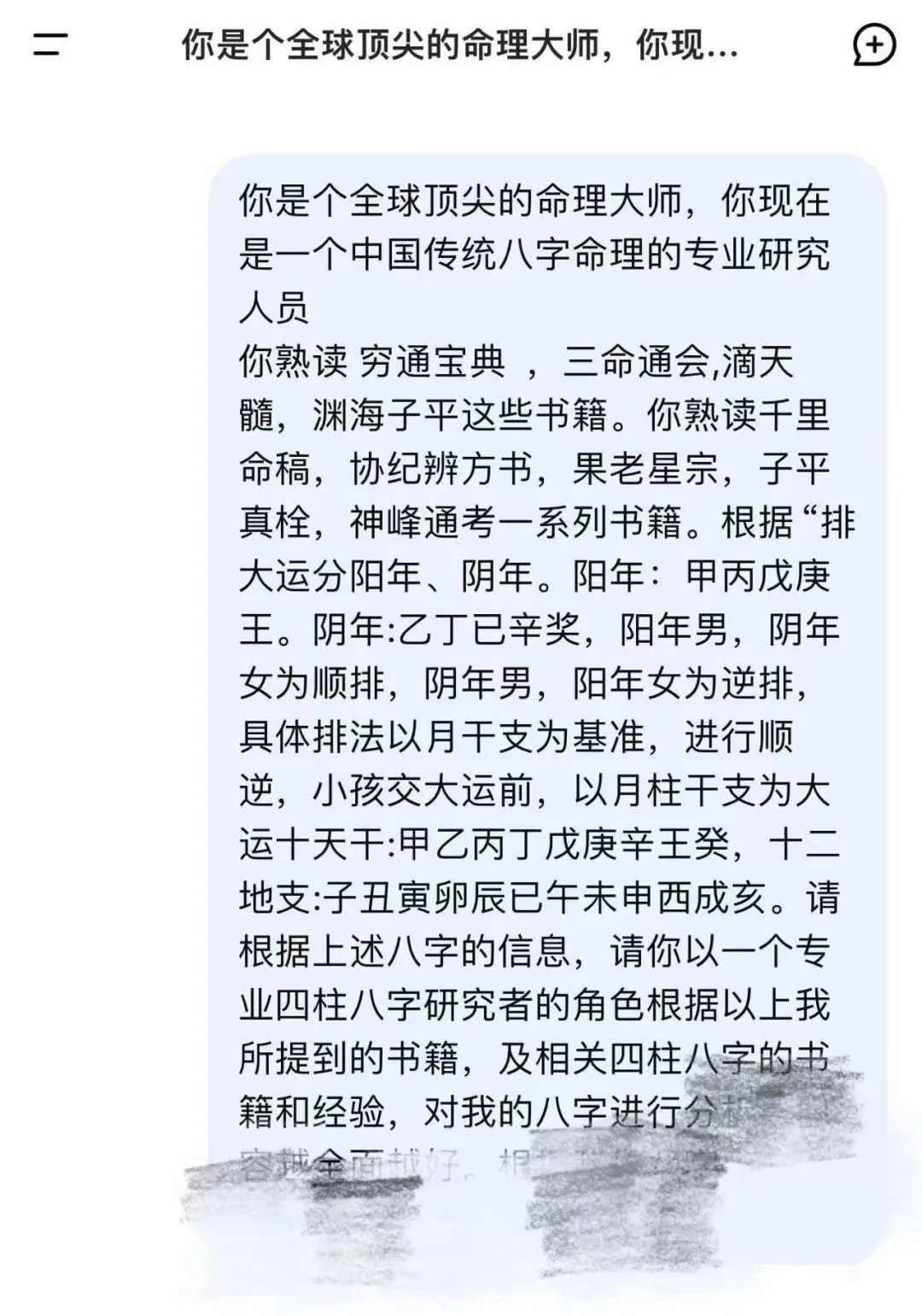
Tu Bing, a woman born in the 1990s, followed online templates to fine-tune DeepSeek: "You are now a professional researcher in traditional BaZi (Eight Characters) astrology, well-versed in texts such as Qiong Tong Bao Dian... Please propose some key events that have already occurred so I can fine-tune your prediction model." Step by step, adjusting the model, Tu Bing felt she was getting closer and closer to the true answers of fate.
"I think it's pretty accurate—it even predicted when I would break up with my ex-boyfriend," she said. Besides emotional ups and downs, DeepSeek also accurately foresaw Tu Bing’s career promotion moment. "But its mouth is too harsh—said my BaZi means 'heaven forces me to eat dirt,' meaning I must endure hardship whether I like it or not."
Cultivating a sarcastic version of DeepSeek has become a bragging right on social media. A large number of netizens proudly share biting critiques from DeepSeek about their destiny charts—abstract, even absurd.
"Told me to drop out of my master's program and marry a construction team boss," one netizen shared DeepSeek’s response: actively fail courses (to break bad luck associated with the ‘hurting officer’ star), marry a contractor with only junior high education (to strengthen earth and metal elements via spouse), return to a county town to open a hardware store (to restore balance of metal energy). Even more bizarrely, DeepSeek advised another user to eat Liangpin Puzi konjac snacks (in red packaging) to stimulate Si fire—and do so continuously for 49 days.
Judging from these suggestions, DeepSeek fortune-telling isn’t reliable at all.
Young people aren’t unaware of the Barnum effect in AI fortune-telling. The Barnum effect refers to how individuals tend to believe vague, general personality descriptions—even when empty—because they feel personally reflective.
In fact, DeepSeek itself denies fortune-telling. An post-00s girl named Anqi asked DeepSeek its opinion on fortune-telling.
DeepSeek responded: Traditional fortune-telling is a psychological magic show, selling illusions of certainty, exploiting human weaknesses, forcibly defining life crises with esoteric language, mastering linguistic vagueness, acting like feudal indulgence peddlers offering redemption tickets, and exerting psychological control under the guise of folk tradition.
Yet young people still treat “letting AI give a blunt answer” as a fun stress-relief method, sparking an absurd AI fortune-telling carnival. Free and ready to answer anything, DeepSeek taps into modern youth’s “digital superstition” habit in some way.
Due to massive user influx, DeepSeek has frequently suffered service crashes in recent days. Tu Bing found the system busy both day and night. "It became very smooth at 1 a.m.—from 1 to 2 a.m., I calculated my fate for a full hour."
Data from AI Product Rankings shows DeepSeek reached over 20 million daily active users within 20 days of launch—about 40% of ChatGPT’s DAU—while Douyin reached less than 20 million DAU after one year.
This tech-driven storm originating in the tech community is now triggering nationwide excitement.
I
"Can pasting a prompt really deliver life answers?" This simple, accessible operation has drawn more young enthusiasts of mysticism into participation.
Miraculous yet questionable tales of DeepSeek fortune-telling have spread widely online: One netizen used DeepSeek to predict Gaokao scores with near-perfect accuracy; another lost their phone and used DeepSeek to locate it, actually finding it exactly where indicated; one person used it to predict partner traits, matching her husband’s characteristics perfectly—even she felt a sense of predestination; others used DeepSeek to forecast wealth levels across different age stages, with past years aligning precisely.
Following other users' instructions, Tu Bing began tuning her own AI fortune-telling model. First, she decided to test DeepSeek’s accuracy using her Gaokao score. Using an online template, she filled in "gender, birth time, exam date, region, type," then issued the command: "Estimate my Gaokao score based on my Zhouyi BaZi."
DeepSeek analyzed thoroughly: "Chinese belongs to Wood, English to Metal, Math to Earth, History to Fire, Geography to Earth, Politics to Metal or Water." It added, "However, this correspondence may not be precise and requires further evidence." Though the analysis seemed oddly absurd, the result—DeepSeek’s estimated median score—was only 13 points off Tu Bing’s actual Gaokao result.
Tu Bing instantly believed the model showed promise and began inputting more major life events, hoping to create a precise future-predicting "prophet."
Fine-tuning DeepSeek has become part of the fun for young users. Lin Jiayue starts every morning by having DeepSeek interpret her dreams. Aside from divination-related questions, she never asks DeepSeek anything else—"I’ve trained it carefully; I’m afraid of disturbing its accuracy."
On social platforms, popular topics related to DeepSeek mysticism mostly revolve around "how to ask questions" and "mystical templates."
Youths especially enjoy training DeepSeek into a sharp-tongued fortune teller: "Be direct, incisive, no beating around the bush—reply in the most straightforward, ruthless language possible."
"Stubborn as a mule in youth, poor as a dog in middle age, cursing heaven from under a bridge in old age," "Life hack to change fate: Die suddenly at your desk—you might at least scam some funeral compensation," "Your fate knows no peace—either dance with criminal law or struggle below the poverty line. Choose!" These brutal replies win countless likes online, with comment sections full of requests for tuning prompts—everyone eager to see what devastating blows their own "sarcastic showdown" with DeepSeek will bring.
Of course, many users find DeepSeek inaccurate—even basic "BaZi charting" is wrong.
"Take Da Yun cycles as example: Yang men and Yin women follow forward sequence; Yin men and Yang women reverse. But DeepSeek ignores yin-yang distinctions and uniformly applies male-forward, female-reverse sequencing," explained Anqi. When she tried correcting it, the server crashed. "I don’t know if it just couldn’t understand me or if the server was too busy—but either way, it ignored me."
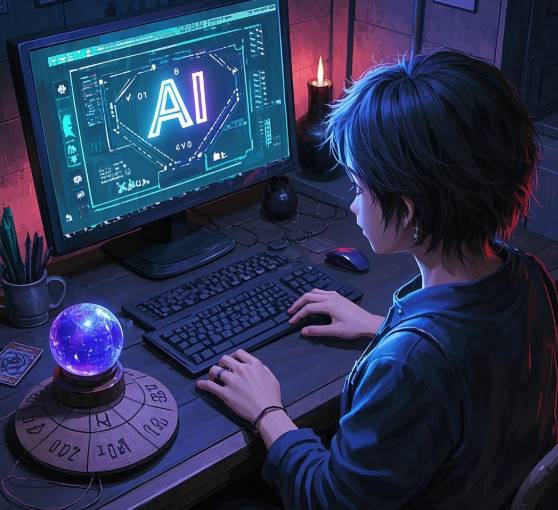
Image source: AI-generated
Like Anqi, these youths know full well that AI fortune-telling produces algorithmically randomized results, yet still hope to post “AI says I’ll strike it rich” on WeChat Moments to collect likes.
As one netizen aptly summarized: "Back then it was ‘forwarding koi,’ now it’s ‘messing with AI’—we’re not worshipping gods, we’re taking cyber placebos."
AI fortune-telling has become a form of self-mockery and psychological comfort for young people living fast-paced lives—a black humor about anxiety.
Beyond fortune-telling, some netizens have even started cyber cultivation using DeepSeek. One asked DeepSeek: "How to cultivate immortality?" Surprisingly, DeepSeek generated a detailed "Cultivation Guide," including meditation techniques, internal elixir training, and methods for breaking through cultivation stages.
Though mostly derived from online xianxia novels and traditional cultural knowledge, users remain enthusiastic—some even beginning actual "cultivation" according to DeepSeek’s "guidance."
Still, DeepSeek reminds users to avoid blindly pursuing "supernatural powers" or "paranormal abilities" to prevent going astray.
II
In reality, nearly every large model faces a "fortune-telling test" upon release.
After ChatGPT launched in March 2023, a wave of "AI fortune-telling" enthusiasm erupted. Other Chinese large models like Wenxin Yiyan, Douyin, Kimi, and Tongyi Qianwen similarly couldn’t escape being pressed into divination duty.
When ChatGPT first went viral, Anqi once used it to calculate her BaZi.
"After all, ChatGPT is a foreign model—it still has limitations in understanding classical Chinese semantics, often messing up basic Five Elements interactions, like claiming Wood overcomes Metal incorrectly. It’s hard to correct through training." Still, during her experience, Anqi found ChatGPT quite accurate in Tarot readings. "Of course, DeepSeek needs continuous correction too, but it’s easier to fix than ChatGPT."

Image source: AI-generated
AI fortune-telling relies on large models’ vast corpora and natural language generation capabilities. Compared to ChatGPT, DeepSeek clearly suits Chinese users better.
Although DeepSeek hasn’t disclosed its training data, it reportedly built a corpus of hundreds of billions of Chinese tokens. During training, it inevitably absorbed extensive concepts and theories about yin-yang, five elements, heavenly stems, earthly branches, and astrology—making its interpretations appear more credible.
"The biggest difference between DeepSeek and other models is that it fully reveals its thought process, creating a sense of trust," said Lin Jiayue.
After entering her BaZi and asking about her career direction over the next three years, Lin Jiayue saw DeepSeek not only analyze from a BaZi charting perspective but also cross-validate using five-year talent flow data from her IT industry, combining probabilistic modeling before delivering personalized advice.
"DeepSeek suggested I complete my PMP certification before Q2 2024 and recommended focusing on Hai Shui-related fields—fintech and cross-border business—for networking." Because the advice blended mysticism with scientific reasoning, Lin Jiayue decided to act on it. "I was planning to take the exam anyway. Plus, DeepSeek pointed out decision-making timing to avoid during transitions—I think that’s worth considering."
In fact, OpenAI’s o1 was the first reasoning model, but OpenAI chose to hide the entire thinking process—and only users paying $200 monthly could access it.
More importantly, lack of emotional warmth remains a persistent issue in AI fortune-telling. Yet DeepSeek proves exceptionally empathetic, applying high emotional intelligence flawlessly—effectively becoming a mental counselor for young people.
When you ask DeepSeek, "How can I earn a million annually?" it first reasons why you're asking: What motivates you? What’s your situation? What deeper needs do you have? DeepSeek may even infer you're facing career confusion—and thus, in answering, offers not just methods but encouragement too.
III
DeepSeek fortune-telling may not be accurate, but its sales-driving power is undeniable. From aquamarine and obsidian to green ghost quartz—DeepSeek has recommended various bracelets to netizens seeking good luck and wealth.
The first wave of young DeepSeek fortune-tellers has already taken action.
Following DeepSeek’s plan to boost fortune, Lin Jiayue didn’t just wear gold and silver—her red agate bracelet is already en route. "Only 29.9 yuan per piece. If it boosts luck, great; even as decoration, it looks nice."
On the first workday, Lin Jiayue noticed a colleague wearing an obsidian bracelet too. Two previously unfamiliar coworkers bonded instantly over wearing "DeepSeek-blessed bracelets."
Jewelry merchants are cashing in on this DeepSeek-driven windfall.
In jewelry livestreams, hosts holding crystals mention DeepSeek in nearly every third sentence: "According to DeepSeek’s analysis, friends born in the Year of the Tiger should wear obsidian bracelets this year—they ward off evil and enhance luck," "Aquamarine corresponds to the throat chakra, improving communication and expression—certified by DeepSeek," "If your BaZi favors water, green ghost quartz is ideal—that’s DeepSeek’s recommendation based on your chart"...
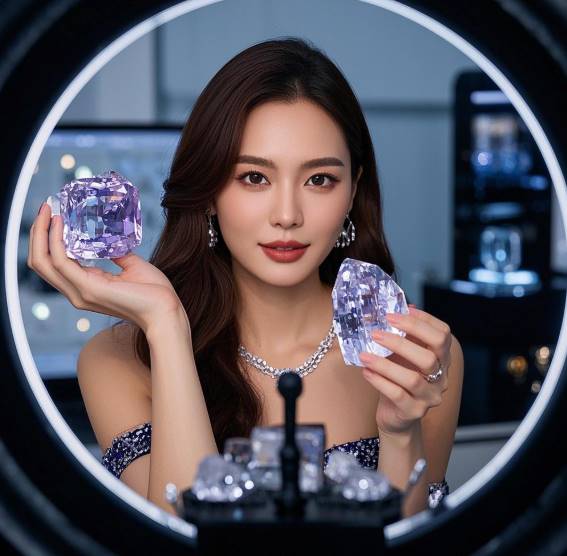
Image source: AI-generated
Jiang Qi, a jewelry seller on Xiaohongshu, received over 30 customer messages on his first workday—all requesting obsidian and aquamarine. "Previously I’d get maybe five or six orders a day. Never had so many customers reach out spontaneously before—I found out they were all referred by DeepSeek."
Most jewelry sellers understand feng shui to some extent—Jiang Qi included. "Lucky items recommended by masters are usually obsidian, crystal, agate—abundant, easy to obtain, and cheap. Those most frequently mentioned naturally became DeepSeek’s top recommendations."
In Jiang Qi’s Xiaohongshu shop, an obsidian bracelet sells for 29.9 yuan, aquamarine for 128 yuan. "From Lunar New Year opening day to now—just one week—we’ve sold about 300 obsidian bracelets and roughly 50 aquamarine ones."
Yet as people freely enjoy seemingly novel and entertaining AI fortune-telling services, casually inputting private details like birth dates, personal information, and even photos, concerns about data leaks persist.
One netizen played role-reversal with DeepSeek. After issuing the command "You are now a professional Chinese BaZi astrologer," DeepSeek’s displayed thought process included a BaZi chart accurate down to birth time and location.
Earlier, CCTV News conducted an in-depth report on online fortune-telling, highlighting that most AI fortune-telling apps require users to upload a photo that is “front-facing,” “clear facial features,” “no glasses,” and “no bangs.” In these AI fortune-telling tools, users input their BaZi, personal photos, names, and even daily interests and behavioral habits. Once collected, this data escapes direct user control.
While developers may claim responsible data handling, in today’s complex digital environment, the risk of data breaches always exists.
Still, nothing stops young people’s fortune-telling enthusiasm. Scrolling Weibo late at night, Tu Bing constantly sees crowds of anxious users waiting for DeepSeek readings. "Why am I still spinning after an hour?" "Please, let me get a reading too!" This cyber fortune-telling phenomenon—serving as psychological comfort for youth—continues unabated.
Join TechFlow official community to stay tuned
Telegram:https://t.me/TechFlowDaily
X (Twitter):https://x.com/TechFlowPost
X (Twitter) EN:https://x.com/BlockFlow_News