How should mainland enterprises issue RWA in compliance?
TechFlow Selected TechFlow Selected
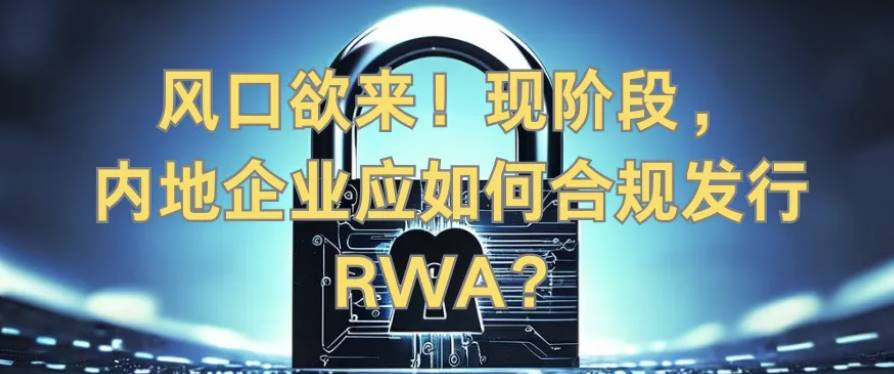
How should mainland enterprises issue RWA in compliance?
In the absence of a regulatory sandbox for RWA in mainland China and with ICO activities explicitly prohibited, pursuing RWA in Hong Kong may be the optimal solution for Chinese enterprises.
 Navigating Web3 tides with focused insights
Author: Xiao Sa Legal Team
As traditional finance increasingly intersects with blockchain technology and digital assets, RWA is emerging as an alternative—or even superior solution—to traditional financial instruments such as asset securitization and IPOs, offering new ideas and methods for asset circulation and trading.
In simple terms, the basic process for compliantly issuing an RWA project goes like this: select a suitable asset ➡ determine the issuance plan ➡ conduct asset valuation and audit ➡ build a tokenization platform to issue tokens ➡ obtain regulatory approval for compliant issuance.
Today, drawing on practical experience and recent successful RWA cases, the Sa Team will walk you through this fascinating topic from three perspectives: "selection of underlying assets," "choice of issuance model," and "choice of issuance jurisdiction."
01 Selection of Underlying Assets — The Key to RWA
Based on the Sa Team's practical experience, at the current stage, the most critical aspect of launching an RWA project lies in correctly selecting the underlying assets for tokenization.
Indeed, digital assets are becoming an important tool in reshaping the global financial landscape. However, due to limitations in our understanding and differences in national conditions across countries, the development and adoption of new technologies—especially those with financial characteristics—must proceed gradually. This has led to varying degrees of acceptance of digital assets across jurisdictions.
Therefore, properly selecting an underlying asset not only helps赋予 the RWA project a more reasonable, reliable, and visible "value," but also increases its chances of being viewed by regulators as a genuinely viable "financial innovation" rather than an illegal fundraising or fraud scheme.
From several high-profile and relatively compliant successful RWA projects in China’s market, the selection of underlying assets generally exhibits the following characteristics:
(1) Physical assets;
(2) Attributes aligned with the "green economy";
(3) Ability to generate stable cash flows;
(4) Moderate total asset value with long-term market price stability.
Notably, many current underlying assets possess "green economy" attributes, primarily because most Chinese companies choose Hong Kong as their RWA issuance destination, utilizing the Ensemble Sandbox launched by the Hong Kong Monetary Authority (HKMA) for compliant issuance. Currently, the first phase of the Ensemble Sandbox focuses on tokenizing traditional financial assets and real-world assets, with emphasis on four themes: (1) Fixed income and investment funds; (2) Liquidity management; (3) Green and sustainable finance; (4) Trade and supply chain financing.
Among these, green and sustainable finance represents the most accessible and financially beneficial category for mainland Chinese enterprises when selecting RWA underlying assets. Thus, the two successful projects currently visible in the market—the charging stations of a certain New Group and the photovoltaic power station of a certain Xin Technology—are both examples of such assets.
Of course, as the market evolves and opportunities on overseas RWA platforms grow, the Sa Team believes that while "green economy" attributes will remain an important consideration, they will not be decisive. Ultimately, the essence of underlying assets is to provide core value to RWA projects—stable cash flow generation and broad market recognition are key.
02 Choice of Issuance Model
Based on current market practices, there are mainly two issuance models for RWA: the direct issuance model and the asset-backed model.
The direct issuance model can be simply understood as a straightforward ICO. Typically, the asset owner acts as the issuer, using blockchain as a ledger tool to register the asset and simultaneously issue corresponding tokens. This model is commonly used on private overseas RWA platforms. However, since China's 2017 announcement by the People's Bank of China and six other departments declaring ICOs as "unauthorized public financing activities," this model has effectively disappeared within mainland China.
The asset-backed model, on the other hand, has gradually become the mainstream choice for compliant RWA projects—particularly in Hong Kong. This model draws heavily from the concept of "asset securitization" in traditional finance. Although it still involves issuing tokens via ICO, these tokens are treated as new securities representing economic rights to the underlying assets. In practice, the issuer registers the underlying asset on a non-blockchain system, a third party purchases the asset, a licensed custodian institution takes custody of the asset, and then the issuer conducts the ICO in proportion to the asset value.
Overall, the asset-backed model offers higher compliance compared to the direct issuance model and better aligns with Hong Kong’s regulatory framework. However, it comes with higher issuance costs, making it more suitable for larger-scale underlying assets.
03 Choice of Issuance Jurisdiction
Currently, the global RWA sector is experiencing a period of rapid and diverse growth. Except in a few jurisdictions like China that impose strict regulations on digital assets, numerous RWA projects are rapidly developing, with varied issuance methods and platforms.
Based on our practical experience, the Sa Team believes that for mainland Chinese companies seeking to combine quality products with the crypto world for financing, Hong Kong remains the top choice for RWA issuance. This is based on two main considerations.
First, the HKMA has established the Ensemble Sandbox, designed to explore innovative financial market infrastructure based on blockchain platforms. The issuance of tokenized assets and technical interoperability between tokenized deposits and wCBDC are central to the sandbox’s testing. Therefore, high-quality RWA projects are likely to thrive within this environment.
Second, several mainland companies have already achieved successful issuances in Hong Kong. The regulatory framework of the Ensemble Sandbox is now relatively clear. If compliance requirements are met, the likelihood of successfully launching an RWA in Hong Kong is high. Moreover, current RWA financing scales have reached the hundred-million level—almost equivalent to a small IPO—meaning the financial benefits from RWA issuance are substantial.
Considering these advantages, in the absence of a dedicated RWA regulatory sandbox in mainland China and with ICOs explicitly prohibited, pursuing RWA issuance in Hong Kong may be the optimal path for Chinese enterprises.
04 Final Thoughts
The Sa Team cautions that Hong Kong’s capital market is highly developed and regulated, requiring mainland enterprises to comply with Hong Kong’s financial regulations when launching RWA projects. The issuance cost naturally includes due diligence requirements typical of traditional asset securitization: professional lawyers, accountants, and others must conduct due diligence on the underlying assets to confirm clear and compliant ownership, ensure on-chain data is properly anchored to real-world assets, verify smart contract compliance, and more.
In summary, the Sa Team believes RWA will gradually evolve into a robust financial tool, offering businesses a newer and more efficient financing channel. However, the market has also seen many fraudulent schemes disguised as RWA projects. For example, the Sa Team once consulted with a client claiming to possess over ten authentic "Ru kiln" antiques and wanting to use them as underlying assets for an RWA... Therefore, readers must remain vigilant, avoid blind investments, and guard against scams.
Join TechFlow official community to stay tuned
Telegram:https://t.me/TechFlowDaily
X (Twitter):https://x.com/TechFlowPost
X (Twitter) EN:https://x.com/BlockFlow_News