Is DeFi still decentralized?
TechFlow Selected TechFlow Selected
Is DeFi still decentralized?
Decentralization is a trade-off.
 Navigating Web3 tides with focused insights
Author: Santisa
Translation: Block unicorn

Decentralized finance (DeFi) was born to create an open, permissionless, and trustless financial system. Early projects like MakerDAO, Uniswap, and Compound fully embodied this ideal—featuring community governance, transparency, and self-custody. However, as DeFi has evolved into its current form, I have to ask: Is it still decentralized? More importantly, does it even matter? And what can you do about it?
On crypto Twitter (CT), many people didn't experience DeFi's birth in 2017/2018, or even the DeFi summer of 2020. Back then, decentralization was at the core of everything. We cared about technology, scrutinized smart contracts for scams or custody risks, and celebrated security researchers who uncovered vulnerabilities.
Those who trusted centralized entities like BlockFi, Celsius, Nexo, and Genesis? They were ordinary people too, unable to navigate the DeFi wave. When these centralized institutions collapsed, their users were left to clean up the mess, entering years-long, costly bankruptcy proceedings. This only deepened our aversion to centralization.
But now? Most participants haven’t experienced the trauma of centralized systems collapsing. So it’s no surprise that most new DeFi projects have largely abandoned decentralization. Decentralization is a trade-off—you sacrifice efficiency for security. If people don’t value security, why should projects make that sacrifice?
Decentralization Is a Spectrum
We lack a single, clear definition of what makes a system "decentralized." So let me propose one. What constitutes a truly "decentralized" system?
-
Direct asset custody: Individuals hold direct control over their assets. If the system’s rules allow (e.g., sufficient market liquidity, cooldown period ended), you should be able to withdraw your funds without external approval.
-
Assets cannot be frozen: The operator of the system cannot freeze or seize your funds. You retain full control over your assets at all times.
-
System immutability or long lock-in periods: Immutability ensures that the rules in place when you enter the system remain unchanged.
-
Decentralized governance: How decentralized is the system you're using? Have blockchain participants ever colluded to freeze or block someone’s funds? Are there multiple nodes? Is stake distributed? Do validators actually perform validation, or do they blindly sign instructions from a foundation? Do they control the entire system (e.g., L2s in phase 0)?
-
External dependencies: Does the system rely on intervention by centralized third parties to function? If your lending market depends on oracles curated by a centralized risk team, then your funds depend entirely on that curator’s integrity.
Now, let’s see how some protocols fare under this framework.
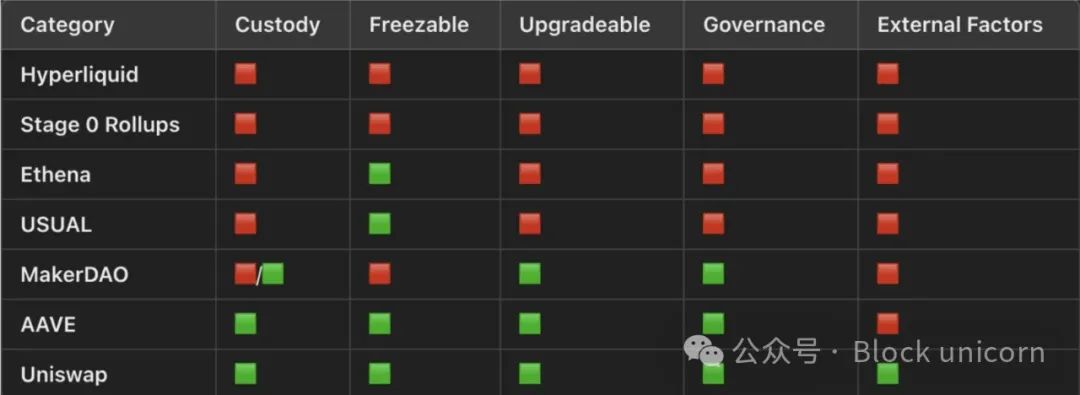
As shown in the chart, earlier projects score higher on decentralization, while newer ones fall short. This clearly reflects market preferences.
In 2024, centralized on-chain investment funds absorbed $8 billion in deposits, DAI/USD grew at 2.3%, while decentralized stablecoins like LUSD declined by 65%.

I came of age in an environment rooted in decentralization ideals, so adapting to this new trend hasn’t been easy. I haven’t fully given up on decentralization—but I’m learning to adapt. Below, I’ll highlight some examples and share strategies for surviving—and thriving—in this evolving landscape.
Centralized Instances in “Decentralized Finance” (DeFi)
-
Hyperliquid: An on-chain, KYC-free centralized exchange. You send funds to an address on Arbitrum and receive USDC on their platform. They control both the funds and the platform. The only upside: their deposit address is public and can be verified in real time.
-
Ethena: A fund primarily engaged in basis trading. Whitelisted users send them capital and can sell LP shares on secondary markets. Ethena controls all funds, payouts, and redemptions. USDe funds cannot be frozen.
-
Usual: Similar to Ethena, Usual operates a fund holding Treasuries. They set redemption rules and asset pricing. Usual demonstrated centralized risk by unilaterally determining redemption prices for locked bonds, while Gauntlet and MEV Capital hardcoded their oracle price to $1 via polls.
-
MakerDAO: Maker is now a DAO-operated investment fund. The community votes on fund allocations, including investments into centralized custodians and projects such as Blocktower Andromeda and Ethena (via hardcoded Morpho pools).
-
Uniswap: On Ethereum mainnet, Uniswap remains fully decentralized. You retain complete control over your funds, rely on no external data, and the smart contracts are immutable. Hats off to Uniswap!
These setups introduce massive trust assumptions and binary risks—you’re either "rugged" or you’re not. We haven’t seen any major blowups yet, but if these centralized projects collapse, the fallout will be devastating: frozen redemptions, lawsuits, and exorbitant fees (think FTX assets).
How to Minimize Risk
-
Borrow against risky collateral: Don’t directly hold high-risk centralized assets. Instead, use them as collateral for loans. If the risky asset drops in price, you incur no loss while still capturing similar yields. DeFi will always offer leverage opportunities—there will be no shortage of places to lend against such collateral.
-
Withdraw during market turbulence: Exit early when markets turn volatile. You might pay some gas fees and lose a few basis points (e.g., 100% APY over 24 hours is just ~18 bps), but that’s better than losing everything.
-
Set a minimum risk premium: Decide in advance what risks are worth taking. If a high-risk investment offers 2–3x baseline returns, it might be acceptable. But if the gap narrows to just 30%, don’t get greedy.
-
Monitor on-chain activity: Watch large transfers or insider movements closely. For example, if you tracked the USD0++ exit scam, you could’ve exited at $0.99 instead of $0.9251.
-
Understand the risks: Know exactly what you're exposed to. Understand that beyond risk itself, you must actively monitor your positions. During market downturns, gas fees may spike (300–400 gwei), so size your positions accordingly. If gas is an issue, consider Layer 2s.
Conclusion
Decentralization was once DeFi’s core appeal. Today, many projects have abandoned it in favor of efficiency and mainstream adoption. This undoubtedly weakens the original vision—but it also reflects market reality.
I believe that, over time, things naturally trend toward centralization. We see an initial state of centralization, followed by a "Cambrian explosion" of user-driven decentralization, and eventually, large centralized players dominate every aspect. We’re slowly transitioning into an on-chain centralized world. Centralized stablecoins are now market darlings, and even decentralized projects gradually centralize over time to stay relevant. Decentralized money markets begin custoding collateral to boost profits; decentralized stablecoin projects peg their tokens to fiat-backed assets to maintain stability; and decentralized exchanges abandon decentralization altogether for greater efficiency. The bankruptcies of 2022/2023 were merely roadblocks on our path to centralization. In the short term, the only way to prevent this may be letting today’s centralized giants fail—eventually "rugging" everyone out.
In ancient Rome, after Octavian (Augustus) killed the Republic, he ruled as dictator for 41 years. The duration was so long, the rules and incentives so entrenched, that when Augustus died, neither the Senate nor the people restored freedom. They simply asked, “Who should we trust next?” I hope DeFi is far from reaching that point—that for now, we can still escape the tyrants.
So, is DeFi decentralized? Not really. Does it matter? It depends. If you move quickly before these emerging centralized entities collapse, you can make substantial gains. If you’re in fund management, leave your ideals at the door.
Either way, staying informed and prepared is your best strategy for survival in this game.
Join TechFlow official community to stay tuned
Telegram:https://t.me/TechFlowDaily
X (Twitter):https://x.com/TechFlowPost
X (Twitter) EN:https://x.com/BlockFlow_News
 @Tiza4ThePeople