








2025 On-Chain Movement Research Report: Making DeFi More DeFi
TechFlow Selected TechFlow Selected
2025 On-Chain Movement Research Report: Making DeFi More DeFi
DeFi achieves a second-system effect.
 Navigating Web3 tides with focused insights
Author: Zuo Ye
Within a single month, the crypto market has experienced two shocks on 10·11 and 11·03, raising widespread doubts about DeFi's future. At this moment, it’s an ideal time to examine the current structure of the DeFi market and its evolving direction.
From the broadest perspective, DeFi is rapidly escaping the "second-system effect." The impact of stablecoins on traditional banking and payment industries is becoming increasingly tangible—evidenced by the Federal Reserve’s attempt to offer streamlined master accounts. Institutional DeFi, represented by Aave/Morpho/Anchorage, is reshaping traditional finance, while Uniswap’s plan to activate fee switches and Perp DEX wars exemplified by Hyperliquid remain fiercely competitive.
Immaturity manifests in choosing noble death for the sake of ideals. It's far too early to claim that DeFi has fully matured and only awaits mass adoption. In DeFi’s sky, two dark clouds still loom:
-
Who serves as the lender of last resort for the entire on-chain economy? Morgan created the Federal Reserve—what mechanism should fulfill such a role in DeFi?
-
Beyond the endless nesting of established DEX/Lending/Stable products, how can truly original DeFi sectors or mechanisms emerge?
Price Is the Outcome of博弈
Barter, as long as you're online, I'm always with you.
We are often blinded by omnipresent things. In the DeFi microcosm, all innovation so far revolves around DEX, Lending, and Stablecoin—not because BTC/ETH lack mechanistic innovation, nor because RWA/DAT/crypto stocks/insurance lack asset innovation.
Referencing the six pillars of on-chain protocols, BTC and Bitcoin fundamentally require no other assets or protocols. The DeFi we discuss refers to projects on public chains/L2s like Ethereum/Solana. Referencing leveraged cycles of crypto stocks/bonds, the cost of selling innovative assets keeps rising. The industry now seeks products with real profitability, such as Hyperliquid.
Image caption: Evolution of DeFi paradigms, Image source: @zuoyeweb3
Since the end of DeFi Summer, DeFi innovations have been continuous improvements upon existing products, assets, and established facts. For example, trading splits into spot, perp, and meme, corresponding respectively to AMM/CLOB/Bonding Curve from DeFi Summer. Even Hyperliquid, the most innovative, still bears strong traces of Serum.
At the most granular level, Pendle began as a fixed-income product, evolved to embrace LST/LRT, then Ethena-like yield-bearing stablecoins. Euler and Fluid both independently chose to build native lending + swap products. If users set yield strategies using Ethena-like YBS, they could theoretically leverage DEX/Lending/Stablecoin across any chain, any protocol, any vault simultaneously.
This synergy amplifies returns but also "creates" numerous liquidation disasters and trust crises. Beyond this, vast No-Go Zones remain. Blockchain was born free, yet everywhere in chains.
Decentralization is a beautiful vision, but centralization offers higher efficiency. What’s scarcer than赛道 is protocol centralization. Aave is undoubtedly large and secure, but this also means you rarely have newer or more diverse choices. Latecomers like Morpho/Euler can only embrace risky managers and "inferior" assets.
Unbanked populations sparked Third World pursuit of stablecoins. You can’t say Aave’s prudence caused Morpho’s crisis, but unAaved users have driven demand among on-chain "rats" and younger generations for subprime bonds, subprime protocols, and subprime managers.
Innovation can only happen at the margins, where trial costs are extremely low. Survivors repeatedly challenge the status quo. Aave V4 will likely resemble its competitors more than its past self.
The current market prices and volumes of protocols and their tokens merely reflect the present environment—i.e., already recognized outcomes of repeated博弈.
It’s hard to say whether these hold future validity or even reference value. Stablecoin chains like Plasma and Stablechain are booming, yet unlikely to challenge Tron and Ethereum’s adoption rates. Even xUSD’s attempt to surpass USDe—a stablecoin much smaller than USDT—has already failed.
Pricing systems favor time; older protocols tend to survive longer. Hyperliquid and USDe succeeding would be aberrations. How much market share Euler/Morpho/Fluid can take from Aave is debatable, but outright replacement is nearly impossible.
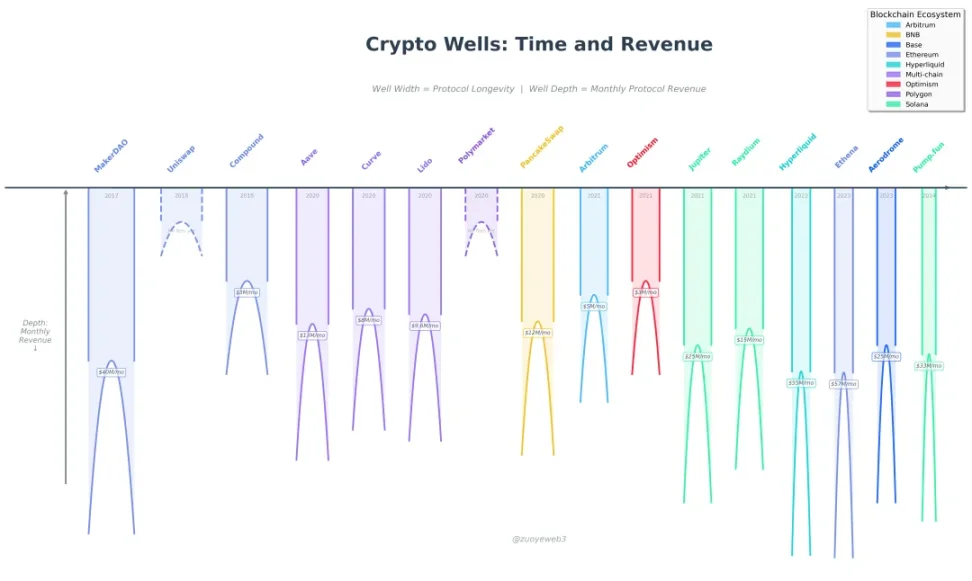
Image caption: Crypto gravity well: time scale and revenue, Image source: @zuoyeweb3
Crypto gravity well: time and App Rev【continuous】—left to right is token launch time, top to bottom is revenue
-
Time: Balancer (hacked), Compound (dormant), Aave (thriving) capture our time
-
Rev: Profitability is the sole commercial value—one path being intrinsic token value in BTC terms (USDT issuance volume, yield stablecoins aiming for this shortcut), the other being value capture ability (Pump’s mine-and-dump)
Competition turns inward, burning cash for growth.
As shown above, x-axis is protocol longevity, y-axis is value capture ability. Compared to metrics like token price, volume, and TVL, revenue generation is the most objective measure (Polymarket theoretically earns nothing).
Theoretically, earlier-established protocols have stronger stable profitability. New entrants must continuously strengthen the token<>liquidity<>volume flywheel—referencing Monad/Berachain/Story—where failure remains the probable outcome.
Value as the Target Within Balance
Believe in the power of the masses, but not their wisdom.
DeFi is a movement. Compared to exchanges and TradFi, under overall loose conditions, this may indeed be one of the best innovation cycles in history—possibly birthing new paradigms beyond DeFi Summer.
Exchanges are taking heavy hits. Hyperliquid’s transparency first demonstrated anti-fragility exceeding Binance. After 1103, lending and stablecoin momentum slowed but wasn’t invalidated. People genuinely need subprime bonds and simple funds/bonds/equity instruments—stablecoins.
Compared to market makers constrained by CEX liquidity migration during 10·11, on-chain trading—spot/derivatives, alternative assets—are actively expanding scale. As long as problems can be engineered into combinations, complete solutions become possible.

Image caption: Crypto assets: time & volatility, Image source: @zuoyeweb3
-
First Quadrant (Rising Stars): HYPE, PUMP, Layer1s/L2s/Alt L1s (Monad, Berachain, MegaETH), RWA (Bonds, Gold, Real Estate)
-
Second Quadrant (Alt Zone): DOGE, SOL, Compound, Pendle, Polymarket, Euler, Fluid, Morpho, Ether.Fi, Lido, Non-USD Stablecoins, Options
-
Third Quadrant (Industry Leaders): BTC/ETH/USDT/USDC/USDS/Aave
-
Fourth Quadrant (Death Zone): ADA, Meme, DAT, Insurance
Placing many new assets in the Rising Star zone reflects their sensitivity to time and volatility—essentially short-term speculative assets. Only by transcending simple博弈cycles and settling into stable holder bases and use cases can they enter the Alt Zone, where time sensitivity diminishes but liquidity cannot withstand severe market swings. Most projects stall here.
Moreover, no matter how hard teams work—through ve(3,3), buybacks, burns, mergers, rebrandings—they may still stagnate, entering a flat uphill phase where effort doesn’t guarantee progress and advancement might even mean regression.
Afterward, the story simplifies: successful渡劫enter the stability zone, becoming so-called cycle-surviving assets like BTC and ETH—perhaps half of SOL and USDT too—but most assets slowly die, becoming insensitive to time and devoid of volatility.
Meme and DAT as categories will persist long-term, but individual assets under them rarely find lasting opportunities. DOGE and XRP are outliers as rare representative meme and alt assets.
In fact, viewing protocols as asset innovation resolves many issues—i.e., the entrepreneurial goal is a one-time exit rather than building a sustained open system:
-
Spot DEX: Trading concentrates on major assets (BTC/ETH) and whale rebalancing. Retail no longer trades alts. Projects focus on niche clients rather than permissionless public infrastructure—e.g., dark pools rationalizing information asymmetry between whales and retail;
-
Perp DEX: Lighter’s massive funding round signals imminent token launch, with VCs highly fragmented. Big names act more like TGE financiers, while small VCs perish as the Perp赛道declines. Retail scours various launchpads for scraps;
-
Meme: Emotion itself becomes a tradable asset, unable to gain industry-wide consensus. No sign or capability seen from PumpFun to solve this;
-
Platformed & Modular Lending: A long-term trend. Lending protocols can modularly sell liquidity, brand, and tech—essentially B2B2C;
-
DEX+Lending Convergence: Among the latest in nesting, with dedicated articles to follow on mechanisms;
-
Non-USD / Non-Dollar-Pegged Stablecoins: Short-term focus on developed regions (EUR, JPY, KRW), but long-term markets lie in the Third World.
Separately highlighting yield-bearing stablecoins: overall, they best embody the integration of DEX/Lending/Stable, but require massive engineering integration.
In contrast, innovation beyond DEX/Lending/Stable remains sparsely observed. For instance, NeoBank-style stablecoins still combine the three, prediction markets fall under broad DEX types. More promising ideas may lie in Agentics and Robotics.
The internet enabled scalable replication, vastly different from industrial-era production, yet lacked a matching economic model. Advertising economics sacrifices user experience. Compared to LLM-on-chain, Agentics better aligns with blockchain’s technical traits—extreme programmability enabling 24/7 trading efficiency.
As gas fees gradually decrease, TPS improves over years, and ZK infrastructure advances, blockchain’s mass adoption may first occur in human-less replicative economies.
Robotics’ short-term integration with crypto isn’t particularly compelling. Until robots like Unitree shed gimmick and educational toy status, Web3 applications remain impractical. Long-term? Only time will tell.
Conclusion
Make DeFi more DeFi.
Robotics takes too long—liquidations happen overnight.
The composite liquidation mechanism of DEX+Lending represents proactive construction against DeFi crises, yet couldn’t stop the spread of the 11·03 crisis. Most effective was Aave’s preemptive rejection. Across the industry, managing liquidations and subsequent recovery has become the greatest challenge.
In 2022, after 3AC collapsed, SBF proactively acquired and restructured involved protocols—yet FTX itself was taken over by traditional law firms less than half a year later. After Stream’s xUSD blowup, legal handover occurred immediately.
Code is Law is becoming Lawyer is Coder.
Before SBF and law firms, BTC long served as the ultimate settler—though rebuilding trust in the on-chain economy required immense time. But at least, we still have BTC.
Join TechFlow official community to stay tuned
Telegram:https://t.me/TechFlowDaily
X (Twitter):https://x.com/TechFlowPost
X (Twitter) EN:https://x.com/BlockFlow_News
 @zuoyeweb3






