








Berachain Panorama: Seizing New Opportunities in the Layer 1 Race
TechFlow Selected TechFlow Selected
Berachain Panorama: Seizing New Opportunities in the Layer 1 Race
Berachain is poised not only to become an efficient trading platform, but also a significant and unique player within the DeFi ecosystem.
 Navigating Web3 tides with focused insights
Berachain was undoubtedly the only public blockchain to attract widespread attention before mainnet launch in 2024. Its strong funding background, collaborations with multiple flagship projects, and enticing airdrop expectations reignited enthusiasm among DeFi enthusiasts. Overall, Berachain stands out in terms of project fundamentals, innovation, and performance metrics. Through analysis across these dimensions, we will uncover its strengths in technical architecture, community building, and market performance, as well as its potential within the future Layer 1 landscape.
1. Project Overview
Berachain is a Layer 1 blockchain project built on the Cosmos SDK and compatible with the Ethereum Virtual Machine (EVM). It aims to address liquidity challenges in the DeFi (decentralized finance) space through its unique Proof of Liquidity (PoL) consensus mechanism. The PoL mechanism ensures network security and vitality by incentivizing users to provide liquidity—differing from traditional Proof of Stake (PoS), as it places liquidity at the core of network security and efficiency.
PoL (Proof of Liquidity) Mechanism:
• Liquidity Staking: Berachain requires validators to stake liquidity rather than simply holding tokens. This mechanism rewards users who contribute liquidity to the network, promoting long-term network health and sustainability.
• Three-Token System:
○ BERA: Serves as the network's gas token for transaction fees and basic operations.
○ HONEY: Berachain’s native stablecoin designed to offer a stable store of value and medium of exchange, similar to stablecoins in other ecosystems.
○ BGT (Berachain Governance Token): Used for governance purposes, non-transferable to ensure decision-making power remains with long-term stakeholders genuinely committed to the network's development.
Team Background:
Berachain was founded by a group of DeFi enthusiasts who met in the Olympus DAO community, bringing extensive experience in decentralized finance. They initially entered the market through the NFT project Bong Bears. In April 2023, Berachain raised $42 million in a Series A round led by top-tier crypto investors including Polychain Capital, OKX Ventures, and Hack VC. This was followed by a $100 million Series B round in April 2024. These funding milestones not only validate market confidence in Berachain’s innovative design but also provide robust financial support for ongoing development.
2. Data Snapshot
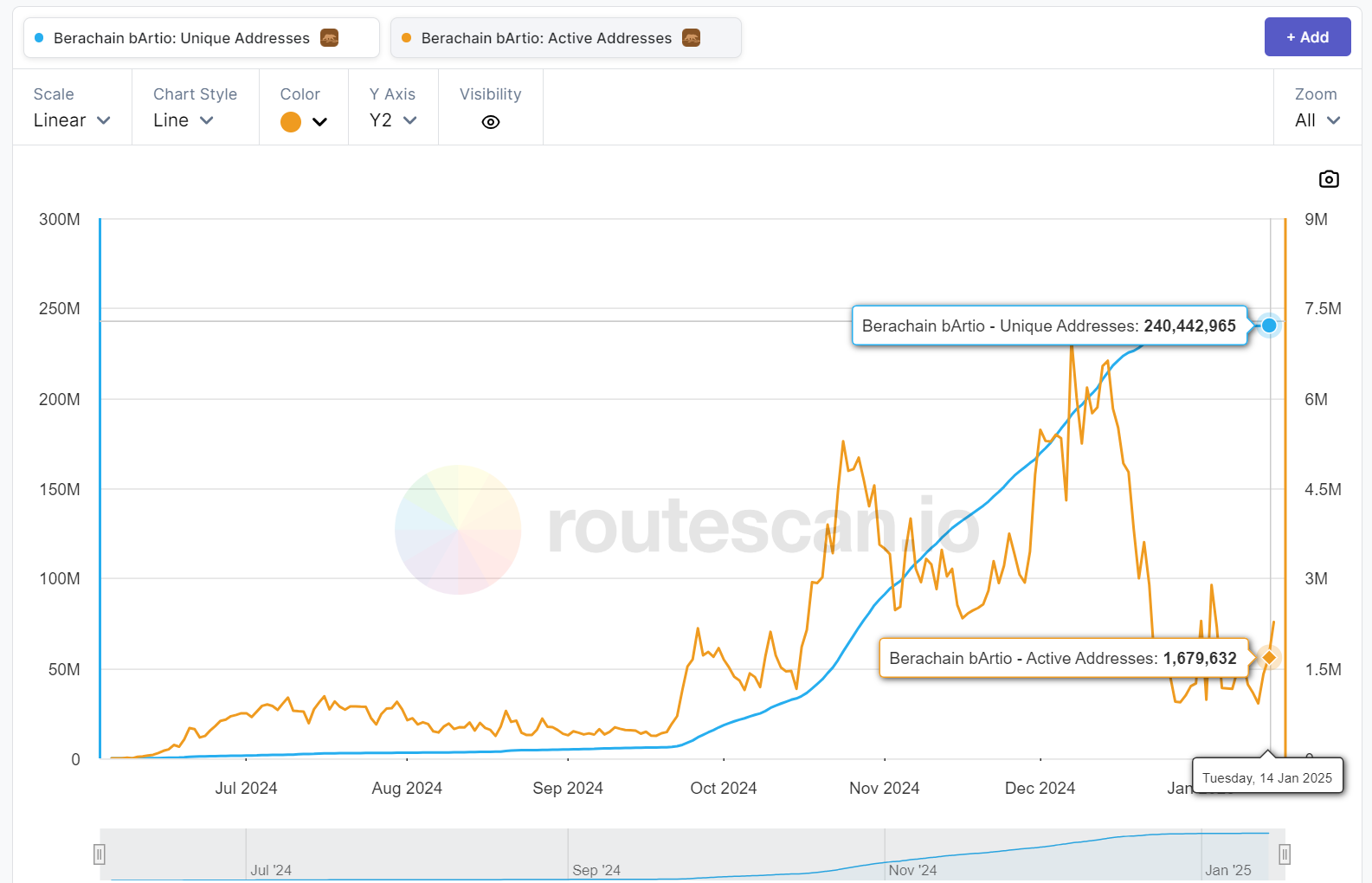
Berachain’s ecosystem has grown rapidly despite the mainnet not yet launching, with over 270 projects committed to participate, primarily focused on consumer-facing applications. Its second testnet (v2 Bartio) launched in June 2024, and after September, the number of addresses grew exponentially. Within less than a month, active addresses surged from 6.4 million to 33.3 million, continuing to rise through October to December. The current number of unique addresses has reached 240 million, with daily active addresses peaking at 7 million in December.
Data source: https://80084.testnet.routescan.io/
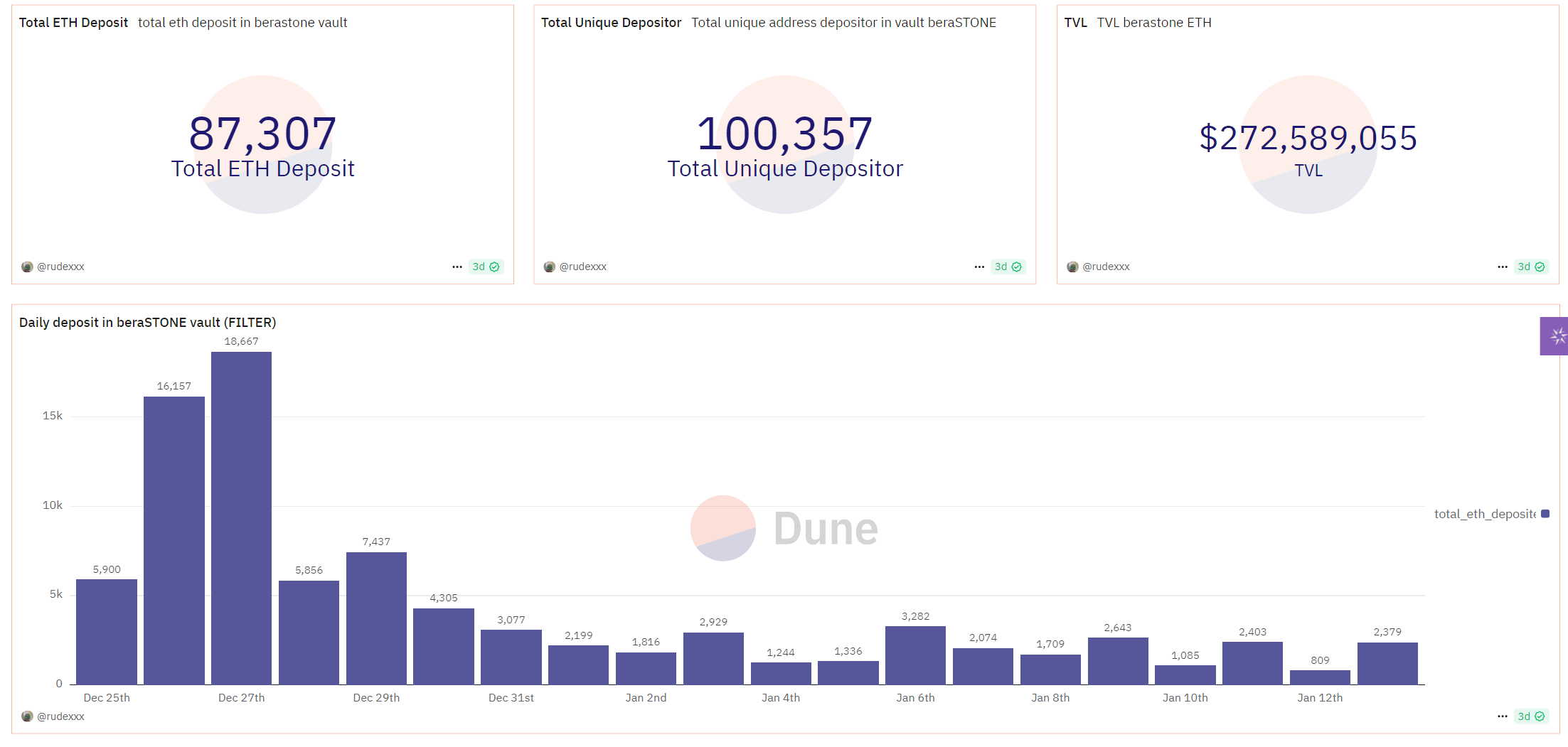
Since opening pre-deposits, the Berastone vault has received 87,307 ETH from 100,357 unique addresses, achieving a TVL of $273 million.
Data source: https://dune.com/rudexxx/berachain-vault-berastone
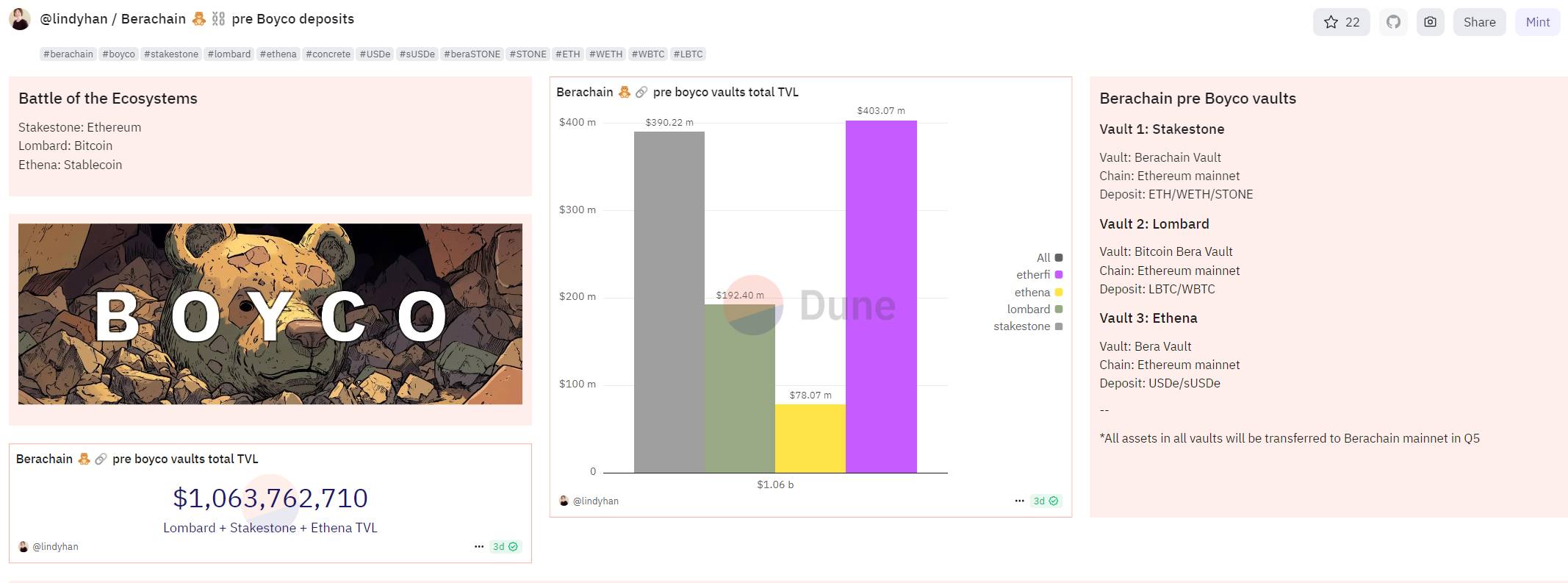
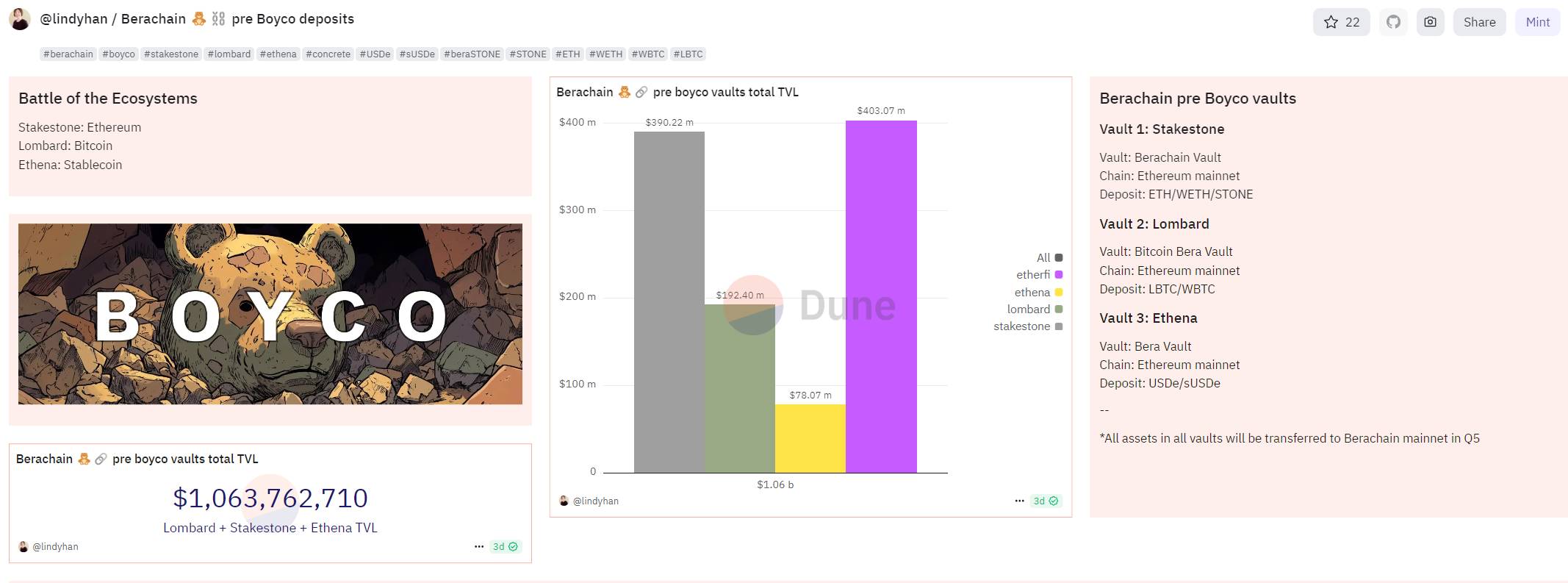
The combined TVL of Pre Boyco deposit pools, in collaboration with Ethena, Etherfi, Lombard, and Stakestone, has reached $1.064 billion.
Data source: https://dune.com/lindyhan/berachain-pre-boyco-deposits
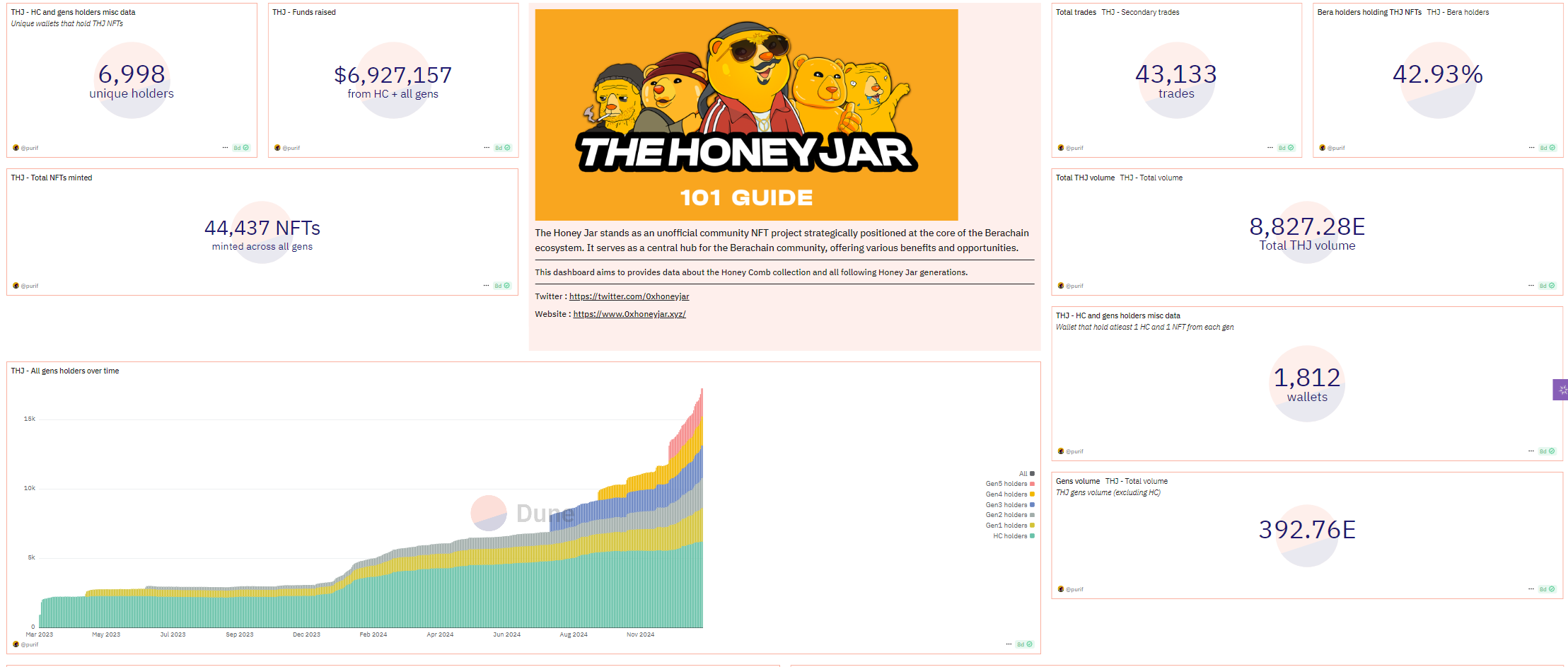
The THJ NFT collection has 6,998 unique holders, with over 44,000 minted, raising $6.927 million and generating trading volume of 8,827 ETH.
Data source: https://dune.com/thj/thehoneyjar
3. Key Milestones
2021.8 Bong Bears NFT minted and launched
2021.11 First mention of Berachain
2022.3 Olympus DAO OIP-87 proposal approved, allocating $0.5M investment in Berachain at a $50M valuation
2023.4 Completed $42 million Series A funding at a $420 million valuation, led by Polychain
2024.1 Berachain testnet launched
2024.2 LayerZero announces support for Berachain
2024.3 Tabi Chain announces deployment of NFT marketplace, Launchpad, and event platform on Berachain
2024.4 Completed $100 million Series B funding at a $1.5 billion valuation, led by Framework Ventures
2024.6 Second public testnet (v2 Bartio) launched
2024.7 Joint testnet launched for the chain abstraction alliance between Berachain and modular L1 Particle Network
2024.9 Launched RFB incentive program and partnered with Stakestone and other liquidity deposit projects
2024.10 Magic Eden adds support for Berachain
2025 Q1 TGE expected
4. Partner Projects
In addition to the partnerships mentioned in key milestones, Berachain launched the Request for Broposal (RFB) incentive program in September 2024 following the v2 testnet release. RFB provides early teams with liquidity and other forms of support. It consists of three components: Boyco, Request for Application, and Request for Community.
Boyco is a liquidity market designed to supply liquidity to the Berachain mainnet, ensuring sufficient liquidity for DApps within the ecosystem. Users can make "pre-deposits" via the Boyco vault to receive corresponding tokens and rewards upon mainnet launch.
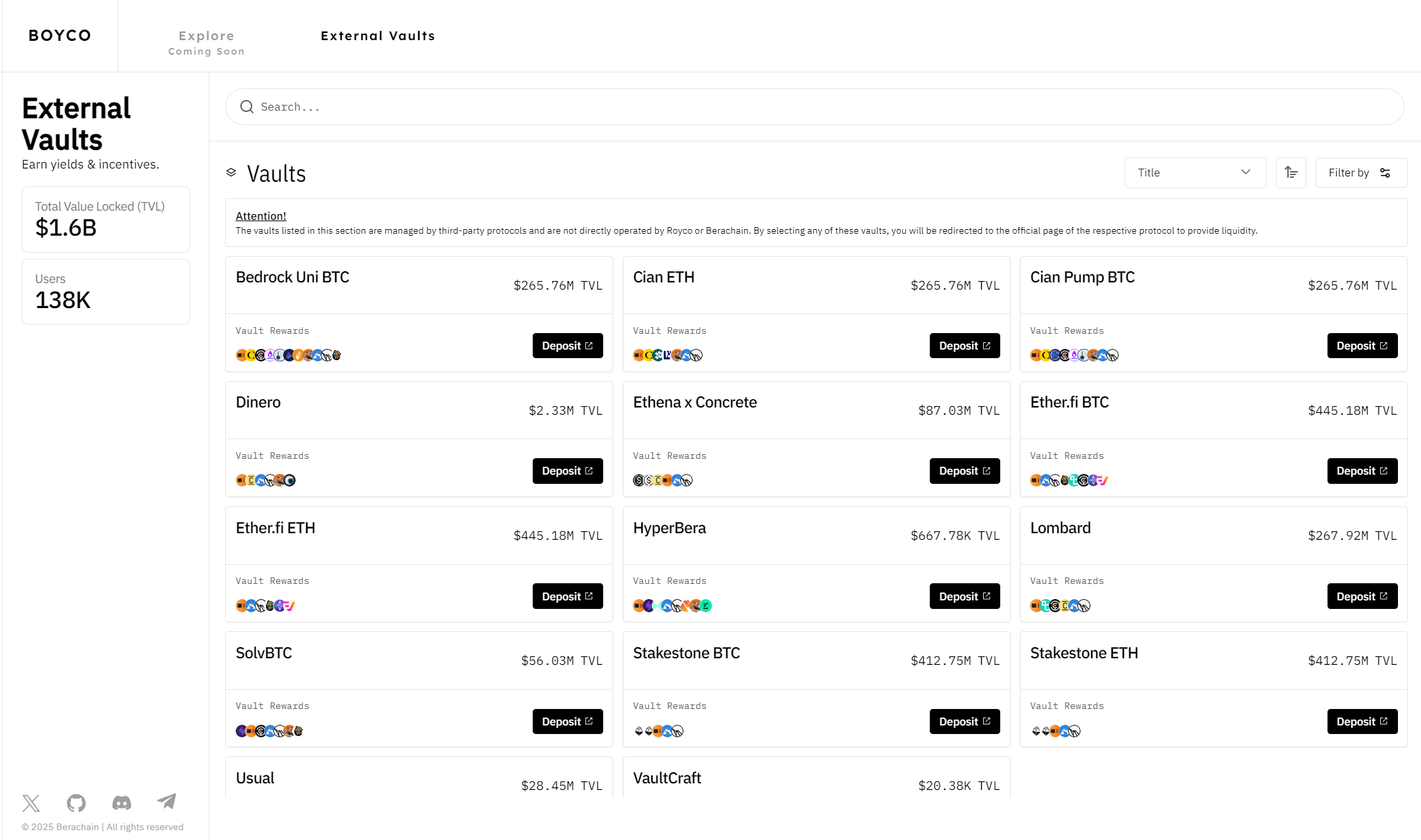
Boyco currently collaborates with multiple DeFi protocols on external deposit pools, totaling $1.6 billion in TVL. Partners include Bedrock, Cian, Dinero, Ethena+Concrete, Etherfi, Lombard, Solv, Stakestone, Usual, VaultCraft, and ListaDAO. Below are highlights of several major partners:
1. Stakestone
StakeStone, an omnichain liquidity asset protocol, announced a strategic partnership with Berachain in August last year. The STONE token is now fully deployed on Berachain’s bArtio testnet. Users can leverage StakeStone’s liquid assets—STONE, ssBTC, and STONEBTC—to participate in the Berachain ecosystem and earn yield. Additionally, StakeStone launched StakeStone Vault, a yield product issuance platform. Its first offering, the StakeStone x Plume pre-deposit vault, supports deposits in STONE and SBTC.
In December, StakeStone launched a second vault product: the Berachain Vault. This product offers dedicated yield services for both Boyco pre-deposits and subsequent PoL (Proof of Liquidity) mining on Berachain. Holders of the vault’s LP tokens (beraSTONE/beraSBTC) gain access to premium DeFi opportunities such as trading, lending, and leveraged yield strategies. Participants receive multiple rewards, including up to 1.5% of total STO governance token supply, BERA token incentives from Berachain’s pre-mine, PoL mining yields post-mainnet launch, and additional rewards from blue-chip Berachain ecosystem projects like Kodiak and Dolomite. Co-launched with partners including Pendle, Royco, Morpho, Dolomite, Kodiak, Native, and over 20 Berachain ecosystem projects and communities, the StakeStone Berachain Vault surpassed $111 million in deposits within 24 hours, attracting over 30,000 addresses. Subsequently, beraSTONE surpassed stETH to become the largest yield-bearing Ethereum asset, and the beraSTONE/ETH pool on Uniswap V3 became the largest liquidity pool on the platform.
2. Lombard
Lombard, a Bitcoin-focused DeFi project, offers collaborative opportunities with Berachain. Its Bitcoin Bera Vault quickly attracted significant capital, demonstrating strong market appeal. By depositing LBTC or wBTC into the Lombard vault, users earn rewards from multiple protocols, including Berachain, Lombard, and Babylon.
3. Ethena
Ethena Labs announced in December last year the launch of Ethena Berachain pre-deposit vaults, supporting deposits of USDe, sUSDe, USDC, and USDT. Additionally, Concrete launched two Ethena pre-deposit vaults for Berachain, enabling users to maintain USD exposure while earning Berachain rewards and participating in its ecosystem. After Berachain mainnet launch, deposited funds will be used to deploy liquidity in whitelisted protocols within the Berachain ecosystem. Depositors of USDe and sUSDe qualify for rewards from Ethena, Concrete points, BERA tokens, and native ecosystem incentives.
4. Etherfi
Ethereum restaking protocol ether.fi announced the launch of an incentivized pre-deposit vault for Berachain on January 1, supporting deposits of weETH, WETH, stETH, eBTC, wBTC, cbBTC, and LBTC. After the Berachain mainnet launches, deposits will remain locked for 90 days.
5. Usual
On January 5, Usual announced that the jointly launched Boyco pre-deposit Usual Bera Vault reached over $15 million in TVL within 24 hours. Users can earn a 37% annual percentage yield (APY) along with incentives from Berachain, Kodiak, Dolomite, and Veda. Key details:
• Vault deposits earn USUAL rewards based on displayed APY, claimable only on the Vault page.
• Supported deposit assets: USD0, USD0++, USDC, or DAI.
• Withdrawals are made in USD0++.
• Positions are locked for 1–3 months after mainnet launch.
6. Bedrock
Multi-asset liquidity restaking protocol Bedrock launched the uniBTC Berachain Vault on January 6, featuring cross-chain reward mechanisms to bridge the Ethereum and Berachain ecosystems. This vault enables automated yield generation, cross-chain asset management, and participation in Berachain’s Boyco pre-deposit campaign. With a four-layer yield structure—including Berachain-native rewards, Bera DeFi returns, CIAN reward layer, and CIAN points—users during the pre-deposit phase can earn multiple rewards from ETH mainnet yields, Berachain incentives, Pendle, EQB, Corn, and more. An additional 30% referral bonus is available. To participate, users must visit the Bedrock dApp, select supported assets (uniBTC, WBTC, cbBTC, or FBTC), and deposit to receive pre-deposit receipts.
5. Ecosystem Projects
Berachain Exchange (BEX):
BEX is the native decentralized exchange (DEX) within the Berachain ecosystem, delivering efficient trading experiences through its unique liquidity pool design. What sets BEX apart is its deep integration with the PoL mechanism, rewarding liquidity providers to enhance overall network liquidity. It is also tightly integrated with other Berachain DeFi protocols such as BEND and BERPS, forming a comprehensive decentralized financial ecosystem.
BEX is designed to simplify the trading process, making it easy for users to engage in DeFi activities. Leveraging Berachain’s distinctive Proof-of-Liquidity (PoL) consensus, BEX effectively separates the gas token from the governance token, significantly improving user experience.
Overall, BEX serves as a core component of Berachain, aiming to deliver a secure, efficient, and user-friendly decentralized trading platform that drives the broader DeFi ecosystem forward.
The Honey Jar (THJ):
The Honey Jar (THJ) is a community-driven initiative on Berachain that acts as a coordinator between users, bApps, and the Berachain protocol. THJ functions not only as an educational and community hub for Berachain but also focuses on project incubation and matchmaking to accelerate ecosystem growth. Core features include the creation of Honeycomb NFTs, liquidity provisioning, and incentive mechanisms.
Within the THJ ecosystem, users earn BGT rewards by providing liquidity, which they can then stake to earn further rewards and bribes. THJ emphasizes deep integration with partners beyond simple branding, actively exploring novel possibilities and innovative collaborations.
In summary, The Honey Jar is a multifunctional ecosystem designed to enrich user experiences and rewards through innovation and strategic cooperation.
Beradrome:
Beradrome specializes in Restaking, optimizing resource utilization by enabling users to put their liquidity to multiple uses such as staking and yield farming. During the testnet phase, Beradrome ran NFT campaigns and promised BGT airdrops upon mainnet launch to incentivize early participants.
Additionally, Beradrome collaborates with protocols like Beramonium, a game development project that pledged $125,000 in bribes on Beradrome to attract liquidity. This demonstrates that Beradrome is more than just a liquidity platform—it actively partners with other projects to drive ecosystem expansion.
Overall, Beradrome is a protocol designed to boost user engagement through liquidity incentives and governance mechanics, distinguishing itself through unique functionality and application.
Sudoswap:
As an NFT liquidity marketplace, Sudoswap plans to deploy on Berachain, offering NFT liquidity solutions. This goes beyond being a simple NFT trading platform—by bridging NFTs, it enhances diversity and interaction within the Berachain ecosystem.
Infrared Finance:
Infrared Finance is a liquid staking protocol focused on providing Berachain users with one-click access to Proof of Liquidity (PoL). As the first and only dedicated liquid staking solution on Berachain, Infrared Finance optimizes liquidity staking rewards, ecosystem participation, and Berachain’s three-token model ($BERA, $BGT, $HONEY), while simplifying user experience and enhancing capital efficiency.
The protocol has launched two products: $iBGT and $iBERA, allowing users to deposit liquidity, earn $iBGT, and stake $iBGT on Berachain’s testnet. Its goal is to maximize value capture by offering accessible liquid staking solutions.
Infrared Finance secured a $2.5 million seed round, including strategic investment from Binance Labs. It also partnered with Solv Protocol to further strengthen infrastructure around Berachain’s Proof of Liquidity mechanism.
As Berachain mainnet approaches, the $iBGT ecosystem continues to expand, with new use cases emerging daily. The launch of Infrared Finance marks a significant milestone in DeFi innovation, encouraging users to participate in liquidity provision and related activities to earn $iBGT on the testnet.
Overall, Infrared Finance drives Berachain’s ecosystem growth through innovative liquid staking solutions, offering users more efficient ways to utilize their capital.
KodiakFi:
KodiakFi primarily offers BGT mining pools, enabling users to participate in Berachain’s governance and yield generation in a more decentralized manner. Through close collaboration with projects like Infrared Finance and Beradrome, KodiakFi delivers a richer ecosystem experience. Furthermore, KodiakFi has co-launched Automated Liquidity Management (ALM) islands with partners such as Mozaic and Gamma Strategies, significantly enhancing liquidity management capabilities.
Ooga Booga:
Ooga Booga is a decentralized trading aggregator operating on Berachain. By scanning over six exchanges, it provides the cheapest cryptocurrency swap rates, improving trading efficiency. According to website data, it has interacted with over 460,000 unique wallets and processed over $2.5 billion in total trading volume.
Future Outlook
With its innovative PoL mechanism and diverse ecosystem projects, Berachain exemplifies how technological innovation can solve persistent issues in the blockchain space. As the mainnet launches and more projects join, Berachain is poised not only to become an efficient trading platform but also a significant and distinctive player in the DeFi ecosystem. Future success will depend on sustained community incentives, continued technical optimization, and seamless integration with other ecosystems.
Despite its substantial potential, the following risks should be noted:
1. Technical Risk: The stability and security of the novel PoL mechanism and three-token model remain to be proven over time.
2. Ecosystem Growth Risk: The long-term viability of the chain hinges on its ability to continuously attract protocols and users post-mainnet.
3. Market Competition Risk: Establishing differentiation and competitive advantages against other established Layer 1 blockchains remains a challenge.
Join TechFlow official community to stay tuned
Telegram:https://t.me/TechFlowDaily
X (Twitter):https://x.com/TechFlowPost
X (Twitter) EN:https://x.com/BlockFlow_News
 @XTexchange






