Grass Update: From Idle Mining to AI Development Platform, Building Foundational Tools for the AI Gold Rush
TechFlow Selected TechFlow Selected
Grass Update: From Idle Mining to AI Development Platform, Building Foundational Tools for the AI Gold Rush
Grass is moving toward becoming a transformative AI development platform.
 Navigating Web3 tides with focused insights
Author: Aylo
Translation: TechFlow

The real gold rush lies in AI data, and one project is building the foundational tools for this "gold rush."
Imagine if you could invest in a crypto project quietly rising to become the "Google" of AI...
In yesterday's Discord live session, @0xdrej shared the latest updates from @getgrass_io. The highlight? Grass is evolving into a transformative AI development platform with massive potential value.
Here are the key takeaways from the workshop:
-
Massive Data Advantage: Grass has already indexed over 3 billion video data points—far exceeding the 200 million videos used by companies like NVIDIA to train top-tier video models. This gives Grass an unmatched multimodal dataset.
-
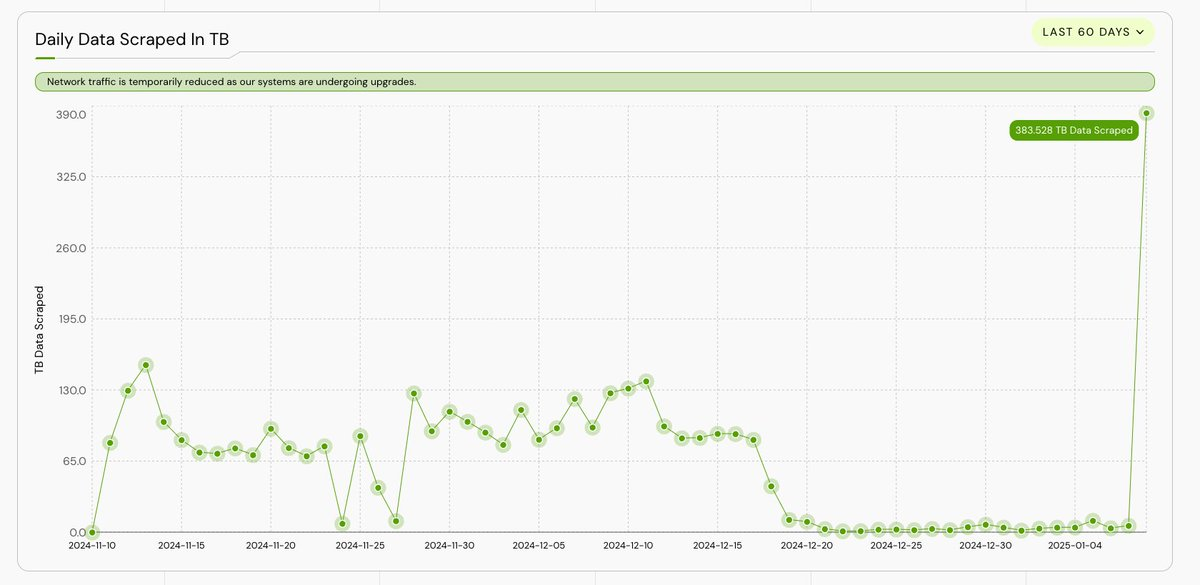
Technical Upgrade: With the Scion upgrade, Grass has significantly enhanced its data retrieval efficiency and scale. After the upgrade launched, data scraping volume noticeably increased. A second-phase upgrade will further expand its capabilities.
-
Semantic Multimodal Search: Grass is launching semantic multimodal search across its vast data index. This means users can efficiently search and extract highly relevant video, audio, and image clips. No other platform currently offers this functionality at Grass’s scale.
-
Future-Focused Demand: As AI increasingly shifts toward multimodal models in fields like robotics, demand for specialized datasets will keep growing. Grass’s unique edge positions it as the ideal platform to meet this demand.
-
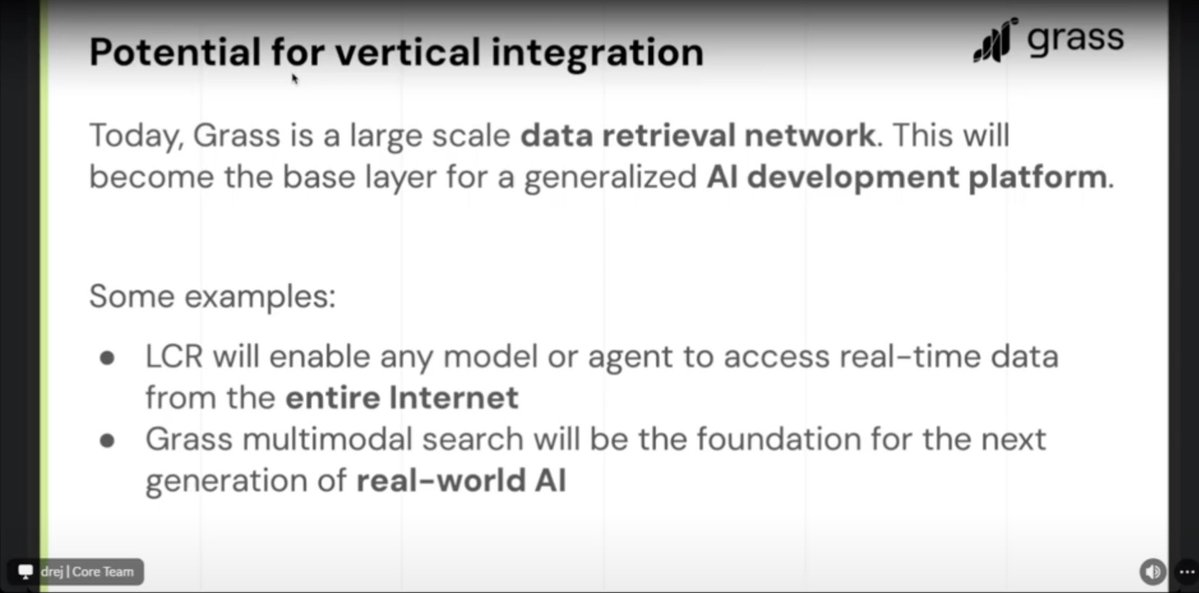
Vertical Integration: Grass plans to evolve from a data retrieval network into an end-to-end AI development platform for model training. They may even open-source some of their powerful in-house models, providing greater support to developers.
-
Hardware Innovation: Grass is exploring new node distribution methods, including dedicated hardware technology. This innovation could be game-changing—enabling Grass to do what only a few companies can today: load web scraping scripts directly onto hardware, drastically improving efficiency. If successful, this would solidify Grass’s competitive advantage in cost and scale.
-
Platform Expansion: The workshop also revealed a new product in development that will introduce "horizontal scaling" and "change how you perceive Grass." While details remain under wraps, this suggests Grass is working on a major expansion feature that could unlock entirely new use cases and markets.
Overall, Grass is building critical infrastructure for next-gen AI—including large-scale multimodal datasets and efficient scaling solutions. As demand grows from models like those at NVIDIA for specialized data, Grass is poised to become the go-to platform for developers seeking easy access to searchable, customizable datasets.
If Grass executes its vision, the potential value creation is enormous. It will provide the "foundational tools" for the multimodal AI wave, becoming a pivotal player in this technological revolution.
From web development to robotics, nearly every field will attempt to leverage this technology. And Grass is well-positioned to capture a significant share of this multi-trillion-dollar market.
Imagine designing a robot that needs to understand the world around it. To achieve this, the robot requires not just text data, but also images, videos, and audio. This is known as "multimodal" data—and Grass is providing the core infrastructure to support exactly this need.
Today’s large AI models can process multimodal data, but they’re often too general-purpose. If you want your robot to excel at specific tasks—like identifying various fruits or navigating warehouses—you need to fine-tune the model using task-specific, specialized datasets.
This is where Grass shines. They’ve already indexed a vast amount of multimodal data from the internet—billions of images, videos, and audio files. But the truly disruptive part? Their upcoming "semantic multimodal search" feature.
"Semantic multimodal search" allows you to search not just by keywords, but by the actual meaning of content. For example, if you need videos of robots picking apples, you can precisely find such footage—not just clips tagged with the words "robot" and "apple."
The significance? No other platform currently offers this level of accurate, context-aware search at Grass’s scale. As more companies and developers aim to apply AI in robotics and similar domains, they’ll need these specialized datasets to make AI more effective. Grass was built specifically to fulfill this need.
Of course, Grass faces execution risks and operates in a competitive space. Yet its data scale, decentralized efficiency, and semantic search capability give it a distinct edge. The workshop also hinted at a new horizontal-scaling product in development, which could further broaden Grass’s application scope and market reach.
Overall, Grass remains in its early stages. This reminds me of Chainlink in 2018/2019—back when it emerged as the key infrastructure unlocking global DeFi, gradually revealing immense potential. Grass shares a similar vision and positioning: enabling AI developers and enterprises to unlock multimodal data, potentially creating tremendous value for the world.
Currently, Grass stores 0.5 PB (petabytes) of data daily—a number likely to surge soon. Given the high storage costs involved, the protocol must generate sufficient revenue to cover expenses (much of the data scraping is done based on client demand).
In the AI and crypto space, I haven’t seen another protocol like Grass—one that already has a real product being paid for by Web2 AI customers, while continuously innovating and delivering tech that unlocks new AI value. There are some interesting AI agent platforms out there (which I also hold), but they remain largely speculative ("casino logic"). Grass’s LCR product will also serve AI agents.
If Grass succeeds, its future potential is boundless. It could become a landmark tech platform in AI. The next 6 to 12 months will be crucial, as Grass must capitalize on its current lead. If it does, today’s market cap may look insignificant in just a few years.
Disclaimer: The above does not constitute investment advice. I am a holder of Grass. While I’m optimistic about its prospects, I also recognize the execution risks and challenges ahead.
Join TechFlow official community to stay tuned
Telegram:https://t.me/TechFlowDaily
X (Twitter):https://x.com/TechFlowPost
X (Twitter) EN:https://x.com/BlockFlow_News
 @alpha_pls