Grass Network: How to Earn by Sharing Internet Resources?
TechFlow Selected TechFlow Selected
Grass Network: How to Earn by Sharing Internet Resources?
Grass focuses on data at the intersection of cryptocurrency and AI, differing from traditional closed-source, centralized AI participants by serving as a raw, decentralized source of AI data.
 Navigating Web3 tides with focused insights
Author: Ebunker
Grass's Positioning and Use Cases
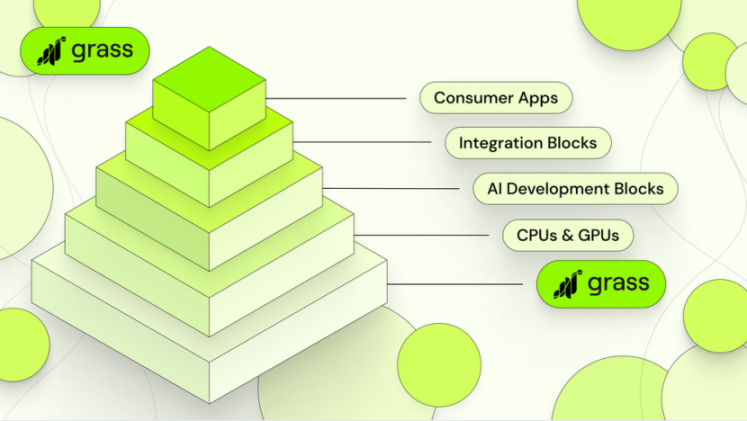
Grass is a project built on the Solana blockchain that integrates AI, DePIN, and Solana technology, positioning itself as the data layer for AI. It is a decentralized web scraping platform designed to help companies and nonprofit organizations train artificial intelligence (AI) by leveraging unused internet bandwidth. Through a browser extension application, Grass enables web scraping using individuals' idle internet bandwidth and rewards users with Grass Points. By allowing users to share their unused bandwidth resources, Grass aims to redefine internet incentive structures, enabling users to directly benefit from the network and ensuring that the value of the internet remains in users' hands. Currently, over 2 million users are running nodes on the network, collectively gathering vast amounts of data for AI models.
Technical Architecture
The Grass Sovereign Data Rollup is a network specifically built by Grass on Solana, enabling the protocol to manage all operations from data sourcing to processing, validation, and dataset creation. The architecture is centered around three core components: Validators (which issue data collection instructions), Routers (managing the distribution of web requests), and Grass Nodes (used by users to contribute their idle network resources). The detailed structure is as follows:
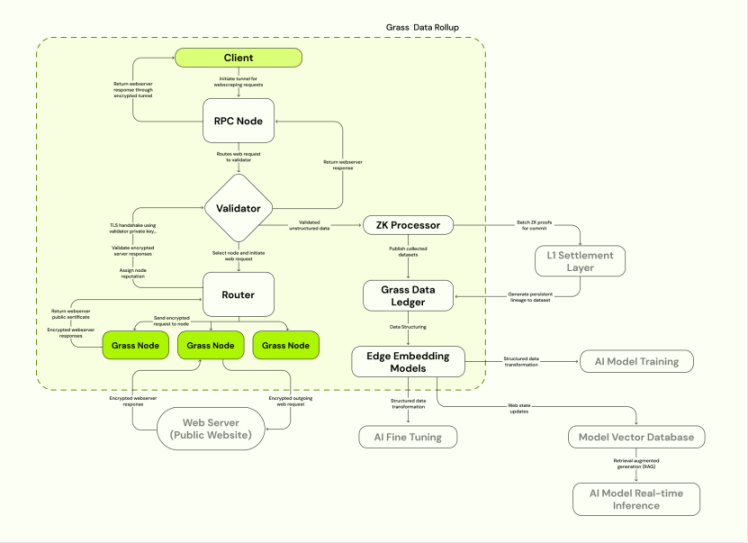
Validator: Receives, validates, and batches web transactions from Routers. Then generates ZK proofs to verify session data on-chain. On-chain proofs can be referenced within datasets to authenticate data origins and track lineage throughout their lifecycle. The validator set will transition from an initially centralized single-validator framework to a decentralized committee of validators.
Router: Connects Grass Nodes to Validators. Routers maintain traceability across the node network and relay bandwidth. Grass incentivizes Router operation based on the proportion of total validated bandwidth they relay. Routers are responsible for reporting the following metrics to Validators on the network: size (in bytes) of each incoming and outgoing request; latency of each node and the Validator; and network status of each connected node.
p>Grass Node: Utilizes users' unused bandwidth and relays traffic so the network can scrape public web data (not personal user data). Running a node is free, and node operators are compensated based on the volume of data relayed through their node.ZK Processor: Processes validity proofs for batches of web request session data and submits these proofs to the L1 blockchain. This permanently records every scraping activity performed on the network, laying the foundation for full transparency into the sources of AI training data.
Grass Data Ledger: Acts as the bridge between scraped data and the L1 settlement layer. The ledger is an immutable data structure that hosts complete datasets and links them to their corresponding on-chain proofs, serving as a repository ensuring data provenance.
Edge Embedding Models: This refers to the process of transforming unstructured web data into structured formats suitable for modeling. It includes all necessary preprocessing steps—cleaning, normalizing, and structuring raw collected data—to meet the requirements of AI models.
Technical Features
In the above architecture, the Grass network sits between clients and web servers. Clients initiate web requests, which are routed via Validators and ultimately forwarded through Grass Nodes. Regardless of which website the client requests, the server responds to the web request, allowing its data to be scraped and sent back along the chain. This data is then cleaned, processed, and prepared for training next-generation AI models.
Two key additional features must be understood in this process: the Grass Data Ledger and the ZK Processor.
The Grass Data Ledger is where all data is ultimately stored—it serves as a permanent record of every dataset scraped by Grass, embedding metadata that traces the origin and lineage of each dataset from inception. Proof of metadata for each dataset is stored on Solana’s settlement layer, and the settlement data itself is also provided through the ledger.
The purpose of the ZK Processor is to help document the source of datasets scraped on the Grass network. Here's how it works: when a node on the network (i.e., a user with the Grass extension installed) sends a web request to a given site, it receives an encrypted response containing all requested data. This marks the birth of the dataset—the moment of origin that needs to be recorded—and the time when metadata is captured. This metadata includes various fields such as session keys, scraped website URLs, target website IP addresses, transaction timestamps, and of course, the data itself. With this essential information and clearly sourced datasets, AI models can be trained accurately and faithfully.
The ZK Processor ensures that data requiring on-chain settlement remains invisible to Solana validators. Moreover, the sheer volume of future web requests executed on Grass will exceed the throughput capacity of L1 blockchains. Grass is expected to scale rapidly to tens of millions of web requests per minute, with each request's metadata needing on-chain settlement. Without the ZK Processor first generating proofs and batching transactions, submitting these to L1 would be impossible. Therefore, Rollup is the only viable method to achieve these goals.
Beyond recording the originating websites of datasets, metadata also indicates which node on the network routed the data. This means that whenever a node scrapes the web, it can be rewarded proportionally for its contribution without revealing any personal identity information. This allows Grass to reward nodes fairly—those that scrape more valuable or higher-volume data receive greater incentives. This mechanism significantly increases rewards for users in high-demand geographic regions, encouraging more people from those areas to join and expand network capacity. The larger the network grows, the greater the scraping capacity becomes, and the larger the repository of stored web data. More data means Grass can provide richer datasets to AI labs needing training data, further fueling network growth.
Grass Node Operation and Security Mechanisms
Running a Grass Node is free and acts as a gateway connecting the network to the internet. Node operators (i.e., app users) are rewarded based on traffic relayed through their nodes, with rewards influenced by their reputation score and regional demand for network traffic.
Grass Nodes serve two primary functions: relaying traffic initiated by clients and directed by Validators (i.e., web requests); and returning encrypted responses from web servers to designated Routers.
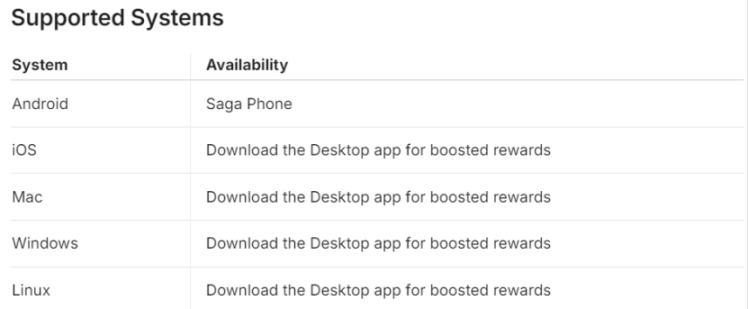
The supported systems for running nodes are shown in the diagram above. The process is simple: create an account, download the Grass desktop application, and connect to the network.
Once connected, the node automatically registers on the network. Operators are responsible for maintaining uptime so their node can forward network requests to public web servers. Each request sent to a Grass Node is an encrypted packet. These packets only contain routing instructions for their destination node. Network requests are authenticated via digital signatures from all involved parties, verifying the legitimacy of each request and determining whether it should be forwarded to the target web server (i.e., public websites). This encryption process prevents data tampering and enables Validators to accurately measure each node’s reputation.
Node reputation scoring includes the following key aspects:
-
Integrity: Assesses whether the data is complete and contains all necessary data points required for intended use cases.
-
Consistency: Checks consistency of data across different datasets or within the same dataset over time.
-
Timeliness: Measures whether data is up-to-date when needed.
-
Availability: Evaluates the degree to which data from each node is accessible.
Regarding security mechanisms, the Grass network does not access or monitor users’ devices (computers) or any activities performed on them. It merely routes internet traffic through users’ IP addresses—completely independent of user activity. This means Grass has zero access to personal user data; all scraped data comes 100% from public web sources.
Additionally, Grass uses bandwidth encryption to protect all users while sharing internet connections. Grass also partners with AppEsteem, a leading cybersecurity compliance auditing firm, which monitors Grass products 24/7 for vulnerabilities, leaks, backdoors, and malware to ensure user safety. AppEsteem certification holds strong credibility in the cybersecurity industry. Achieving this certification means Grass products are whitelisted by top anti-malware applications including Avast, Microsoft Defender, McAfee, AVG, and others.
Functions of Grass Token
Holders of Grass tokens can participate in the Grass network in several ways:
-
Transactions and Buybacks: After decentralization, Grass tokens will support web scraping transactions, dataset purchases, and usage of LCR (Live Context Retrieval).
-
Staking and Rewards: Stake Grass tokens to Routers to facilitate network traffic and earn rewards for contributing to network security.
-
Network Governance: Participate in the development of the Grass network, including proposing and voting on network improvements, coordinating partnerships with organizations, and determining incentive mechanisms for all stakeholders.
According to statistics from Dune, the current annualized yield for staking Grass tokens is approximately 45%, with about 33% of all Grass tokens staked—amounting to over 26 million tokens staked.
Router Staking and Earnings
Routers act as distributed hubs connecting all network nodes and managing incoming and outgoing web requests from Validators. Router operation is incentivized, with rewards proportional to the amount of staked tokens delegated to each Router. All traffic routed through Routers is encrypted and metered to ensure security and performance.
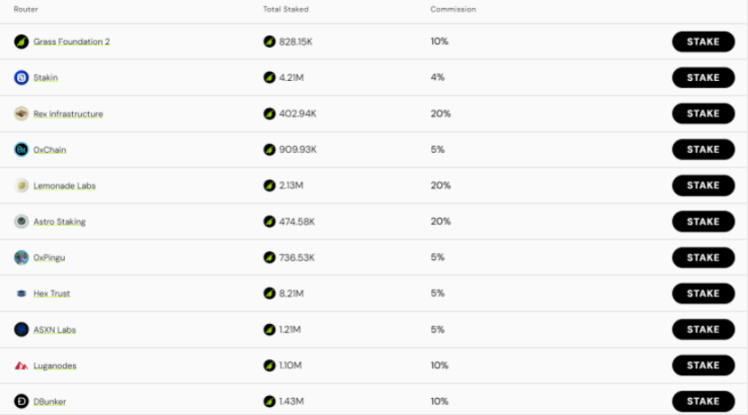
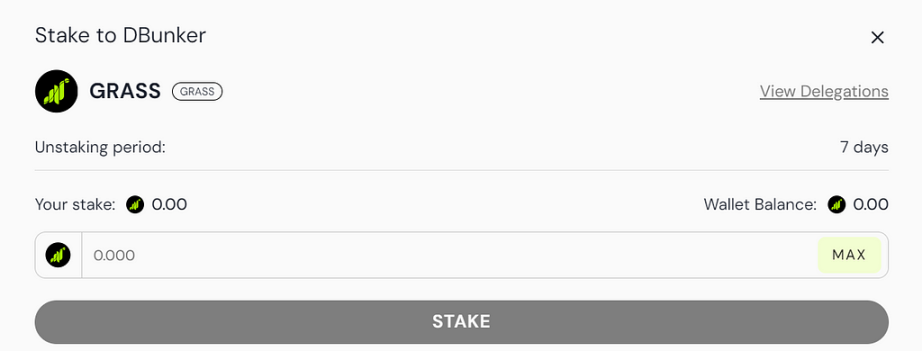
The current staking amounts for various Routers are shown in the charts above. Users can delegate their Grass tokens to a Router to earn returns, with commission rates varying per Router.
Currently, DBunker has approximately 1.43 million Grass tokens staked, with a minimum staking period of 7 days and a commission rate of 10%. (Data source: https://www.grassfoundation.io/stake/delegations) Users simply click "STAKE" to connect their wallet, stake Grass tokens, and begin earning Router staking rewards.
Summary
Grass is committed to building a fair and open decentralized data layer, aiming to address ethical concerns and data quality issues in current internet data extraction while opposing data monopolies controlled by a few large corporations. From a technical standpoint, Grass builds a data rollup and introduces a metadata mechanism that records the provenance of all datasets. These datasets’ ZK proofs are stored on the L1 settlement layer, while the metadata itself is permanently linked to its underlying dataset, which resides in Grass’s Data Ledger. Thus, ZK proofs lay the foundation for enhanced transparency and enable proportional rewards for node providers based on their actual workloads—an essential driver for expanding the Grass network.
Focusing on data at the intersection of cryptocurrency and AI, Grass differs from traditional closed-source, centralized AI players by serving as a foundational, decentralized source of AI data. As a significant participant in the Web3 wave, Grass leverages decentralized technologies to build a fair and open data layer for AI companies and protocols, entering the market with strong demand potential and promising future prospects.
Join TechFlow official community to stay tuned
Telegram:https://t.me/TechFlowDaily
X (Twitter):https://x.com/TechFlowPost
X (Twitter) EN:https://x.com/BlockFlow_News
 @ebunker_eth