








2025 Crypto Investment Guide: How to Allocate Assets in the New Year for Maximum Returns?
TechFlow Selected TechFlow Selected
2025 Crypto Investment Guide: How to Allocate Assets in the New Year for Maximum Returns?
Help you find an investment approach that suits you.
 Navigating Web3 tides with focused insights
Author: Edgy - The DeFi Edge
Translation: TechFlow
The goal of this cycle is to achieve life-changing returns.
If you want life-changing gains in this market cycle, you need to build your portfolio correctly. However, this cycle has played out differently than expected. ETH has remained nearly flat around $3,200, and a broad altseason—like we’ve seen in past cycles—has yet to materialize.
Even more surprisingly, new investment trends emerge every few weeks. If you've held Goat or Zerebro (early players in AI) since last October, you're likely underperforming the broader market.
Therefore, adapting to market shifts is crucial.
The new year is a great time to reevaluate and rebalance your portfolio. I’d like to share how I structure my investment strategy, hoping it helps you find an approach that works for you. For me, dividing my portfolio into distinct “buckets” has proven highly effective—helping manage risk while clarifying objectives.
Note: I won’t provide specific allocation percentages. Everyone’s goals and risk tolerance differ. Smaller investors may lean aggressive; larger ones often prioritize capital preservation.
What I’m sharing is a strategic framework—to help you find your own path.
Bucket One: Multi-Year Reserve

Examples: Bitcoin, Ethereum, Solana
Goal: Long-term wealth accumulation and hedging against fiat devaluation. This bucket is designed to generate steady profits over extended periods. These tokens are core holdings meant to survive multiple cycles, growing larger with each one.
I treat this portion as “untouchable” reserves. New capital flows into this bucket during each cycle—but never out. All profits eventually feed back into this reserve.
During bull markets, FOMO kicks in. When you hear about a new token with massive potential but no spare funds, you might consider tapping this reserve:
“I’ll sell some Bitcoin, jump into this new coin. Once it 10x’s, I’ll buy back in!”
These plans rarely work out. Even if you do 10x, you may feel invincible and keep gambling—until you give it all back to the market.
The core role of this bucket is defense. No matter what happens in life, I never want to start from zero again. Bitcoin could reach $1 million someday. You definitely don’t want to regret selling BTC to chase garbage coins that eventually go to zero.
In the past, I split this bucket evenly between Bitcoin and Ethereum. But I’ve since shifted strategy—now favoring Bitcoin more heavily. Why? Bitcoin as digital gold is irreplaceable, while Ethereum faces mounting challenges every cycle—from competing smart contract platforms to its own scalability issues and complex ecosystem dynamics.
Most of these reserves sit in cold wallets. About 30% is deployed into DeFi for yield and potential airdrops. For example, I use @SolvProtocol to earn yield on BTC while qualifying for future drops. My ETH is staked as $mETH for liquidity mining on @0xMantle.
Success metric: At the end of each market cycle, I measure performance by the growth of this bucket. The objective is clear: accumulate more Bitcoin and prepare for the future.
Bucket Two: Cycle Conviction Holdings
Examples: Virtuals, Hyperliquid, Solana, Sui, Pendle, etc.
Goal: Hold assets you truly believe in. Many lose money due to excessive trading and rotation—this bucket avoids that by focusing on long-term conviction holds.
These are your strongest convictions—assets you won’t panic-sell even if they drop 25%. They typically represent the dominant narratives of the cycle.
Start building positions early, hold throughout the cycle, take partial profits as prices rise, and fully exit before the bear market hits. Then look for re-entry opportunities during the downturn.
Adjustments are normal. I originally listed ai16z as a long-term conviction hold, but recently decided to exit—even though it was meant to be multi-cycle. Simple reason: I no longer want to deal with unpredictable founder behavior.
Key point: Maintain strong conviction, but stay flexible to change.
Bucket Three: Short-Term Trading
Goal: This bucket is where most high returns come from—but also brings significant volatility. Success hinges on focusing on the hottest sectors in the market.
Right now, I don’t expect a broad altseason where everything rises together. Too many tokens, not enough liquidity. This phenomenon is known as “altcoin dispersion.”
Therefore, identifying the hottest niches becomes critical. In this cycle, memecoins and A.I. agents have clearly led the charge.
My process:
-
Identify 1–2 strongest-performing sectors;
-
Find the most promising projects within them;
-
Secure profits by moving gains into BTC or stablecoins.
How to spot hot sectors? Honestly, experienced investors often sense trends through market “vibes.” But today, tools can help quantify these signals.
For example, @_kaitoai is a paid tool, while @_dexuai is free and highly effective.
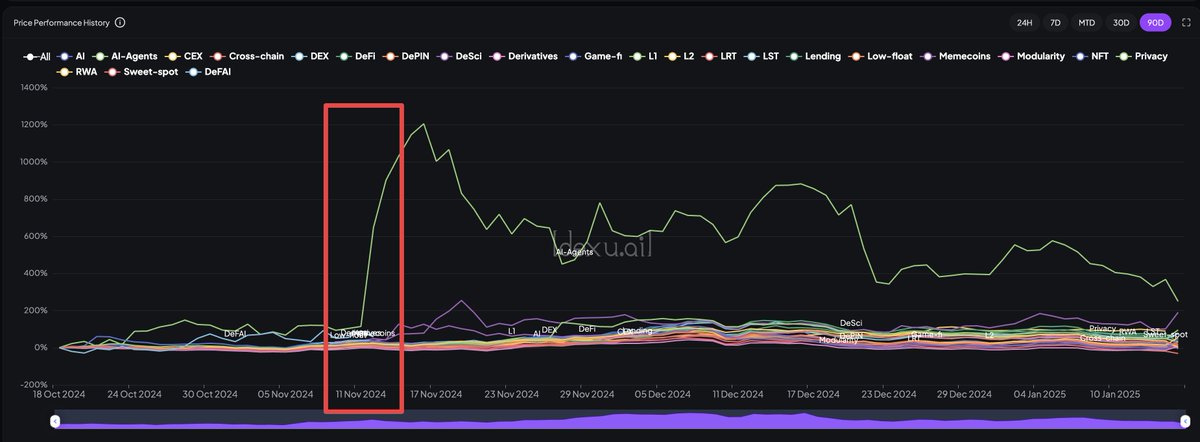
Data shows A.I. agents began outperforming starting November 11, 2024. You don’t need to catch the trend at inception—just act decisively once signals become clear.
Some might argue: “These A.I. agents are just repackaged ChatGPT.”
Possibly. Or not.
As long as the market rewards me, I’ll take the profit instead of wasting time opposing things on social media.
Think of navigating industry trends like surfing. I’m always looking for bigger waves, ready to ride the next one.
For instance, I firmly believe A.I. agents will revolutionize DeFi. DeFi has a steep learning curve and poor user experience (UX/UI).
Over recent months, I invested in the MODE network due to their unique edge. They were deep into DeFAI (DeFi + AI) long before it became trendy.
But my logic is loyalty to trends—not individual protocols. My aim is to find the fastest horse in each race.
When @DanieleSesta launched @HeyAnonai, I judged it a faster horse—and promptly reallocated.
Why? Because in the last cycle, I saw him successfully grow two protocols to $1B+ valuations. He possesses exceptional skill in driving protocol value and demonstrates relentless competitive focus—an operator worth watching.
(To clarify: I’m not criticizing MODE. I believe they’re ahead of most DeFAI projects and could perform well in the future. But I share these stories to make this article more practical.)
In crypto, making money isn’t about what you think will rise—it’s about predicting what others will believe will rise. This is the essence of Keynes’ beauty contest theory—market expectations drive prices.
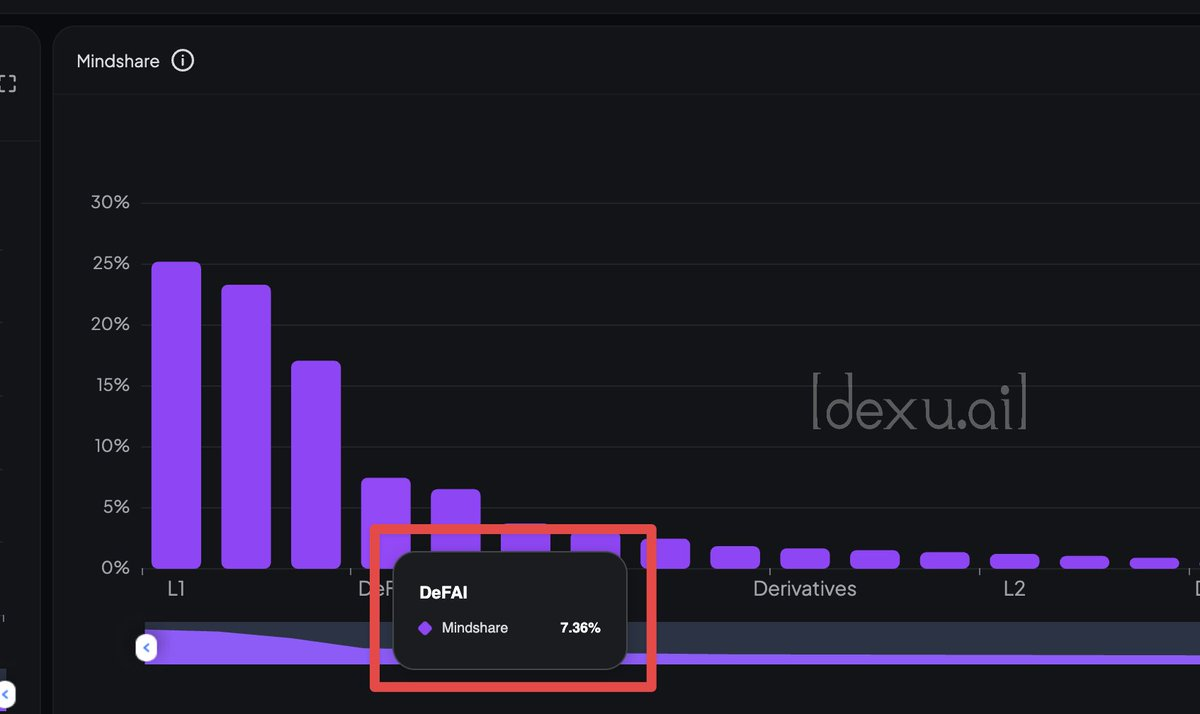
The chart below shows DeFAI gradually gaining attention. I believe this narrative still has room to run and deserves ongoing focus.
In short-term trading, I focus on several key aspects:
-
Stay alert to emerging categories. I’m naturally drawn to new spaces—that’s why AI Agents stand out. Today, novel AI use cases appear constantly, making valuation difficult. Consider AI agents merging with metaverse worlds, or specialized AI tools built to detect system vulnerabilities.
As of January 15, 2025, DeFAI remains nascent. If a bigger opportunity arises in coming months, I’ll adapt quickly to ride that wave.
-
Speed of iteration matters. In crypto, user attention spans are famously short—often compared to “goldfish memories.” Therefore, development velocity is crucial. Fast iteration keeps a protocol visible and relevant.
-
Conviction vs. momentum: Which style suits you? Broadly speaking, trading falls into two styles:
First: Conviction-based trading. You conduct deep research, position early, and develop strong belief in a project. Then you wait for the broader market to catch on. That was my approach with GAME—I bought early and held patiently for weeks until price exploded.
But this comes with risk. During long sideways periods, you question whether you’re a visionary—or simply wrong.
Second: Momentum chasing. When a project suddenly pops off, you jump in and ride the wave. This method works too. Each has merits; the key is finding your fit. Keeping a trade journal helps immensely. Over time, data reveals your patterns and highlights when you perform best.
Ultimately, understand your strengths. I don’t enjoy digging through sub-$1M market cap projects in the “trenches”—it doesn’t suit me.
From experience, my most successful trades involve protocols with $5M–$25M market caps, holding until they break $100M+. That’s my edge. Others may thrive in higher-risk “Degen” plays.
In trading, I follow these rules:
-
I cut losses early.
-
I typically take profits around 3x.
-
If a project performs exceptionally, I scale into it further.
Bucket Four: Stablecoins
Stablecoins play a vital role in portfolio management:
-
Reduce volatility: Holding stablecoins smooths portfolio swings. After all, losing 40% in a day is hard to stomach if you’re fully exposed to volatile assets. Stablecoins let you stay calm and stay in the game.
-
Provide dry powder for buying dips: Bull markets never go straight up—they pull back. Having stablecoins allows you to seize those moments.
-
Earn yield: Current APYs range from 15–20%, which adds up over time. I personally recommend @0xfluid for yield generation.
I divide stablecoins into two types:
-
Permanent yield: Stablecoins I’ve withdrawn from crypto permanently. I deploy them into yield farming or convert to fiat. This ensures I don’t give back all profits in a single cycle.
-
Temporary yield: Profits I’ve taken off the table temporarily, waiting for new opportunities. For clarity, I use different stablecoins—for example, storing permanent yield in USDC and temporary in USDT, or routing all permanent yield to Fluid.
Diversification is key: Last cycle reminded us that stablecoins can fail. Holding a mix—USDC, USDT, sUSD, even asset-backed variants—reduces risk. Also spread across multiple yield platforms to avoid single points of failure.
Additional Tips
-
“Put all your eggs in one basket—but watch that basket closely.” This quote has many interpretations. I’m not concentrating funds in one protocol, but I am focusing intensely on one sector: AI Agents.
Also, I laugh when people preach “buy the dip” while holding 25+ protocols. You need real conviction in a direction. Otherwise, even if one moonshots, it barely moves your portfolio needle.
I believe 5–7 tokens is optimal. When I pick a token, I go all-in: active in its Discord/Telegram, tracking team updates, founder moves, and listening to every related podcast.
Holding more than 15 makes deep research impossible—and suggests lack of confidence in your picks.
-
Don’t ignore market momentum. My biggest wins usually come from jumping in after a token starts rising. Winners tend to keep winning. How do you know if you’re just catching a falling knife? Simple.
Ask yourself: Are you buying out of FOMO or KOL hype—or based on research and genuine conviction? Does the protocol have real progress and catalysts to sustain interest?
-
Market rotation is faster than ever. First-mover advantage no longer guarantees dominance. GOAT and Zerebro led early but lost ground. For any first-mover, assess whether their lead is “sticky.” Is their moat wide enough?
Take AIXBT: It had first-mover advantage, but its market penetration and mindshare far exceed other Alpha bots. I admire that most tech is built in-house—making it harder for competitors to copy and displace them.
-
Design your portfolio forbear markets. Define your goals, then reverse-engineer the path. For example, target 30% BTC and 70% stablecoins. Either way, lock in profits incrementally during rallies.
-
Reassess your portfolio regularly. It may be filled with dead weight—emotional “moonbags” or legacy tokens. Ask: If I rebuilt my portfolio from scratch today, what would it look like?
Remember: Holding an asset is equivalent to repurchasing it every single day.
-
“When should I convert crypto tofiat?” When you need to. I rarely cash out—only for taxes or when crypto exposure becomes too large relative to traditional finance (TradFi) assets.
My goal is to let crypto assets compound continuously. I keep personal expenses low, and my company (The DeFi Edge) pays me a fixed monthly salary. That way, I avoid interrupting compounding growth.
My goal is continuous compounding. With minimal living costs and a steady paycheck from The DeFi Edge, I strive to never break the chain of exponential growth.
That’s all I’ve got. If you'd like deeper dives into any topic, let me know—I can write more detailed pieces.
Thanks for reading!
Join TechFlow official community to stay tuned
Telegram:https://t.me/TechFlowDaily
X (Twitter):https://x.com/TechFlowPost
X (Twitter) EN:https://x.com/BlockFlow_News
 @thedefiedge


