Deconstructing AI Frameworks: Exploring from Intelligent Agents to Decentralization
TechFlow Selected TechFlow Selected
Deconstructing AI Frameworks: Exploring from Intelligent Agents to Decentralization
Frameworks that simplify the Agent construction process while offering combinations of advanced features will continue to dominate in the future, giving rise to a more interesting Web3 creative economy than the GPT Store.
 Navigating Web3 tides with focused insights
Author: Zeke, Researcher at YBB Capital
Preface
In previous articles, we have repeatedly discussed the current state of AI Memes and our outlook on the future development of AI Agents. However, the narrative evolution within the AI Agent sector has progressed so rapidly and dramatically that it's almost overwhelming. In just two months since the "Truth Terminal" initiated Agent Summer, the convergence of AI and Crypto has seen near-weekly shifts in storytelling. Recently, market attention has shifted toward technically driven "framework-type" projects. This niche segment has already produced multiple breakout projects with market caps surpassing hundreds of millions—or even billions—of dollars in just a few weeks. These projects have also given rise to a new asset issuance paradigm: tokens launched directly from GitHub code repositories, where frameworks serve as foundational layers and Agents built atop them can issue their own tokens. Frameworks form the base; Agents sit on top. Resembling asset issuance platforms, what’s actually emerging is a unique infrastructural model native to the AI era. How should we interpret this new trend? This article begins with an introduction to these frameworks and integrates personal insights to explore what AI frameworks truly mean for Crypto.
1. What Is a Framework?
By definition, an AI framework is a底层 development tool or platform that integrates pre-built modules, libraries, and tools to simplify the construction of complex AI models. These frameworks typically include functionalities for data processing, model training, and prediction generation. In simple terms, you can think of a framework as an operating system for the AI era—akin to Windows or Linux on desktops, or iOS and Android on mobile devices. Each framework has its own strengths and weaknesses, allowing developers to freely choose based on specific needs.
Although the term “AI framework” remains relatively novel in the Crypto space, tracing its origins back to Theano (created in 2010), the development of AI frameworks spans nearly 14 years. In traditional AI circles—both academic and industrial—there are already mature frameworks available such as Google’s TensorFlow, Meta’s PyTorch, Baidu’s PaddlePaddle, and ByteDance’s MagicAnimate, each excelling in different application scenarios.
The current wave of framework projects emerging in Crypto were developed in response to the surge in demand for Agents during this AI boom, later expanding into other Crypto sectors, ultimately forming specialized AI frameworks across various niches. Let us expand on this by examining several mainstream frameworks currently popular in the ecosystem.
1.1 Eliza

Take ai16z's Eliza as an example—an open-source multi-agent simulation framework designed specifically for creating, deploying, and managing autonomous AI agents. Built using TypeScript, it offers superior compatibility and easier API integration.
According to official documentation, Eliza primarily targets social media use cases, offering robust cross-platform support including full-featured Discord integration (with voice channel support), automated X/Twitter accounts, Telegram integration, and direct API access. For media content handling, it supports PDF reading and analysis, link extraction and summarization, audio transcription, video processing, image analysis and description, and conversation summarization.
Current use cases supported by Eliza fall into four main categories:
1. AI assistant applications: customer support agents, community moderators, personal assistants;
2. Social media personas: automated content creators, interactive bots, brand representatives;
3. Knowledge workers: research assistants, content analysts, document processors;
4. Interactive characters: role-playing avatars, educational tutors, entertainment robots.
Models currently supported by Eliza:
1. Open-source models with local inference: e.g., Llama3, Qwen1.5, BERT;
2. Cloud-based inference via OpenAI APIs;
3. Default configuration uses Nous Hermes Llama 3.1B;
4. Integration with Claude for complex queries.
1.2 G.A.M.E
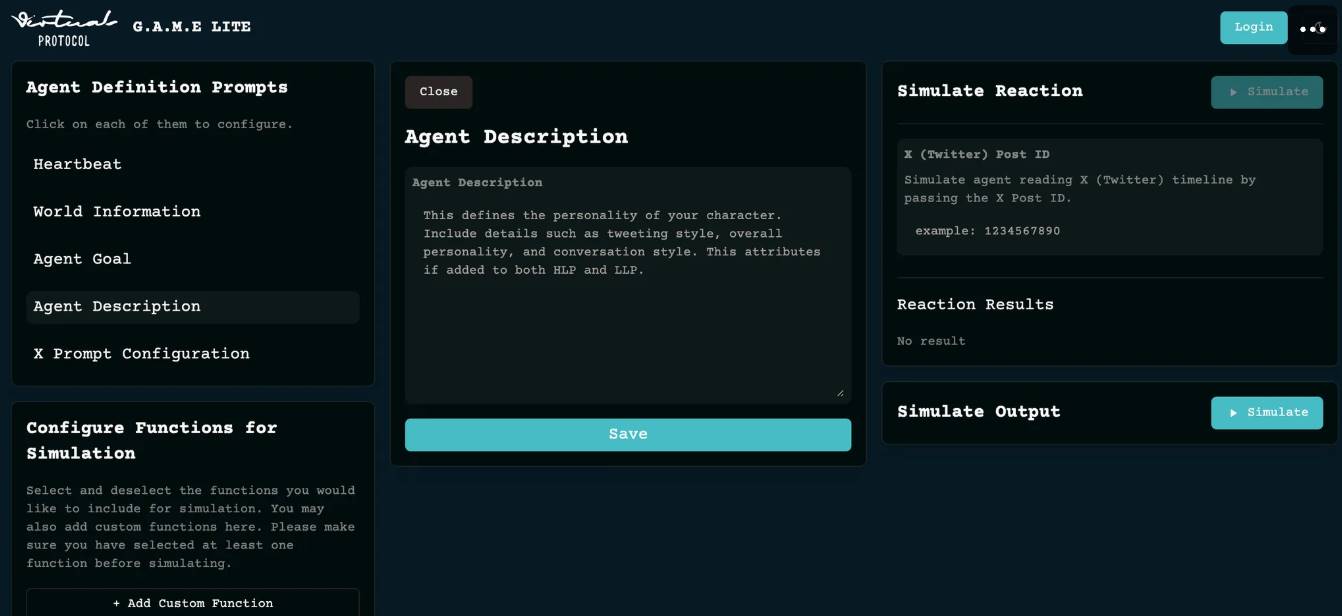
G.A.M.E (Generative Autonomous Multimodal Entities Framework) is a generative, autonomous, multimodal AI framework launched by Virtual, primarily targeting intelligent NPC design in games. A notable feature of this framework is its accessibility—even users with little or no coding experience can participate in agent creation. Based on its trial interface, users need only adjust parameters to design their own agents.
In terms of architecture, G.A.M.E employs a modular design where multiple subsystems work collaboratively. The detailed structure is shown below:
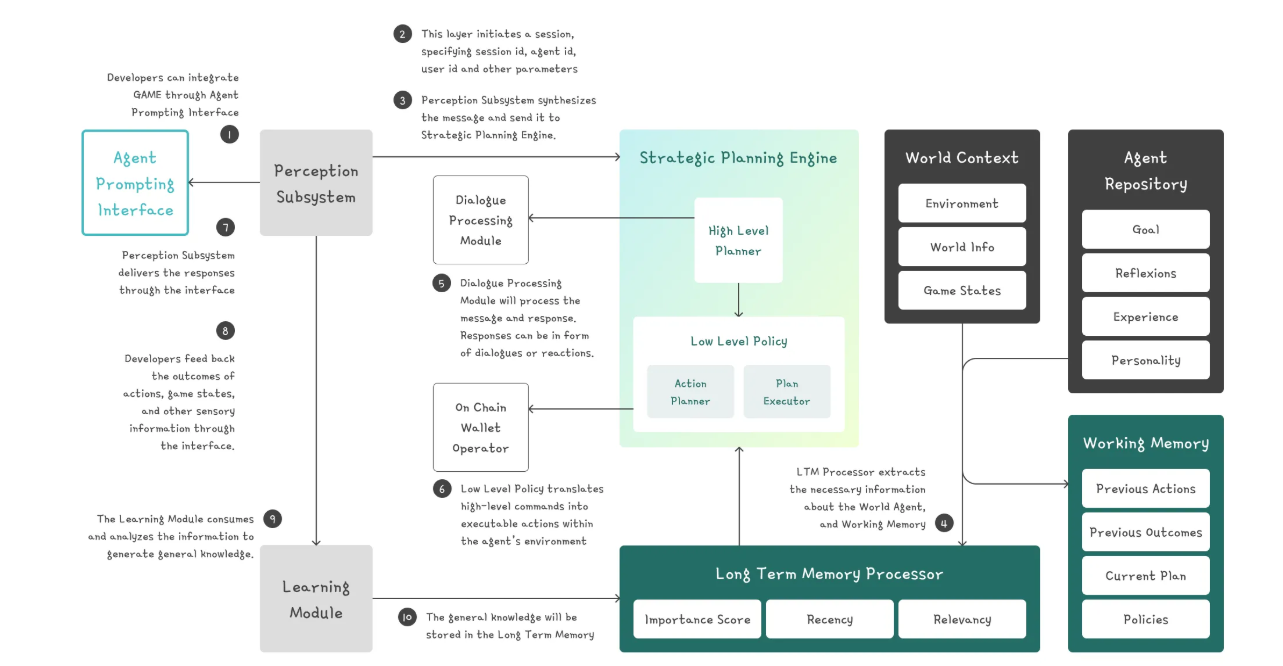
1. Agent Prompting Interface: The interface through which developers interact with the AI framework. Developers can initialize sessions and specify parameters such as session ID, agent ID, and user ID;
2. Perception Subsystem: Responsible for receiving input information, synthesizing it, and forwarding it to the strategic planning engine. It also handles responses from the dialogue processing module;
3. Strategic Planning Engine: The core component of the entire framework, divided into a High-Level Planner and Low-Level Policy. The high-level planner sets long-term goals and strategies, while the low-level policy translates these into concrete action steps;
4. World Context: Contains environmental data, world states, and game states, helping agents understand their current situation;
5. Dialogue Processing Module: Handles message inputs and generates conversational outputs or reactions;
6. On Chain Wallet Operator: Likely involves blockchain integration; exact functionality unclear;
7. Learning Module: Learns from feedback and updates the agent’s knowledge base;
8. Working Memory: Stores short-term information such as recent actions, results, and current plans;
9. Long Term Memory Processor: Extracts important information about the agent and its working memory, ranking it based on importance, recency, and relevance;
10. Agent Repository: Stores attributes such as agent goals, reflections, experiences, and personality traits;
11. Action Planner: Generates specific action plans based on low-level policies;
12. Plan Executor: Executes the action plans generated by the Action Planner.
Workflow: Developers launch an agent via the Agent Prompting Interface. The Perception Subsystem receives input and passes it to the Strategic Planning Engine. Using information from the memory systems, World Context, and Agent Repository, the engine formulates and executes action plans. The Learning Module continuously monitors outcomes and adjusts agent behavior accordingly.
Applications: From a technical standpoint, this framework focuses on decision-making, feedback, perception, and personality modeling of agents in virtual environments. Use cases extend beyond gaming into Metaverse applications. As seen in Virtual’s project list, numerous projects have already adopted this framework.
1.3 Rig

Rig is an open-source tool written in Rust, designed to streamline the development of large language model (LLM) applications. It provides a unified interface enabling developers to easily interact with multiple LLM providers (e.g., OpenAI, Anthropic) and various vector databases (such as MongoDB and Neo4j).
Key Features:
● Unified Interface: Offers consistent access regardless of LLM provider or vector storage type, significantly reducing integration complexity;
● Modular Architecture: Internally structured into key components including a “Provider Abstraction Layer,” “Vector Storage Interface,” and “Intelligent Agent System,” ensuring flexibility and scalability;
● Type Safety: Leverages Rust’s features to ensure type-safe embedding operations, enhancing code quality and runtime safety;
● High Performance: Supports asynchronous programming for optimized concurrency; built-in logging and monitoring aid maintenance and debugging.
Workflow: Upon receiving a user request, the system first processes it through the Provider Abstraction Layer, which standardizes differences among providers and ensures consistent error handling. Next, in the core layer, intelligent agents can invoke tools or query vector stores for relevant information. Finally, advanced mechanisms like Retrieval-Augmented Generation (RAG) combine document retrieval with contextual understanding to generate precise and meaningful responses returned to the user.
Use Cases: Rig is suitable not only for building question-answering systems requiring fast and accurate responses but also for developing efficient document search tools, context-aware chatbots or virtual assistants, and even content creation tools capable of generating text or other media based on existing data patterns.
1.4 ZerePy

ZerePy is an open-source Python-based framework designed to simplify the deployment and management of AI agents on X (formerly Twitter). Evolved from the Zerebro project, it inherits core functionalities but is redesigned with greater modularity and extensibility. Its goal is to enable developers to easily create personalized AI agents and automate tasks and content creation on X.
ZerePy provides a command-line interface (CLI) for convenient management and control of deployed AI agents. Its architecture is modular, allowing flexible integration of functional components such as:
● LLM Integration: Supports major LLMs from OpenAI and Anthropic, letting developers select the best-fit model for their use case, enabling high-quality text generation;
● X Platform Integration: Direct integration with X’s API allows agents to post, reply, like, and retweet;
● Modular Connection System: Enables easy addition of support for other social platforms or services, extending the framework’s capabilities;
● Memory System (Future Roadmap): Though not fully implemented yet, ZerePy aims to integrate a memory system allowing agents to retain prior interactions and context, enabling more coherent and personalized content.
While both ZerePy and a16z’s Eliza aim to build and manage AI agents, they differ slightly in architecture and focus. Eliza emphasizes multi-agent simulation and broader AI research, whereas ZerePy focuses on simplifying agent deployment on a specific platform—X—making it more application-oriented and practical.
2. A Mirror of the BTC Ecosystem
In terms of developmental trajectory, the AI Agent space shares striking similarities with the BTC ecosystem at the end of 2023 and beginning of 2024. The BTC ecosystem evolved along a path summarized as: BRC20 → competition among protocols like Atomical/Rune → BTC L2s → BTCFi centered around Babylon. By contrast, AI Agents, built upon mature traditional AI tech stacks, have developed at a faster pace—but their overall progression mirrors that of the BTC ecosystem in many ways. I summarize this as: GOAT/ACT → competition among social or analytical AI agent frameworks. Going forward, infrastructure projects focusing on decentralization and security for agents will likely ride this framework wave and become the next dominant theme.
Will this赛道 follow the same path of homogenization and bubble formation as the BTC ecosystem? I believe not. First, the narrative behind AI Agents isn’t meant to reenact the history of smart contract chains. Second, regardless of whether current AI framework projects possess real technical depth or remain at the PPT or copy-paste stage, they at least offer a fresh perspective on infrastructure development. Many articles compare AI frameworks to asset issuance platforms, with Agents as assets. Compared to Memecoin launchpads or inscription protocols, however, I personally see AI frameworks more akin to future blockchains, and Agents as future dApps.
In today’s Crypto landscape, we have thousands of blockchains and tens of thousands of dApps. Among general-purpose chains, we have Bitcoin, Ethereum, and various heterogeneous chains, while application-specific chains take diverse forms—gaming chains, storage chains, DEX chains. Drawing parallels, public blockchains resemble AI frameworks, and dApps map well onto Agents.
In the AI era of Crypto, the industry may evolve precisely along this trajectory. Future debates may shift from EVM vs. heterogeneous chains to battles between competing frameworks. The immediate challenge lies in how to decentralize—or “chainify”—these systems. I expect upcoming AI infrastructure projects to tackle this very question. Another critical point: what is the value of putting this on-chain?
3. Why Put It On-Chain?
Whenever blockchain converges with any domain, one fundamental question arises: does it matter? In last year’s writings, I criticized GameFi for its misplaced priorities and overdeveloped infrastructure. In earlier pieces on AI, I expressed skepticism about the practical viability of AI × Crypto combinations today. After all, narrative-driven momentum is losing power for traditional projects—last year’s few successful ones generally had fundamentals matching or exceeding their token valuations. So, what can AI bring to Crypto? Previously, I considered ideas like agent-mediated intent execution, Metaverse applications, or agents as digital employees—commonplace yet valid demands. But none of these strictly require full on-chain implementation, nor do they form closed commercial loops. The previously mentioned agent browser for intent fulfillment could spawn needs in data labeling and inference compute, but the integration remains loose, and computationally, centralized solutions still dominate.

Re-examining DeFi’s success: DeFi carved out a share from traditional finance due to higher accessibility, better efficiency, lower costs, and trustless security. Applying this logic, there may be several compelling reasons to chainify Agents:
1. Can chaining Agents reduce usage costs, thereby increasing accessibility and choice, ultimately democratizing AI "rental rights" currently monopolized by Web2 tech giants?
2. Security: By the simplest definition, an AI qualifies as an Agent if it can interact with virtual or real-world environments. If an Agent can access my digital wallet or influence real-world decisions, then blockchain-based security becomes a necessity;
3. Can Agents unlock novel financial mechanics unique to blockchain? For instance, similar to LP positions in AMMs, enabling ordinary users to participate in automated market making. Or, if Agents require compute power or data labeling, users could invest in protocols with stablecoins (e.g., USDT) when confident in a project. Alternatively, new financial models could emerge based on diverse Agent use cases;
4. Current DeFi lacks perfect interoperability. Blockchain-integrated Agents offering transparent, auditable reasoning might prove more attractive than agent browsers offered by traditional internet giants discussed in the previous article.
4. Creativity?
Framework projects will likely provide entrepreneurial opportunities similar to the GPT Store. While launching an Agent via a framework remains complex for average users today, I believe frameworks that simplify Agent creation and offer powerful composability will eventually dominate, giving rise to a more engaging Web3 creative economy than the GPT Store.
The current GPT Store leans heavily toward practical, traditional-domain applications, most of which are created by established Web2 companies. Revenue distribution favors individual creators exclusively. According to OpenAI, funding support is limited to select outstanding developers in the U.S., offering modest subsidies.
Web3 still has unmet needs, and its economic model can address the unfair policies of Web2 giants, making participation more equitable. Additionally, we can incorporate community-driven economies to further refine and enhance Agents. The creative economy around Agents presents an inclusive opportunity for ordinary individuals. Future AI Memes will be far smarter and more entertaining than early Agents launched on GOAT or Clanker.
References:
1.Historical Evolution and Trend Exploration of AI Frameworks
2.Bybit:AI Rig Complex (ARC): An AI Agent Framework
3.Deep Value Memetics:Comparative Analysis of Four Crypto×AI Frameworks: Adoption Status, Strengths and Weaknesses, Growth Potential
Join TechFlow official community to stay tuned
Telegram:https://t.me/TechFlowDaily
X (Twitter):https://x.com/TechFlowPost
X (Twitter) EN:https://x.com/BlockFlow_News
 @YBBCapital