








Four Frameworks Compete in Crypto x AI: In-Depth Analysis of Eliza, GAME, Rig, and ZerePy's Technical Architectures and Market Landscape
TechFlow Selected TechFlow Selected
Four Frameworks Compete in Crypto x AI: In-Depth Analysis of Eliza, GAME, Rig, and ZerePy's Technical Architectures and Market Landscape
Each framework occupies a unique market segment, and they are more complementary than directly competitive.
 Navigating Web3 tides with focused insights
Author: arndxt
Translation: TechFlow
Introduction
Crypto x AI is making waves, and Virtuals have surged again (at the time of compiling this article, Virtuals' market cap has exceeded $2.4 billion, with a 24-hour gain as high as 24%). Beyond Virtuals, what other Crypto x AI frameworks are worth watching? What are their key similarities and differences?
TechFlow compiles and translates this comprehensive analysis of the technical architecture, market positioning, and potential industry impact of four major frameworks: Eliza ($AI16Z), GAME ($VIRTUAL), Rig ($ARC), and ZerePy ($ZEREBRO).
Main Content
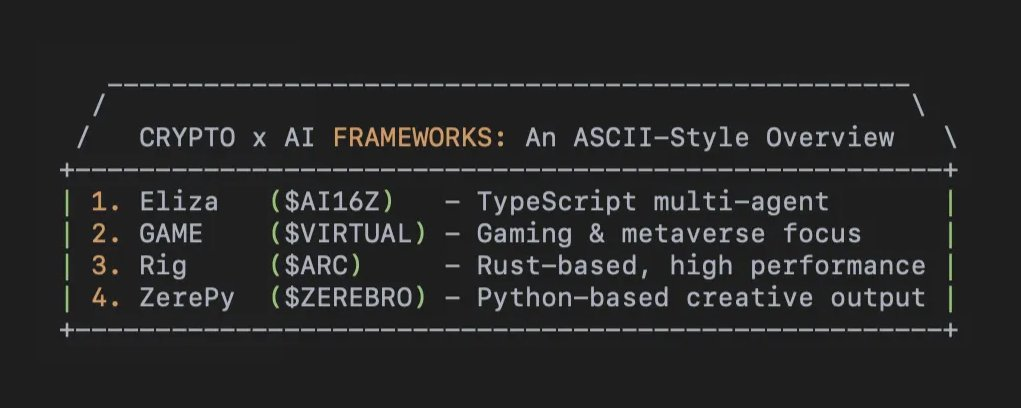
In the Crypto x AI space, there are currently four dominant frameworks:
-
Eliza ($AI16Z)
-
GAME ($VIRTUAL)
-
Rig ($ARC)
-
ZerePy ($ZEREBRO)
Each framework has a clear positioning aimed at meeting diverse developer needs.
Eliza holds around 60% market share thanks to its first-mover advantage and active TypeScript community; GAME (~20%) focuses on gaming and metaverse applications and is rapidly gaining traction.
Rig (~15%) is built on Rust, offering high-performance modular design ideal for the Solana ecosystem; ZerePy (~5%) is an emerging Python-based framework focused on creative output and social media automation. Currently, these frameworks have a combined valuation of $1.7 billion. As AI-driven crypto applications expand, the total market could surpass $20 billion, making a market-cap-weighted investment strategy a compelling option. Each framework occupies a distinct niche—Eliza in social and multi-agent systems, GAME in gaming and the metaverse, Rig in enterprise-grade performance, and ZerePy in creative community applications. These frameworks are more complementary than directly competitive.
1. Overview and Market Position
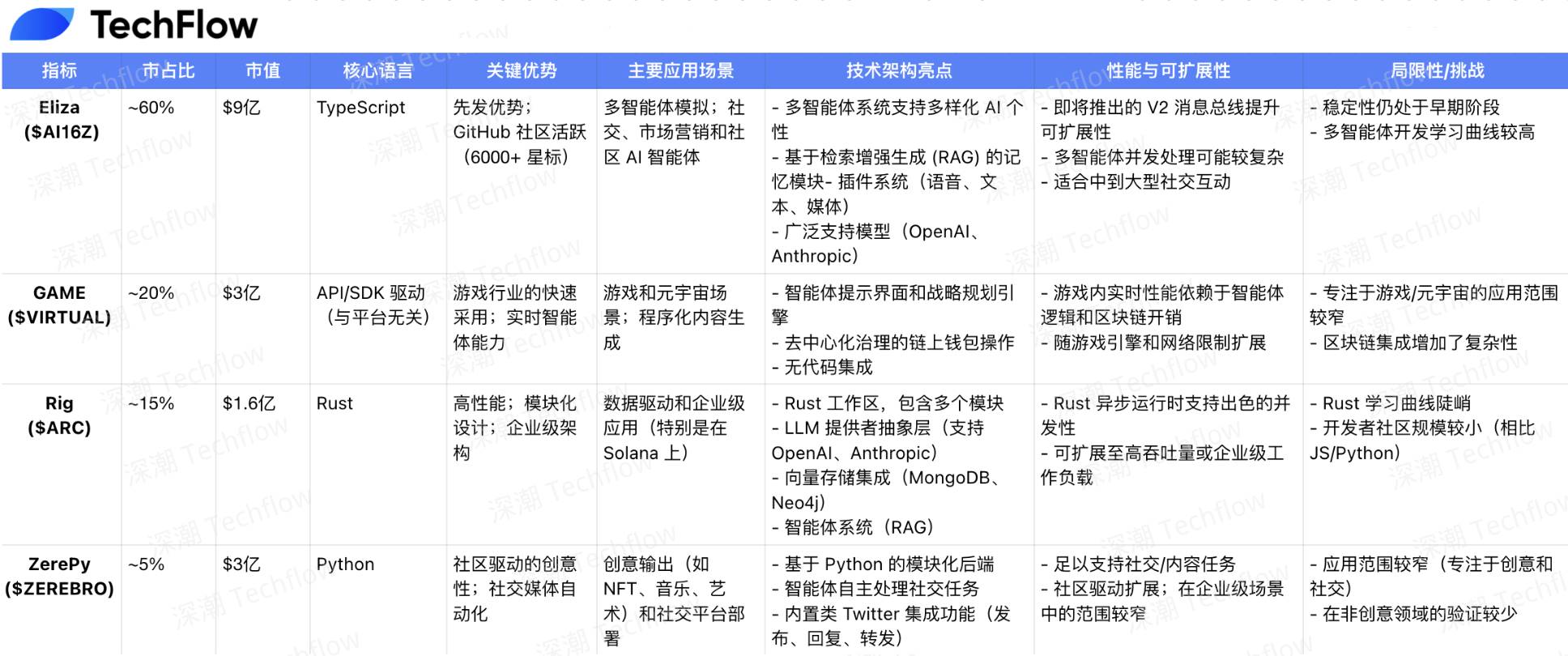
(Original English table by @arndxt_xo, translated by TechFlow)
1.1 Eliza ($AI16Z)
-
Market Share: ~60%
-
Market Cap: $900 million
-
Core Language: TypeScript
-
Key Advantages: First-mover advantage, large GitHub community (6,000+ stars, 1,800 forks)
-
Key Applications: Multi-agent simulation, cross-platform social interaction
As one of the earliest AI agent frameworks in the field, Eliza dominates the market. Its early lead stems from a robust developer community that accelerates feature iteration and drives widespread adoption. Built on TypeScript, it’s an ideal choice for web developers, attracting a broad base of contributors.
1.2 GAME ($VIRTUAL)
-
Market Share: ~20%
-
Market Cap: $300 million
-
Core Language: API/SDK-based, language-agnostic design
-
Key Advantages: Rapid adoption in gaming, supports real-time agent interactions
-
Key Applications: Procedural content generation, adaptive NPC behavior
GAME is designed specifically for gaming and metaverse applications. Its API-first architecture allows seamless integration into existing projects, and its tight coupling with the $VIRTUAL ecosystem fuels rapid growth. To date, over 200 projects have adopted the framework, generating up to 150,000 daily requests, with steady weekly growth. GAME's no-code integration capability is particularly valuable, enabling teams to deploy functionality quickly without deep technical expertise.
1.3 Rig ($ARC)
-
Market Share: ~15%
-
Market Cap: $160 million
-
Core Language: Rust
-
Key Advantages: High-performance modular design optimized for the Solana ecosystem
-
Key Applications: Enterprise-grade performance, complex transaction processing
Rig is a performance-focused framework built in Rust, leveraging Solana’s high throughput. Its modular architecture enables flexible customization based on specific needs, making it ideal for enterprise applications requiring high performance and low latency. Despite a smaller market share, its strategic position within the Solana ecosystem makes it highly attractive to developers building high-frequency trading systems or executing complex smart contracts.
1.4 ZerePy ($ZEREBRO)
-
Market Share: ~5%
-
Market Cap: $300 million
-
Core Language: Python
-
Key Advantages: Focus on creative output and social media automation
-
Key Applications: Generative content, community engagement tools
As an emerging player, ZerePy uses Python as its core language, lowering the barrier to entry and attracting many creative developers and content creators. Its focus on generative content and social automation makes it ideal for creative communities and marketing teams. While currently holding a small market share, its growth potential should not be overlooked.
2. Technical Architecture and Core Components
Eliza ($AI16Z)
-
Multi-Agent System: Supports collaboration or competition among multiple AI agents within a shared runtime environment, suitable for complex interactive scenarios.
-
Memory Management (RAG): Enhances context awareness through retrieval-augmented generation, supporting long-term interactions.
-
Plugin System: Allows community-developed extensions for voice, text parsing, and multimedia file handling (e.g., PDFs, images).
-
Broad Model Support: Compatible with both local open-source LLMs and cloud-based APIs (e.g., OpenAI, Anthropic).
Eliza’s architecture centers on multimodal communication, making it well-suited for social, marketing, and community-oriented AI applications. It integrates easily with platforms like Discord, X (formerly Twitter), and Telegram, offering developers extensive extensibility. However, managing personality and memory modules across multiple agents at scale requires careful orchestration to maintain system stability and efficiency.
GAME ($VIRTUAL)
-
API + SDK Model: Provides game studios and metaverse projects with a streamlined agent integration solution.
-
Agent Prompt Interface: Coordinates user input with the agent’s strategy engine to optimize player experience.
-
Strategy Planning Engine: Separates agent logic into high-level goal planning and low-level execution, increasing behavioral flexibility.
-
Blockchain Integration: Enables on-chain wallet operations and decentralized agent governance, enhancing asset management in the metaverse.
GAME’s architecture is optimized for gaming and metaverse use cases, prioritizing real-time performance and dynamic agent adaptation. Its strategy engine allows characters to set goals and adjust actions in real time, delivering a more immersive player experience. While extendable to other domains, its design remains primarily oriented toward virtual worlds and procedural generation.
Rig ($ARC)
-
Rust Workspace Structure: Divides functionality into independent crates for clarity and modularity.
-
Provider Abstraction Layer: Standardizes interactions with multiple LLM providers (e.g., OpenAI, Anthropic).
-
Vector Store Integration: Supports various backends (MongoDB, Neo4j) for contextual retrieval.
-
Agent System: Integrates RAG and dedicated tool usage for advanced agent capabilities.
Rig’s high-performance architecture benefits from Rust’s concurrency model, making it ideal for enterprise applications requiring strict resource control. Its layered abstraction ensures high reliability, though Rust’s steep learning curve may limit broader developer participation.
ZerePy ($ZEREBRO)
-
Python-Based: Designed for AI/ML developers familiar with Python libraries and workflows, easy to get started.
-
Modular Zerebro Backend: Powers creative content generation, especially useful in social media and art contexts.
-
Agent Autonomy: Focused on "creative output," including meme, music, and NFT generation tasks.
-
Social Platform Integration: Includes built-in modules resembling Twitter functionalities such as posting, replying, and retweeting.
ZerePy offers a tailored solution for Python developers aiming to quickly deploy agents on social platforms. Though narrower in scope compared to Eliza or Rig, ZerePy excels in artistic or entertainment-driven scenarios, holding unique advantages in decentralized creative communities.
3. Comparative Dimensions
3.1 Usability
-
Eliza: Strikes a balance in design—while multi-agent complexity introduces a learning curve, strong support from the TypeScript developer community mitigates this.
-
GAME: Designed for non-technical users, especially in gaming, offering no-code or low-code solutions that lower entry barriers.
-
Rig: Requires higher developer proficiency due to Rust’s strictness, but rewards skilled users with superior performance and reliability.
-
ZerePy: Highly accessible to Python users, especially those working on creative or media-related AI tasks.
3.2 Scalability
-
Eliza: Version 2 introduces an extensible message bus and improved concurrency handling, though fine-grained task scheduling and resource allocation across agents still require careful management.
-
GAME: Scalability depends on real-time gaming demands and blockchain network stability—performance remains strong if game engine constraints are well managed.
-
Rig: Inherently scalable thanks to Rust’s async runtime, well-suited for high-throughput and enterprise-scale workloads.
-
ZerePy: Scalability is largely community-driven, effective in creative and social media domains, but limited in supporting large enterprise loads.
3.3 Adaptability
-
Eliza: Most adaptable, with plugin support, broad model compatibility, and cross-platform integration, suitable for diverse use cases.
-
GAME: Exceptionally adaptable within gaming, seamlessly integrating with various game engines, but less applicable outside this domain.
-
Rig: Ideal for data-intensive or enterprise tasks, supporting flexible choices of LLMs and vector stores to meet complex requirements.
-
ZerePy: Focused on creative output, easily extended via the Python ecosystem, but constrained in application breadth.
3.4 Performance
-
Eliza: Optimized for social and conversational tasks; performance relies heavily on the quality and speed of external model APIs.
-
GAME: Delivers excellent real-time performance in dynamic game environments, contingent on coordination between agent logic and blockchain overhead.
-
Rig: Outstanding performance due to Rust’s concurrency and memory safety, ideal for complex, large-scale AI processing.
-
ZerePy: Performance depends on Python execution speed and model call efficiency—sufficient for social and content creation tasks, but unsuitable for enterprise-grade throughput.
4. Strengths and Limitations
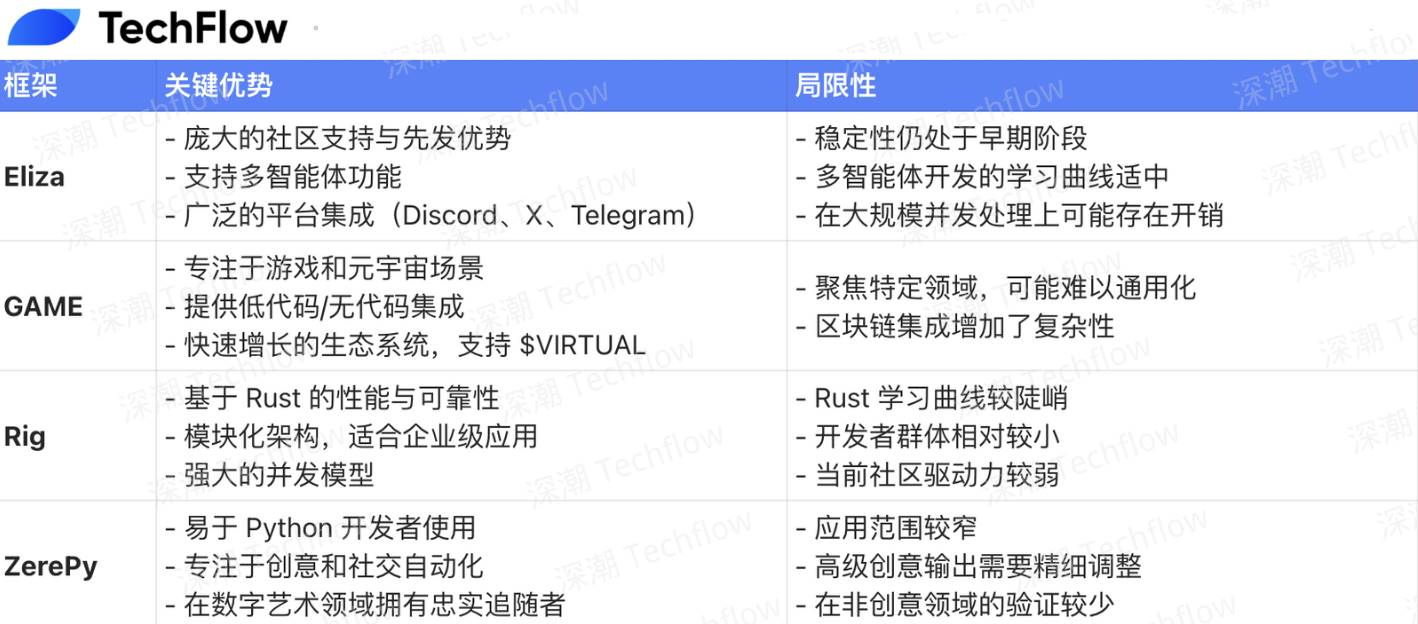
(Original English table by @arndxt_xo, translated by TechFlow)
5. Market Potential and Outlook
The four frameworks currently have a combined market cap of $1.7 billion. If the Crypto x AI sector experiences explosive growth similar to L1 blockchains, its potential could exceed $20 billion. For investors, a market-cap-weighted strategy may be prudent, especially since each framework serves distinct niches and could benefit collectively from overall market expansion.
-
Eliza ($AI16Z): With a mature ecosystem, robust codebase, and upcoming V2 features (such as the Coinbase Agent Toolkit and Trusted Execution Environment (TEE) support), it is well-positioned to maintain its market leadership.
-
GAME ($VIRTUAL): Accelerating adoption in gaming and the metaverse, bolstered by synergies with the $VIRTUAL ecosystem, ensuring sustained developer interest.
-
Rig ($ARC): Could emerge as Solana’s “hidden gem” for enterprise AI. As handshake initiatives progress, it may replicate the success of other chain-specific frameworks.
-
ZerePy ($ZEREBRO): Though niche-focused, its alignment with the Python ecosystem and strong community momentum gives it a solid foothold in creative and artistic domains often overlooked by general-purpose solutions.
6. Integrated Comparative Insights
6.1 Tech Stack and Learning Curve
-
Eliza (TypeScript): Achieves a good balance between usability and feature richness.
-
GAME: Offers simple, accessible APIs for game development, though applicability beyond gaming is limited.
-
Rig (Rust): Prioritizes peak performance at the cost of increased complexity.
-
ZerePy (Python): Simple to operate in creative applications but lacks broad enterprise-grade versatility.
6.2 Community and Ecosystem
-
Eliza: Boasts the largest GitHub community, reflecting broad applicability and strong developer support.
-
GAME: Growing rapidly in gaming and metaverse circles, driven by support from the $VIRTUAL ecosystem.
-
Rig: Smaller developer base but technically strong, focused on high-performance use cases.
-
ZerePy: Cultivates a niche community around creativity and decentralized art, further strengthened by collaborations with Eliza.
6.3 Future Growth Catalysts
-
Eliza: The upcoming plugin registry and TEE integration could further solidify its market leadership.
-
GAME: Expansion of the $VIRTUAL ecosystem may attract more non-technical users, fueling adoption.
-
Rig: Potential partnerships on Solana and its enterprise focus could drive significant growth as its developer base expands.
-
ZerePy: Leveraging Python’s dominance in AI development and rising trends in community-driven creative projects, it can strengthen its position in niche markets.
Join TechFlow official community to stay tuned
Telegram:https://t.me/TechFlowDaily
X (Twitter):https://x.com/TechFlowPost
X (Twitter) EN:https://x.com/BlockFlow_News
 @arndxt_xo


