








The Silent Evolution of the TON Ecosystem: Decoding the Technological TON DEX PixelSwap
TechFlow Selected TechFlow Selected
The Silent Evolution of the TON Ecosystem: Decoding the Technological TON DEX PixelSwap
Unveiling the art of simplified trading with PixelSwap.
 Navigating Web3 tides with focused insights
Written by: TechFlow
Recently, Bitcoin has been performing exceptionally well, breaking its all-time high and continuing its upward trajectory toward the long-anticipated $100,000 mark. After three years of prolonged pain, Bitcoin is now profitable for the vast majority of holders, and prices nearing $100,000 have once again captured global attention.
Likewise, the development of most things involves unique growing pains, and TON's ecosystem trajectory this year serves as a prime example. With the opening of Telegram Mini Apps, TON Network has entered its own cycle—TVL has steadily climbed, and ecosystem highlights have followed one after another. Yet beneath this surface-level boom in the TON ecosystem came wave after wave of controversial MiniGame token launches.
This token launch frenzy brought apparent short-term prosperity to TON: trading volume surged, user numbers skyrocketed, and trending tokens emerged continuously. However, the essence behind this prosperity was that numerous game projects attracted users to farm through simple gameplay mechanics and token incentives, without being able to sustain long-term value. This not only failed to bring substantive progress to the TON ecosystem but also damaged market confidence to some extent.
Beyond the reputational damage caused by the token launch craze, the TON ecosystem currently faces deeper, more fundamental challenges: DeFi infrastructure plays a critical role across ecosystems—not only serving as the foundational layer for user transactions but also acting as a hub for healthy ecosystem growth. Just as Ethereum’s development could not have happened without Uniswap’s boost, a good DEX can often serve as a pivotal lever for ecosystem expansion. Yet, the current TON ecosystem clearly falls short in this regard. Incomplete decentralized exchange infrastructure, missing developer toolchains, and fragmented user experiences have made it difficult to effectively concentrate liquidity within the ecosystem, leaving project teams struggling to access stable and reliable liquidity support. These shortcomings in DeFi infrastructure not only constrain user trading experiences but also represent a key bottleneck hindering the launch of high-quality projects, directly impacting the TON ecosystem’s sustainable development.
In response to a TON ecosystem suffering from weakened confidence, LayerPixel—an all-in-one DeFi solution—is attempting to address these “structural issues” through its innovative architecture and core sub-product, PixelSwap.
With PixelSwap set to undergo its Token Generation Event (TGE) in Q4, this article will provide an in-depth analysis of PixelSwap’s technical innovations, helping readers get ahead of the curve on its unique advantages and detailed TGE plans.
PixelSwap: The Core DEX Under the LayerPixel Architecture
To understand PixelSwap, one must first understand its parent project, LayerPixel.
As a Layer 1.5 solution on TON, LayerPixel overcomes the limitations of TON’s asynchronous and heterogeneous architecture through modular design, fully leveraging its sharding advantages. At the same time, LayerPixel seamlessly integrates DeFi functionalities with Telegram Mini Apps, building a complete ecosystem including wallets, DEXs, and oracles.
Within the LayerPixel architecture, several core components play distinct roles:
-
PixelSwap, as the first modular DEX on TON, supports advanced trading models including weighted pools and LBP (Liquidity Bootstrapping Pools)
-
PixelWallet, a smart contract wallet featuring account abstraction (AA), provides users with a seamless DApp interaction experience
-
Pixacle, a decentralized oracle, delivers fast and accurate price data to DApps and smart contracts within the ecosystem
-
LayerPixel also offers developers in the TON ecosystem a full suite of development tools, including convenient SDKs and APIs, along with practical tools and insights accumulated from the team’s hands-on experience building within the TON ecosystem
As a key component of the LayerPixel architecture, PixelSwap delivers value across multiple dimensions within the TON ecosystem.
In terms of security, the project collaborates with globally top-tier blockchain security auditing firms to provide the strongest possible protection for user assets. On the user experience front, PixelSwap deeply integrates with Telegram Bot to develop a smooth Mini App interface, allowing users to complete all DEX-related operations with a single click within the familiar Telegram environment—truly achieving “seamless” interactions.
At the technical level, PixelSwap employs an innovative layered architecture supporting multiple advanced trading algorithms. Specifically:
-
Atomic swap functionality enables complex DeFi transaction scenarios to be completed within a single transaction
-
The weighted pool mechanism provides professional market makers with finer-grained liquidity management tools
-
LBP (Liquidity Bootstrapping Pool) offers project teams a more flexible token issuance model
Thanks to PixelSwap’s deep technical foundation, "simple user interaction + easy token launch" becomes possible within the TON ecosystem.
The synergy between PixelSwap and LayerPixel unfolds further, revealing a clear and comprehensive project incubation pipeline tailored for TON ecosystem developers:
Developers can use components provided by LayerPixel to rapidly build applications, then optionally deploy their projects on the PixelSwap platform. This synergistic effect creates a virtuous cycle: LayerPixel focuses on building underlying infrastructure and development tools, while PixelSwap specializes in providing liquidity support for TON ecosystem projects.
This clearly defined division of labor allows developers to focus on product innovation without excessive concern over low-level technical implementation or liquidity challenges—a model of constructive interaction essential for the thriving growth of the TON ecosystem.
Peeling Back the Layers: PixelSwap’s Art of Simplifying Complexity in Trading
Technology is the primary productive force. To truly grasp PixelSwap’s uniqueness, understanding the technical principles underpinning its diverse functionalities is essential.
Atomic Swap: Bundling All Steps into One
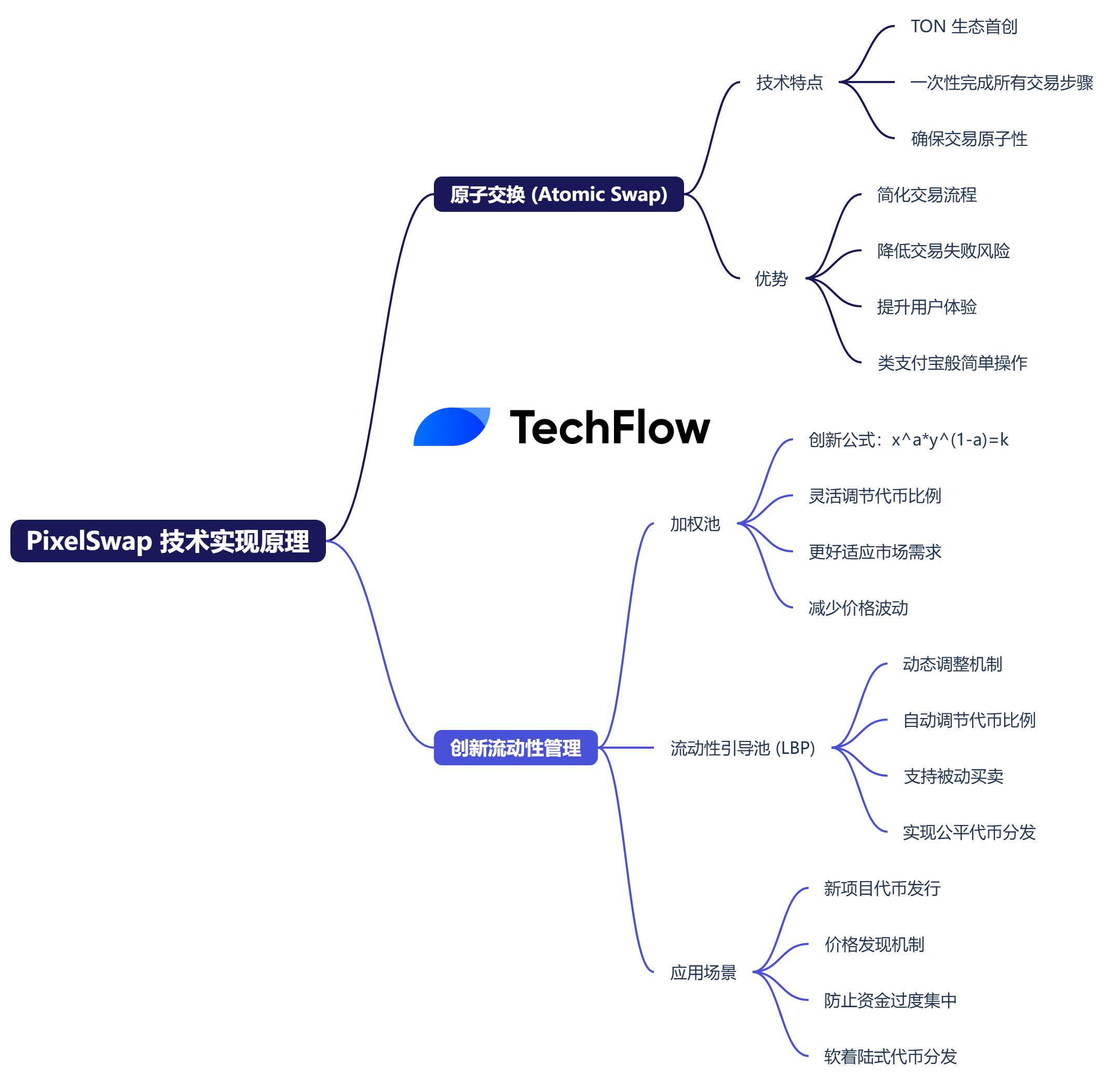
PixelSwap is the first and only DEX in the TON ecosystem to implement atomic swaps—an outstanding technological innovation and the foundation for users’ seamless trading experience on PixelSwap.
Imagine the process of swapping tokens on a traditional DEX: first approve token A, wait for confirmation; then approve token B, wait again; finally execute the swap. This process is like passing through three traffic lights before reaching your destination. PixelSwap’s atomic swap mechanism elegantly solves this problem. By designing a transaction orchestration system at the smart contract level, all necessary actions (approval, transfer, swap) are bundled into a single, indivisible atomic operation. It’s akin to carving out a dedicated tunnel through the city—users need only one call via a TON wallet (such as TONkeeper) to complete the entire transaction flow in one go.
Technically, PixelSwap’s atomic swap leverages TON’s internal message-passing mechanism within smart contracts. Through meticulously designed contract architecture, it ensures that all transaction steps either succeed completely or roll back entirely, perfectly fulfilling the atomicity requirement of blockchain transactions’ ACID properties. This not only reduces gas costs but fundamentally eliminates financial risks arising from intermediate states.
With atomic swap support, users no longer need to navigate complex procedures for everyday small transactions. A single click automatically completes all required steps, bundling and hiding the intricate on-chain processes beneath a clean, intuitive interface—making the trading experience as simple as using Alipay.
Weighted Pools and LBP: Innovative Liquidity Management
Beyond delivering an exceptional trading experience, PixelSwap has also introduced deep innovations in liquidity management. The platform supports two advanced liquidity pool designs: weighted pools and Liquidity Bootstrapping Pools (LBP).
Most traditional DEXs use the xy=k constant product formula—analogous to a cup filled with water, where pouring some out causes the remaining water level to rise quickly, leading to significant price slippage. PixelSwap innovatively introduces a weighted pool mechanism using a more flexible formula: x^a*y^(1-a)=k—like a container whose shape can be adjusted to better accommodate market demand.
Building on the weighted pool foundation, PixelSwap implements a dynamic adjustment mechanism known as LBP (Liquidity Bootstrapping Pools). During pool operation, the ratio of the two tokens automatically adjusts, enabling the contract to passively buy or sell assets in one direction. This offers new projects a fairer and more efficient token distribution solution.
Consider a new project launching a token on TON. The traditional approach is like setting up a stall with a fixed price—say, “1 TON = 100 TOKEN.” But if priced too high, no one buys; if too low, whales scoop up everything instantly.
This is where PixelSwap’s weighted pools and LBP come into play. Think of them as an intelligent market regulation system:
-
What does the weighted pool do?
It controls the exchange ratio during trading. For instance, if a project deposits 1 million TOKEN and 1,000 TON into the pool, it initially gives higher weight to TOKEN, making it easier to acquire—offering early supporters a favorable rate.
-
How does LBP complement this?
It acts like a timer on the pool, automatically adjusting the difficulty of acquiring TOKEN over time (by tuning weights). For example, on day one, 100 TON might get 10,000 TOKEN; by day seven, the same 100 TON only gets 5,000 TOKEN.
Through the combined tuning of weighted pools and LBP, the entire token issuance process becomes fluid. Project teams simply define a reasonable price curve range and let the market naturally discover value. It’s like designing a soft landing runway for a token—preventing extreme volatility and avoiding excessive capital concentration, enabling truly fair and efficient token distribution.
Value Contributors First: $PIX Token Distribution Targets Genuine Users
As mentioned earlier, market sentiment toward TON ecosystem project token launches is no longer as enthusiastic as during the MiniGame token frenzy. Aware of user skepticism, the upcoming PixelSwap TGE places great emphasis on ensuring $PIX stands apart from past precedents—addressing market bias from the outset.
Rigorous Distribution Mechanism and High-Quality User Profiling
If You’ve Interacted, You’re One of Us
Traditional projects often rely on simple task-checking mechanisms for airdrops, which are vulnerable to bot accounts and lead to massive sell pressure. In contrast, PixelSwap requires users to prove their activity through genuine on-chain interactions. By swapping or providing liquidity on the DEX, users increase their account’s “value” while simultaneously contributing to the protocol’s health. This deep engagement rewards users while fostering a sense of ownership and alignment with the protocol. The team also cleverly combines GameFi with DeFi: every real in-game purchase within the gaming ecosystem translates into token point rewards. This mechanism ensures that $PIX holders are actual contributors to the ecosystem.

Connecting Partners and High-Quality Users via Airdrop
Through the PIXArena platform, users can engage in meaningful interactions such as Farming Pool participation and swapping with partner projects like Tomarket to earn $PIX airdrops. The “earn first, receive later” model effectively filters for high-quality users who genuinely believe in the project’s long-term potential. Moreover, the innovative airdrop collaboration models within the PIXArena platform offer partner projects a precise channel to reach authentic users, forming a natural barrier against bulk account exploitation.

Tokenomics
As a DEX project within the TON ecosystem, PixelSwap’s tokenomics are built around a long-term vision of sustainability and utility. The $PIX token serves dual roles as a governance instrument and incentive mechanism within the ecosystem.
Token Allocation and Vesting
The total supply of $PIX is capped at 500 million tokens, with a gradual vesting schedule. Half of the allocation (50%) goes to community incentives, used to fuel ecosystem growth through liquidity mining and trading rewards. Early investors receive 20%, with 5% unlocked at TGE, followed by a 4-month cliff and 18-month linear vesting. Core team and future employees are allocated 15%, subject to a 12-month lock-up and 2-year linear release. An additional 15% is reserved for special allocations: 3% for IDO, 2% for advisors, and 10% dedicated to liquidity provision.

Revenue Distribution Mechanism
Protocol revenue is evenly split into two parts. One portion supports ongoing development by the core team, ensuring continuous iteration and upgrades. The other flows into a protocol treasury managed by DAO, with spending decisions fully governed by the community.
Early Ecosystem Development
In the initial phase following TGE, the team plans to allocate 3.5% of community tokens to nurture the ecosystem. This includes 0.5% airdropped to paying users within the ecosystem; 1% allocated to airdrops and partnerships with other Web3 projects and KOLs—for instance, 0.14% of total $PIX supply was distributed in the December 18 Gate.io startup sale; and 2% reserved for retroactive airdrops and early liquidity incentives.
Conclusion
From its initial ambition of achieving real mass adoption to facing today’s dual challenges of waning confidence and fading hype, the rise and fall of the TON ecosystem mirrors the evolution of any emerging technology.
At this uncertain juncture, a fascinating paradox emerges between technological innovation and market perception: the more pessimistic the market mood, the greater the need for grounded builders; the less mature the infrastructure, the more it tests a team’s technical foresight and strategic patience. The work of LayerPixel and PixelSwap cuts to the heart of this challenge—how to keep innovating while bringing crypto applications back to their core purpose: solving real problems.
From a broader perspective, the development of any new phenomenon is rarely smooth. A temporary cooling of hype may be a necessary phase—one that allows the ecosystem space to reflect and consolidate, so it can enter the next growth cycle with clearer direction.
Throughout this process, what truly matters isn’t surface-level booms or busts, but the pragmatic efforts pushing the ecosystem forward beneath the noise of market fluctuations. Perhaps this—more than anything else—is the ultimate measure of a project’s true value.
Join TechFlow official community to stay tuned
Telegram:https://t.me/TechFlowDaily
X (Twitter):https://x.com/TechFlowPost
X (Twitter) EN:https://x.com/BlockFlow_News
 深潮TechFlow






