








Powell "slaps down" Trump as BTC plunges 5%, barely holding $100K level
TechFlow Selected TechFlow Selected
Powell "slaps down" Trump as BTC plunges 5%, barely holding $100K level
Powell stated that the Federal Reserve is not permitted to own Bitcoin, as the Federal Reserve Act specifies what we can hold, and we do not wish to change the law.
 Navigating Web3 tides with focused insights
By BitpushNews
On Wednesday afternoon local time, the Federal Reserve announced a 25-basis-point cut to its benchmark policy rate. However, it signaled that the number of rate cuts in 2025 could be fewer than previously expected, triggering sharp declines in both U.S. stock and cryptocurrency markets.
The Fed's latest quarterly economic projections indicate only two rate cuts next year—down from four projected in September and below the three anticipated by markets ahead of the meeting—suggesting a more cautious approach to balancing inflation and economic growth. Federal Reserve officials raised their forecasts for personal consumption expenditures (PCE) and core PCE inflation in 2025 from 2.1% and 2.2% respectively in September to 2.5%.
Chair Jerome Powell described this shift as a "new phase" in monetary policy, emphasizing that after 100 basis points of rate cuts in 2024, interest rates are now significantly closer to a neutral stance.
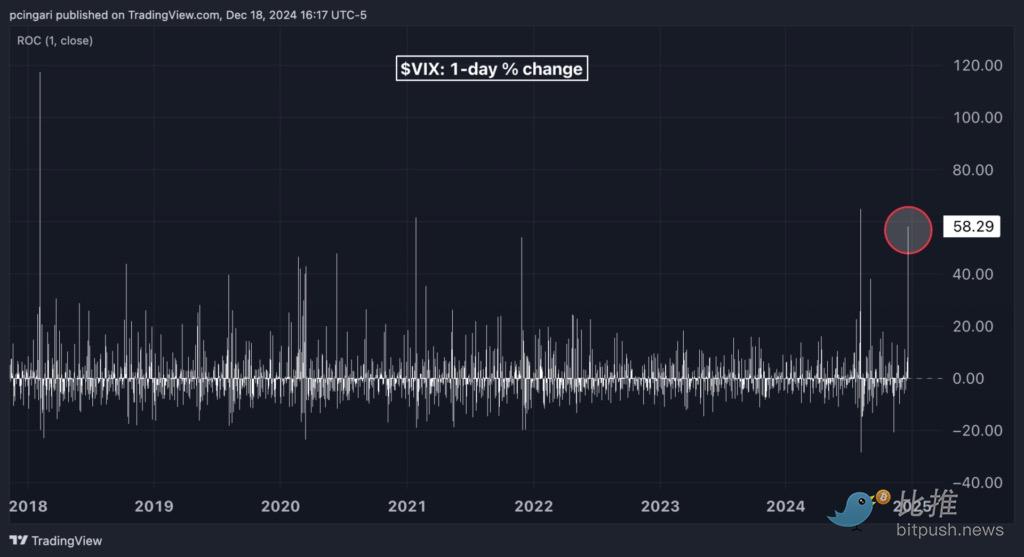
By market close, all three major indices were sharply lower: the Dow Jones Industrial Average initially closed down 2.59%, marking its longest single-day losing streak in 50 years (declining for ten consecutive trading days); the S&P 500 fell 2.95%; and the Nasdaq Composite dropped 3.56%. The dollar surged to a two-year high, while the CBOE Volatility Index (also known as the VIX or Wall Street’s fear gauge) jumped 58% to 25, reflecting rising investor uncertainty and growing anxiety over future interest rates.
Did Powell Just Contradict Trump?
At Wednesday’s press conference, when asked by an Axios reporter about Donald Trump’s idea of establishing a strategic Bitcoin reserve if he returns to office, Powell said: “We at the Fed are not allowed to hold Bitcoin. The Federal Reserve Act defines what we can own, and we do not wish to change the law. That is a matter for Congress. We don’t want the Federal Reserve changing the law.”
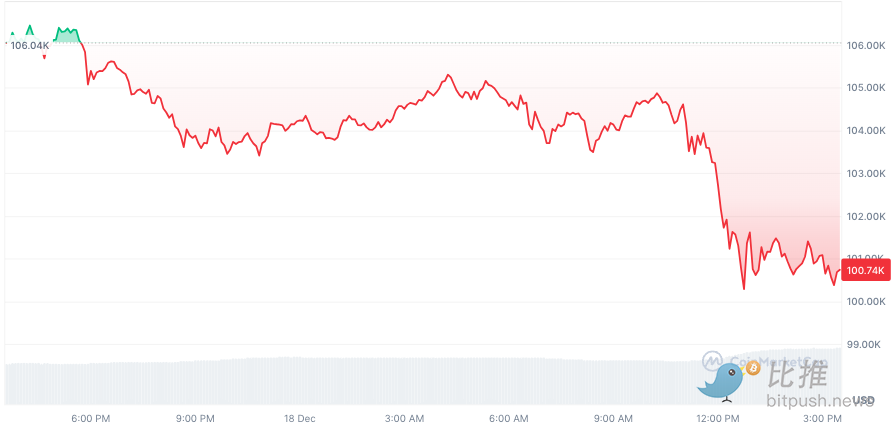
Bitcoin dropped to $104,000 following the Fed announcement and then fell further to around $100,256 after Powell’s comments, declining nearly 5% within 24 hours. Altcoins suffered larger losses, with XRP, ADA, and LTC each falling nearly 10%.
Trump has repeatedly advocated for creating a strategic Bitcoin reserve. In a recent CNBC interview, he said: “We will do great things in the crypto space because we don’t want any other country embracing crypto—we want to be the leader.”
As previously reported by BeepCrypto, Republican Senator Cynthia Lummis of Wyoming is drafting legislation that would direct the U.S. Treasury to purchase one million bitcoins over five years, funded by deposits held at Federal Reserve banks and gold reserves.
Other U.S. states have also introduced bills to invest in Bitcoin. In November, Republican lawmakers in Pennsylvania proposed legislation allowing the state’s treasury to invest in Bitcoin, digital assets, and crypto-based exchange-traded products.
The idea of a strategic Bitcoin reserve has drawn criticism as well. Former New York Fed President Bill Dudley wrote in a Bloomberg commentary last week that such a move would be a “bad deal” for Americans.
A research report published this week by Barclays suggests funding a strategic Bitcoin reserve might require congressional approval and new debt issuance. Barclays analysts added: “Given how such a reserve might be structured, we suspect the plan would face strong resistance from the Federal Reserve.”
What Comes Next?
Crypto markets currently place excessive expectations on the possibility of the U.S. establishing a strategic Bitcoin reserve, overlooking developments elsewhere. Research from Grayscale indicates that sovereign wealth funds in Asia and the Middle East are more likely to drive the next wave of adoption.
Zach Pandl, Head of Research at Grayscale, said: “The sharp drop in Bitcoin’s price after Chair Powell’s remarks shows investors may have overestimated the likelihood of a strategic Bitcoin reserve. Grayscale Research expects more nation-states to adopt Bitcoin, but the next step is more likely to come from sovereign wealth funds in Asia or the Middle East, which already manage highly diversified asset pools.”
Andre Dragosch, Head of European Research at Bitwise, said: “I think the Fed’s biggest issue right now is that despite rate cuts, financial conditions remain tight. Since September, long-term bond yields and mortgage rates have been rising, and the dollar has strengthened—indicating tighter financial conditions. A persistently stronger dollar also poses macro risks for Bitcoin, as dollar strength often correlates with shrinking global money supply, which tends to hurt Bitcoin and other crypto assets. Indeed, the Fed’s net liquidity continues to decline. In my view, tightening liquidity and a strong dollar represent BTC’s biggest risks… On the other hand, on-chain fundamentals for BTC remain very favorable, especially the ongoing decline in exchange balances, supporting the hypothesis of an intensifying supply squeeze.”
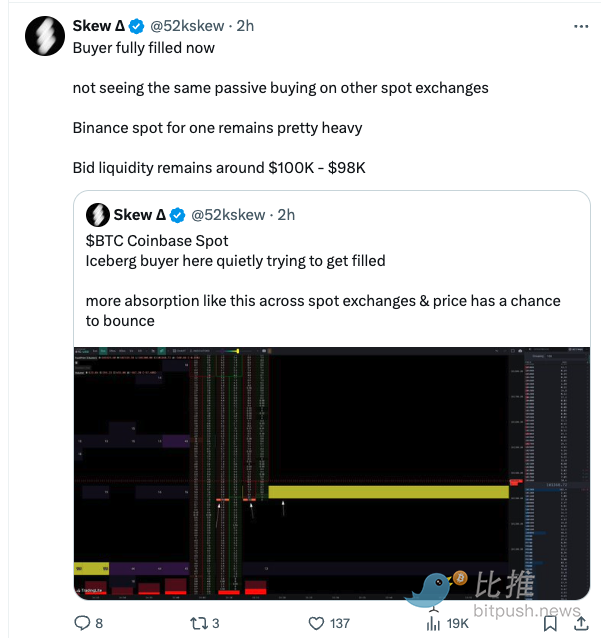
The decline in Bitcoin prices triggered significant shifts in long and short positions. According to charts from crypto analyst Skew, longs were stopped out and shorts took profits as Bitcoin fell into the $100,000–$98,000 range to find support. Skew emphasized that to reverse the downtrend, Bitcoin must reclaim the $100,000–$101,400 zone through spot buying and establish a firm footing on the daily chart.
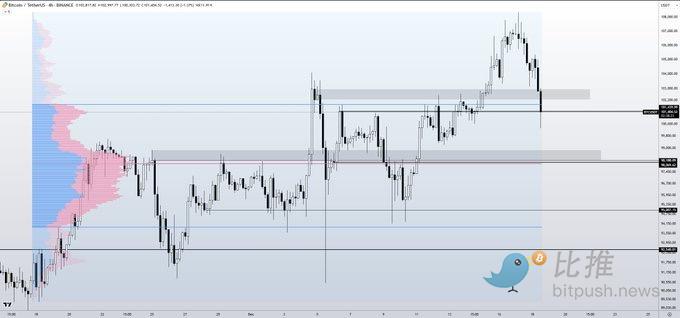
Additionally, the 4-hour chart shows that bulls need to see strong buying emerge near $100,000 and a close above $101,400 to confirm a sustained rally. Failure to hold this level could lead to a retest of the $98,000 support and accumulation zone.
Santiment, a blockchain analytics platform, expressed optimism, posting on X: “Considering BTC has temporarily held above $100,000 and the drawdown isn’t as large as typical volatility would suggest compared to the S&P 500, this could actually be interpreted as a sign of strength once stability returns within the next 24–48 hours.”
Join TechFlow official community to stay tuned
Telegram:https://t.me/TechFlowDaily
X (Twitter):https://x.com/TechFlowPost
X (Twitter) EN:https://x.com/BlockFlow_News
 比推 BitpushNews






