Huobi Growth Academy | Cryptocurrency Market Macro Research Report: Powell's Dovish Stance and Ethereum Reaching New Highs, Macro Logic and Structural Outlook for the Cryptocurrency Market
TechFlow Selected TechFlow Selected
Huobi Growth Academy | Cryptocurrency Market Macro Research Report: Powell's Dovish Stance and Ethereum Reaching New Highs, Macro Logic and Structural Outlook for the Cryptocurrency Market
For investors, it is important to capture the structural opportunities brought by ETH while remaining cautious of volatility risks from short-term overheating, maintaining rationality and patience as macroeconomic and on-chain data are validated.
 Navigating Web3 tides with focused insights
Summary
On August 22, 2025, Federal Reserve Chair Powell delivered a clearly dovish signal at the Jackson Hole symposium, hinting at a likely 25-basis-point rate cut in September. Market expectations for a rate cut surged to 91.1%, driving a broad rebound in risk assets. Major U.S. equity indices closed higher, and the crypto market's total market cap returned to $4.1 trillion. ETH rose 14.33% in a single day, hitting a new all-time high of $4,956, boosting Layer2 and staking sectors.
There was a noticeable on-chain rotation from BTC to ETH, with large whales accumulating ETH and some top-tier funds amplifying leverage through rolling positions. Figures like Arthur Hayes expect that if ETH breaks its historical high, its upside could extend to $10,000–$20,000. However, cautious voices remain within the Fed, and liquidity conditions are volatile—short-term markets may face dual challenges of overheated sentiment and data verification.
1. Macroeconomic Background: The Fed’s Policy Shift
On August 22, 2025, Federal Reserve Chair Powell’s speech at the Jackson Hole Global Central Bank Symposium became the focal event of the week for global markets. His final public appearance during his tenure unexpectedly conveyed a clearly dovish message, opening the door for a potential rate cut in September. This statement not only reshaped market expectations for future monetary policy but also directly ignited rallies in risk assets including cryptocurrencies. To understand the market’s sharp reaction, we must examine the Fed’s policy dilemma, key messages from the speech, and immediate market interpretation at the macro level.
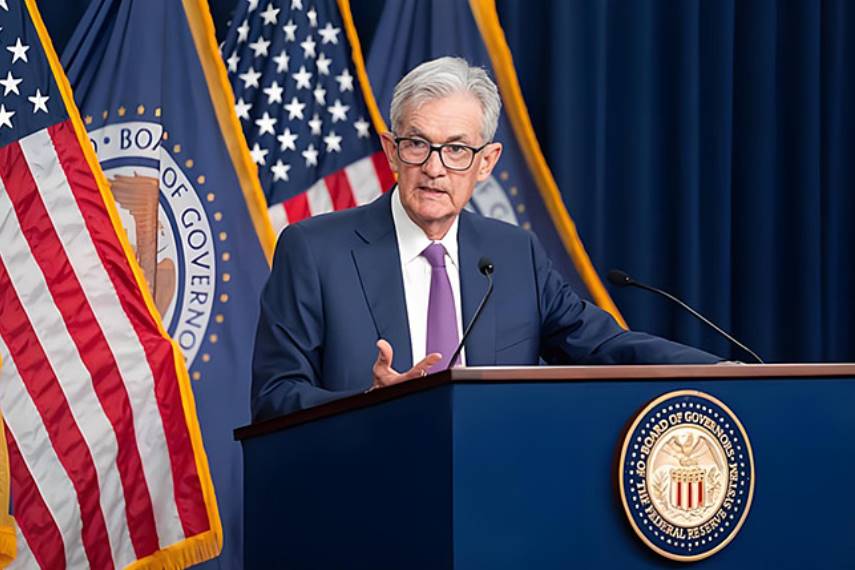
Since the beginning of 2025, the Fed’s policy environment has been stuck in a dilemma. On one hand, President Trump’s high-tariff policies have significantly driven up prices for certain goods, pushing inflation upward again. Maintaining a tight stance would help suppress inflation, but long-term high interest rates risk triggering financial market turmoil or concentrated credit crises. On the other hand, the U.S. labor market has shown clear signs of cooling since early this year, with employment growth slowing markedly. Ignoring downside risks to employment would violate the Fed’s dual mandate of “maximum employment,” potentially causing broader social discontent. This “no-win” policy situation led markets to widely expect Powell to maintain a hawkish tone, prioritizing inflation control. Some even likened him to “Volcker 2.0”—using strong monetary policy to secure long-term price stability and credibility. Yet reality proved more complex: inflationary pressures were more akin to a one-time level jump rather than a persistent spiral, while labor market softening appeared more real and enduring. This risk reassessment ultimately pushed Powell toward an unexpected dovish turn.
The core of Powell’s speech lay in redefining risk balance. For the past two years, the Fed’s communication framework emphasized “upside inflation risks,” treating the labor market as resilient. But at Jackson Hole, he explicitly stated the labor market is in a “peculiar balance”—with both supply and demand slowing, and job growth well below recent-year levels. If this trend continues, it could quickly evolve into widespread layoffs and a rapid rise in unemployment. This marked the first time the Fed placed downward employment risks on par with—or even above—inflation concerns. Second, his assessment of inflation was equally telling. Powell acknowledged tariffs had raised prices for some goods but characterized the effect as largely “one-time,” not a long-term threat. In other words, the Fed does not intend to keep rates high due to short-term price increases but will instead observe how these effects dissipate. More importantly, the Fed officially revised its policy framework at the symposium, removing the phrase “average 2% inflation target” from its 2020 framework and reverting to a “flexible inflation targeting” approach. This shift means the Fed no longer deliberately seeks long-term average compensation but emphasizes dynamic adjustments based on actual economic data. This return to flexibility gives the Fed greater leeway when balancing conflicting inflation and employment goals. Finally, Powell stressed that if employment risks materialize, the Fed might take “preemptive action” to avoid a cliff-like collapse in the labor market—an almost explicit hint at a September rate cut.
Markets reacted swiftly. According to CME FedWatch data, the probability of a 25-basis-point rate cut in September jumped from 75.5% before Powell’s speech to 91.1% afterward. In other words, markets now treat a rate cut as “certain.” Across asset classes, risk assets rallied collectively: major U.S. indices gained over 1.5% on the day, and crypto market cap returned to $4.1 trillion. ETH surged over 14% in a single day, breaking its previous high of $4,887, becoming the biggest beneficiary of rate cut expectations. The logic is clear: once rate cuts begin, improved liquidity leads investors to rebalance portfolios toward high-growth, high-beta assets. As the core asset of next-generation financial infrastructure, ETH is naturally positioned to absorb this new liquidity. That said, market euphoria warrants caution. While stronger rate cut expectations do provide upside momentum, dissenting voices remain within the Fed, with some officials warning not to overlook inflation risks. If upcoming August CPI and nonfarm payroll data come in strong, market expectations for rate cuts could still be revised. Overall, the message from the speech is clear: the Fed is shifting gradually from hawkish “inflation-first” to dovish “employment-first” policy. This change in risk balance opens a new growth window for risk assets—especially the crypto market.
Powell’s dovish remarks at Jackson Hole not only altered expectations in U.S. rate markets but triggered ripple effects across global assets. First, U.S. equities rose sharply, with all three major indices gaining between 1.5% and 1.9%, led by tech and growth sectors. Crypto-related stocks stood out, with SharpLink up 15.7%, Bitmine up 12.1%, and Coinbase up 6.5%, as capital repriced future liquidity benefits from rate cuts. Second, the dollar and rate markets adjusted in tandem. The dollar index declined notably post-speech, signaling rising risk appetite; federal funds futures rapidly priced in a high likelihood of a 25-basis-point September cut, pushing the entire yield curve lower. Falling long-term Treasury yields further reinforced bets on looser conditions. Finally, the crypto sector benefited immediately, with total market cap rebounding to $4.1 trillion. ETH led the charge, breaking new highs and driving broad gains in Layer2 and staking sectors. On-chain flows showed a clear trend of capital shifting from BTC to ETH. Overall, global markets have entered a new phase of “rising risk appetite + liquidity repricing,” with crypto at the forefront.
2. Structural Changes in the Crypto Market
Against the backdrop of Powell’s dovish remarks, the crypto market exhibited structural divergence. Sector performance revealed shifts in capital flows and market logic. Overall, BTC faced capital outflows and structural selling pressure, while ETH emerged as the central force behind new highs, spreading risk appetite across altcoins and lighting up Altseason signals. BTC underperformed this week, remaining weak despite finding support at its 60-day moving average. On the funding side, BTC spot ETFs saw net outflows of $1.165 billion for the week—the main factor suppressing prices. This suggests institutional investors took profits or rotated positions short-term, weakening marginal demand for BTC. More importantly, BTC dominance continued to decline. Over recent months, BTC dominance has trended downward, indicating its role as a “safe-haven anchor” is weakening. With investor risk appetite shifting toward high-beta assets like ETH and altcoins, BTC’s pricing dominance is being challenged. Combining on-chain data and ETF flows, we can conclude BTC currently serves more as a “funding source” than a “destination.” ETH became the undisputed centerpiece of the week. It surged 14.33% in a day, breaking its previous high of $4,887.5, with a weekly gain of 6.88%. This wasn’t just a price breakout—it marked a structural turning point: ETH successfully drove capital rotation, cementing its status as the core asset of the new cycle. On-chain data showed ETH liquidations hit $368 million in the past 24 hours—exceeding BTC—indicating short squeezes were a major driver of the rapid price rise. Such a “short squeeze” often implies genuine capital inflows backing the rally, not just emotional momentum.
ETH’s rally also generated significant “spillover effects.” Related ecosystem sectors broadly rose: Layer2: Arbitrum (ARB) gained 9.5%, reflecting renewed pricing of scaling ecosystems; Staking: SSV surged over 25.5% in a day, signaling accelerating capital inflows into ETH staking and distributed validation; Restaking: ETHFI rose 20.7%, showing fast market adoption of this emerging narrative. These figures indicate ETH isn’t just breaking price records—it’s lifting the valuation of its entire ecosystem, acting as a “liquidity magnet.” As ETH attracted capital and broke new highs, the altcoin market turned broadly active. Capital rotation became evident, with non-ETH assets benefiting from spillover gains. The continued drop in BTC dominance is a key sign of Altseason onset. Historically, when this signal appears, capital tends to spread further into mid- and small-cap tokens over the coming weeks. This ETH-led rally could create a top-down transmission: from ETH → ecosystem sectors → large-cap alts → mid/small-cap tokens, layer by layer releasing risk appetite.
However, Altseason typically brings high volatility and risk. Capital games in alt sectors are more intense, potentially leading to rapid rotations and concentrated liquidations in the short term. While indicators suggest alt markets may enjoy several weeks of prosperity, sustainability depends on whether macro liquidity materializes and whether ETH can hold its高位. Overall, the crypto market is undergoing structural repricing. BTC, as a “source of existing liquidity,” is temporarily under pressure. ETH has become the “core asset of the new cycle,” lifting overall risk appetite and igniting altcoin rallies. If the Fed formally cuts rates in September, ETH could maintain strength and push Altseason further. But if macro data reverses or capital inflows stall, the market may face sharp pullbacks.
Overall, whale activity this week showed three traits: BTC capital outflows, ETH as the new cycle’s core asset; leveraged rolling positions fueling the rally but building potential liquidation risk; top investors concentrating bets on ETH, reinforcing market consensus. This means ETH’s rise isn’t driven solely by retail sentiment but by real capital migration and leverage expansion. However, aggressive whale moves also increase short-term risks. If macro data disappoints or rate cut expectations fail, the market could reverse quickly. In the coming weeks, on-chain capital flows will remain a key indicator for whether ETH can sustain its高位. Continued inflows could extend ETH’s strength; if whales start reducing positions or locking profits, the market should watch for high-level consolidation or deep corrections.
3. Core Logic Analysis of ETH and BTC
Ethereum (ETH) broke its all-time high this week, becoming the brightest star among global risk assets. From macro policy to on-chain ecosystems and capital allocation logic, ETH is undergoing multidimensional value re-rating. Unlike purely emotion-driven rallies, this surge is supported by solid macro and fundamental foundations. ETH’s price performance is highly correlated with macro monetary conditions. Powell’s dovish signal at Jackson Hole rapidly boosted market expectations for a 25-basis-point September rate cut to over 90%. Rate cuts mean lower funding costs and expanded liquidity, with high-growth, high-beta assets typically benefiting first. Compared to BTC’s “store of value” nature, ETH behaves more like a “risk asset,” exhibiting greater sensitivity to marginal liquidity changes. Once rate cuts materialize, global portfolios will likely increase exposure to tech, growth, and digital assets—with ETH as the primary recipient in crypto. Thus, ETH’s new high reflects not just on-chain dynamics but also macro liquidity expectations.
ETH’s ecosystem advantage forms its long-term core logic. Since the 2022 “Merge,” ETH transitioned to PoS, making staking a key value capture mechanism. Network-wide staking rates continue rising, with over one-third of ETH now staked. As staking yields are increasingly seen as “bond-like,” ETH becomes a unique asset combining growth and cash flow. Meanwhile, Layer2 scaling ecosystems are accelerating. Networks like Arbitrum and Optimism see sustained growth in active users and transaction volume, drastically lowering fees and enhancing scalability. This strengthens ETH’s network utility and supports its positioning in global financial infrastructure. Emerging restaking projects are also attracting capital. Initiatives like ETHFI boost capital efficiency by compounding staked ETH assets. Continuous capital inflows not only lift related token prices but also reinforce ETH’s centrality. In essence, ETH’s ecosystem is forming a “staking–restaking–Layer2 expansion” triad of support.
Among market participants, top investors express broad optimism about ETH. Arthur Hayes, co-founder of BitMEX, stated in an interview that once ETH breaks its all-time high, its upside becomes “fully unlocked,” with a target range of $10,000–$20,000. This reflects a growing view of ETH as the protagonist of the new cycle. Short-term, ETH’s rapid rise came with massive short liquidations. In the past 24 hours, ETH liquidations reached $368 million—surpassing BTC. This indicates the breakout wasn’t just driven by buying pressure but also by forced short covering. Such “short squeezes” often amplify short-term gains but can cause greater volatility when sentiment cools. Mid-term, ETH’s ability to extend gains hinges on two factors: whether the Fed actually cuts rates and maintains a loose path, and whether ETH’s ecosystem sustains high growth—especially in staking and Layer2 activity. If both macro and ecosystem tailwinds align, ETH’s valuation could undergo repricing, making a $10,000+ price less far-fetched. Long-term, ETH is transitioning from a “speculative asset” to “new financial infrastructure.” Whether in DeFi, restaking protocols, or blockchain-native apps, ETH remains the foundational settlement and collateral layer. As institutional adoption grows, ETH could become indispensable in global investment portfolios.
Despite ETH’s strong narrative, potential risks remain: Macro uncertainty: if August CPI or nonfarm payrolls exceed expectations, rate cut hopes may fade, stalling ETH’s momentum; Leverage risk: whale rolling positions and high-leverage trades increase market fragility—any price reversal could trigger cascading liquidations; Regulatory risk: developments in the U.S. and other major economies could significantly impact capital inflow timing. ETH’s bullish case can be summarized as: “macro liquidity inflection + ongoing ecosystem expansion + active capital rotation.” Amid strengthening rate cut expectations, ETH’s breakout is not just emotional but structural. Over the coming months, ETH is poised to remain the “cycle leader,” with its performance setting the tone for crypto market risk appetite.
In this rally, Bitcoin (BTC) and Ethereum (ETH) diverged sharply. ETH hit new highs and attracted massive inflows, while BTC languished, falling 3.41% this week to close at $113,478. As crypto’s original “blue chip,” BTC’s relative weakness has drawn attention: why didn’t BTC benefit equally from rate cut expectations? Where do its future challenges and opportunities lie? BTC has long been seen as “digital gold,” with its thesis rooted in “inflation hedging” and “value storage.” But in the current macro climate, this logic is weakening: Different inflation drivers: current U.S. inflation stems more from tariffs and structural factors, not broad-based demand overheating. This reduces demand for “safe-haven” assets and boosts preference for “growth” assets. ETH, as a high-beta growth asset, is more attractive, while BTC’s role as an “inflation anchor” is marginalized. Divergent rate cut transmission: when rate cut expectations rise, capital favors assets with cash flow or ecosystem expansion potential. ETH, with PoS staking yields and a thriving ecosystem, becomes the preferred choice, while BTC lacks comparable cash flow, making it less sensitive to looser liquidity. Thus, in a “rising risk appetite” phase, BTC’s macro attributes become a drag.
BTC faces another challenge from spot ETF flows. This week, BTC spot ETFs saw net outflows of $1.165 billion—the direct cause of price pressure. This outflow reflects institutional behavior: when BTC prices stay high for long periods, investors tend to lock in profits or rotate into more elastic assets like ETH. Data shows BTC ETF inflows early this year drove price spikes, but with the rise of ETH narratives, a clear “rotation from BTC to ETH” has emerged. This shift in institutional sentiment is a key pressure on BTC. On-chain data reveals long-term holders (LTH) are releasing some holdings. Rising on-chain profitability has prompted early investors to cash out at highs, increasing selling pressure. Meanwhile, BTC’s market share (dominance) keeps falling—from nearly 50% at year-start to below 45%. This trend shows BTC’s “dominance” is eroding. ETH’s ecosystem growth and capital attraction are reducing BTC’s relative weight in portfolios. If this continues, BTC may shift from “market core” to “strategic base layer,” losing its market-driving edge. Technically, BTC is in a downtrend channel, finding limited support at its 60-day MA but facing heavy resistance above. Declining volume and shrinking volatility suggest BTC is in a “low-activity” phase. In contrast, ETH and altcoins’ high volatility and turnover attract more short-term capital. From a cycle perspective, BTC usually leads macro liquidity cycles, yet lags behind ETH this time—a shift closely tied to changing investor preferences. Traders now favor short-term gains, and BTC’s slow pace and low elasticity reduce its trading appeal.
Despite outflows and fading attention, BTC’s long-term thesis isn’t dead: Institutional cornerstone: BTC remains the most widely accepted crypto asset, with ETFs providing a stable base of long-term capital. Safe-haven floor: if macro shocks occur, BTC’s “digital gold” status could still draw capital. Cyclical rebound potential: if ETH sees a pullback, capital may rotate back into BTC, creating relative recovery. However, BTC’s future leans more “defensive” than “offensive.” It may hold steady during downturns but will likely trail ETH and alts during liquidity expansions and rising risk appetite. BTC’s current challenges center on three fronts: Weakened macro logic: under rate cut expectations, its “digital gold” story lacks elasticity; Severe capital outflows: ETF outflows and whale rotation weaken buying pressure; Shrinking dominance: ETH and altcoin growth erode BTC’s lead. Going forward, BTC’s path may be one of “defensive consolidation.” It remains a foundational asset for institutions but is unlikely to drive the next leg of the rally. In the new liquidity cycle, BTC is more likely to serve as a “value anchor” than a “growth engine.”
4. Macro Risks and Uncertainties
With ETH breaking new highs and risk appetite broadly recovering, investor optimism has surged. Yet macro and on-chain data show this rally isn’t bulletproof—potential risks and uncertainties remain. Whether due to policy shifts or capital structure, the market could face sharp reversals. This section analyzes risks from four angles: macro policy, data verification, market structure, and regulation. Despite Powell’s clear dovish signal at Jackson Hole, markets nearly treat a September rate cut as “guaranteed,” but internal Fed divisions persist. Some officials stress inflation risks remain elevated, and premature easing could destabilize inflation expectations. For example, Fed Governor Musalem emphasized that rate decisions shouldn’t hinge on a single meeting but on the “overall rate path.” This means if incoming data fails to justify easing, the Fed could delay or scale back cuts. Markets have priced in too much optimism around liquidity expansion—any disappointment could trigger sharp near-term pullbacks in ETH and crypto broadly.
The August CPI and nonfarm payroll reports will be pivotal in determining whether the Fed cuts rates. Weak data would reinforce employment risks and support a rate cut cycle. But if inflation rebounds or jobs data surprises to the upside, markets will revise rate cut expectations, potentially compressing valuations for risk assets. This “data dependence” heightens near-term uncertainty. Investors should beware: volatility will spike around data releases, and highly leveraged positions will be most vulnerable. On-chain data shows ETH’s recent rally involved $368 million in liquidations—more than BTC. Many shorts were squeezed out during the breakout, fueling rapid price gains. But accompanying the rise is accelerated inflow of leveraged capital. Whale rolling, 25x longs, and FOMO chasing have significantly raised market leverage. If the trend reverses, these leveraged positions could trigger cascading liquidations and short-term liquidity crunches. Extreme sentiment amplifies volatility and increases systemic vulnerability.
Crypto’s long-term development remains constrained by global regulatory environments. While President Trump has shown openness to crypto in some areas, uncertainty around his tariff and financial regulatory policies could still pose external risks. Stricter scrutiny of crypto platforms, stablecoins, or staking operations could disrupt capital inflow rhythms.
Moreover, policy stances in other major economies matter. Europe is advancing MiCA, while Asian nations cautiously monitor capital flows. Should major economies tighten policies, cross-border crypto capital flows could be restrained. In sum, while the current rally is driven by rate cut hopes and on-chain capital, risks remain high: Internal Fed splits could slow the expected pace of rate cuts; Macro data verification is a key variable for sustaining the rally; Accumulated leveraged capital increases volatility risks; Global regulatory uncertainty could hinder long-term capital inflows. Therefore, despite ETH’s favorable macro and ecosystem conditions, market participants must stay rational and avoid blind chasing. Until rate cuts are confirmed and data validated, the rally’s sustainability requires cautious monitoring.
5. Conclusion
In the fourth week of August 2025, Powell’s Jackson Hole speech became the catalyst for global risk asset movements. The dovish signal pushed market expectations for a September rate cut above 90%, sparking synchronized rallies in U.S. equities and crypto. ETH seized the moment to break its all-time high, surging over 14% in a day, reshaping market structure and establishing itself as the core asset of the new cycle. Overall, this week’s rally reflected three core themes: First, macro liquidity repricing. Powell’s remarks signaled a Fed pivot from “inflation-first” to “employment-first” policy. This shift implies a materially improved liquidity environment over the coming months, offering medium-term support for risk assets. ETH’s sensitivity to marginal liquidity changes far exceeds BTC’s, making it the preferred destination for capital. Second, market restructuring. BTC faced outflows and ETF-driven selling pressure, declining in price with dominance continuing to fall. ETH not only broke its price ceiling but lifted Layer2, staking, and restaking sectors, creating “ecosystem resonance.” The capital rotation is clear: BTC is evolving from a “destination” into a “funding source,” while ETH is becoming the new “liquidity magnet.” Third, on-chain capital and sentiment alignment. Whale rotation, leveraged rolling, and prominent investors doubling down on ETH reflect top-tier confidence in its long-term prospects. Yet this capital-driven momentum also amplifies volatility. High leverage and FOMO sentiment make the rally powerful—but also expose significant underlying risks.
Looking ahead, ETH’s breakout has opened new market expectations. If the Fed cuts rates as expected in September, ETH could maintain strength, possibly advancing toward a $10,000–$20,000 range. However, the rally’s sustainability hinges on data confirmation and continued capital inflows. On the risk side, investors should watch three things: first, if August CPI or nonfarm payrolls exceed forecasts, the rate cut thesis could unravel; second, excessive on-chain leverage raises the risk of chain-reaction liquidations; third, global regulatory uncertainty could suppress capital flows. Overall, this week’s core narrative can be summarized as: “macro shift + capital rotation + ETH’s emergence as cycle leader.” ETH has become the most elastic core asset in the new cycle, and its performance will set the tone for crypto market risk appetite in the months ahead. For investors, the task is twofold: seize structural opportunities from ETH’s rise while guarding against short-term overheating and volatility—maintaining rationality and patience as macro and on-chain data unfold.
Join TechFlow official community to stay tuned
Telegram:https://t.me/TechFlowDaily
X (Twitter):https://x.com/TechFlowPost
X (Twitter) EN:https://x.com/BlockFlow_News
 @HTXAcademy