November Blockchain Gaming Report: GameFi's Breakthrough Path Amid Bull Market
TechFlow Selected TechFlow Selected
November Blockchain Gaming Report: GameFi's Breakthrough Path Amid Bull Market
Web3 gaming hits record highs in user numbers and market capitalization amid Bitcoin's all-time high, with social platforms emerging as key drivers of adoption.
 Navigating Web3 tides with focused insights
Author: Stella L
In November 2024, the Web3 gaming industry saw significant market growth, yet strategies for mass adoption remain in evolution. As Bitcoin reached historic highs approaching the $100,000 milestone, the gaming sector's market capitalization surged by 79.1% to $35.1 billion. Despite strong traditional metrics—including 5.5 million daily active users—the industry continues to face challenges regarding blockchain integration and widespread adoption.
Macro Market Overview
Cryptocurrency markets made history in November, with Bitcoin soaring from $69,386 to $96,427—an increase of 39.0%. Ethereum followed closely behind, rising 47.8% from $2,511 to $3,711. Bitcoin’s outstanding performance propelled its market cap past silver and Saudi Aramco, securing seventh place among global assets after nearing the $100,000 mark on November 23.
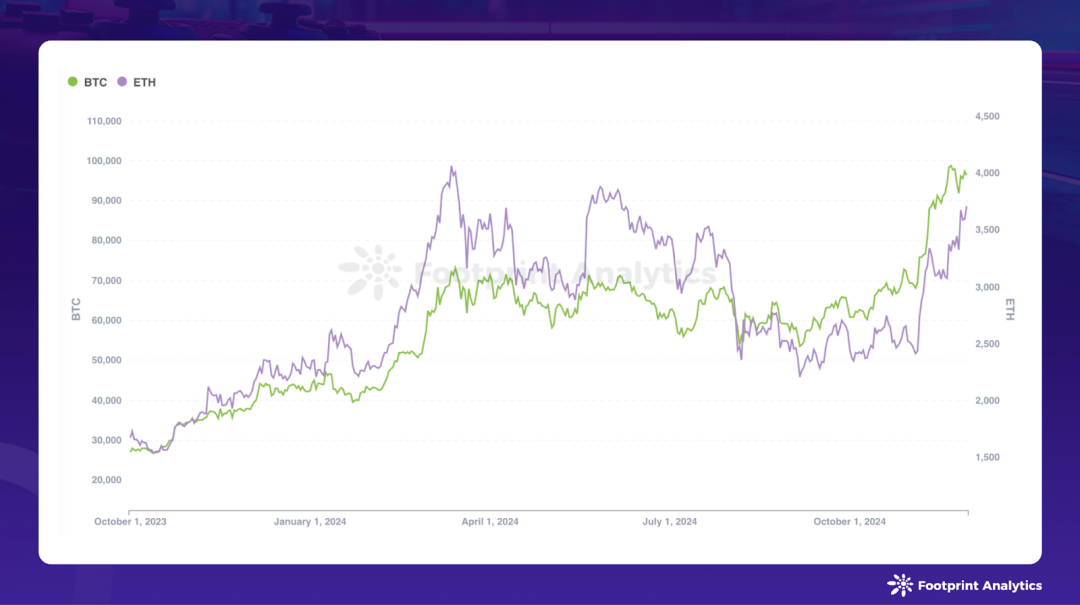
Data source: Bitcoin and Ethereum price trends
The U.S. election outcome acted as a catalyst for crypto market growth, potentially influencing comprehensive cryptocurrency legislation and regulatory oversight. Markets responded positively, particularly reflected in the performance of trending sectors such as memecoins, decentralized artificial intelligence (deAI) projects, and decentralized science (DeSci).
Broad financial markets also performed strongly. The financial sector led equity gains amid expectations of U.S. tax reform and deregulation. However, international markets experienced some volatility—RMB weakened under concerns of potential U.S. tariff increases, while gold prices declined as election-related uncertainties subsided.
Blockchain Gaming Market Overview
In November, blockchain gaming tokens surged alongside the broader crypto bull market, increasing their total market cap from $19.6 billion to $35.1 billion.
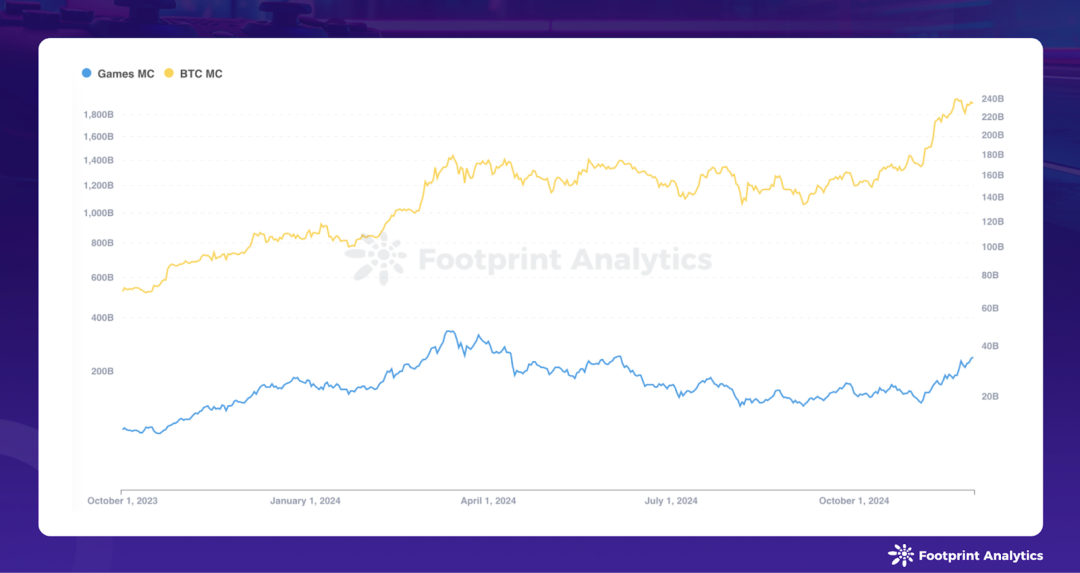
Data source: Blockchain gaming token market cap and Bitcoin market cap
Daily trading volume mirrored this momentum, growing 79.4% to $11.9 million.
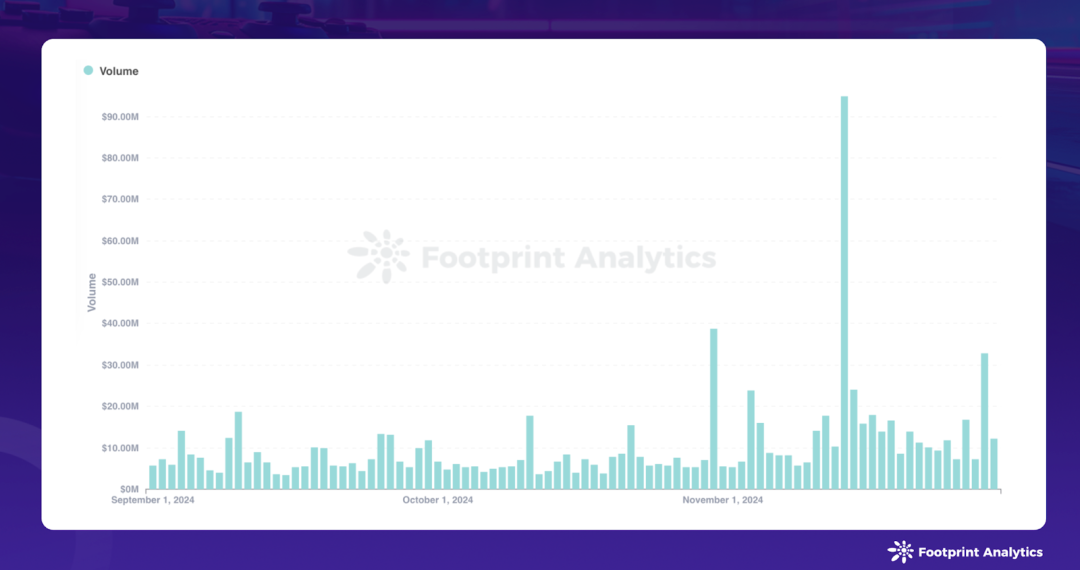
Data source: Daily trading volume of blockchain games
Daily active users hit a new high in November, averaging 5.5 million DAU—a 15.7% increase from October. This growth was primarily driven by sustained user engagement on opBNB and solid performance within the Ronin ecosystem.
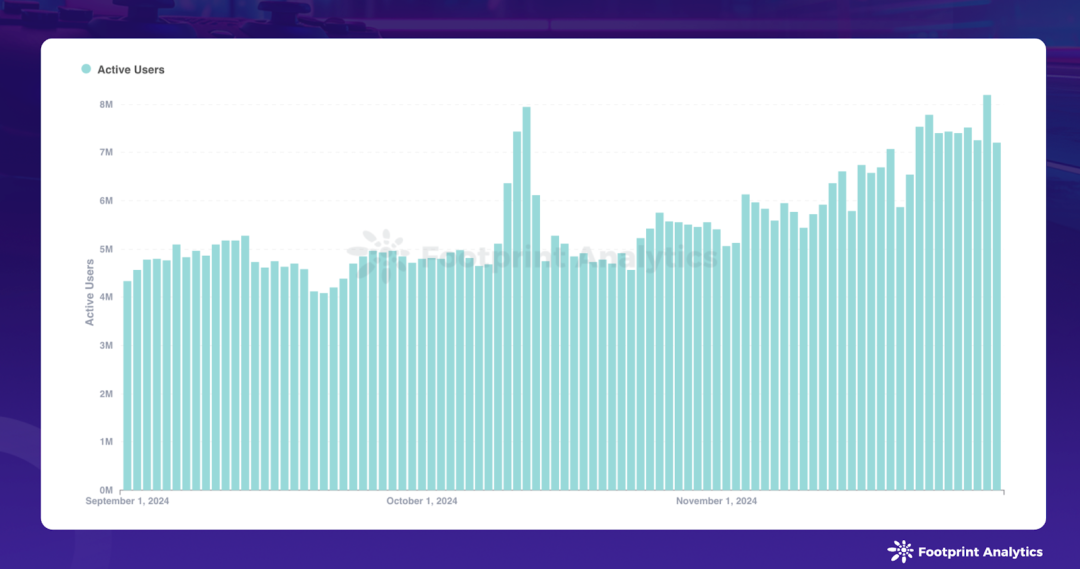
Data source: Daily active users in blockchain gaming
Transaction metrics revealed complexity. While average daily transactions reached 15.3 million (up 3.3% from October), average transactions per user dropped from 3.131 to 2.810. Monthly transaction volume remained stable at 460.4 million, suggesting a declining intensity of blockchain feature usage among new users.
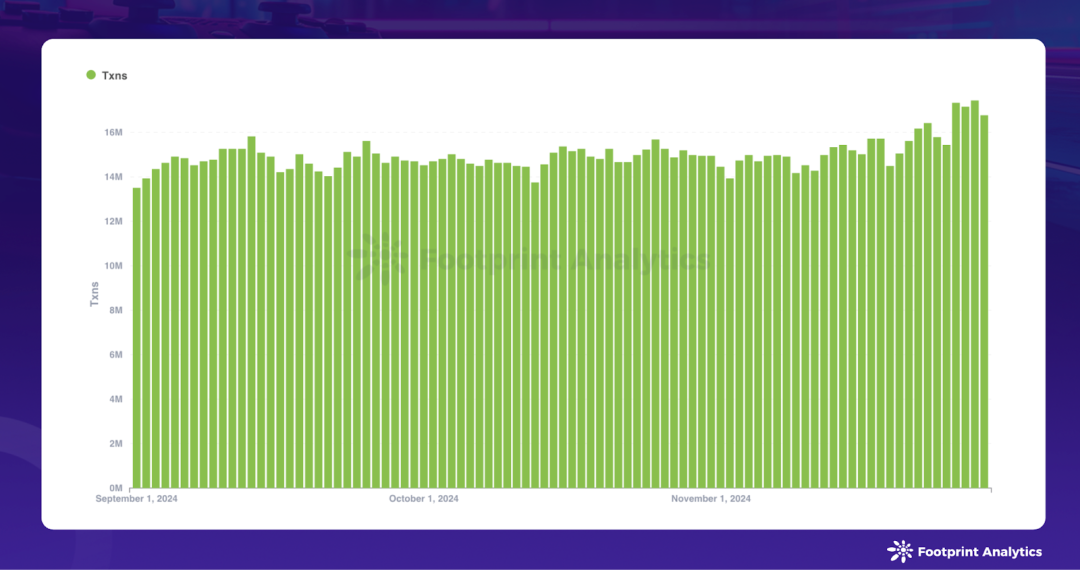
Data source: Daily number of transactions in blockchain gaming
The approach taken by games like Off The Grid may represent a pivotal shift in the industry. By positioning themselves as traditional games with optional blockchain elements rather than "NFT games," they reflect a growing understanding that mass adoption may require more subtle integration of blockchain technology. This strategy of making blockchain features “optional and invisible” helps overcome initial resistance many gamers have toward cryptocurrency, reducing friction—but it also raises fundamental questions about the role of blockchain in gaming.
Technical challenges for fully on-chain gaming remain significant. Existing blockchain infrastructure still struggles to meet the demands of real-time gameplay, competitive matchmaking, and the high throughput required by modern games. Although Layer 2 solutions and dedicated gaming blockchains are emerging, the gap between traditional gaming performance expectations and current blockchain capabilities continues to shape development strategies.
Despite favorable conditions from the ongoing bull run, the Web3 gaming sector has yet to deliver a defining breakthrough moment. The industry appears to be at a crossroads between maintaining appeal to crypto-native users and achieving mass adoption. For game projects to succeed, they must carefully balance these two goals—and ensure technological infrastructure can keep pace with ambitious visions.
Overview of Blockchain Gaming Public Chains
In November, the number of active games across blockchain networks reached 1,696, up 4.6% from October. In terms of distribution, BNB Chain, Polygon, and Ethereum remained market leaders, holding shares of 20.9%, 15.4%, and 13.4%, respectively.
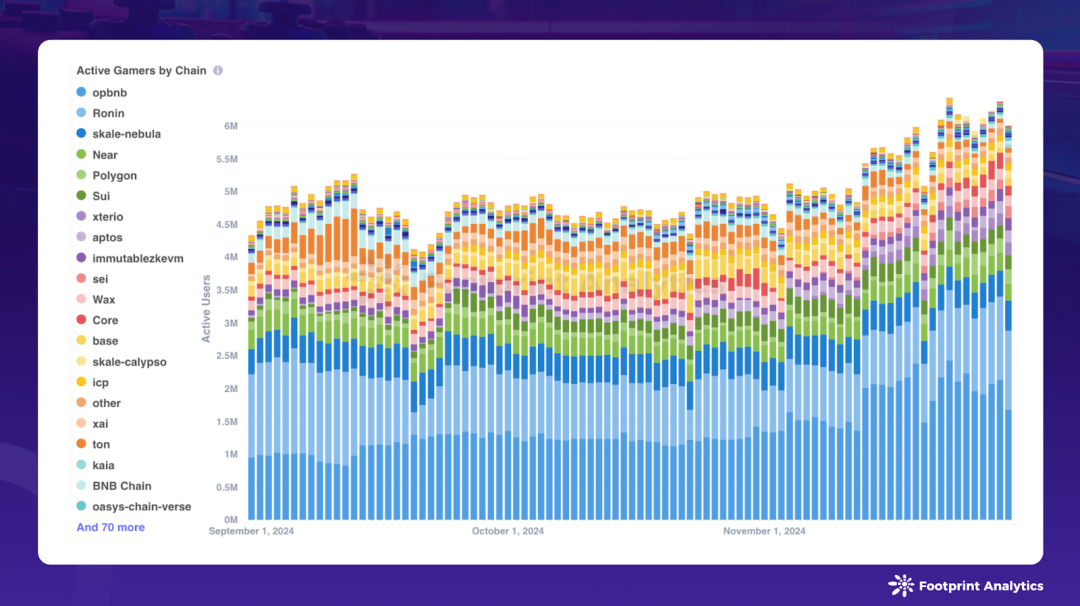
Data source: Daily active game users per public chain
opBNB maintained strong growth, with average DAU increasing 46.1% month-over-month. This was driven by flagship titles SERAPH: In The Darkness and MEET48, along with platform benefits from projects migrating from BNB Chain.
Ronin showed notable recovery, doubling its DAU from 600,000 to 1.2 million in November. This resurgence stemmed from new partnerships bringing multiple game studios onto the platform, the launch of the new title Fableborne, and renewed player growth in existing game Lumiterra.
TON’s gaming ecosystem faced setbacks, with DAU dropping 41.9% to 116,400, highlighting retention challenges for Telegram-based on-chain games. However, exceptions exist. Sui achieved an average DAU of 233,300 in November, up 23.1% month-over-month. The Telegram game BIRDS contributed most of this user base, with an average DAU of 224,900—its weekly new-user retention rate setting a benchmark in the current blockchain gaming landscape.
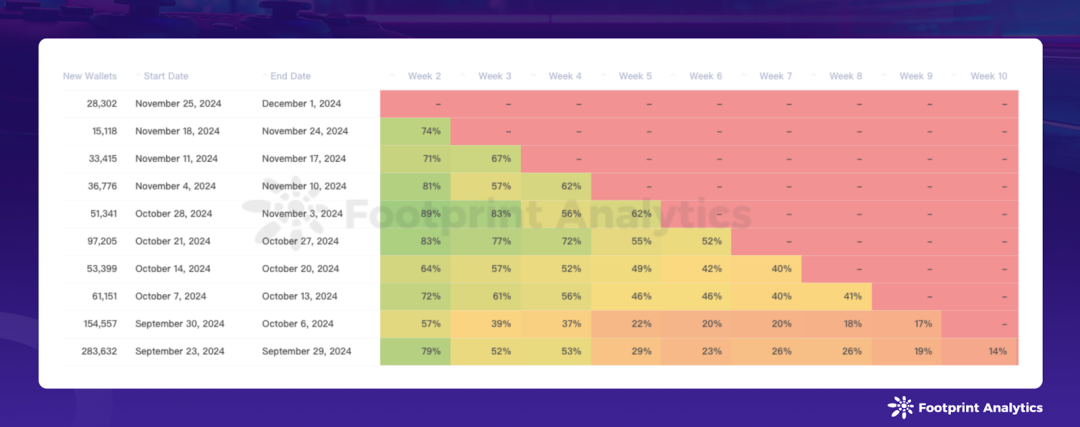
Data source: Weekly user retention rate of BIRDS game
The Web3 gaming industry remains one of both challenges and opportunities. More players are entering blockchain gaming infrastructure development, and new gaming-focused public chains continue to emerge. As one of the largest Web3 gaming guilds, Yield Guild Games (YGG) launched its Studio Chain, building proprietary game infrastructure.
Meanwhile, B3 introduced the Open Gaming Layer, with Prime Chain as its first blockchain. Developed by Echelon Prime Foundation, Prime Chain will provide foundational infrastructure and momentum for the ambitious sci-fi card game Parallel.
Blockchain Game Landscape
By the end of November, there were 3,602 blockchain games in total, with 1,361 maintaining active participation. Among them, 298 attracted over 1,000 monthly active users (MAU), accounting for 21.9% of active games.
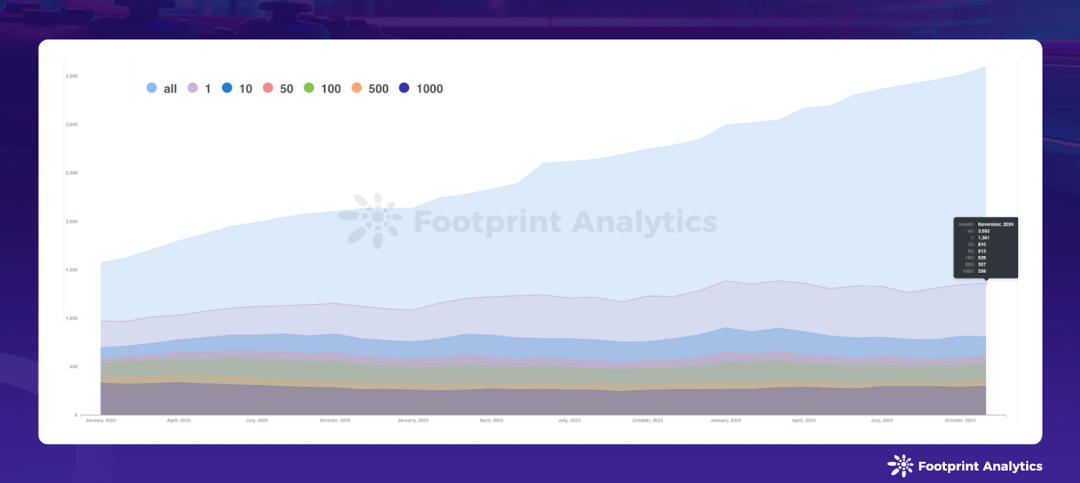
Data source: Number of monthly active blockchain games
Analyzing Telegram gaming metrics reveals a stark gap between platform users and on-chain engagement. As of November 30, Hamster Kombat ranked second among Telegram games by monthly activity with 26.16 million MAU, yet had only 736 on-chain users. Even MemeFi, which achieved the highest conversion rate among the top 10 games, recorded just a 7.96% on-chain participation rate, with 1.36 million TON users.
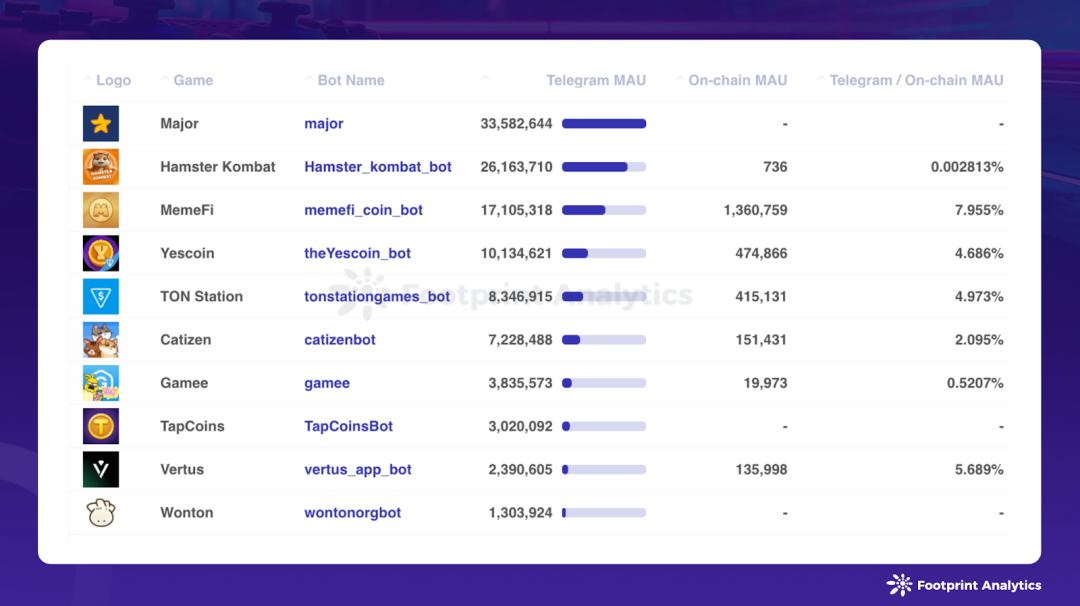
Data source: MAU of popular Telegram games and corresponding on-chain MAU on TON
Despite these conversion hurdles, the success of the Telegram gaming ecosystem is prompting broader emulation across social platforms. Line—the dominant messaging platform in Japan, Taiwan, Thailand, and Indonesia—announced plans to launch 30 mini dApps by the end of January, expanding to 150 by the end of Q1 2025. These mini dApps will be built on the Kaia blockchain, with gaming applications forming the largest segment, alongside social and DeFi apps.
At the same time, Solana-based project Sonic X surpassed 1 million KYC-verified users through TikTok integration. The platform’s success stems from its seamless onboarding: users access the game directly via their TikTok accounts, while Solana wallets are automatically created in the background. This achievement highlights TikTok’s potential as an entry point for Web3 gaming.
Blockchain Gaming Investment and Funding
In November, Web3 gaming secured 18 funding rounds totaling $73.6 million. While the number of deals increased by five compared to October, the total amount raised fell by 22.3%. Additionally, eight of these events did not disclose specific funding amounts.
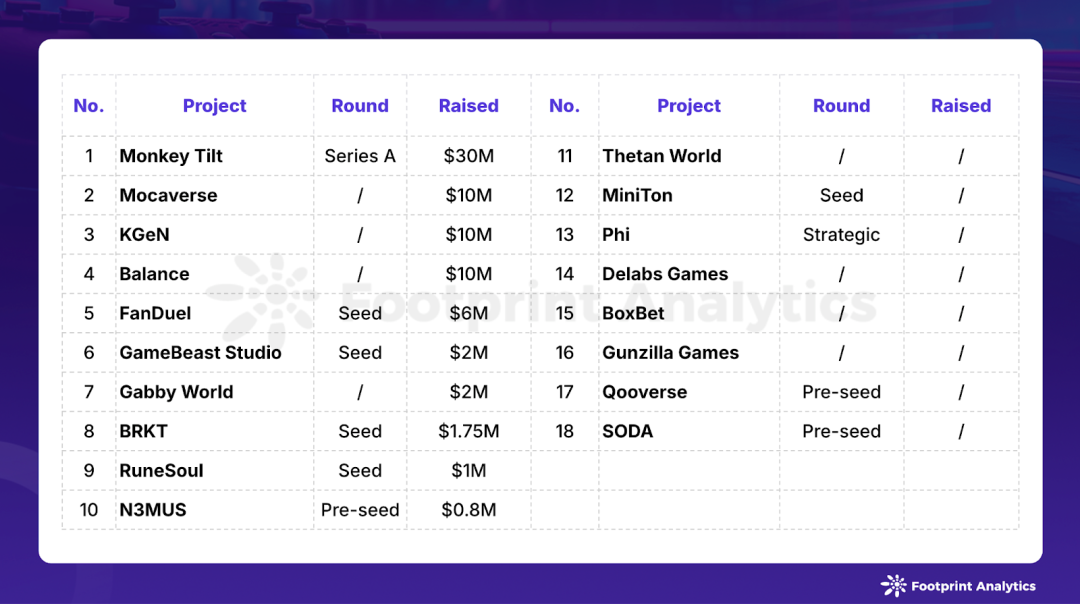
Funding events in blockchain gaming – November 2024 (Source: crypto-fundraising.info)
Monkey Tilt led the month with a $30 million Series A round led by Pantera Capital. Combining gaming, entertainment, and betting functions, the platform has achieved $200 million in monthly wagers since launching in March. It includes social features like in-game chat and peer tipping, though remains unavailable in major markets including the U.S., UK, and Australia due to regulatory constraints. Despite these challenges, the betting segment continues to attract investment, with FanDuel, BRKT, and BoxBet also securing funding.
Other notable funding news includes Animoca Brands’ additional $10 million investment into Mocaverse, building on its prior $31.88 million commitment. The deal includes warrants to acquire MOCA Coin tokens at a $1 billion fully diluted valuation, supporting Mocaverse’s further development of interoperable infrastructure for mainstream crypto adoption.
Data for this report comes from Footprint Analytics’ Games Research page, a real-time data dashboard offering comprehensive and reliable Web3 gaming statistics. If you find any chains or games missing and would like them included in the dataset, please contact us.
Join TechFlow official community to stay tuned
Telegram:https://t.me/TechFlowDaily
X (Twitter):https://x.com/TechFlowPost
X (Twitter) EN:https://x.com/BlockFlow_News
 Footprint Analytics