Interview with Marc Andreessen: The Dark Side of U.S. Financial Regulation and the Truth About Debanking
TechFlow Selected TechFlow Selected
Interview with Marc Andreessen: The Dark Side of U.S. Financial Regulation and the Truth About Debanking
The essence of de-banking lies in regulators making banks carry out financial repression, thereby avoiding direct government accountability.
 Navigating Web3 tides with focused insights
Author: nic carter
Translation: TechFlow
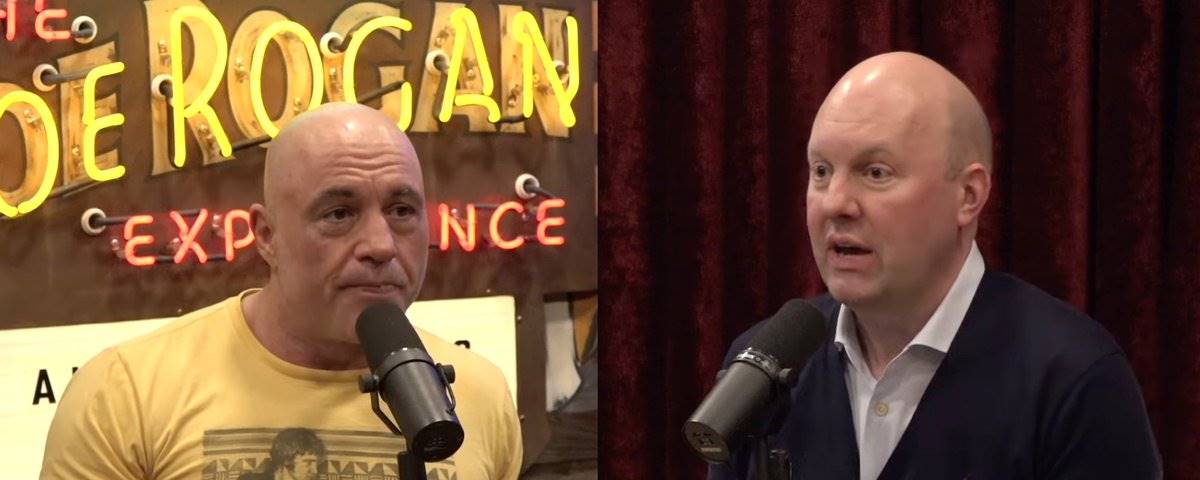
This week, venture capitalist Marc Andreessen appeared on Joe Rogan’s podcast, making controversial remarks about systemic “debanking,” particularly within the crypto industry. He opened by directly naming the Consumer Financial Protection Bureau (CFPB) as the driving force behind debanking experienced by crypto startups—pointing to Elizabeth Warren, who championed its creation. Critics have pushed back, arguing not only that debanking isn’t real, but that the CFPB is actually working to end such practices.
Several distinct issues need clarification here. First, what exactly is Marc Andreessen complaining about—and are his concerns valid? Second, what role does the CFPB play in debanking politically disfavored entities—is it an enabler or a deterrent?
For many on the left, there may be limited understanding of the crypto industry and right-wing concerns about debanking. Thus, following Marc’s comments and Elon’s endorsement on X, confusion and disbelief have been widespread. I believe one must first read the full conversation between Marc and Joe, as many react based only on snippets. The dialogue contains numerous independent claims and nuanced points. See the appendix for the full transcript. Let’s examine this in detail.
What Are Marc Andreessen’s Main Points?
During the interview, Marc made several interrelated arguments. He began by criticizing the CFPB as an almost unsupervised "independent" federal agency capable of “intimidating financial institutions, blocking new competition—especially emerging startups challenging big banks.”
He then described debanking as a specific harm, defining it as “when individuals or companies are completely kicked out of the banking system.” Marc noted this typically occurs via banks acting as proxies (similar to how governments indirectly censor through Big Tech), allowing the government to remain at arm’s length and avoid direct accountability.
Marc argued that “over the past four years, nearly every crypto entrepreneur has been affected by this. The same applies to many fintech entrepreneurs, or anyone trying to launch a new kind of bank service, because the government wants to protect incumbent large banks.” He also referenced politically disfavored businesses under Obama, such as legal cannabis operations, escort services, gun shops, and manufacturers. The Department of Justice (DoJ) referred to these efforts as “Operation Choke Point.” Later, the crypto industry dubbed similar tactics “Operation Choke Point 2.0.” Marc stated these actions primarily target political enemies and technology startups the government opposes. “Over the past four years, we’ve seen around 30 founders impacted by debanking.”
Furthermore, Marc mentioned knowing people who were debanked due to “holding unacceptable political views or making improper statements.”
In summary, Marc Andreessen made the following key points:
-
Debanking refers to individuals or businesses being cut off from banking services—often because their industry is politically unpopular or they hold dissenting political views.
-
The Consumer Financial Protection Bureau (CFPB) bears at least partial responsibility, alongside other unnamed federal agencies.
-
The mechanism involves regulators outsourcing financial suppression to banks, enabling the government to avoid direct responsibility.
-
Under the Obama administration, primary victims included legally operating but politically unpopular industries like cannabis, adult entertainment, and firearms retailers/manufacturers.
-
Under the Biden administration, crypto firms and entrepreneurs, along with fintechs, became primary targets. Occasionally, conservatives have also faced debanking due to their political stances.
-
Marc added that he knows of 30 tech startup founders in a16z’s portfolio who have experienced debanking.
We will evaluate these claims in detail toward the end of this article.
How Do Critics View Marc Andreessen’s Claims?
Briefly put, liberal leftists are frustrated by Marc’s narrative. They argue he co-opts the idea of “debanking” to support crypto and fintech interests while ignoring more deserving victims—such as Palestinians whose Gaza donations were blocked by GoFundMe. The mainstream left tends to be even more blunt, often supporting debanking of political opponents and thus avoiding discussion altogether.
However, some on the left maintain ideological consistency, questioning corporate and governmental power over speech and finance. (This group may be growing, especially as the right regains control of certain tech platforms and reasserts state authority.) These voices have spoken out against debanking for some time. They recognize that although current victims are mostly right-wing dissidents (e.g., Kanye, Alex Jones, Nick Fuentes), the same mechanisms could easily turn against the left if circumstances shift. Their definition of debanking is narrower: “Debanking, or what some institutions call ‘derisking,’ refers to banks severing relationships with clients deemed politically incorrect, extreme, dangerous, or otherwise noncompliant.” (Quoted from an article in TFP). Rupa Subramanya discusses how banks can destroy someone’s financial life by deeming them high reputational risk. In fact, people across the political spectrum have been affected—including Melania Trump, Mike Lindell, Donald Trump himself, Christian charities, January 6 participants, and Muslim crowdfunding organizations.
Nonetheless, many on the left remain critical of Marc’s views, especially regarding the CFPB. Here are some examples:
-
Lee Fang: The CFPB has consistently opposed debanking—why does Andreessen claim otherwise? What evidence does he have? He fails to mention that CFPB investigated startups backed by Andreessen due to suspected consumer fraud, not political speech. The real drivers of debanking are the FBI and DHS—not the CFPB.
-
Lee Fang: Debanking is indeed a serious issue—for example, truckers opposing pandemic mandates lost bank accounts, and pro-Palestinian groups were banned from Venmo. But now predatory lenders and scammers are conflating consumer protection with “debanking” to push for deregulation.
-
Jarod Facundo: I don’t understand @pmarca at all. Just months ago, CFPB Director Chopra warned Wall Street against arbitrarily debanking conservatives at a Federalist Society event.
-
Jon Schweppe: I agree with @dorajfacundo. I have no idea what @pmarca is referring to. The CFPB has led efforts against discriminatory debanking. What’s going on here?
-
Ryan Grim: The CFPB recently issued a strong new rule specifically targeting banks that debank users based on political views. Yes, a left-populist CFPB director is defending conservative rights. Now, VCs and Musk—who dislike the CFPB—are spreading misinformation to incite public backlash and weaken the agency.
Overall, these critics are unsympathetic toward cryptocurrency and fintech industries. They argue these firms aren't genuine victims of debanking—especially compared to crowdfunding platforms sending aid to Gaza. To them, crypto companies “got what they deserved.” They believe crypto founders engaged in rampant token issuance, scams, and fraud—so banks cutting them off is justified. “If crypto founders are debanked, it's just a matter of banking regulation—not our concern.”
Moreover, critics say Marc’s mistake lies in blaming the CFPB. They emphasize that the CFPB actively fights discriminatory debanking. Marc dislikes the CFPB simply because his fintech investments face strict oversight aimed at protecting consumers.
Since Marc’s appearance on Rogan, many tech and crypto founders have come forward sharing experiences of unilateral loss of banking services. Some in crypto believe unconstitutional attacks on the sector are nearing an end—they see light ahead. Calls for investigations into “Operation Choke Point 2.0” have reached a peak. So who is right—Andreessen or his critics? Is the CFPB truly to blame? And is debanking as severe as Marc claims? Let’s begin by examining the CFPB’s role.
What Is the CFPB?
The Consumer Financial Protection Bureau (CFPB) is an “independent” agency established in 2011 under the Dodd-Frank Act after the financial crisis. Its mandate is broad, covering supervision of banks, credit card companies, fintechs, payday lenders, debt collectors, and student loan providers. As an independent body, the CFPB receives funding outside congressional appropriations (shielding it from budgetary scrutiny), its director cannot be easily removed by the president, and it can create rules and file enforcement actions independently. In short, the CFPB wields significant power. It was largely driven into existence by Senator Elizabeth Warren.
The CFPB has long been a target of conservatives and libertarians due to its status as a powerful new federal agency with minimal oversight. Founded by Elizabeth Warren—a frequent target of right-wing criticism—it aims to regulate fintechs and banks. Yet most of these entities were already heavily regulated. Banks are supervised by state or federal bodies (OCC), report to the FDIC, Fed, and SEC (if public). Credit unions, mortgage lenders, etc., each have dedicated regulators. Before the CFPB, U.S. financial regulation wasn’t lacking. In fact, America has more financial regulators than any other country. So skepticism among the right about Warren’s motives isn’t unfounded.
Regarding the CFPB’s mandate:
The CFPB’s authority includes explicit prohibitions against banking discrimination. These include the Equal Credit Opportunity Act (ECOA) and the “Unfair, Deceptive, or Abusive Acts or Practices” (UDAAP) provision of Dodd-Frank. Under ECOA, creditors may not discriminate based on race, color, religion, national origin, sex, marital status, age, or receipt of public assistance.
However, Marc Andreessen’s concerns about “Operation Choke Point” fall outside these protections. “Crypto entrepreneurs” or “conservatives” are not legally protected classes. Therefore, even in theory, this part of the CFPB’s mandate cannot address politically motivated crackdowns on entire sectors. Additionally, ECOA applies mainly to credit transactions—not general access to banking services.
The UDAAP clause offers another potential avenue. It gives the CFPB broad authority to act against unfair, deceptive, or abusive practices—for instance, its major settlement with Wells Fargo relied on UDAAP. Theoretically, the CFPB could use UDAAP to address debanking. But beyond statements, no concrete action has been taken.
The CFPB’s Official Stance
In June, CFPB Director Rohit Chopra delivered a speech at the Federalist Society explicitly opposing payment platforms banning users for political reasons. He expressed concern about large tech payment providers like PayPal and Venmo shutting down accounts irresponsibly—especially without appeal processes. He highlighted cases where users were excluded due to politically unpopular speech elsewhere. That Chopra can openly discuss these issues is encouraging.
But two problems remain.
First, Chopra focuses on irresponsible behavior by private corporations, especially those with quasi-monopolistic traits. He hasn’t addressed the risk of government power—i.e., regulators coercing banks into redlining entire industries. This is precisely Marc Andreessen’s central critique.
Second, despite Chopra’s commendable rhetoric, the CFPB’s actual actions remain limited. Current trends suggest it may regulate large non-bank payment networks. However, “Operation Choke Point 2.0” stems more from federal financial regulators pressuring banks—outside the CFPB’s jurisdiction. Oversight of banks falls to the Fed, FDIC, OCC, and relevant executive departments (or Congress during investigations). The CFPB lacks authority over other regulators, limiting its ability to counter “Choke Point”-style actions. (That said, Chopra serves on the FDIC board, so he likely has awareness—and some responsibility—for FDIC misconduct.)
Notably, in an August court filing, the CFPB stated that Christians being debanked constitutes discrimination and affirmed its statutory authority to intervene. Lee Fang viewed this as a positive (and surprising) development, given the CFPB’s lack of prior sympathy toward conservatives. As previously noted, religious affiliation is a legally protected class, so intervening in financial exclusion of religious groups faces little legal controversy. Yet we’ve yet to see the CFPB extend similar action to unprotected categories—such as ordinary conservatives or entire industries like crypto—which we’ll explore next. Still, this move is a step in the right direction.
CFPB Actions
Recently, the CFPB finalized a new rule bringing digital wallets and payment apps under its oversight, treating them as bank-like entities. Under this rule, major platforms like Cash App, PayPal, Apple Pay, and Google Wallet must provide transparent explanations when closing accounts. In announcing the rule, the CFPB explicitly cited “debanking.” However, note: this rule targets “Big Tech” or peer-to-peer apps—not traditional banks. No enforcement actions have followed, so real-world impact remains unproven.
Can this rule curb “Operation Choke Point 2.0”? Almost certainly not. First, it applies only to tech firms—not banks. Second, “Choke Point”-style pressure doesn’t originate from banks’ autonomous decisions, but from systemic federal regulatory coercion. If the CFPB wanted to stop coordinated debanking of crypto startups, it would have to confront the FDIC, Fed, OCC, or even the White House directly. Given Elizabeth Warren’s strong anti-crypto stance, one must question whether the CFPB would ever take such action. More importantly, the core problem with “Choke Point” is that banking regulators exceed legal boundaries to debank entire industries—not individual banks acting independently (banks merely comply with regulator directives).
Theoretically, under UDAAP, the CFPB could investigate systemic account closures affecting an entire industry (e.g., crypto). However, the recent payment app rule—cited by critics to prove the CFPB opposes debanking—does not apply to banks. Moreover, in practice, the CFPB has yet to take meaningful enforcement action on debanking.
Major CFPB Enforcement Cases
I found no CFPB settlements directly related to debanking. Below are its top 30 settlements by amount:
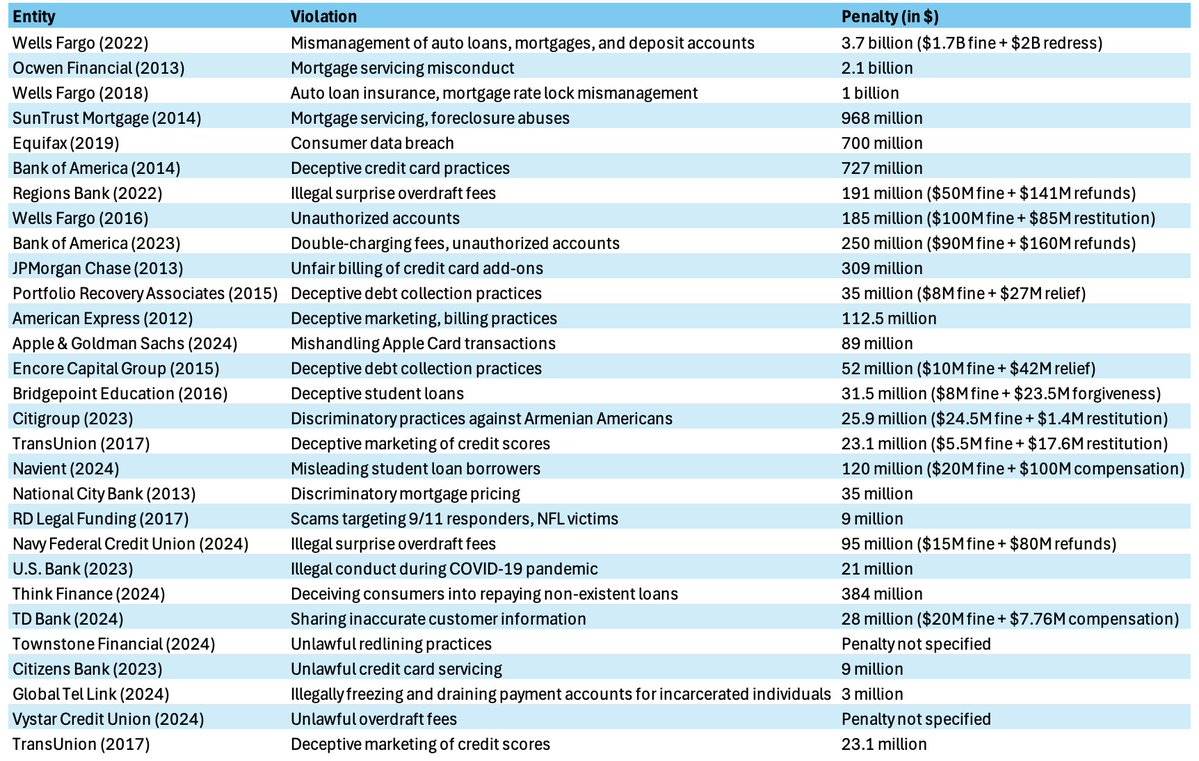
The closest case was Citigroup in 2023, penalized $25.9 million for discriminating against Armenian-Americans in credit card approvals. Citigroup claimed higher fraud rates in California’s Armenian communities caused the policy.
Another was Townestone Financial in 2020, fined $105,000 for discouraging Black Americans from applying for mortgages.
Note: National origin and race are legally protected classes—so these cases differ fundamentally from allegations of purely political “redlining.” This contrasts sharply with critics’ claims about crypto debanking.
I also reviewed the CFPB’s last 50 settlements since March 2016—none involved arbitrary denial of banking services. Among them: 15 involved UDAAP violations (including the famous Wells Fargo case), 8 fair lending breaches, 5 student loan servicing failures, 5 inaccurate credit reporting, 5 mortgage servicing lapses, 4 auto loan discrimination cases, and 3 illegal overdraft charges. On debanking: nothing.
On Marc’s Claims About Debanking of Crypto/Fintech Companies and Conservatives
Here, the facts are clear. I’ve documented “Operation Choke Point 2.0” extensively. Originating under Obama, it resurfaced under Biden. In 2013, the Obama DOJ launched Operation Choke Point, an official initiative using banks to target legal but politically disfavored industries—payday lenders, medical marijuana, adult entertainment, firearm makers. Iain Murray detailed this in “Operation Choke Point: What It Is and Why It Matters.”
Under Obama, the FDIC—led by Marty Gruenberg—used implicit threats to persuade banks to “derisk” dozens of companies across over ten industries. This sparked conservative outrage and was exposed by Rep. Luetkemeyer’s House panel. Critics called it unconstitutional, as it bypassed formal rulemaking or legislative process.
In 2014, internal DOJ memos leaked, prompting a critical report from the House Oversight Committee. The FDIC then issued new guidance urging banks to assess risks case-by-case rather than redline entire sectors. In August 2017, the Trump DOJ officially ended the program. In 2020, Trump’s Comptroller of the Currency, Brian Brooks, introduced a “Fair Access” rule to end reputation-based debanking.
But in May 2021, Biden’s acting Comptroller Michael Hsu revoked that rule. Early 2023, post-FTX collapse, I and others in crypto noticed similar “Choke Point” tactics returning—this time targeting crypto founders. In March 2023, I published “Operation Choke Point 2.0 Is Happening—And Crypto Is the Target”, followed in May by a follow-up.
Specifically, I uncovered a secret “15% deposit cap” imposed by the FDIC and other regulators on banks accepting deposits from crypto-related firms—limiting such deposits to no more than 15% of total deposits. Furthermore, I believe Silvergate and Signature banks did not fail organically but were forced to liquidate due to government hostility toward crypto.
Since then, crypto firms continue facing severe challenges accessing banking—despite no public laws or regulations mandating such restrictions. Law firm Cooper and Kirk argues “Operation Choke Point 2.0” violates the Constitution.
Recently, I revisited this and found new evidence suggesting Silvergate was not just failed—but intentionally executed.
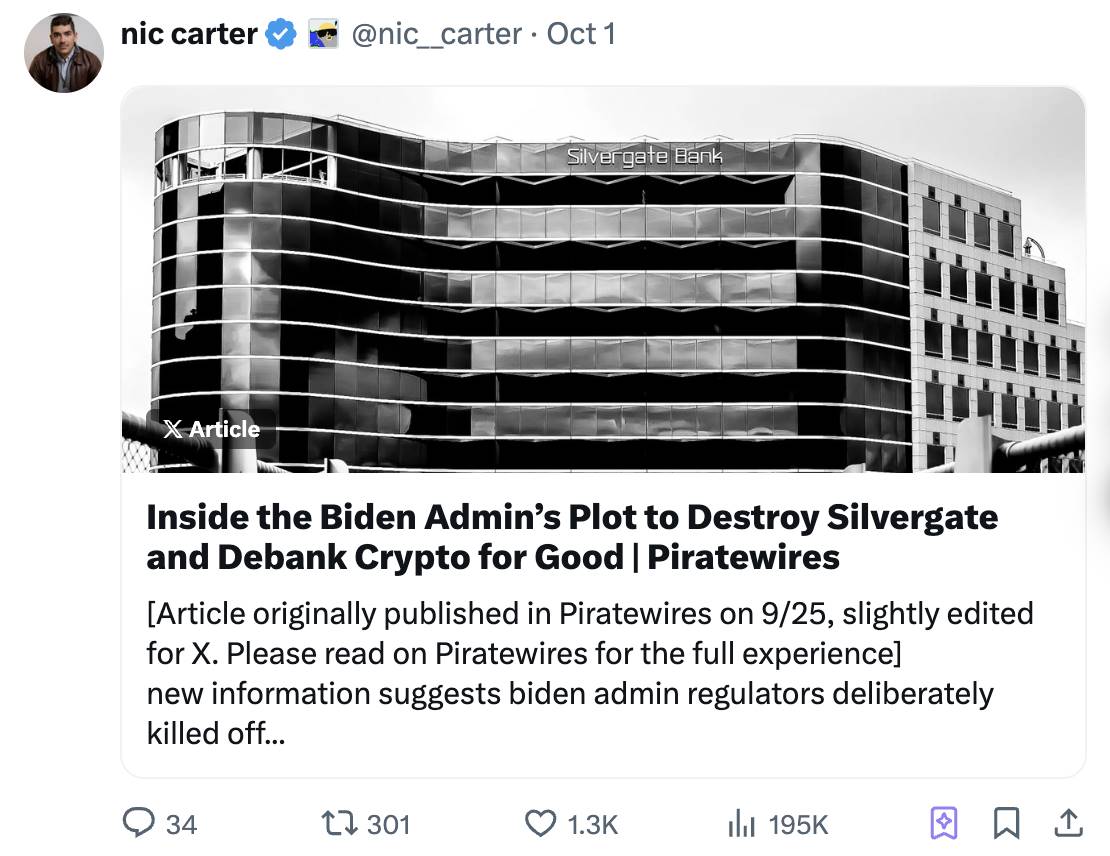
The “15% deposit cap” remains in place, severely constraining industry growth. Nearly every domestic crypto founder has been affected—I can confirm about 80 crypto startups in our portfolio faced such issues. Even my own firm, Castle Island (a VC investing solely in fiat-native businesses), had its bank account abruptly closed.
After Marc’s Rogan appearance, many crypto executives shared similar stories. David Marcus revealed Facebook’s Libra project was killed due to Janet Yellen’s intervention. Kraken CEO Jesse Powell, Joey Krug, Gemini CEO Cameron Winklevoss, Visa’s Terry Angelos, and Coinfund’s Jake Brukhman all reported major obstacles securing banking services. Caitlin Long has long opposed “Choke Point 2.0,” even founding her own bank Custodia—but the Fed denied Custodia a master account, preventing normal operations.
Even critics unsympathetic to crypto must acknowledge: crypto is a fully legal industry being suppressed via secret directives and signals from banking regulators. This suppression occurs not through legislation or open rulemaking, but via administrative backchannels—bypassing democratic processes.
It’s not just crypto—fintechs face similar struggles. According to Klaros Group research, since early 2023, a quarter of FDIC enforcement actions targeted banks partnering with fintechs—compared to just 1.8% against non-fintech partner banks. As a fintech investor, I can attest: finding banking partners has become extremely difficult—rivaling the challenge crypto firms face.
The Wall Street Journal criticized this FDIC campaign, noting the agency “is effectively making rules while circumventing the notice-and-comment requirements of the Administrative Procedure Act.” Such actions harm industries substantively and raise serious legal concerns.
Marc’s claim about conservatives being debanked is well-supported. Melania Trump recently wrote in her memoir about losing her bank account. Right-wing platform Gab.ai faced similar issues. In 2021, General Michael Flynn had his JPMorgan account closed over “reputational risk.” In 2020, Bank of America shut down the Christian nonprofit Timothy Two Project International, and in 2023 froze Pastor Lance Wallnau’s account. In the UK, Nigel Farage was debunked by Coutts/NatWest, sparking a minor scandal. These are just a few examples.
Under current law, U.S. banks may close accounts for any reason without explanation. Substantively, Marc is correct: debanking exists and is widespread.
The Controversy Over the Term “Debanking”
Critics argue Andreessen is weaponizing “debanking” to advance his economic agenda. Some say his interest stems from wanting to reduce regulatory pressure on crypto and fintech. Lee Fang said:
“Debanking is a real issue. We’ve seen truckers opposing vaccine mandates lose accounts, pro-Palestinian groups blocked from Venmo. But now predatory lenders and scammers are conflating consumer protection with ‘debanking’ to demand deregulation.”
Additionally, Axios suggested Andreessen’s focus on the CFPB may relate to his investment in controversial neobanks like Synapse, which collapsed earlier this year. Critics imply Andreessen cares about “debanking” only to benefit crypto and fintech interests while evading CFPB consumer safeguards.
While logical, the reality is more complex. Historically, the Obama administration developed strategies to suppress industries like gun manufacturing and payday lending via banking regulation—widely considered unconstitutional. The Biden administration refined these tactics, effectively deploying them against crypto—using pressure on partner banks to indirectly restrict services. These actions bypassed legislation and open rulemaking, relying instead on administrative backdoor maneuvers.
Now, these tactics are extending to fintech. Klaros Group data shows a quarter of FDIC enforcement actions since early 2023 targeted fintech-partnering banks—vs. 1.8% for others. As a fintech investor, I feel firsthand how this makes securing bank partnerships extremely difficult—on par with crypto’s struggles.
These patterns show administrative overreach harming multiple legitimate industries. Whether crypto or fintech, all require transparent, democratic regulation—not opaque directives and vague enforcement. Future policy shifts may gradually expose and correct these abuses.
Whether commentators like Fang believe Biden’s debanking of crypto firms undermines moral credibility when defending marginalized groups matters less. The point is: it happened. It is debanking. And it is unlawful. Likewise, whether Marc Andreessen criticizes the CFPB for economic gain is irrelevant. (My research shows the CFPB has taken no enforcement action against any company in a16z’s portfolio to date.)
What matters is that financial regulators—not just the CFPB, but multiple agencies—have instrumentalized the financial system for political ends. This exceeds administrative authority and harasses legitimate industries. The fact is: overreach exists.
Evaluating Andreessen’s Claims on Rogan
Based on comprehensive analysis, here’s a point-by-point assessment of Andreessen’s arguments:
-
Debanking means individuals or businesses lose banking access due to operating in politically disfavored industries or holding dissenting political views.
This definition is accurate. Importantly, the severity of debanking should not depend on whether victims align with certain sympathies.
-
The CFPB frequently exerts high-pressure policies on fintechs and banks, and its necessity is questionable.
Yet based on available information, the CFPB is not the main driver of “Operation Choke Point 2.0.” Primary responsibility lies with the FDIC, OCC, and Fed, which coordinated actions under the Biden administration. While the CFPB has recently voiced opposition to debanking, it has taken no concrete steps—so it neither alleviates nor drives the problem.
-
The essence of debanking is regulators outsourcing financial suppression to banks to avoid direct government accountability.
This mirrors how governments indirectly censor dissenters through Big Tech. By having banks or fintech platforms deny service, “regime enemies” can be effectively silenced with minimal scrutiny.
-
Under Obama, “Operation Choke Point” targeted legally operating but politically unpopular industries—cannabis, adult entertainment, firearms retailers, and manufacturers.
This description is accurate. Though it originally started with payday lenders—an omission by Andreessen.
-
Under Biden, debanking has focused on crypto and fintech firms, occasionally extending to conservatives.
Both claims are true. Stronger evidence shows coordinated attacks on crypto. Evidence for fintech is weaker, though the FDIC has indirectly pressured via enforcement on partner banks. Regarding conservatives, anecdotal evidence abounds, but no bank policy explicitly targets them. Decisions are usually framed as “reputational risk” and made case-by-case. Ultimately, banks operate as black boxes—they need not justify reducing exposure to individuals or companies.
-
Founders in a16z’s portfolio have been debanked.
Given available information, it’s entirely plausible—even likely—that 30 tech founders in a16z’s portfolio have faced debanking. As an active crypto investor, a16z backs many crypto projects, and virtually every domestic crypto startup has encountered banking issues at some stage.
Where Did Marc Get It Wrong?
-
Marc exaggerated the CFPB’s role. Recent crackdowns on crypto and fintech were primarily led by the FDIC, OCC, and Fed—not the CFPB. That said, Marc did reference unnamed “agencies” involved in debanking, though he omitted FDIC, OCC, or Fed. Still, Elizabeth Warren’s influence cannot be ignored. She helped create the CFPB and appointed Bharat Ramamurti, who led related efforts in Biden’s National Economic Council. So amplifying CFPB’s blame is understandable.
-
Marc’s discussion of PEPs was somewhat narrow. Being classified as a Politically Exposed Person doesn’t automatically trigger account closure, but it does increase due diligence burdens. Marc may have been influenced by Nigel Farage’s case at Coutts, where PEP status played a role—but not the sole factor.
Despite minor inaccuracies, Marc’s core argument holds. His critics’ rebuttals fail. The CFPB is not yet an effective anti-debanking force. Debanking is real—and its impact on crypto and fintech is profound. With Republicans poised to control Congress and launch investigations, more evidence on the scale and mechanics of debanking is likely to emerge.
Join TechFlow official community to stay tuned
Telegram:https://t.me/TechFlowDaily
X (Twitter):https://x.com/TechFlowPost
X (Twitter) EN:https://x.com/BlockFlow_News
 @nic__carter