Willy Woo: What are the potential liquidation risks for MSTR?
TechFlow Selected TechFlow Selected
Willy Woo: What are the potential liquidation risks for MSTR?
Convertible bonds might be MicroStrategy's only current liquidation risk.
 Navigating Web3 tides with focused insights
Author: Willy Woo
Translation: Shaofaye123, Foresight News
On MicroStrategy (MSTR) Convertible Bond Risks
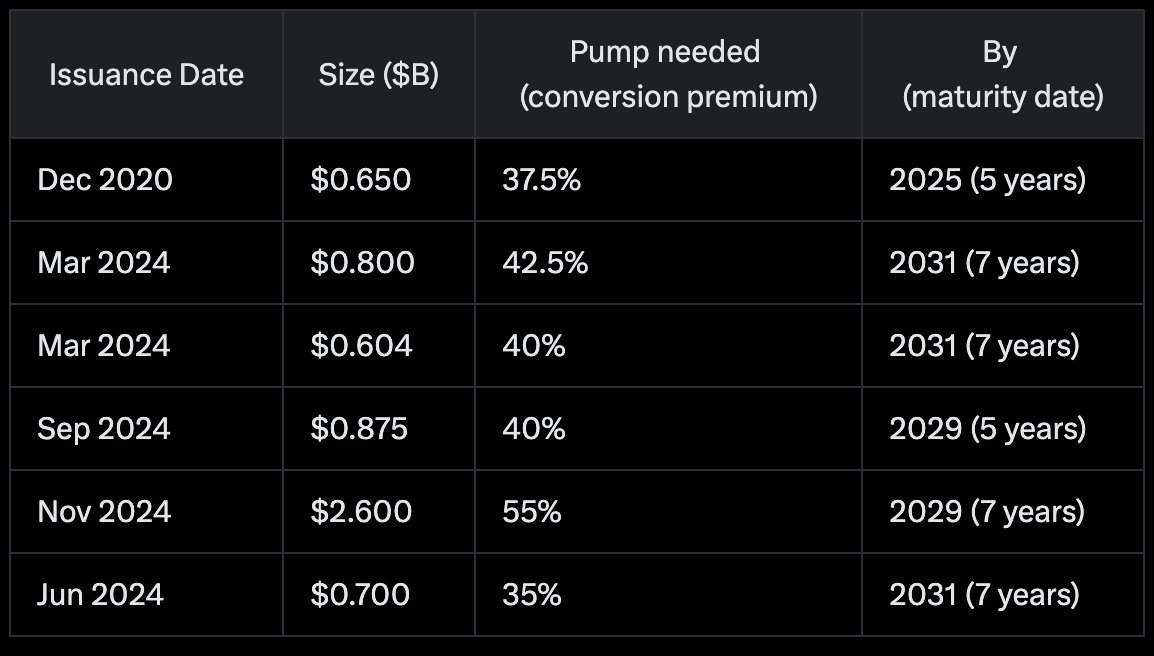
Currently, the only liquidation risk I can see is its issued convertible bonds:
-
If convertible bondholders do not convert into shares before maturity, MSTR will have to sell BTC to repay debt holders.
-
This would occur if MSTR fails to achieve more than a 40% increase within 5–7 years (varies by each bond—see table below). Essentially, either MSTR’s correlation with BTC fails, or BTC itself fails.
Other risks of varying degrees include:
-
Competitive risk—other companies copying and replicating, reducing MSTR's premium over net asset value;
-
Risk of SEC intervention in future purchases, reducing MSTR's premium over net asset value;
-
Custody risk with Fidelity and Coinbase;
-
Risk of U.S. nationalization (seizure of BTC);
-
Key person risk involving Saylor;
-
MSTR operational risk;
Final note: please be aware that the convertible notes table, while providing a general idea, is not accurate as I used Grok AI to generate it.
Other Questions About MSTR
Question One: Why doesn't MSTR have self-custody rights?
Willy Woo: The exact custody arrangements have not been disclosed. As far as we know, MSTR may hold co-signing rights under a multisignature arrangement. This is a prudent approach.
Question Two: Could MSTU and MSTX be liquidated and harm MSTR?
(Translator’s note: MSTU invests in T-Rex 2X Long MSTR Daily Target ETF; MSTX invests in Defiance Daily Target 2X Long MSTR ETF. These two ETFs have accumulated over $600 million and $400 million in assets respectively.)
Willy Woo: MSTU/MSTX = higher risk. The 2x leverage is achieved through paper bets on MSTR, with liquidation levels close to immediate liquidation (also, no claim on actual BTC).
Note: derivative positions dilute BTC value.
Additionally, due to volatility drag, holding long-term does not result in 2x returns (losses are more costly than gains).
Question Three: What if a large number of shareholders simultaneously sell due to external events (e.g., stock market downturn)?
Willy Woo: This is only a short-term impact. In the long run, markets always trend toward higher prices, so this isn't a real risk. Debt holders can wait up to 5–7 years after purchasing the notes to convert. As long as Bitcoin exceeds the initial price by more than 40% within 1–2 macro cycles, there is no issue.
Question Four: Are leveraged ETFs gaining exposure via options rather than swaps?
Willy Woo: Volatility arbitrage desks at TradFi hedge funds perform such operations daily. $70 million is very small—given mispricing in the options market, this amount is sufficient to support trading volume on any given day.
Join TechFlow official community to stay tuned
Telegram:https://t.me/TechFlowDaily
X (Twitter):https://x.com/TechFlowPost
X (Twitter) EN:https://x.com/BlockFlow_News
 @woonomic