








How Long Can On-Chain "Elixir of Immortality" DeSci Survive?
TechFlow Selected TechFlow Selected
How Long Can On-Chain "Elixir of Immortality" DeSci Survive?
When Memes Have Fundamentals.
 Navigating Web3 tides with focused insights
Author: Tuoluo Finance
When it comes to the hottest sector over the past two weeks, nothing stands out more than DeSci.
Since November 8, when Binance Labs announced its investment in BIO Protocol, this once-silent concept has reemerged into the spotlight. Backed jointly by CZ and Vitalik Buterin, DeSci has drawn a flood of speculative capital. Tokens like RIF and URO have generated thousand-fold returns, giving rise to an entirely new potential meme sector.
DeSci, short for decentralized science, refers—according to Messari—to the use of Web3 technologies to build public infrastructure that enables open, fair funding, storage, and dissemination of scientific knowledge. It encourages scientists to openly share their findings and gain recognition, while allowing anyone easy access to and contribution toward research. In simple terms, DeSci aims to leverage blockchain technology to solve challenges in scientific research, covering fundraising, knowledge sharing, peer review, intellectual property rights, and more.
In practice, current DeSci projects are primarily focused on fundraising. Most adopt tokenization as a means to finance research and development, while advocating for storing research outputs on-chain to enhance transparency and protect intellectual property. At present, DeSci’s core function is opening new funding channels for long-term scientific research. By linking two seemingly unrelated domains—cryptocurrency and scientific research—it gives tokenization greater practical significance, leading the market to hail it as one of the few viable examples of meme coin utility.
The root cause behind this recent surge in DeSci’s popularity lies largely in celebrity endorsement. On November 8, Binance officially disclosed its strategic investment in BIO Protocol, bringing into light what some call the “Y Combinator of on-chain science.” Shortly afterward, CZ attended Binance's DeSci Day event in Bangkok, where he appeared alongside Vitalik Buterin to discuss DeSci, catapulting the concept into mainstream crypto discourse.
The crypto community, always eager to chase trends, quickly embraced the DeSci wave. Platforms like Pump.Science rose rapidly to fame, with projects such as RIF and URO delivering thousand-fold gains, pushing the sector well beyond niche circles. Andrew Kang, partner at Mechanism Capital, even compared today’s DeSci landscape to early-stage DeFi in 2019: “It feels primitive and experimental, but one thing is clear—it holds enormous potential.” Under this sentiment, even amid broad market corrections, the DeSci sector has逆势 risen by 3.35%, according to SoSoValue data.
Despite its promising vision and the undeniable value of expanding funding avenues for scientific research, the current state of DeSci leans heavily toward speculation rather than tangible impact. Fundamentally, there is a stark contradiction between the long-term nature of scientific research and the short-term profit-driven behavior typical of meme markets—trying to balance zero-speculation science with purely speculative meme coins seems far-fetched.
On one hand, scientific research involves high uncertainty. Drug development often takes over a decade, and wrong directions can lead to total failure. It requires sustained, long-term investment due to its high cost and risk profile. This is precisely why traditional research funding typically relies on state-led initiatives or industry leaders, combining public and private capital to hedge risks and maintain competitiveness. In contrast, attention is fleeting in crypto markets. The current influx of capital into DeSci is concentrated mainly around platforms like Pump.Science—a meme-based fundraising platform for science-related projects—highlighting investor focus on quick profits rather than long-term outcomes.
In reality, DeSci isn’t all that novel in concept. Looking back, VitaDAO—the earliest and most representative DeSci project launched by Vitalik Buterin in July 2021—set the precedent. Yet, despite its ambitious premise, the project’s progress has been underwhelming.
VitaDAO is a community-owned initiative dedicated to funding early-stage longevity research. Its goal is to drive scientific innovation through collective community efforts, supporting projects aimed at extending human lifespan and preventing age-related diseases. In essence, VitaDAO is a DAO focused on longevity research.
Prior to recent developments, VitaDAO briefly gained attention after Pfizer made a strategic investment. However, interest soon faded. Today, VitaDAO claims to have deployed $4.2 million across 24 projects and established research collaborations with institutions like Newcastle University. Still, actual results remain limited. From 2021 until just recently at Devcon, Vitalik finally unveiled VitaDAO’s first product: VD001.
On the other hand, while putting research data on-chain may improve transparency and IP protection, and aid knowledge diffusion, doing so represents a structural disruption within the traditionally closed-off world of scientific research. Currently, most research teams keep their findings and experimental data strictly confidential during the process, especially when significant commercial interests are involved. Premature exposure could lead to unauthorized use or theft. With decentralized systems now forcing openness, data security becomes a serious concern.
Given these factors, it’s reasonable to expect that only extremely difficult, time-consuming, and highly collaborative research topics will truly align with crypto-native models. Observing this latest trend, many DeSci projects have converged on one universal human aspiration—longevity—leading some to jokingly refer to DeSci as “immortality pills on the blockchain.”
Immortality remains a fantasy. Market interest in DeSci ultimately hinges on liquidity prospects. Although BIOProtocol raised $33 million through its BIO Genesis community funding campaign and the DeSci sector has surged in the past two weeks, activity in primary markets remains limited. Major institutional players have yet to enter. Moreover, secondary market performance of leading projects is lackluster—VITA and RIF both hover between $120 million and $200 million in market cap, far below the $1 billion+ caps seen in top projects from other sectors.
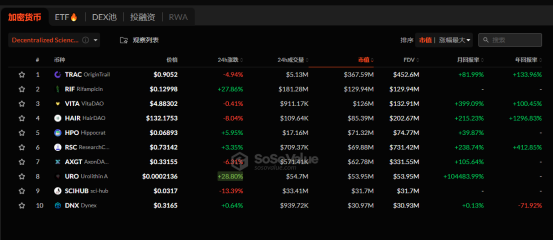
DeSci Sector Development, Source: sosovalue
That said, if viewed purely from a meme perspective, DeSci stands out as a relatively strong narrative. Compared to other meme coins, DeSci offers deeper storytelling. While celebrity endorsements alone don’t last, the presence of real research projects provides fundamental backing. Any breakthrough or product launch strengthens the narrative. Biomedical research is inherently funding-hungry and welcoming of new sources, making it particularly compatible with crypto integration. Furthermore, DeSci holds latent crossover potential. Currently, its celebrity appeal is confined within crypto circles—led by figures like Vitalik and CZ—with no major names from traditional medicine or academia joining yet, and large institutions still absent. This leaves room for future narrative expansion.
Zooming out to the broader market, whether it’s animals, artists, AI-driven narratives, or science-validated concepts, MEMEs have clearly become the main vessel for market capital. But unlike previous cycles where altcoins were the primary beneficiaries of bull runs, this time the landscape looks different. Bitcoin has climbed from $10,000 to nearly $100,000, while Ethereum’s momentum has weakened significantly. Most altcoins have declined, with only SOL and XRP among the top ten assets showing gains. The era of altseason—where dozens of alts surged tenfold or more—appears unlikely to return anytime soon.
The key driver behind this shift lies in changing capital flows. Traditionally, bull markets follow a cascade pattern: capital moves from stable, high-cap assets down to riskier, lower-cap ones—from major coins → altcoins → meme coins → niche sectors. But this year, that flow has broken down. With increasing institutional participation and market saturation, fresh liquidity increasingly concentrates solely in Bitcoin. No major new applications have emerged in the smart contract ecosystem, and altcoins face deep supply-demand imbalances. Bitcoin acts as a vacuum, sucking capital from other sectors. Only fast-moving, high-reward meme coins stand out—transforming what was once "altseason" into "memeseason."
A telling example: Pump.fun has become the biggest winner of this bull cycle. According to Dune Analytics, as of November 24, pump.fun had generated nearly $230 million ($228,908,720) in cumulative revenue, with approximately 3.74 million tokens deployed.
Of course, memes aren’t replacing alts outright. The rise of memes doesn’t necessarily mean the death of alts. With regulatory easing and sector rotation, alts could still rebound. However, the elevated status of meme coins undeniably reflects a structural shift in the market. Whether it’s live mints on Pumpfun, TikTok shilling, or AI-driven narratives, the crypto space is undergoing profound changes in storytelling logic, distribution models, and operational paradigms—driven by Gen Z adoption and rapid technological evolution.
Traditional alt projects relying on long-term VC-controlled token releases to sustain narratives are no longer sustainable. Markets reject VC-centric tokenomics. Instead, users are gravitating toward fairer, more autonomous, and community-aligned models. Attention is scarcer than ever. In this context, combining memes with real projects appears more competitive than standalone ventures. Alts enable centralized manipulation; memes offer relative fairness. Memes lack longevity; projects add fundamentals. Together, they form a powerful synergy—perhaps explaining the rise of concepts like AIMEME and DeSci.
Still, consensus formation remains highly random. True meme goldmines are exceedingly rare. According to Panews, as of November 21, Pump.fun had issued 3.59 million tokens—surpassing the total number of crypto tokens launched over the past decade. Of those, only 50,389 tokens (about 1.4%) successfully graduated (reached full curve and listed on Raydium). Just 32 tokens reached a market cap above $100 million—less than one in a hundred thousand memes achieve even $10 million valuation.
In the long run, finding a balance between attention-grabbing virality and sustainable longevity will be crucial for meme development. But for individuals, survival—avoiding zero—is the only prerequisite.
Join TechFlow official community to stay tuned
Telegram:https://t.me/TechFlowDaily
X (Twitter):https://x.com/TechFlowPost
X (Twitter) EN:https://x.com/BlockFlow_News






