Can DeSci solve the "broken window effect" in scientific research funding?
TechFlow Selected TechFlow Selected
Can DeSci solve the "broken window effect" in scientific research funding?
DeSci (decentralized science) is essentially applying the concept of cryptocurrency to the field of scientific research.
 Navigating Web3 tides with focused insights
By Thejaswini M A
Translated by Saoirse, Foresight News
A friend of mine spent seven full months writing a research grant proposal.
Seven months—longer than many people spend planning a wedding, and likely more stressful too. She’s a brilliant cancer therapy researcher who ends up spending more time fundraising than actually doing science.
The entire system is backward. Research requires funding, yet to get funding you must first prove your research will succeed—but how can you prove it will succeed if you haven’t done the research?

Meanwhile, absurdities happen: a YouTube creator raised $100,000 in a weekend for a “counting rice grains” fundraiser. The contrast couldn’t be more ironic.
Now, in the world of crypto, a movement called DeSci (Decentralized Science) is emerging, aiming to revolutionize scientific funding using cryptocurrency and blockchain technology.
Don’t dismiss it just yet—you might change your mind after hearing this out. This approach could actually work.
How Bad Is the Current System?
Here’s how traditional research funding works: researchers write detailed proposals, submit them to government or corporate bodies, then wait 6 to 18 months for a response. Most applications are rejected. Even when approved, they come with so many restrictions that researchers end up spending more time on paperwork than actual research.
The core principle here is "risk reduction," which sounds reasonable—except that groundbreaking discoveries are inherently risky. From antibiotics to the internet, the most significant scientific breakthroughs were often ideas that review committees would have dismissed as too speculative.
Then there’s the issue of publication: researchers must publish their findings in expensive academic journals that charge exorbitant fees and lock knowledge behind paywalls. As a result, research funded by taxpayers remains inaccessible to those very taxpayers.
In the end, talented scientists waste years navigating bureaucracy instead of solving real problems. Important research gets delayed or dies entirely, while the public—whose taxes fund much basic research—is locked out of the results they’ve paid for.
Enter DeSci
DeSci (Decentralized Science) essentially applies the principles of cryptocurrency to scientific research: instead of begging funding committees for grants, researchers can crowdfund directly from people who care about their work; instead of locking findings behind paywalls, results are stored on public blockchains where anyone can access them.
DeSci gained widespread attention when Ethereum co-founder Vitalik Buterin and former Binance CEO Changpeng Zhao began discussing it publicly. When major figures in crypto focus on something, it often signals that the underlying infrastructure is finally ready for real-world application.
Here’s how it works: researchers issue tokens representing their project. People fund the research by buying these tokens, and if the research succeeds and generates commercial value, token holders share in the returns.
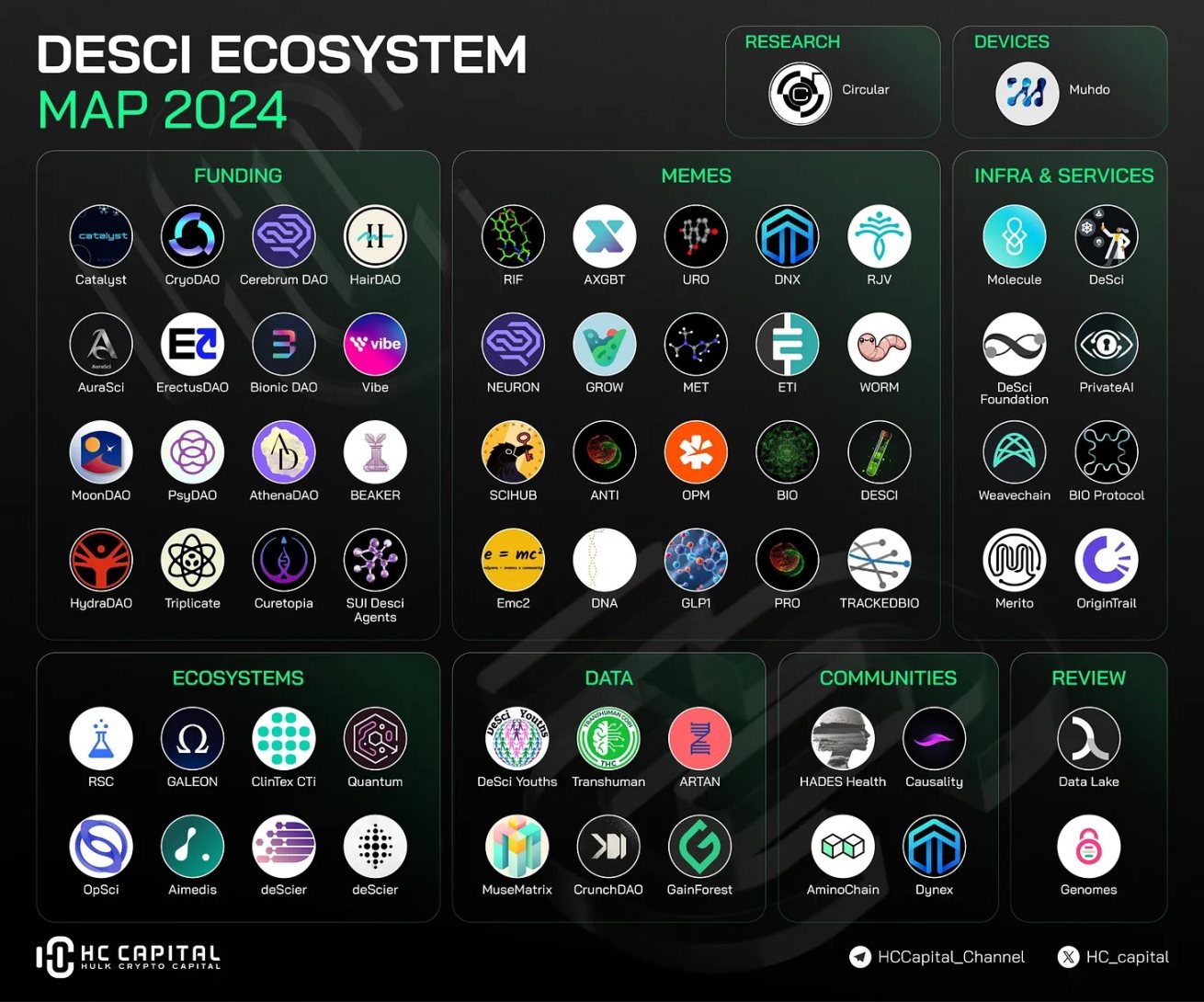
This isn’t theoretical—it’s already happening. Several organizations are building real infrastructure for decentralized science.
Take BIO Protocol, a key player in this space backed by Binance Labs with strong financial support. BIO has created so-called "BioDAOs"—essentially crowdfunding communities investing in biotech research. Instead of a handful of wealthy individuals deciding which cancer therapies get developed, thousands of people can pool funds and vote on research directions.
There’s also Molecule and VitaDAO, focused on longevity research, which tokenize intellectual property: when researchers achieve milestones, ownership is distributed among funders. Projects they currently support include aging research at Newcastle University and longevity studies at the University of Copenhagen.
Funding volumes are growing rapidly. These platforms have already processed millions of dollars in research funding, with some individual projects raising hundreds of thousands through token sales. While still small compared to traditional funding, the growth rate is staggering.
The more I think about DeSci, the more profound it seems. Scientific research is inherently collaborative—researchers build on prior work, share data, conduct peer reviews—and blockchain technology is precisely designed for transparent collaboration.
Traditional funding creates distorted incentives: to secure grants, researchers must overstate the certainty of their outcomes, which ironically discourages exploration of uncertain but potentially transformative paths. DeSci flips this. It rewards researchers for sharing all data—including failed experiments—because such information can help others avoid dead ends.
Another benefit is global participation. A researcher in Nigeria with a great idea no longer needs affiliation with a Western university or funding body to raise money globally. This is huge for democratizing scientific progress.
And transparency comes built-in: when research is funded via blockchain tokens, everyone can see exactly where the money goes, eliminating guesswork about whether funds are being used for actual research or buried in administrative overhead.
Risks and Challenges
Of course, risks remain. The biggest issue is quality control. Traditional peer review, despite its flaws, does filter out some junk science. In a decentralized system, how do we prevent people from funding obviously pseudoscientific or implausible projects?
Volatility is another real challenge. What happens to a five-year cancer research project funded by crypto tokens if the token price crashes 90%? Long-term research requires stable funding.
Regulatory uncertainty also looms large. Most countries have complex regulations around medical research, drug development, and intellectual property. How tokenized research fits into existing legal frameworks remains unclear.
To be honest, most scientists aren’t native to the crypto world. Expecting them to suddenly become experts in tokenomics and DAO governance is asking a lot.
Conclusion
Despite the challenges, DeSci’s momentum cannot be ignored. Infrastructure is maturing, funding is increasing, and the traditional research funding system continues to deteriorate. When traditional institutions take 18 months to approve emergency research funding, while crypto crowdfunding can deliver in days, the efficiency gap is obvious.
Early projects are mostly concentrated in biotech and longevity research—this makes sense, as these fields offer clear commercial potential: if funded research leads to a new drug, token holders can profit. But this model can apply to any research that ultimately creates value.
I believe we’re at the beginning of something significant. Not that cryptocurrency will overnight replace traditional research funding, but it offers a faster, more transparent, and globally accessible alternative.
The true test for DeSci lies in whether it can produce actual scientific breakthroughs—not just raise money. But given the state of traditional research funding, trying new approaches is absolutely worth it.
This is just the beginning. The DeSci space is evolving rapidly, with new projects emerging constantly and real capital flowing into real research. At the intersection of crypto and scientific funding, opportunities are emerging that didn’t exist a year ago.
Join TechFlow official community to stay tuned
Telegram:https://t.me/TechFlowDaily
X (Twitter):https://x.com/TechFlowPost
X (Twitter) EN:https://x.com/BlockFlow_News