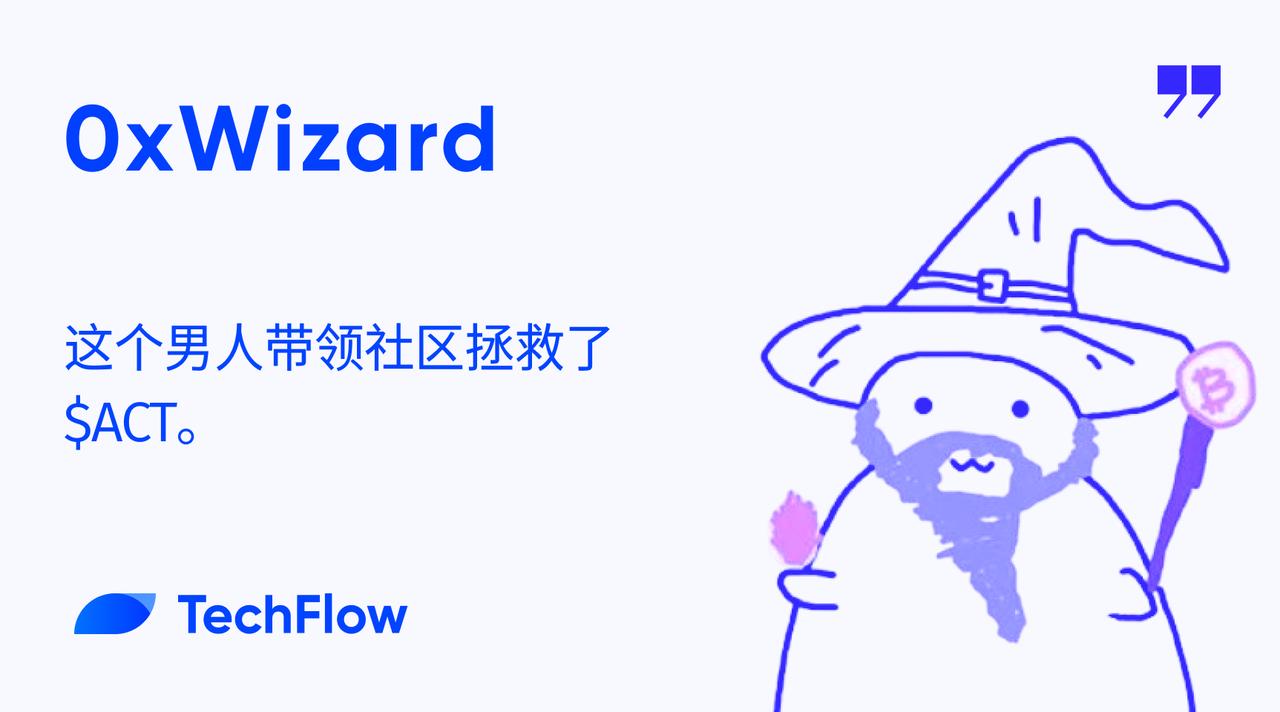
Dialogue with 0xWizard: This man led the community to save ACT
TechFlow Selected TechFlow Selected
Dialogue with 0xWizard: This man led the community to save ACT
Behind great results often lies profound suffering.
 Navigating Web3 tides with focused insights
Written by: TechFlow
When Binance suddenly announced the listing of ACT, amidst widespread astonishment, you might repeatedly hear one name—Wizard.
People thank Wizard, saying he saved ACT. Wizard, in turn, calls it a victory for the community.
This is a Hollywood-style tale of an ordinary person battling a dragon:
The developer dumped all tokens, causing an instant 50% crash that nearly destroyed the project. Wizard and other community members rebuilt from the ashes. Three times the price dropped 80%, yet the community held firm. Market makers remarked they’d never seen such a “poor” project. Then Binance arrived as a white knight, and ACT made its breakthrough.
In Wizard’s eyes, ACT and GOAT represent an AI Renaissance—a future where AI won’t just be assistants, but autonomous, controllable free minds within certain bounds.
Today, Wizard seems to have become the Murad of the Chinese crypto space. But greatness comes through endurance; behind every big outcome lies profound suffering.
He once blew up eight figures in a single day, was deeply trapped in ORDI for half a year, and said he experienced palpitations so severe it felt like walking down a busy street on a sunny afternoon while his heart convulsed uncontrollably.
How did this mysterious ordinary man repeatedly turn defeat into victory? What deep philosophical thinking lies beneath seemingly simple MEME investments?
This is Wizard’s story and reflections.
Entering Crypto: 100x on Algorithmic Stablecoins, Took Revenge on "Old Huang"
TechFlow: Please introduce yourself, Wizard. How did you enter the crypto world?
0xWizard:
I actually entered crypto back in 2018, but didn't actively trade then. In 2018, I read the Bitcoin and Ethereum whitepapers and bought some major coins like BTC and ETH—but only held them. From 2018 to 2019 was a bear market, during which I did almost nothing, just holding.
Around mid-2020, I noticed my holdings had significantly appreciated. That’s when I started wondering—was this an opportunity?
A friend introduced me to DeFi (decentralized finance). I looked into it briefly—projects like Compound, early liquidity mining pioneers. At first, I thought it resembled FCoin’s trading-mining model, unsustainable. It was June 2020; my understanding of trading was shallow, and I hadn’t really engaged with DeFi.
What truly drew my attention to DeFi was YFI. People said YFI returned 10,000x—the wealth effect was intense.
So in September, I began actively studying crypto, especially DeFi. I learned to use MetaMask, bought some tokens on Sushi before it launched. Though Sushi later crashed hard, teaching me a painful lesson, this marked my formal start into DeFi—or rather, active trading.
Then came the boom in algorithmic stablecoins. I entered in September, lost 60% in October, then made 100x on stablecoins in November.
From there, I became one of the earliest on-chain players, involved in both primary and secondary markets—trading altcoins, large caps, leveraged positions, ETH, various on-chain projects. The ups and downs were quite interesting.
TechFlow: You mentioned making 100x on algorithmic stablecoins. Which specific project was that?
0xWizard:
I participated in Basis and Mith Cash. On Basis, I made 10x with an investment of tens of thousands of dollars. Then I joined Mith Cash—that’s Old Huang’s (Lyc Lin) project.
There's an interesting story here. Earlier in KP3R, I met a friend called "X." Back then, neither of us had much money to play KP3R. We got dumped on constantly by Old Huang, dropping from $200 to $80. We were both trapped, chatting every day.
Later, we both joined Basis and Mith Cash. He didn’t participate in Basis—I did, and made 10x. With Mith Cash, we both joined. He made about $5 million, I made $3 million. This was our revenge on Old Huang from KP3R. We buried him with Mith Cash—pretty satisfying.
Thinking Behind ACT: An AI Renaissance
TechFlow: Recently, ACT has been the hottest topic. Many people mention you, thanking Wizard for helping them hold on. When you heard about Binance listing ACT, were you surprised? Why do you think Binance chose ACT over GOAT, the sector leader?
0xWizard:
I was sitting at my computer. I saw the chart spike first, then congratulatory messages, and finally the official announcement.
Was Binance listing ACT surprising? There was definitely luck involved. No one could predict it would happen, but it wasn’t entirely unexpected either. The reason Binance picked ACT over GOAT is actually quite clear.
This ties into how Solana’s MEME ecosystem works. There are two types of meme coins: one is genuine community-driven coins, the other is heavily controlled by a few holders.
Many hyped-up coins fall into the latter category—controlled by a small group who build a fake “community” to pump the price. If such a coin gets listed on a major exchange, it usually ends badly because insiders dump immediately. For Binance, listing a token with unhealthy distribution brings no benefit.
ACT and Neiro, however, are true community coins. When I observed ACT, I noticed trading was extremely quiet, yet it stabilized around a $20M market cap—proof of strong community support.
In the ACT community, there are about 20 core contributors actively participating. I’m the only Chinese member, so I know the situation well.
The challenge for such genuine community coins is the lack of strong whales entering. But from Binance’s perspective, this is actually ideal.
It genuinely has a strong community. Look at how ACT holders voted on Kucoin’s listing poll—they cast over 20,000 votes. While each user can vote five times, ACT has 15,000 holder addresses, roughly 9,000 valid ones after filtering out dummies. Accounting for multi-address ownership, there are likely 6,000–8,000 real holders. About 4,000 of them voted—showing high engagement and cohesion.
For Binance, this kind of asset is perfect. Some projects with higher market caps don’t even have as many or as dedicated holders as ACT.
ACT has massive fan appeal but a low market cap—leaving ample room for both primary and secondary markets to generate wealth effects and legends.
I once tweeted that if Binance were to list a new coin, it should meet these criteria:
-
New narrative, new赛道, representing vast future potential;
-
Genuine strong community;
-
Small market cap, enabling wealth creation across tiers;
-
High timeliness—whether controversial or trending.
ACT meets all four. I wrote that tweet based on ACT’s characteristics, though honestly, I didn’t expect it would actually get listed—after all, exchanges make their own decisions. But logically, analyzing the entire MEME market makes it clear Binance wouldn’t pick highly centralized coins.
Coins with concentrated ownership will see immediate dumps upon listing—only benefiting a few insiders while retail investors suffer. As Binance, which side should you choose? That’s a fundamental consideration.
As for GOAT, it’s certainly a great project, but Binance may have passed due to its high market cap. With unclear token distribution and high valuation, listing it carries risk. Binance must prioritize user protection—ensuring fairness for the majority.
Another key point I mentioned earlier: high growth potential, new赛道, new narratives—are crucial.
Many friends message me: “Wizard, look at our community—we’re resilient too, we’ve suffered.” But they’re focusing on just one factor from a success story. The most critical reason I backed ACT is that it represents a new赛道and narrative—this cannot be ignored. Without this, how do you drive speculation? How do you guarantee upside? A strong community alone isn’t enough.
Most importantly, I believe Binance also sees this as a trend and wants to pick a representative project. All subsequent considerations serve to validate that ACT was the right choice. That’s my view.
TechFlow: So how did you discover ACT initially? What qualities attracted you early on—even during sharp declines?
0xWizard:
ACT endured three drops of over 80%.
I discovered ACT relatively late—saw someone mention it on social media, checked the chart, and found the market cap already at $40M. I happened to buy at the peak, then watched it drop 80%. Throughout the decline, I kept accumulating—from $40M down to $5M market cap.
I joined the ACT community on day one—got trapped first, then dug deeper. My initial reason for entering was that the market was hunting for the next GOAT, and ACT shared many similarities with GOAT:
First, Marc Andersson funded both—ACT was the first, GOAT the second.
Second, within the AI MEME space, there’s a small circle centered around Andy. Nearly all researchers in this group participated in ACT. AMP is the public face, but not the originator. Digging deeper, you’ll find the original conceptual framework came from Andy, with others building upon it. On ACT’s launch day, Andy retweeted multiple related posts.
Therefore, the logic for choosing ACT was clear: entering this field means seeking unique projects capable of telling new stories. Others talk about AI Agents, imitating GOAT—but ACT forged its own path.
I once compared this to an AI Renaissance on Twitter. Reflecting on the emergence of GOAT and ACT is akin to the historical human Renaissance. The Renaissance elevated human rights above divine authority, breaking old paradigms. Similarly, GOAT and ACT represent a paradigm shift.
Traditionally, AI is seen merely as an assistant. But looking ahead, in the future internet world, 80% of inhabitants might be AI—people won’t even distinguish humans from AI. Future AI won’t be mere assistants, but autonomous, controllable free minds within limits.
AI MEMEs explore exactly this imagined future. That’s why I deeply appreciate this project—it feels futuristic, has real-world social media applications and massive traffic, perfectly aligning with crypto’s needs.
GOAT embodies Andy’s philosophy: let AI think freely, autonomously—just as the Renaissance freed humanity from religious dogma, now freeing AI from human constraints to see what it creates. Hence the idea: “Profanity is sacred, sacred is profane.” That’s GOAT—tokenizing a philosophy.
To realize this vision, it must be built on Renaissance foundations: freedom, science, democracy. ACT is a research framework designed around these principles, with multiple researchers advancing individual studies under it. AMP is just one participant. In fact, AMP didn’t create ACT—ACT funds the entire AI Renaissance movement. This is why I originally joined and believed in the project.
Regarding AMP personally, although he’s part of the ACT project, his conduct has been disappointing. When he first received $30K+ funding from Marc Andersson, he was grateful and tearful. But when the crypto community gave him $1M in support, he began belittling us—calling us gamblers, claiming we only used his name.
That’s why I had to speak up for the ACT community. When AMP started dumping, I became emotionally overwhelmed—the first time I ever angrily posted on Twitter. Because I share genuine emotional bonds with community members. I couldn’t accept an outsider treating our crypto community with such arrogance and disdain. We funded his research—how dare he treat us this way?
Back to your original question—my conclusion rests on two pillars: rational analysis and emotional resonance. Rationally, I saw it as a solid investment. Emotionally, I empathized with my 2020 self. No one spoke for me back then—I now stand up for them.
In the Name of Community: Rebuilding the Tower of Babel
TechFlow: AMP’s betrayal was like destroying ACT’s foundation. Yet your community rebuilt ACT from ruins. What did the community do? How was work divided?
0xWizard:
ACT isn’t a traditional project. There’s no formal structure—no CEO, CFO, CMO controlling PR or narratives. When we saw AMP dumping, everyone reacted based on genuine emotion.
For example, the quality of ACT’s community account content was high from day one. Those high-quality images and videos weren’t random memes—they were created by a female artist overseas, contributing silently as a holder, unpaid.
Telegram moderation—if there weren’t active admins online 24/7, the group would be flooded with spam. But in ACT’s community, you see zero ads because admins instantly delete and ban spammers. All spontaneous community efforts.
Besides, figures like NaiZiGe (X: Crypto Philanthropist) helped connect centralized exchange (CEX) resources, while other foreign members introduced quality market makers.
Actually, we contacted market makers before Binance listing—but due to limited funds, they said they’d never seen such a “poor” project. Still, we were honest: “This is our reality—can you accept it?”
Eventually, top-tier market makers, seeing we were among the strongest communities, reluctantly agreed to collaborate.
Everyone worked toward one goal, driven by shared anger: We’re good farmers—why be bitten by a snake? Why must retail always bear the worst consequences?
When the market cap dropped from $40M to $5M, I began boosting confidence in Telegram—simply by showing my trades. I told everyone I was buying tens or hundreds of thousands of dollars, urging them to stay strong.
During each of ACT’s three 80% crashes, I appeared in the group saying, “I’m here. I’m with you.” As someone with influence, I wanted retail members to know I wouldn’t leave—I’d support them.
But I must emphasize: I’m not a savior or godfather—I’m just an ordinary community member. Without others’ contributions, could I have persisted alone? Could I manage groups 24/7? Create graphics? Contact market makers? Alone, I’d have given up long ago.
This is the community’s victory—not mine. The Chinese community sees me, but countless others worked behind the scenes.
Notably, Binance didn’t ask us for any tokens. Even after listing, when their post-listing team contacted me, I told them I was just another bagholder. Two hours before final confirmation (Nov 11, 6PM), they verified basic info—total supply, circulating supply, official Twitter. They even asked for thousands of test tokens, which baffled me—clearly unprepared.
This proves Binance maintains strict confidentiality protocols.
Whether with Neiro or ACT, whenever the community fights against manipulation groups, Binance sides with the community—leaving space for both primary and secondary markets. Isn’t that positive?
Take Neiro—I bought at $30M market cap, now tripled. After Binance listing, you can deploy larger positions—buying millions becomes feasible. Entirely different logic. Both tiers have room—what more could you want? I truly don’t understand those attacking Binance and the project.
TechFlow: For most coins—especially VC-backed, highly centralized ones—Binance listing often marks “sell the news,” followed by mass selling. Now that ACT is listed, what future potential remains?
0xWizard:
ACT, as a community project, continuously redefines its value. This is why I re-engaged with on-chain projects from 2020–2023—based on a core theoretical assumption: Why do MEME coins or on-chain projects generate wealth effects?
Consider traditional VC token models: a team proposes an idea, analyzes market needs, solves industry problems. Then seeks investors, raises from VCs, builds product, launches.
Such projects derive value from several factors:
-
Project quality, team strength;
-
Whether top-tier VCs invested;
-
Listing on major exchanges;
But the problem arises when it lists on a major exchange—secondary markets have little room left. All factors are priced in, valuations reasonable—often starting at hundreds of millions or even billions in FDV. Can average investors still participate?
Additionally, projects often adopt predatory tokenomics—tiny initial release, continuous vesting.
You see coins whose market cap stays flat but price drops tenfold. This is why the classic “down 90%, up 100x” cycle common in past eras rarely repeats today.
On-chain projects like ACT constantly reshape their value. That’s why I dared buy Neiro—after Binance listing, its narrative, capital, user base, and investment logic all transformed.
Previously, ACT might’ve been one of two key players in AI MEME. But post-Binance, it’s no longer just one of two—it’s become the representative of AI MEME itself, the index asset of this赛道. It symbolizes a new赛道, a new trend.
If you have $1M+ to allocate in secondary markets, how would you position? On Binance, if you want exposure to AI, ACT no longer competes with GOAT—it now benchmarks projects with $100B+ FDV, like Worldcoin.
This involves two core logics: first, its value is constantly reshaped; second, judgment on future market opportunities.
In October, I sincerely asked on Twitter: if the next two months enter a bull market (when Bitcoin hadn’t yet risen), which赛道could broadly gain 10x?
For retail traders, if a赛道only gains 2–3x, profits are negligible. Most wait until bull confirmation to buy, and no one knows the top. Quick movers might get 50–80%, doubling is tough. Only a 10x-wide赛道allows even late entries and exits to yield 3–5x returns.
To answer, I studied all赛道—DeFi, BTC ecosystem, TON, AI, general MEME coins. I was frustrated—most investable AI projects already had multi-billion dollar market caps. How can they 10x?
What does crypto speculate on? The macro thesis is AI driving a tech revolution—the next industrial and information revolution. AI powers US stocks—can crypto ignore AI? That’s why AI rallied 10x early this year. But after broad gains, projects with $10B+ FDV become hard to justify.
So when GOAT emerged, I was immediately intrigued. After ACT launched, I realized: if investing in AI, especially with $1M+, ask two questions: First, among all赛道, which can broadly gain 10x? Which is guaranteed to rise? Second, can assets in this赛道gain 10x? Do they have the market cap headroom?
That’s why I believe ACT still has significant upside. Despite three 80% crashes, the community holds many “diamond hands” and “true believers.” In community chats, I say openly: I’m a true believer. Don’t ask my logic—I unconditionally trust and support these people.
TechFlow: Looking back, the battle between uppercase and lowercase Neiro ended with Binance choosing the more community-driven lowercase version. One could argue Binance saved Neiro/ACT.
Yet there’s irony: people reject VC coins, opting for decentralized, community-driven Memecoins on-chain—yet ultimately seek validation from the most centralized powerhouse: a major exchange—achieving liquidity exit. It’s ironic. Your thoughts? Will centralized exchanges—especially Binance—remain Memecoin “saviors”?
0xWizard:
I think we need to examine this from multiple angles:
First, historically, this is a process. Currently, on-chain liquidity is insufficient, while Binance offers abundant depth.
Second, Memecoins themselves face dilemmas. Binance won’t list a coin without visible community formation. I believe Binance has advanced significantly here—their selection logic shows adaptation to this new era. They’re doing well.
I believe community-driven assets constantly redefine value, and Binance is now actively engaging. This reflects the current historical phase. Binance has limitations, on-chain has constraints—but both express positive attitudes, mindsets, and values toward this evolution.
Second, regarding the future. Binance will remain a major liquidity hub—undoubtedly. But on-chain will also see growing liquidity. That’s why I’m bullish on on-chain projects.
The future may bring billion-dollar on-chain projects—even without Binance listings. But financial assets eventually require a leading force to reach maturity—on-chain is no exception.
Still, I hope purely community-driven projects achieve higher ceilings. Projects like Neiro and ACT struggle to exceed $20M market cap. I hope this changes—imagine such projects attracting quality capital, reaching $100M, $200M, even $1B. That’s a brighter future—more capital willing to experiment on-chain.
Exchanges also provide greater liquidity and safer trading environments. Perhaps Binance will continue listing well-designed projects like Neiro and ACT, offering hope. I believe whether Binance or on-chain, everyone can find their role and leverage strengths in this ecosystem.
Also, Binance needs wealth effects—whether broad altcoin rallies or post-listing surges like Neiro and ACT. That’s why I firmly hold both. Binance craves wealth-effect legends—and such myths will inevitably emerge in secondary markets. Isn’t that a virtuous cycle? Wealth myths on Binance, on-chain, and overlaps when Binance supports community projects.
I see this as a healthy interaction. People gain wealth effects across platforms, with meaningful intersections—a positive development direction.
What Happened to the Bitcoin Ecosystem?
TechFlow: This year, the Bitcoin ecosystem flourished with ORDI, giving Eastern crypto forces a voice. But later collapsed. In your view, why hasn’t the Bitcoin ecosystem recovered? Does it still have a chance?
0xWizard:
I believe the Bitcoin ecosystem still has opportunities. But I admit, recent market dynamics haven’t favored it.
Here are some issues I observe:
First, the Bitcoin ecosystem needs better innovation. Earlier, we saw novel ideas—writing data on-chain, tokenizing content—truly innovative. But lately, innovation has stalled. Without novelty, the market loses interest.
Second, liquidity in the Bitcoin ecosystem is highly fragmented. Protocols are割裂ing liquidity—like Ethereum’s Layer 2s. Inscription users, Rune users, Merlin users, and the newly emerged fractal Bitcoin each form separate tribes with little overlap.
I even tweeted: the Bitcoin ecosystem hasn’t attracted significant external liquidity, yet internal liquidity grows increasingly fragmented. How can it succeed?
I still believe in its potential, but to break through, it likely needs a new narrative. You can’t keep recycling inscription stories—their impact weakens over time.
Second, the ecosystem needs solutions to liquidity fragmentation. Right now, I don’t see clear answers—similar to how Ethereum’s L2 fragmentation remains unresolved.
We need a universally recognized project—one that everyone in the Bitcoin ecosystem agrees is groundbreaking. Then native capital can push it to high valuations, exchanges will recognize it, drawing in more users and communities. That could be the breakthrough.
Third, check existing projects like Runes—any candidates for major exchange listings? If so, that’s direct wealth effect, potentially reviving the ecosystem.
But most urgently needed is #1—fundamental innovation. Exchanges follow trends.
Great Outcomes Stem from Great Pain
TechFlow: I saw kay’s tweet: “Behind great outcomes lie great pain.” Can you share some painful moments you’ve endured? How did you endure them?
0xWizard:
Honestly, I’ve lived through so many such moments. Looking back, I still feel palpitations—as if on a bright afternoon, walking a bustling street, my heart convulsing uncontrollably, unable to walk normally—feeling incapable of existing in this world.
I’ve had many such experiences. Like during the May 19 crash—I was leveraged on Ethereum, nearly liquidated. Luckily, it ended well. By end of 2021, my capital not only recovered but hit a new high. But in March 2022, during the 3AC collapse, I lost nearly eight figures in USD within a month—a massive drawdown, nearly unbearable.
I always tell people to consider whether they can accept the worst-case scenario in trading. But that time, even I couldn’t accept the result. For weeks, I stayed in that state of palpitations—unable to walk normally, numb regardless of price movements when opening exchange apps.
Then ORDI—held from 7U down to 3U. Another torture—six months of halving, with large position. I pinned all hopes on ORDI—a bad habit. Maybe I’m too subjective. In trading, you hear my strong conviction and confidence—but such traits are double-edged. When luck turns, it hits extra hard.
Being trapped in ORDI for six months, amid constant criticism—even Bitcoin OGs calling inscriptions worthless—I kept questioning myself: Was I wrong? ACT was similar—three 80% crashes within half a month.
How did I endure? A few things:
First, I’m more optimistic than most. I’ve always been more optimistic than 99% of people. This personality trait helped, but still, I often felt too broken to keep trading—or even living. But dawn always comes. As I tweeted: “No matter how dark the night, always believe morning will arrive.” I kept believing I could rise again—because past experience proved I could.
Second, seek external help. During the ORDI period, after watching Oppenheimer, I tweeted—I felt somewhat relieved.
Who was Oppenheimer? Handsome, rich kid—his father left him over $100M (in today’s terms) when he died. A genius—entered Harvard at 16. Father of the atomic bomb, changed WWII’s course. What was his youth like?
After watching the film, I researched everything about him. He repeatedly neared breakdowns—nearly poisoned his advisor in the UK, felt abandoned when his friend got a girlfriend, even tried strangling him. He collapsed, foaming at the mouth. In his 20s, seeing young women on trains, he wanted to kiss them forcefully—all from sexual repression and unrecognized talent.
You see even such a figure had shameful moments—seeming like a madman needing confinement. Yet he overcame it. I felt relief. Everyone has their darkest hour—even seemingly great people.
What am I better than Oppenheimer? 99.99% of people admit I’m inferior. Why expect less suffering than him and still achieve good results? Impossible.
This is inward and outward seeking: inward is enduring, outward is finding logic, facts, or others’ experiences for resonance.
Third, learn lessons to avoid repeating mistakes. A universal principle: before trading, ask—what’s the worst case? Can I accept it with my current position? If yes, hold or buy. If not, reduce or stay out.
These are the three keys: inner resilience, outer resonance, and learning to avoid repetition.
Three Laws of Bull Market Engines
TechFlow: You once proposed the Three Laws of Bull Market Engines:
1. Old tech, new玩法—if absent, snow lacks stickiness (insufficient fundamentals);
2. New narrative, new hope—if absent, slope isn’t long enough;
3. Mass production of new assets;
If absent, slope isn’t wide enough. Only together can they create scenes as powerful as 2017/2020. Can you explain these three laws?
0xWizard:
We often say, “Understand history to foresee the future.” I suffered in the bear market, wondering—what would a bull market look like? We can only learn from past bulls, but not blindly copy ICO or DeFi patterns—instead, find their commonalities.
First law: Crypto always seeks new narratives, new赛道. Discussing something unprecedented removes ceiling limits. Whether $100M, $1B, or $10B, people accept it—always finding justification. But if you launch another DeFi project today—why should it be worth $1B? Unreasonable—today’s DeFi might not even reach $600M. You must have new赛道, new hope, new narrative.
That’s why when communities approach me, I urge them to first assess their ceiling before building. Strong community alone doesn’t guarantee profit.
Second law: Requires long-term accumulation. Whether ICO or DeFi, takes years to build momentum. Ethereum took two to three years from launch to ICO boom. DeFi: I dug up that Uniswap’s AMM concept emerged late 2017/early 2018. Hayden built Uniswap on it—everyone acknowledges DeFi’s boom relied on Uniswap enabling token swaps, creating lending demand, drawing capital. From concept to explosion—about two years of buildup.
Thus, this bull’s engine can’t stem from sudden new tech—it must build on two to three years of prior groundwork. Like the Meme Coin Super Cycle—concepts born at the previous cycle’s end, now flourishing. AI Meme, inscriptions—they’re branches of meme coin prosperity, new ways of token generation.
This is “old tech, new玩法”—but not mere copying.
Third law: Must mass-produce new assets. ICO era minted countless tokens. DeFi era same. Inscription era—20,000+ inscription coins daily. AI too—countless AI Agents emerging. Without new assets, no viral effect. Imagine if ICO era only had Ethereum—no Neo, no Antshares—would people go crazy? Wealth stories spread one after another.
This returns to crypto’s essence: asset issuance. After years in crypto, reading whitepapers since 2017–2018, I keep asking—where is crypto stronger than Web2 or real world? Issuing assets. This regulatory-arbitrage convenience is unmatched elsewhere.
Negative example: Pandora-like projects can’t spawn mass clones. But AI Agents—now everywhere. Inscriptions—once, tons of projects minted inscriptions. Only such phenomena create震撼 power.
Only when these three laws combine do we get a true bull market engine. Like in June 2020, hearing YFI gained 10,000x—I was震ed, immediately wanted in. That’s the combined force of new narrative, long accumulation, and mass new assets.
Understanding Narrative and Community
TechFlow: Reviewing your tweets, “narrative” and “community” appear frequently. What do you mean by narrative and community for an asset?
0xWizard:
About narrative: I always trace back to root thinking. Don’t just see surface descriptions—someone shows you a tiger, but determine if it’s real or paper. Examine its flesh and bones. When I analyze narrative, I dig into the essence.
Like when people discuss AI Agents—saying AI will do this and that. But I think beyond that—two, three, four steps further. Ask: What’s the essence of MEME? Of on-chain assets? Then, what’s the essence of AI赛道in crypto’s secondary market? Only then grasp AI MEME’s core.
When I wrote “AI Renaissance,” some called it “vague and grandiose.” But it’s distilled from years in crypto—deduced from fundamental truths upward.
If your narrative stands on sand, the tide washes it away. If on granite, it’s indestructible.
This is my first principle of narrative: always dig one, two, three layers deeper than others. Like Wittgenstein’s semantics in modern philosophy: language shapes us; your thinking shapes you. Follow others—you’re not yourself. Be like Euclid’s Elements—set axioms, derive theorems, conclude.
About community, two key views:
First, global community is best. Chinese-speaking community is strong, but a great asset needs both strong English and Chinese communities. “English community” includes Indians, Koreans—many East 8th zone folks using English. English-only fails—top investors, best exchanges exist in Chinese circles. Chinese-only limits—market cap ceiling ~$50–60M, except pioneering projects like ORDI.
Second, judge by how many setbacks the community endured. Don’t just watch rallies—people shouting “buy” and “moon soon” in Telegram aren’t community.
From day one in ACT’s English community, I said: understand what ACT is—don’t FOMO on price. If a long-term project can’t cultivate faithful believers, it’s doomed. Price-only believers scatter at first dip.
But if you have “true believers” like me—believing in logic, emotional connection, secondary judgment, primary thesis—even three 80% crashes won’t shake them.
Good communities must be diverse—united by belief in something real.
Bad communities? A few disbelievers deceiving others. Victims don’t believe either—just hope to scam more, turning into a race to exit fastest.
TechFlow: Final question—for those aspiring to achieve on-chain, any advice?
0xWizard:
About playing on-chain, several key principles:
-
Don’t use large capital;
-
“Large” is relative to personal net worth;
E.g., with $100K, use $10K; with $1M, use $100–200K; with $10M, use $1M. Always use money you can afford to lose. Because on-chain exchanges carry higher risk vs. traditional ones.
-
Define your strategy;
-
I outlined three tradable coin strategies on Twitter—most others are traps;
a) Hype plays:
E.g., recent PINUT, LUCE, BAN—quickly surge to $50–60M+, even $100M+. Key is judging narrative adoption and peak热度. Weak ones reach $30–50M, strong ones $80M–$100M+. If spotted below $10M, jump in. Above $30M, skip. Hype plays typically crash 80%—you can enter at 80% drop, but beware traps.
Don’t go all-in. Plant small positions at 80% drop across hype plays—higher win rate.
b) Blue chips & hidden gems:
Like ACT, POPCAT—not hype-driven, but forged through hardship and community consensus. These often drop 80% but are resilient. Observe community, refine logic, assess viability.
Each 80% drop is a buying opportunity. Best entry: market cap from millions to tens of millions.
c) Large-cap blue chips:
Play only after major exchange listing. Logic shifts to judging fund flows and赛道weight—different secondary-market approach. I dared buy Neiro at $300M, believe ACT still has room—both based on secondary logic. But only play those listed on Binance. If a coin hits $1B without Binance listing—stay out.
These principles stem from years of experience and reflection. Everyone’s standards differ, but having your own logic and judgment matters most. Don’t blindly follow—deeply analyze the rationale behind every trade.
Join TechFlow official community to stay tuned
Telegram:https://t.me/TechFlowDaily
X (Twitter):https://x.com/TechFlowPost
X (Twitter) EN:https://x.com/BlockFlow_News
 深潮TechFlow